Ever get a plastic part that just looks… off? Scratches, dull spots, or not quite the gleam you expected? Chances are, the mold’s polish, or lack thereof, is the culprit.
Plastic mold polishing is a critical finishing step using specific techniques and tools to achieve desired surface characteristics on the mold, directly impacting the final part’s appearance and quality, guided by industry standards like SPI.
Okay, let’s talk about something that might seem like a tiny detail but can make or break your plastic product: mold polishing. I’m telling you, after years with CAVITYMOLD, seeing projects succeed or stumble, this is one of those unsung heroes of the manufacturing world. You can have the most amazing design, but if the mold surface isn’t treated right, your final parts can look amateurish or even fail. Project managers like Alex, who deal with high-spec consumer electronics, know that a flawless finish is non-negotiable. So, let’s dive into this shiny, and sometimes gritty, world. Stick around, and you’ll see why we’re so obsessed with getting it "Master Molding Right."
Why is Mold Polishing So Darn Important Anyway?
Are your plastic parts showing weird flow lines or a finish that’s just not cutting it? It’s super frustrating, right? Well, the secret might just be in your mold’s polish.
Mold polishing is absolutely vital because it directly dictates the final plastic part’s surface quality, its aesthetic appeal, how easily it ejects from the mold, and even the mold’s lifespan by reducing wear.
The True Impact of a Good Polish
You know, it’s easy to overlook polishing. People get excited about the CAD design, the CNC machining, the big stuff. But polishing? That’s where the magic often happens for the end-user experience. I remember one project, a sleek casing for a new gadget. The initial samples came out, and they just looked…dull. The client, understandably, wasn’t thrilled. We took the mold back, gave it a higher level of polish – specifically targeting an SPI A-2 finish – and bam! The next samples gleamed. The perceived value of the product shot up instantly.
Here’s why it’s such a big deal:
- Aesthetics, Baby! This is the most obvious one. A highly polished mold (think mirror finish) produces parts with a high-gloss, premium look. Think shiny phone casings or clear optical lenses. Conversely, a specific matte or textured polish can be intentionally applied for a different aesthetic or functional grip.
- Part Release (Ejection): A smoother mold surface means less friction. This allows the cooled plastic part to pop out of the mold more easily. Poor polish can lead to parts sticking, getting damaged during ejection, or even damaging the mold itself over time. This is a huge factor in cycle times and production efficiency.
- Reducing Defects: A well-polished surface can minimize issues like flow marks, drag marks, or haze on the surface of transparent parts. It helps the molten plastic flow more smoothly and evenly within the cavity.
- Tool Life and Maintenance: Believe it or not, a properly polished surface, especially with corrosion-resistant steels, can be easier to clean and maintain. It can also reduce wear on the mold over thousands of cycles, especially in areas with a lot of plastic flow or moving components like slides.
For someone like Alex, managing timelines for electronic components, a mold that ejects parts cleanly and consistently, producing a perfect finish every time, is gold. It means fewer rejects, faster production, and a happier end customer. It’s not just about looking pretty; it’s about performance and efficiency.What Are the Go-To Mold Polishing Techniques You Should Know?
Feeling a bit lost in the world of polishing methods? Different parts and finishes need different touches, and it’s easy to get confused. Let’s clear up the common techniques.
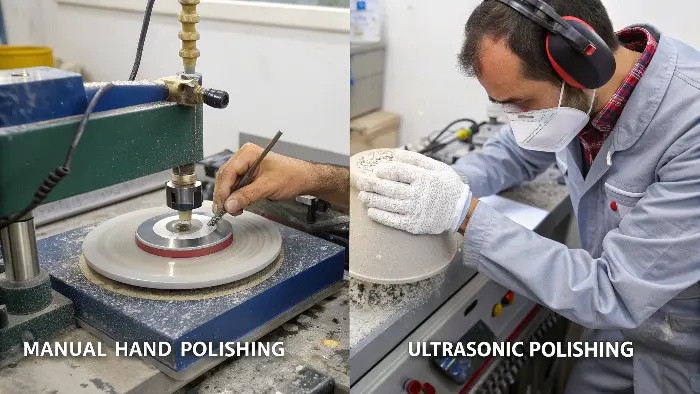
Key mold polishing techniques range from meticulous manual hand polishing using stones and diamond paste for intricate areas, to semi-automated methods like ultrasonic polishing, all selected based on the required SPI finish and mold geometry.
Unpacking Polishing Methods
So, how do we actually get those mold surfaces so smooth? It’s not just a quick buff and shine, I can tell you that! It’s a progressive process, often involving several stages, and the technique chosen depends heavily on the starting surface, the type of steel, the complexity of the mold cavity, and of course, the target finish. At CAVITYMOLD, our guys are artists in this respect.
Here are the main approaches:
- Manual Hand Polishing: This is the classic, and still often the best, way to achieve super fine finishes, especially on complex shapes. It’s labor-intensive but offers incredible control.
- Grinding Stones (Abrasive Stones): The process usually starts with coarser abrasive stones to remove machining marks and level the surface. The polisher will work through progressively finer grits of stones. You have to get the direction of polish right too – often cross-hatching to ensure an even surface.
- Abrasive Papers/Cloths: After stones, finer grit abrasive papers (like silicon carbide paper) are used, again, working down through the grits. These might be wrapped around soft or hard backers depending on the contour being polished.
- Diamond Paste/Compound and Lapping: For the highest gloss finishes (like SPI A-1 or A-2), diamond paste is the king. It comes in various micron sizes. The polisher uses felt bobs, wooden sticks, or soft cloths with the paste, meticulously working the surface. This stage requires immense patience and skill. I’ve seen our polishers spend days on a single complex cavity to get it perfect. It’s an art form, truly.
- Ultrasonic Polishing: This uses a handpiece that vibrates at ultrasonic frequencies. Tiny ceramic fiber stones or diamond files are attached to the tip. It’s great for getting into tight ribs, slots, and detailed areas where hand polishing is difficult or too slow. It can speed things up considerably for certain geometries.
- Mechanical/Rotary Tool Polishing: Small pneumatic or electric rotary tools with various attachments (felt bobs, brushes, abrasive points) are used, often with polishing compounds. These are good for larger, more open areas or for initial smoothing stages, but care must be taken not to over-polish or create uneven surfaces.
It’s rarely just one technique. Often, it’s a combination. For example, a mold might be initially smoothed with rotary tools, then detailed with ultrasonic polishers, and finally hand-finished with diamond paste for that ultimate mirror shine. The skill lies in knowing which tool and which abrasive to use at each stage, and for how long. It’s a feel thing as much as a science.What Tools Do the Pros Actually Use for Polishing Molds?
Ever tried to do a precision job with the wrong tools? It’s a nightmare, right? Mold polishing is no different; the right gear is half the battle for that perfect finish.
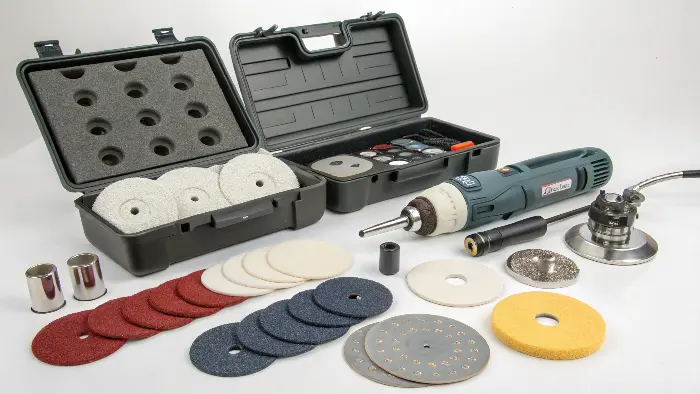
Professional mold polishers rely on a specialized toolkit including various grades of abrasive stones, polishing papers, felt bobs, specific diamond compounds, ultrasonic polishing units, and pneumatic grinders to achieve precise surface finishes.
The Polisher’s Arsenal
Walking into our polishing department at CAVITYMOLD is like stepping into a jeweler’s workshop, but for industrial tools. The range of bits, bobs, pastes, and stones is mind-boggling if you’re not familiar with it. Each tool has a very specific purpose in the journey from a machined surface to a flawless, mirror-like finish or a precise matte texture.
Let’s peek into the toolbox:
- Abrasive Stones (Oil Stones, India Stones, Arkansas Stones, Ceramic Stones): These come in a huge variety of shapes, sizes, and grits (from coarse for initial stock removal to ultra-fine for pre-polishing). The choice depends on the steel hardness and the amount of material to be removed. Our polishers have their favorite sets, almost like a chef with their knives.
- Sandpaper/Emery Cloth/Abrasive Sheets: Again, a wide range of grits (e.g., from 220 grit up to 2000 grit or even finer). These are used on backing pads or by hand. We often use them wet to prevent clogging and achieve a finer finish.
- Felt Bobs, Cotton Wheels, Brushes: These are mounted on rotary tools or used by hand. They don’t do much cutting themselves but act as carriers for abrasive compounds, like diamond paste. They come in various hardnesses and shapes (cylinders, cones, points) to get into different features.
- Diamond Paste/Compounds: The secret sauce for high-gloss finishes! These are suspensions of micron-sized diamond particles in a paste or liquid carrier. They come in different concentrations and particle sizes (e.g., from 45 microns down to 0.25 microns or less for an optical finish). Each finer grade builds upon the previous one.
- Pneumatic/Electric Rotary Tools (Grinders/Polishers): These hand-held tools spin various attachments. Think of a dentist’s drill, but for steel. They provide the power for many polishing operations, but skill is needed to avoid over-polishing or creating ripples.
- Ultrasonic Polishing Systems: As mentioned, these units use high-frequency vibrations with special ceramic fiber stones or diamond files. They are fantastic for detailed work in ribs, slots, and sharp corners. I’ve seen these save hours on tricky jobs.
- Lapping Tools: Flat plates or custom-shaped tools used with abrasive slurries to achieve very flat and smooth surfaces.
- Magnifiers and Inspection Lights: You can’t polish what you can’t see! Good lighting and magnification are essential for spotting tiny imperfections.
- Profilometers (Surface Roughness Testers): For critical applications, we might use these instruments to quantitatively measure the surface roughness (Ra value) to ensure it meets the spec, though visual comparison to SPI standard plaques is very common.
It’s not just about having the tools, it’s about the craftsman’s touch and knowing exactly how to use each one. Our polishers develop a real feel for the material and the process over many years.How Do We Make Sense of Mold Surface Finish Standards (Like SPI)?
Ever heard terms like "SPI A-2" or "B-1 finish" and just nodded along? These codes can seem like a secret language, but they’re actually super helpful for clear communication.
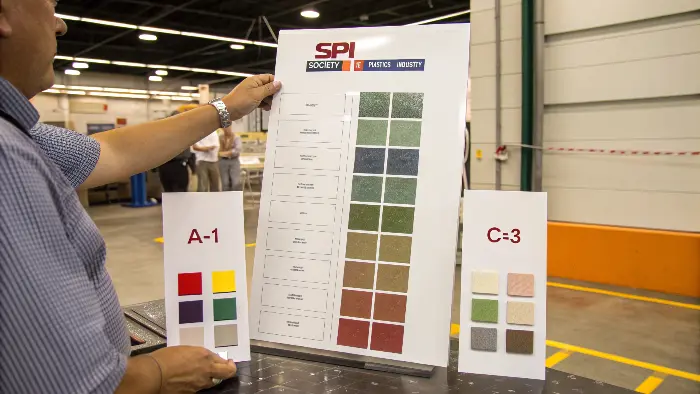
Mold surface finish standards, notably the SPI (Society of the Plastics Industry) guidelines, offer a universal system (e.g., A-1 for mirror, C-3 for matte) to precisely define and verify the required level of polish on a mold.
Decoding SPI and Other Finish Callouts
Okay, this is where we connect the art of polishing with the science of specifications. If a customer like Alex just said, "I want a shiny finish," that’s way too vague. How shiny? Shiny like a new car, or shiny like a precision lens? This is where standards like the SPI (Society of the Plastics Industry) finish guidelines save the day. They provide a common language. At CAVITYMOLD, we live by these standards because they remove ambiguity.
Here’s a breakdown of the common SPI categories:
- SPI A – High Gloss / Mirror Finishes: These are your top-tier, super-smooth, reflective finishes.
- A-1 (Grade #3 Diamond Buff): The highest standard, a flawless mirror polish achieved with #3 diamond buffing compound. Used for optical lenses, mirrors, and ultra-high-end cosmetic parts. This is incredibly labor-intensive.
- A-2 (Grade #6 Diamond Buff): Still a high mirror polish, achieved with #6 diamond. Excellent gloss, for high-quality cosmetic parts.
- A-3 (Grade #15 Diamond Buff): A fine mirror polish, done with #15 diamond. Good gloss.
- SPI B – Semi-Gloss Finishes: Good appearance, but not a true mirror.
- B-1 (600 Grit Paper): Polished with 600 grit abrasive paper. Good luster.
- B-2 (400 Grit Paper): Polished with 400 grit paper. Medium luster.
- B-3 (320 Grit Paper): Polished with 320 grit paper. Lower luster, some fine sanding marks may be visible. Often used for engineering parts where aesthetics are good but not paramount.
- SPI C – Matte Finishes: These are not glossy; they have a duller appearance, often achieved with fine abrasive stones.
- C-1 (600 Stone): Fine stone finish. Good for hiding minor imperfections and flow marks.
- C-2 (400 Stone): Medium stone finish.
- C-3 (320 Stone): Coarser stone finish. Often a good general-purpose finish for non-appearance parts or internal components.
- SPI D – Textured/Dull Finishes: These are typically achieved by methods other than direct polishing.
- D-1 (Dry Blast #11 Glass Bead): Satin texture.
- D-2 (Dry Blast #240 Oxide): Dull texture.
- D-3 (Dry Blast #24 Oxide): Coarse texture.
It’s crucial to specify the exact SPI finish required on the part drawing. Why? Because an A-1 finish can cost significantly more (in time and money) than a C-3 finish due to the intense labor involved. Misunderstanding this can lead to budget overruns or disappointing parts. Sometimes, different areas of the same mold might even have different polish specifications! For example, the main cosmetic surface might be B-1, while non-visible internal features are C-3. We often provide customers with physical SPI comparator plaques so they can see and feel the different finishes, ensuring everyone is on the same page.Conclusion
Mastering mold polishing, from techniques to tools and standards, is key for top-notch plastic parts. It’s a detailed craft ensuring quality and appearance in every piece.