
You are rushing to launch a new medical device, but the material choices are confusing you. Choosing the wrong plastic can lead to safety failures, rejected certifications, and costly recalls. It is a nightmare scenario for any project manager.
Medical-grade ABS differs from industrial-grade primarily through rigorous biocompatibility testing, such as ISO 10993 or USP Class VI standards. While industrial ABS focuses on strength and cost, medical ABS ensures the material will not harm patients during contact. This distinction is vital for regulatory compliance and patient safety.
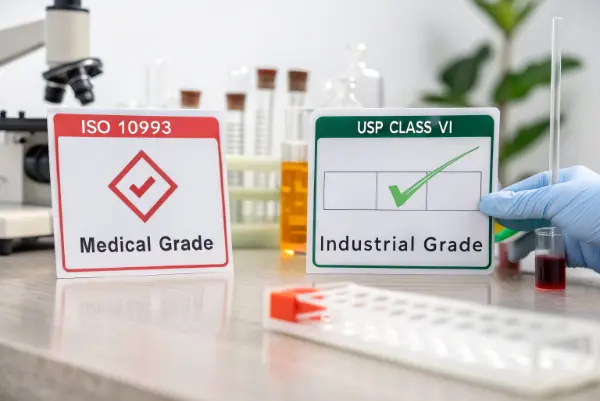
Let’s be honest, distinguishing between these materials is not just about reading a data sheet. It is about understanding the hidden risks that sit below the surface. We need to look closely at what truly separates a safe medical device from a standard industrial part.
Is ABS always medical grade?
Many engineers assume that because ABS is common, it is safe for everything. This is a dangerous mistake. Standard ABS might contain additives or colorants that are toxic when they touch the human body.
No, ABS is not automatically medical grade. Standard or industrial ABS often contains heavy metals, stabilizers, or release agents that are not safe for biological contact. Only specific formulations that pass biocompatibility tests qualify as medical-grade ABS. You must verify the specific resin grade.
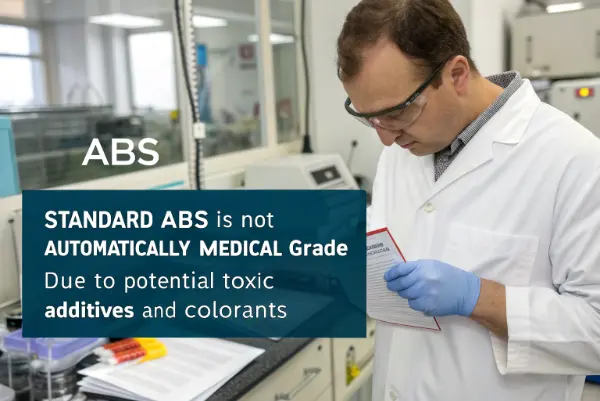
It is easy to get confused by the label "ABS." I remember a project a few years ago where a client wanted to use a generic, cheap ABS for a handheld diagnostic casing. They thought, "It’s just the outer shell, right?" But they forgot about skin contact and chemical resistance to hospital cleaners.
When we talk about ABS (Acrylonitrile Butadiene Styrene), we are talking about a family of plastics, not a single product. The "recipe" changes depending on the manufacturer.
Key Differences Breakdown
Industrial ABS is built for:
- Impact resistance: Taking a beating in a car or a vacuum cleaner.
- Cost efficiency: Being cheap to mass-produce.
- Aesthetics: Looking shiny or matte, regardless of the chemical makeup of the dye.
Medical ABS is built for:
- Biocompatibility: Not irritating skin or poisoning blood.
- Sterilization: Handling gamma radiation or EtO gas without cracking.
- Traceability: You know exactly what lot the resin came from.
Why Assumptions Fail
If you use industrial ABS in a medical setting, you risk "leaching." This is where chemicals from the plastic seep out. In a car dashboard, this does not matter much. In a device touching a patient’s skin for hours, it causes rashes or worse. Also, hospital cleaners are harsh. Industrial ABS often cracks when wiped with strong disinfectants daily. Medical grades are formulated to resist these chemicals.
What qualifies as medical grade?
You might wonder who decides if a plastic is safe. It is not just a marketing term used by suppliers. There are strict, global standards that a material must pass to earn this title.
To qualify as medical grade, a plastic must pass specific biocompatibility protocols, most commonly ISO 10993 and USP Class VI. These tests prove the material causes no toxicity, irritation, or sensitization. The manufacturer must also provide strict quality control and formulation locking.

Understanding these qualifications is critical for your documentation. At CavityMold, we always ask our clients: "Which standard does your regulatory body require?" If you do not know, you cannot choose the right material.
Let’s break down the two big standards you will see on data sheets. You cannot ignore these if you want FDA or CE approval.
The Standards Explained
| Standard | What it Tests | Why it Matters |
|---|---|---|
| USP Class VI | Biological reactivity in vivo (in animals). | This is a historic, rigorous standard. It is often the minimum requirement for implants or fluid-contact devices. |
| ISO 10993 | Cytotoxicity, sensitization, and irritation. | This is the global gold standard now. It is more detailed than USP and required for European markets (CE marking). |
| FDA Drug Master File (DMF) | Formulation details kept on file. | It allows the FDA to review the plastic’s recipe without the supplier giving away trade secrets to you. |
The "No-Change" Policy
There is another qualification that is less technical but equally important: Formulation Locking.
In the industrial world, a resin supplier might change a lubricant in the plastic to save money. They do not have to tell you. In the medical world, this is illegal. A "medical grade" qualification usually comes with a guarantee that the supplier will not change the ingredients without notifying you years in advance. This ensures that the device you test today is the same device you sell five years from now. Without this stability, your initial safety tests become useless over time.
What does medical grade plastic mean for manufacturing?
We have talked about the material itself, but how does this change the way we make the mold? You cannot just throw medical pellets into a dirty machine and hope for the best.
Medical grade plastic means the entire manufacturing process must be cleaner and more controlled. It requires cleanroom molding environments, strict machine cleaning protocols, and full lot traceability. Using the right plastic is useless if the molding process introduces contamination.
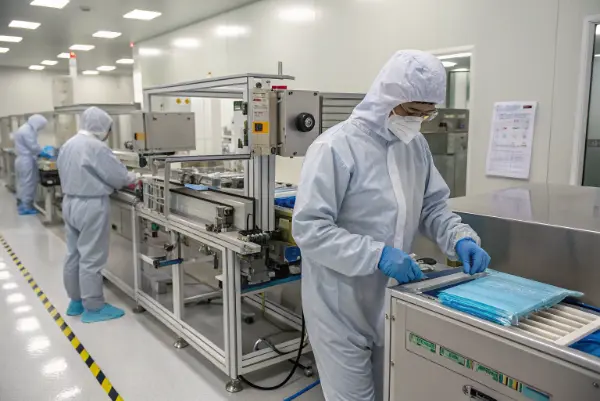
This is where the rubber meets the road—or rather, where the plastic meets the mold. As a mold maker, I see this disconnect often. A client buys expensive medical ABS but wants to mold it in a general-purpose shop.
Contamination Risks
Imagine you are molding a medical housing. The machine used before your job was running black industrial ABS with glass fibers. If the machine is not purged perfectly, microscopic glass fibers or black specks will end up in your medical white part.
- Visual Defects: In medical devices, a tiny black speck looks like dirt. Doctors and patients will reject it.
- Foreign Material: That leftover material might not be biocompatible.
The Processing Parameters
Medical grade ABS often has different flow rates (MFI) compared to industrial ABS.
- Temperature Sensitivity: Some medical grades are more sensitive to heat. If we cook the plastic too long in the barrel, it degrades. Degraded plastic loses its safety properties.
- Mold Release Agents: In industrial molding, we spray the mold with silicone to help parts pop out. In medical molding, we often cannot do this. The spray stays on the part and can be toxic. We must design the mold with better draft angles and polished surfaces so the part releases naturally.
Documentation Burden
When we ship medical parts, the paperwork is heavier than the parts. We need to provide:
- COA (Certificate of Analysis) for the resin.
- Process parameters used during the run.
- Proof that the machine was cleaned.
This adds to the cost, but it "buys" you safety and sleep at night. You are not just paying for plastic; you are paying for the guarantee of purity.
What are the 3 classes of medical devices?
You cannot choose a material until you know where your device fits in the regulatory hierarchy. The risk level of your device dictates how strict your material choice must be.
Medical devices are categorized into Class I (low risk), Class II (moderate risk), and Class III (high risk). Class I devices may use basic medical ABS, while Class III implants require much stricter, implant-grade materials. Knowing your class helps you avoid over-engineering or under-specifying.
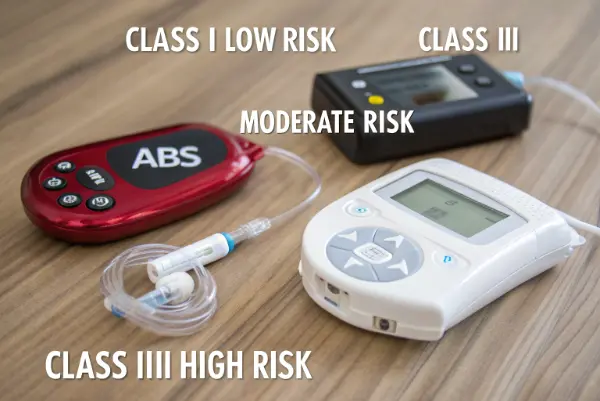
Categorization is the first step in your design history file. I have seen clients spend triple the budget on PEEK or implant-grade materials for a simple Class I device. Conversely, I have seen dangerous attempts to use cheap ABS for blood-contact devices.
Class Breakdown and ABS Suitability
Let’s look at how ABS fits into these three buckets. ABS is versatile, but it has limits.
Class I: Low Risk
- Examples: Bandages, handheld surgical instruments (non-invasive), hospital bed frames, external monitors.
- ABS Role: This is the sweet spot for Medical Grade ABS. It is perfect for housings, handles, and cases.
- Requirement: Limited contact with skin. Basic ISO 10993-5 (Cytotoxicity) is usually enough. You do not need the most expensive resin here.
Class II: Moderate Risk
- Examples: Infusion pumps, surgical needles, pregnancy test kits, powered wheelchairs.
- ABS Role: Still very common for the external parts of these devices.
- Challenge: If the device holds fluids (like a pump), the internal parts touching the fluid usually cannot be ABS. ABS is not great with chemical resistance against drugs. However, the outer shell protecting the electronics is often Medical ABS.
- Requirement: More data needed. You might need sensitization and irritation tests.
Class III: High Risk
- Examples: Pacemakers, heart valves, permanent implants.
- ABS Role: Almost never used. ABS is not an implantable material. It is not designed to stay inside the body. The body will attack it, or it will degrade.
- Requirement: Long-term biocompatibility. For these applications, you look at PEEK or Titanium, not ABS.
Why Classification Saves Money
If you are building a Class I device, do not ask for "Implant Grade" material. You will pay $50/kg instead of $5/kg. Tell your molder: "This is a Class I device with limited skin contact." We can then recommend a standard medical ABS like Polylac PA-757 or a similar medical-certified grade that is cost-effective but safe.
Conclusion
Choosing between medical and industrial ABS is about risk management. Medical ABS offers biocompatibility, traceability, and formulation stability that industrial grades lack. While industrial ABS is cheaper, it cannot be used for devices touching patients due to toxicity risks. By understanding your device’s Class (I, II, or III) and requiring ISO 10993 or USP Class VI compliance, you ensure your product is safe, legal, and ready for market success.