
Outdoor product failures often trace back to one simple mistake: choosing the wrong material. You watch your perfectly designed plastic part turn yellow and brittle after just a few months in the sun. This frustration is avoidable if you understand the core differences between standard plastics and weather-resistant alternatives.
When choosing between ABS and ASA for outdoor use, ASA is the superior choice. While ABS is strong and impact-resistant, it degrades rapidly under UV light, leading to discoloration and mechanical failure. ASA (Acrylonitrile Styrene Acrylate) was specifically engineered to solve this problem, offering the same strength as ABS but with excellent UV stability and weather resistance for long-term outdoor exposure.
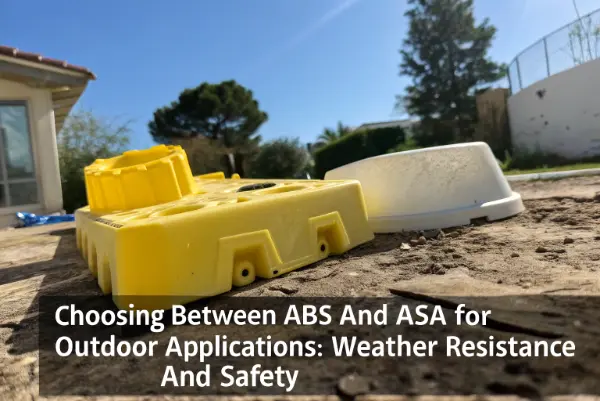
You might be wondering if the extra cost of ASA is really worth it for your specific project. Let’s break down the technical details, safety concerns, and performance metrics so you can make the right call for your manufacturing needs.
Is ABS good for outdoor applications?
You have probably used ABS for countless indoor parts because it is cheap, strong, and easy to mold. However, taking that same material outside creates immediate problems. The sun’s ultraviolet rays attack the chemical structure of ABS, causing it to lose its structural integrity much faster than you might expect.
ABS is generally poor for long-term outdoor applications without specific modifications. Standard ABS contains butadiene rubber, which is highly sensitive to UV radiation. Exposure to sunlight causes the polymer chains to break down, resulting in yellowing, chalking, and a significant loss of impact strength. While painting or UV stabilizers can help, untreated ABS will fail relatively quickly outdoors.
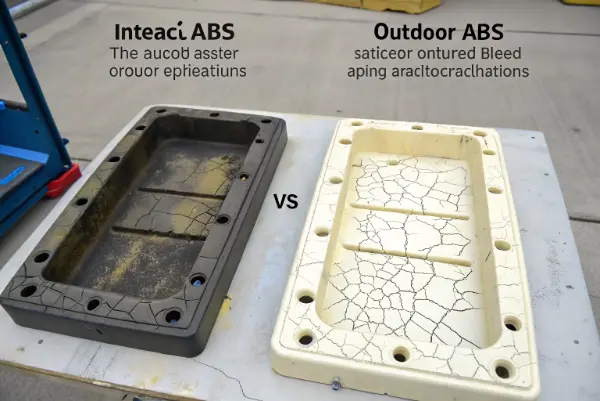
It is important to understand exactly why ABS fails. I remember a project early in my career where a client insisted on using standard ABS for an outdoor sensor housing to save money. We warned them, but budget was king. Six months later, the housings were cracking, and water was leaking into the electronics. It was a disaster.
The culprit is the "B" in ABS—Butadiene. This component gives the material its impact resistance, which is great. But chemically, it contains double bonds that are very reactive to photo-oxidation. When UV light hits these bonds, they break.
Here is a breakdown of what happens to ABS outdoors:
- Color Shift: White or light-colored ABS turns yellow very fast. Black ABS turns grey or chalky.
- Surface Cracking: Micro-cracks form on the surface, ruining the aesthetic finish.
- Brittleness: The material loses its ability to absorb shock. A part that could survive a hammer blow inside will shatter if dropped after a summer outside.
If you absolutely must use ABS outdoors, you have limited options. You can paint it, which creates a physical barrier against the sun. You can also add UV stabilizers during the compounding phase. However, these are band-aid solutions. If the paint scratches, the degradation starts. If the stabilizer isn’t mixed perfectly, you get weak spots. For a professional project manager like yourself, relying on these fixes introduces unnecessary risk.
Is ABS or ASA better for outdoor use?
Comparing these two materials is like comparing a standard raincoat to heavy-duty storm gear. They might look similar and feel similar, but one is built specifically to handle the elements. The chemical difference is small, but the performance gap is massive when the sun comes out.
ASA is significantly better than ABS for outdoor use. ASA replaces the butadiene rubber found in ABS with acrylate rubber. This acrylate component is chemically resistant to UV radiation, meaning the material retains its color, gloss, and impact strength even after years of exposure to harsh weather conditions. It provides the mechanical properties of ABS without the weathering weaknesses.
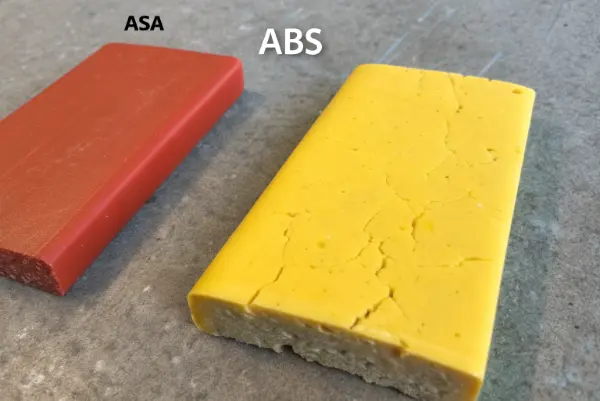
Let’s dive deeper into the comparison. At CavityMold, we often suggest ASA as a "drop-in" replacement for ABS. This means you do not usually need to redesign your mold extensively. The shrinkage rates are very similar.
The main difference lies in the rubber phase of the polymer. As I mentioned before, ABS has Butadiene. ASA has Acrylate. Acrylate does not have those double bonds that UV light loves to attack. This makes ASA naturally immune to UV degradation. It isn’t just an additive; it is the nature of the plastic itself.
Here is a comparison table to help you visualize the trade-offs:
| Feature | ABS (Acrylonitrile Butadiene Styrene) | ASA (Acrylonitrile Styrene Acrylate) |
|---|---|---|
| UV Resistance | Poor (Yellows and cracks) | Excellent (Stable color and strength) |
| Impact Strength | High (drops significantly outdoors) | High (remains stable outdoors) |
| Heat Resistance | Good (approx. 95°C) | Good (similar to ABS) |
| Processability | Excellent | Good (slightly different parameters) |
| Cost | Lower | Higher (usually 20-50% more) |
| Post-Processing | Easy to glue, paint, and sand | Easy to glue, paint, and sand |
When you look at this table, the choice for outdoor gear seems obvious. However, the cost factor always comes up. Yes, ASA is more expensive per kilogram. But you have to calculate the "Total Cost of Ownership." If you use ABS, you might need to add a painting step to your production line. Painting adds labor, material cost, and quality control issues. Often, the cost of raw ASA is actually cheaper than the cost of ABS plus a painting process. Plus, painted ABS chips over time; ASA is the same color all the way through.
Is ABS or ASA safer?
Safety in manufacturing usually refers to two things: the safety of the final product for the user, and the safety of the material during processing. Both materials are styrene-based, so they share some characteristics, but their behavior under stress and heat can impact safety ratings.
Both ABS and ASA are generally considered safe for consumer products when fully cured, but ASA is safer for outdoor structural applications because it does not become brittle. ABS can become a safety hazard outdoors because UV degradation causes unpredictable shattering under load. Regarding processing fumes, both release styrene and require proper ventilation, though neither is typically considered food-safe without specific grades.
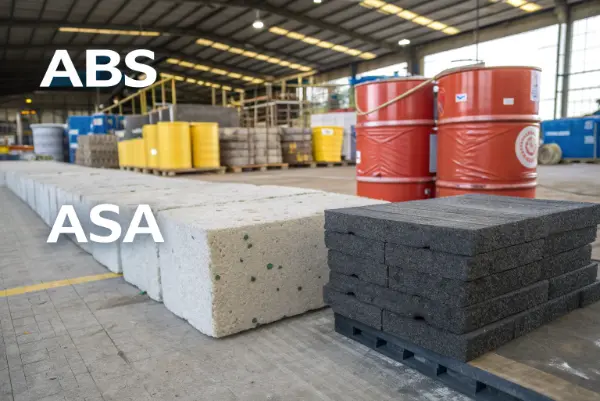
When we talk about safety, we need to think about failure modes. Imagine a handle on an outdoor equipment case. If it is made of ABS and sits in the sun for two years, it might look okay from a distance. But when a user picks up that heavy case, the handle could snap instantly because the plastic has become brittle. That is a safety failure. ASA maintains its ductility. It will bend before it breaks, even after years outside. This predictability makes ASA the safer engineering choice for load-bearing outdoor parts.
Regarding chemical safety during use:
- Fumes: If you are burning these plastics (which you shouldn’t be), both release thick, black, toxic smoke. During injection molding, both smell like styrene. We always ensure our factory floor has high-grade ventilation.
- Food Contact: Generally, neither standard ABS nor standard ASA is FDA approved for food contact. If you are making a picnic plate, you need to look at specific food-grade materials, not general-purpose engineering resins.
- Flammability: Both burn easily. If your product has high fire safety requirements (like outdoor electronics), you will need to source flame-retardant grades (FR-ASA or FR-ABS).
I once helped a client design an outdoor electrical enclosure. They were worried about "safety" regarding chemical leaching. I explained that for an electrical box, the real safety risk was the box cracking and letting rain touch the wires. ABS would crack. ASA would not. Therefore, ASA was the "safer" option for the integrity of the electrical system. You have to define what safety means for your specific product context.
Why use ASA instead of ABS?
You might still be thinking about the budget. If ABS is cheaper, why make the switch? The answer lies in the longevity and the perception of quality your brand offers. Using the right material prevents warranty claims and protects your brand’s reputation.
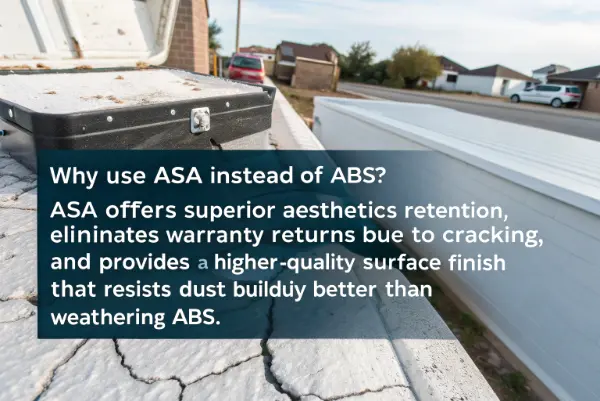
You should use ASA instead of ABS whenever your product will see sunlight, rain, or extreme weather shifts. ASA offers superior aesthetics retention, meaning your product looks new for years, not months. It eliminates the need for secondary painting processes, reduces warranty returns caused by cracking, and provides a higher-quality surface finish that resists static dust buildup better than weathering ABS.
Let’s look at the long-term value. At CavityMold, we see this constantly with automotive exterior parts. Side mirrors, front grilles, and radiator covers are almost exclusively made from ASA (or similar blends). If car manufacturers used ABS, every car on the road would look gray and cracked after three years.
Here are the key reasons to switch, broken down by benefit:
Aesthetics and Brand Image:
Nothing kills a brand image faster than a product that looks old and cheap shortly after purchase. ASA has high gloss potential. It resists "chalking," which is that white powdery residue that appears on old plastics. If you are selling a premium outdoor device, the customer expects it to stay looking premium.Manufacturing Simplification:
- No Painting: As discussed, you can skip the paint booth. This saves time and reduces the scrap rate associated with bad paint jobs (drips, dust inclusion).
- Similar Shrinkage: Because ASA shrinks similarly to ABS (around 0.4% – 0.7%), you can often test ASA in an existing ABS mold. You might need to adjust gate sizes or cooling slightly, but you do not need to cut a whole new tool to test the material.
Environmental Resistance Beyond UV:
ASA is not just about the sun. It handles stress cracking from environmental agents better than ABS. It resists alcohols and cleaning solutions slightly better, and it stands up to heat aging well.Cost-Benefit Analysis Example:
Imagine producing 10,000 outdoor camera housings.- ABS Option: Material cost $2.00/part + Painting cost $1.50/part = $3.50 total.
- ASA Option: Material cost $2.80/part + No Painting = $2.80 total.
In this scenario, the "expensive" material is actually cheaper per part. Plus, you don’t have to worry about paint peeling off. For a project manager, this is an easy win to present to stakeholders.
Conclusion
Choosing between these two materials comes down to exposure. If your part stays inside, ABS is a cost-effective, strong champion. However, if your product faces the sun, rain, and wind, ABS is a liability. ASA provides the UV stability and impact resistance necessary to keep your outdoor products safe, functional, and looking professional for years to come.