
Navigating the world of medical plastics is terrifying if you don’t know the rules. One wrong material choice can kill a product launch or, worse, endanger a patient. Are you confident that your current polyethylene selection actually meets the strict global standards required for medical devices?
Medical-grade polyethylene is a specialized form of PE that has been rigorously tested and certified for biocompatibility and safety in healthcare applications. It must comply with specific standards like USP Class VI and ISO 10993 to ensure it does not react negatively with the human body or degrade under sterilization, making it suitable for implants, packaging, and diagnostic tools.
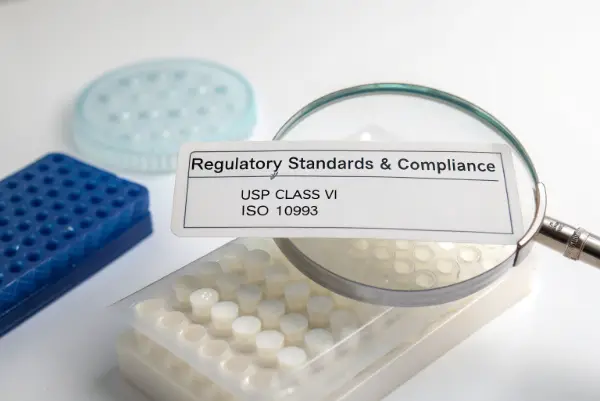
We need to understand exactly what makes this material "medical grade." It is not just about the chemical formula. It is about the paperwork, the testing, and the traceability. I have seen too many projects stall because the team assumed "food safe" meant "medical safe." It does not. Let’s break down the specific regulations you need to know to get your product approved.
What is medical grade polyethylene?
Many engineers assume all polyethylene is the same, but that mistake can ruin a medical project. You might think you can just pick a standard resin, but standard industrial plastics often contain additives that are toxic to biological tissues. How do you distinguish the safe material from the unsafe one?
Medical-grade polyethylene (PE) is a subset of polyethylene resins manufactured under strict controls to minimize contaminants and ensure lot-to-lot consistency. It includes variations like UHMWPE (Ultra High Molecular Weight Polyethylene) for implants and LDPE/HDPE for tubing and packaging. Crucially, it comes with a "change notification" guarantee, meaning the supplier cannot alter the formula without warning you.
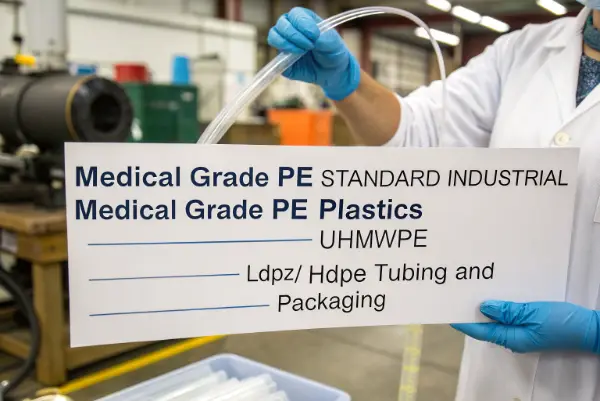
We need to look deeper into the specific types of medical PE. At CavityMold, we often guide clients through this selection process because the mechanical properties vary wildly. You cannot use the same PE for a hip replacement that you use for a syringe bag.
There are three main categories we deal with:
- LDPE (Low-Density Polyethylene): This is soft and flexible. We use it often for tubing and squeezable containers. It is transparent but not very strong.
- HDPE (High-Density Polyethylene): This is stiffer and harder. It resists chemicals well. You will see this in pharmaceutical bottles or rigid device housings.
- UHMWPE (Ultra-High Molecular Weight Polyethylene): This is the high-performance king. It has incredible wear resistance. This is the gold standard for orthopedic implants like artificial joints.
When you select a medical grade, you are paying for the "cleanliness" of the resin. Industrial resins might use release agents that are fine for a toy but cause inflammation in a body. Medical grades limit these additives.
Here is a quick comparison of why you choose one over the other:
| Type | Key Property | Typical Medical Use | Sterilization Tolerance |
|---|---|---|---|
| LDPE | Flexibility | Intravenous (IV) tubing, film packaging | Low (Gamma preferred) |
| HDPE | Chemical Resistance | Tyvek® packaging, surgical trays | Medium (EtO, Gamma) |
| UHMWPE | Impact/Wear Resistance | Joint replacements (hips/knees) | High (Specialized EtO/Gamma) |
You must also consider the "Change Control." In the medical world, if the resin supplier changes the catalyst used to make the plastic, you might have to re-validate your entire device. Medical-grade suppliers contractually agree not to change the recipe for a set period (often 12-24 months) or to give you significant warning. This stability is worth the extra cost.
Is polyethylene FDA approved?
People often ask me if a specific plastic is "FDA approved," but the question itself is slightly wrong. The FDA does not technically approve a raw material like plastic pellets; they approve the final medical device. So, does the material itself matter for your FDA submission?
The FDA does not approve raw polyethylene itself; instead, it maintains lists of materials that are "safe for use" in food or drug contact, found in the Code of Federal Regulations (CFR) Title 21. For medical devices, you must prove your specific polyethylene component is safe within your device’s application, often by referencing a supplier’s Drug Master File (DMF).
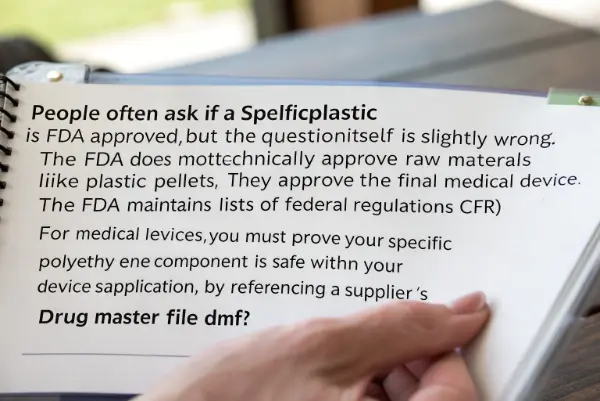
Let us clarify the "approval" myth because it confuses many of my clients. The FDA regulates the finished product. However, using the right raw material makes that approval process much faster.
When we select a polyethylene for a mold, we look for two specific regulatory pathways to help your submission:
1. FDA 21 CFR 177.1520 (Olefin Polymers)
This regulation covers safe plastics for food contact. While medical devices are not food, this is the baseline for safety. If a plastic is safe enough to wrap a sandwich, it passes the first hurdle for low-risk medical contact (like skin contact). Most medical PEs meet this standard.
2. The Drug Master File (DMF)
This is critical for invasive devices. A resin manufacturer (like Dow or ExxonMobil) submits a secret file (the DMF) to the FDA. This file details the exact chemical formulation of the plastic. The manufacturer gives you a "Letter of Access." When you submit your device for FDA 510(k) clearance, you tell the FDA reviewer: "Look at DMF #12345." The reviewer checks the secret file to confirm safety without the resin company giving away their trade secrets to you.
If you choose a cheap, industrial polyethylene without a DMF, you have a problem. You will have to pay for expensive chemical characterization tests to prove to the FDA exactly what is in that plastic. This costs thousands of dollars and takes months.
Critical Thinking Step: Does "Food Safe" equal "Implant Safe"? Absolutely not.
- Food Safe (21 CFR): Good for temporary contact, non-toxic if swallowed.
- USP Class VI: This is a separate standard (United States Pharmacopeia). It involves injecting extracts of the plastic into animals to check for toxicity.
- Implant Grade: This requires ISO 10993 testing (biological evaluation).
So, do not just ask "Is it FDA approved?" Ask your molder or supplier: "Does this resin have a DMF number, and does it meet USP Class VI standards?" This protects your project from rejection.
What is the ISO standard for medical device packaging?
You can have the perfect medical device, but if the sterile barrier breaks during shipping, the product is garbage. Packaging is not just a box; it is a sterile barrier system. Which ISO standard dictates how we test and validate these polyethylene packages?
ISO 11607 is the primary global standard for packaging terminally sterilized medical devices. It is divided into two parts: Part 1 covers materials and sterile barrier systems (like the polyethylene pouch), and Part 2 covers the validation of the packaging processes (like heat sealing). Compliance ensures the device remains sterile from the factory to the operating room.
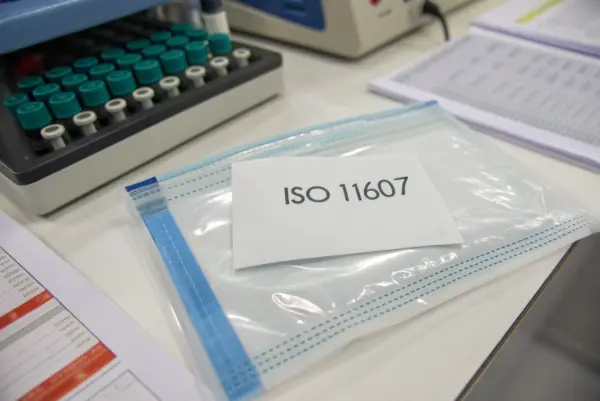
I cannot stress this enough: ISO 11607 is the bible for medical packaging. If you are using Polyethylene (specifically Tyvek®, which is spun-bonded HDPE) for your sterile barriers, you live and die by this standard.
We need to break down the two parts because they affect different stages of your production.
ISO 11607-1: Materials and Design
This part asks: "Is this polyethylene bag strong enough?"
You have to prove:
- Microbial Barrier: Can germs get through the plastic? (HDPE is great here).
- Biocompatibility: Will the dye on the package label leach through the plastic and poison the device?
- Physical Strength: If I drop the box, does the pouch burst?
- Shelf Life: Will the polyethylene degrade after 2 years on a shelf?
ISO 11607-2: Process Validation
This part asks: "Is your sealing machine reliable?"
At CavityMold, when we manufacture packaging components, we have to prove our process is repeatable.
- Installation Qualification (IQ): Is the heat sealer installed correctly?
- Operational Qualification (OQ): Does it seal correctly at the high and low temperature limits?
- Performance Qualification (PQ): Does it work perfectly for three straight production runs?
The Role of Polyethylene in ISO 11607:
Polyethylene is often the sealant layer. In a typical medical pouch, you have a top web (often Tyvek/HDPE) and a bottom web (a clear plastic film). The clear film usually has a layer of LDPE. When you heat them, the LDPE melts and bonds to the HDPE.
Common Failure Mode:
If you choose the wrong grade of LDPE, it might seal too well. When a nurse tries to peel the package open in surgery, the plastic tears instead of peeling cleanly. This releases "particulate" (tiny plastic bits) into the sterile field. ISO 11607 strictly forbids this. You need a "peelable" blend of polyethylene.
Here is a checklist for your packaging validation:
| Test Type | Goal | Standard Reference |
|---|---|---|
| Dye Penetration | Check for holes in the seal | ASTM F1929 |
| Bubble Leak | Check for gross leaks underwater | ASTM F2096 |
| Peel Strength | Measure force needed to open | ASTM F88 |
| Visual Inspection | Look for channels or wrinkles | ASTM F1886 |
What is medical device regulatory compliance?
Understanding the material is one thing, but understanding the overarching system of compliance is another. It is not just about passing one test. What does "regulatory compliance" actually look like for a project manager overseeing a new medical product launch?
Medical device regulatory compliance is the continuous process of adhering to laws, guidelines, and standards (like FDA 21 CFR Part 820 or EU MDR) throughout the entire product lifecycle. It involves documenting design controls, risk management (ISO 14971), and quality management systems (ISO 13485) to prove safety and efficacy to government bodies.
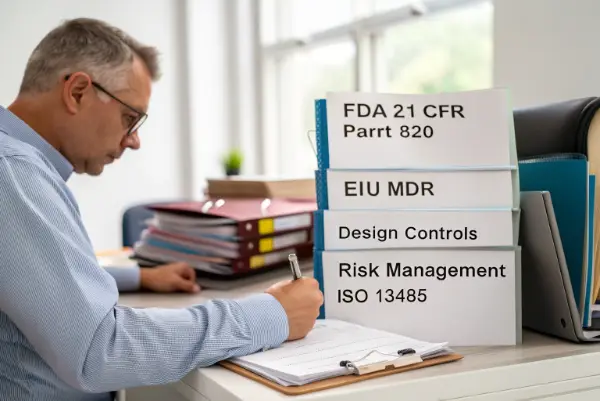
Compliance is not a destination; it is a habit. For a Project Manager like Alex, this means your job is 20% engineering and 80% documentation. When we talk about polyethylene components, compliance connects several different dots.
We need to look at the "Big Three" frameworks that dictate how you handle your plastic parts.
1. Quality Management System (ISO 13485)
This is the foundation. You cannot just make medical parts in a dirty garage. ISO 13485 requires traceability.
- Traceability: If a patient gets sick, can you trace the polyethylene in their device back to the specific batch of resin from the supplier?
- Documentation: Every change to the mold, every change to the resin temperature, must be recorded.
2. Risk Management (ISO 14971)
This standard asks: "What could go wrong?"
You have to analyze the risks of using Polyethylene.
- Hazard: The PE degrades under UV light.
- Risk: The device casing cracks.
- Harm: The patient gets an electric shock.
- Mitigation: We add UV stabilizers to the PE or paint the housing.
You must document this thought process. If you do not write it down, it did not happen.
3. Biological Evaluation (ISO 10993)
This is the big one for materials. As we discussed earlier, you must prove the material is biocompatible.
- Cytotoxicity: Does the plastic kill cells?
- Sensitization: Does it cause an allergic reaction?
- Implantation: (If applicable) How does tissue react after 30 days?
The Impact of the EU MDR (Medical Device Regulation):
Europe recently updated their rules (MDR). They are now much stricter than before. They require "GSPR" (General Safety and Performance Requirements). Under the new MDR, you cannot just say "This PE has been used for 20 years, so it is safe." You need clinical data or very strong technical equivalence data.
The "Technical File":
All of this data—your material certificates, your ISO 11607 packaging tests, your ISO 10993 biocompatibility reports—goes into a massive folder called the Technical File (or Design History File in the US).
If you are sourcing molds from CavityMold, we help you fill this file. We provide:
- Material Certs (COA): Proof of the resin used.
- Process Parameters: Proof of how we molded it.
- Dimensional Reports: Proof the part fits the drawing.
Without these papers, your polyethylene part is just a piece of plastic. With them, it is a medical device component.
Conclusion
Choosing medical-grade polyethylene is about managing risk, not just picking a plastic. You must ensure the material meets USP Class VI and ISO 10993 standards, verify FDA compliance through DMF access, and validate packaging per ISO 11607. Correct documentation and traceability are the keys to a successful, compliant product launch.