
Electronics and safety go hand in hand, but finding the right materials can be a nightmare. You worry about compliance, failing tests, and the terrifying risk of a product catching fire in a customer’s home. Ignoring flame retardancy isn’t just risky; it is a business-ending mistake.
Flame-retardant Polyethylene (PE) is a specialized formulation of standard PE plastic treated with chemical additives to inhibit or delay ignition. While standard PE is highly flammable, these additives allow it to meet strict safety standards like UL 94 V-0 for use in electronic housings, wire insulation, and components where fire safety is critical.
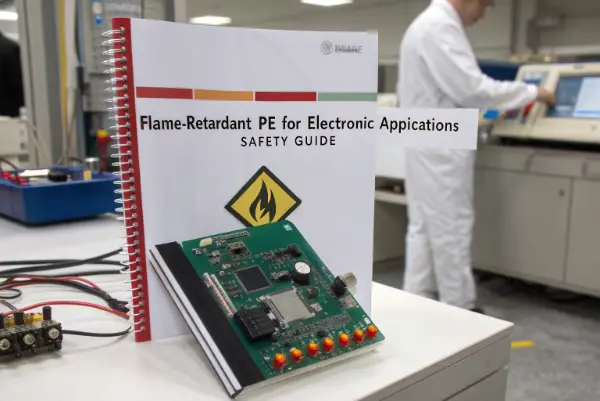
Now that we have established what this material is, let’s talk about why it matters so much for your projects. I have seen too many good designs fail because the wrong material was chosen at the start. Let’s dive into the specifics of PE and how it handles heat and flame.
Is PE naturally flame-retardant?
Most people assume all heavy industrial plastics are safe, but that is a dangerous assumption. Standard Polyethylene burns easily, dripping flaming plastic that spreads fire rapidly. This creates a huge liability for any project manager overseeing electronic components that generate heat.
No, standard Polyethylene (PE) is not naturally flame-retardant. It has a high calorific value and burns much like candle wax, sustaining a flame even after the ignition source is removed. To make PE suitable for electronics, manufacturers must compound it with additives like halogenated compounds, phosphorus, or metal hydroxides to suppress combustion.
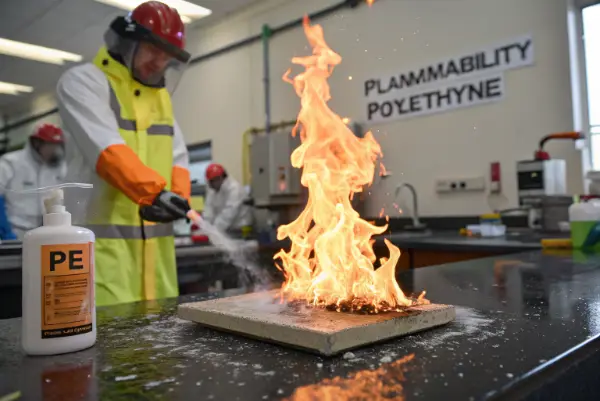
Let’s break this down further because understanding the chemistry helps you make better decisions. Standard PE is a hydrocarbon. Chemically, it is very similar to gasoline or oil, just in a solid form. When I first started at CavityMold back in 2009, I remember a client who tried to use basic HDPE for a high-voltage connector housing to save money. We had to simulate a failure, and the results were scary. The plastic didn’t just melt; it became fuel.
Here is a critical look at the difference between standard and modified PE:
The Mechanism of Burning PE
When standard PE gets hot enough, it undergoes pyrolysis. This means the polymer chains break down into volatile gases. These gases mix with oxygen, and if there is a spark, you get fire.
- Dripping: This is the worst part. Standard PE melts and drips while burning. These "flaming droplets" fall onto other parts of the device, spreading the fire instantly.
- Fuel Load: PE releases a lot of energy when it burns. It adds heat to the fire, making it grow faster.
How We Fix It (The Additives)
To change this behavior, we use specific strategies. We don’t just "spray" something on; we mix these chemicals into the melted plastic before molding.
| Additive Type | How it Works | Pros | Cons |
|---|---|---|---|
| Halogenated (Bromine/Chlorine) | Interferes with the chemical reaction of the flame in the gas phase. | Very effective, low cost. | Environmental concerns, toxic smoke. |
| Metal Hydroxides (ATH/MDH) | Releases water vapor when heated, cooling the plastic and diluting the flammable gas. | Low smoke, non-toxic. | You need a lot of it (high loading), which weakens the plastic. |
| Phosphorus-Based | Creates a "char" layer (a hard crust) that blocks oxygen and heat from reaching the plastic. | Good for mechanical properties. | Can be more expensive. |
For Alex, our project manager persona, this choice is vital. If you need a strong, thin wall, Metal Hydroxides might make the part too brittle. If you are selling to a market with strict eco-rules (like the EU), Halogenated might be banned. You have to balance safety with performance.
What is the UL 94 standard?
You have likely seen "UL 94" on spec sheets, but ignoring the details can lead to compliance failure. If you pick a V-2 rated material when your client requires V-0, you will have to scrap expensive molds and start over. The wrong rating means your product cannot be sold.
UL 94 is the most common standard for testing flammability of plastic materials used in devices and appliances. It classifies plastics based on how they burn in various orientations and thicknesses. The ratings, from least to most resistant, generally range from HB (Horizontal Burn) to V-2, V-1, and the highest standard, V-0.
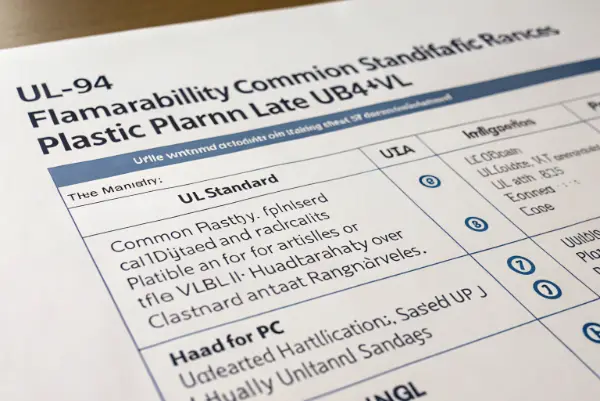
Understanding UL 94 is non-negotiable for us at CavityMold. We deal with this daily. The test isn’t just about "does it burn?" It is about "how does it stop burning?"
The Vertical Burn Test (V Ratings)
This is the one that matters most for electronics. We clamp a specimen vertically and put a flame under it for 10 seconds. We do this twice.
- V-0 (The Gold Standard): The burning stops within 10 seconds. Crucially, there are no flaming drips. This is what you want for internal parts of computers, TVs, or power supplies.
- V-1: The burning stops within 30 seconds. No flaming drips. It is good, but not the best.
- V-2: The burning stops within 30 seconds, BUT flaming drips are allowed. This is risky. If that drip hits a carpet or another wire, the fire spreads.
Why Thickness Matters
This is a detail many designers miss. A material might be V-0 at 3mm thickness, but only V-2 at 1.5mm thickness.
I recall a project where a designer thinned out a wall to make room for a bigger battery. He didn’t check the material spec sheet. The thinner wall no longer met the V-0 requirement, and the prototype failed certification. We had to redesign the mold to thicken the ribs, costing weeks of delay.
Thinking Critically About UL 94
Just because a material passes UL 94 doesn’t mean it is invincible.
- It’s a small flame: The test uses a small burner. A massive electrical short might overwhelm even a V-0 plastic.
- It doesn’t measure toxicity: A V-0 material might put out the fire but release thick, black smoke.
- Aging: Does the flame retardant degrade over 10 years? Sometimes UV light or heat can weaken the chemical bonds of the additives.
When we select a resin for you, we check the "Yellow Card" (the UL database). We look for the specific thickness of your design to ensure the rating holds up in the real world.
What is the NFPA 701 fire retardant standard?
While UL 94 is for solid parts, you might encounter NFPA 701 if your product involves films or fabrics. Confusion between these standards leads to improper testing. You cannot apply a textile standard to a rigid housing, yet people make this mistake often.
NFPA 701 is a standard specifically for flame propagation of textiles and films, not typically rigid injection molded parts. It tests how fabrics, curtains, and plastic films used in public spaces resist ignition. While less common for rigid electronics, it applies if your device uses large PE protective sheets or covers.
You might be wondering, "I make hard plastic parts, why do I care about a fabric standard?" It comes up more than you think, especially in industrial electronics or medical devices that use protective barriers.
Method 1 vs. Method 2
NFPA 701 is split into two test methods based on the density of the material.
- Method 1: For lightweight fabrics (curtains, draperies).
- Method 2: For heavier fabrics, films, and vinyl-coated fabrics. This is where Polyethylene films usually fall.
Application in Electronics
Let’s say you are designing a large medical cart. The rigid shell is tested to UL 94. However, if you have a disposable PE dust cover or a flexible screen shield, that specific component might need to meet NFPA 701, especially if the cart is used in a hospital corridor (a public space).
The "Flame Retardant" Misconception
There is a big difference between "Flame Retardant" additives and "Flame Resistant" fabrics.
- Inherently Flame Resistant: The material structure itself resists fire (like Kevlar or glass fiber).
- Chemically Treated (FR): Standard PE is treated. Over time, or with washing (if it is a fabric), this treatment can wear off.
Critical Thinking: The System Approach
You need to look at the whole product. If your rigid PE case is V-0 (very safe), but you wrap the internal wires in a cheap tape that burns like paper, the V-0 case won’t save you. Fire safety is a system.
We often advise clients to map out every material in the BOM (Bill of Materials).
- Housing: UL 94 V-0
- PCB: UL 94 V-0
- Cables: VW-1 (Wire flame test)
- Films/Covers: NFPA 701 (if applicable)
If one link in this chain is weak, the safety certificate is invalid. It is better to over-specify safety than to under-specify it.
What are five 5 products on which flame retardants are applied or added to?
You see these products every day, but you probably don’t realize they are chemically treated to save your life. Without flame retardants, our modern electronic infrastructure would be a ticking time bomb. Knowing these applications helps you identify where your own product fits.
Flame retardants are essential in 1) Consumer Electronics housings (TVs, laptops), 2) Wire and Cable insulation (preventing short-circuit fires), 3) Automotive components (engine covers, battery casings), 4) Printed Circuit Boards (PCBs), and 5) Building materials like insulation foams and pipes used in infrastructure.
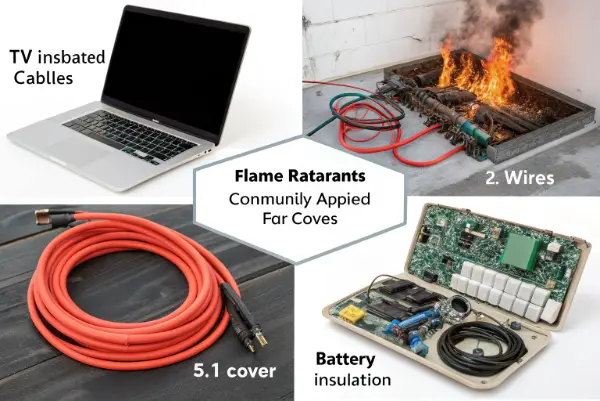
Let’s look deeper into these five categories. As a mold maker, I have worked on molds for almost all of these, and the requirements for the PE used in them are very different.
1. Consumer Electronics Housings
Think about your Wi-Fi router. It stays on 24/7. It gets warm. If a capacitor blows inside, the plastic case must not catch fire.
- Material: Often ABS or PC/ABS, but Flame Retardant PE or PP is used for internal brackets and shields.
- Requirement: Must be UL 94 V-0. Aesthetic finish is also key here, so the flame retardant cannot ruin the surface look.
2. Wire and Cable Insulation
This is a massive use case for PE. Cross-linked Polyethylene (XLPE) is the standard for power cables.
- The Risk: Wires get hot when overloaded. If the insulation burns, the fire runs along the wire like a fuse, spreading behind walls.
- The Tech: We use heavy loads of flame retardants here because appearance doesn’t matter, but flexibility does.
3. Automotive Components
Cars are full of electronics now. The battery pack in an EV is a huge fire risk.
- Application: Battery separators, connectors, and wire harnesses.
- Challenge: The material must resist fire AND harsh chemicals (oil, brake fluid) AND extreme vibration.
4. Printed Circuit Boards (PCBs)
The green board itself (FR-4) is named "FR" for Flame Retardant.
- The Role: The resin holding the fiberglass layers together is brominated to prevent the board from burning if a chip overheats.
- Connection: While not usually PE, the connectors mounted on the board are often molded from high-performance flame-retardant plastics.
5. Building Materials (Insulation Foams)
Expanded Polyethylene (EPE) foam is used to wrap pipes and insulate walls.
- Safety Code: Building codes are strict. If a wall catches fire, the foam cannot act like solid gasoline.
- Additives: These foams are heavily treated to self-extinguish.
Table: Flame Retardant Needs by Application
| Product Category | Primary Fire Risk | Key Material Requirement | Typical Standard |
|---|---|---|---|
| Electronics (TV/PC) | Internal heat, short circuits | High aesthetic finish, V-0 rating | UL 94 |
| Cables | Overheating, spark propagation | Flexibility, high dielectric strength | VW-1 / FT1 |
| Automotive | Crash fire, engine heat | Chemical resistance, heat stability | FMVSS 302 |
| Construction | External fire source | Low smoke density, self-extinguishing | ASTM E84 |
Understanding where your product fits helps us design the mold correctly. Flame-retardant plastics often flow differently in the mold—they can be thicker or more abrasive. Knowing the application lets us gate the mold properly to avoid defects.
Conclusion
Choosing the right flame-retardant PE is about balancing safety, compliance, and functionality. Whether you need to meet UL 94 V-0 for a device housing or NFPA 701 for a film, understanding these standards protects your business. At CavityMold, we ensure your molds and materials meet these critical safety benchmarks every time.