
Choosing the right manufacturing process can feel overwhelming. A wrong decision can lead to blown budgets, missed deadlines, and a final product that just doesn’t work. Making the right call early on is critical for your project’s success.
The best manufacturing method depends on your project’s stage. CNC machining is ideal for single, high-precision prototypes. Urethane casting is perfect for creating low-volume production runs (10-100 units) for market testing. Injection molding is the undisputed champion for mass production (1,000 to millions of parts) when you need consistency and the lowest cost per part. Your choice hinges on quantity a nd budget.
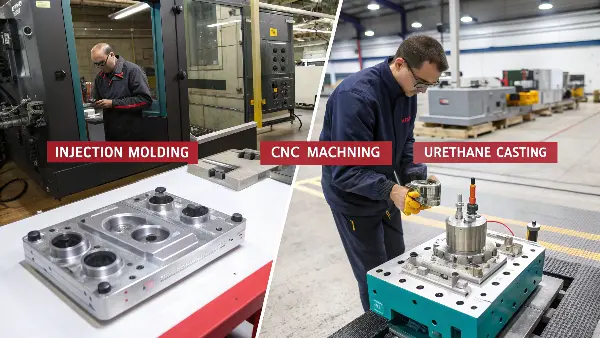
I’ve seen many project managers, like you, get stuck at this crossroad. You have a great design, but how do you bring it to life without wasting time or money? It’s a classic challenge in product development. We’re going to break down these three popular methods. My goal is to give you the clarity you need to pick the right path for your parts. Let’s dive in and make sure you get it right from the start.
What is the Difference Between CNC Machining and Injection Molding?
You have a perfect 3D model, but you need a physical part in your hands. Should you machine it or invest in an injection mold? This decision trips up many teams, leading to wasted time on a process that isn’t a good fit for their current needs.
The main difference is how they create the part. CNC machining is a subtractive process; it carves your part from a solid block of material, which is great for one-off prototypes. Injection molding is an additive process; it injects molten material into a pre-made mold, perfect for producing thousands of identical parts cheaply. One subtracts, the other adds (to a mold).
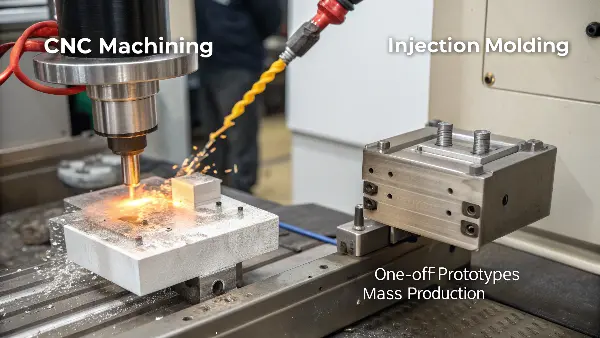
Let’s dig deeper into this. Imagine you’re making a new enclosure for a small electronic device. You need one to start, just to check the fit and feel. This is where CNC machining shines. It’s a direct translation of your CAD file into a physical object.
I remember a project manager from Australia, let’s call him Alex. He needed a few prototypes fast. We used CNC machining to create five units for him from a solid block of ABS plastic. They were in his hands in about a week. This allowed his team to test the assembly with the circuit board and get real-world feedback immediately. The downside? Each part was quite expensive. That’s the nature of a subtractive process where you pay for machine time and wasted material.
When Alex’s design was confirmed and he needed 50,000 units, CNC was no longer an option. The cost and time would have been huge. This is where injection molding takes over. We first had to build a mold—a high-precision steel tool. This is the main upfront investment.
Here’s a simple breakdown:
| Feature | CNC Machining | Injection Molding |
|---|---|---|
| Process | Subtractive (carving from a block) | Additive (injecting into a mold) |
| Best For | Prototypes, 1-10 parts | Mass production, 1,000+ parts |
| Upfront Cost | Low (no tooling) | High (mold cost) |
| Cost Per Part | High | Very Low (at high volumes) |
| Lead Time | Fast (days) | Slow (weeks for mold) |
| Material | Solid blocks of plastic or metal | Molten pellets of plastic |
So, the choice isn’t about which is "better," but which is right for your stage. Use CNC for speed and validation at the start. Then, when you’re ready to scale, make the jump to injection molding.
What is the Difference Between Urethane Casting and Injection Molding?
Your prototypes are approved, but you’re not ready for a 50,000-part run. You need about 100 units for a trade show or for beta testers. Injection molding tooling is too expensive for this small quantity. This is a common gap that can stall a project.
Urethane casting bridges the gap between prototyping and mass production. It uses a soft silicone mold to cast dozens of high-quality parts, making it perfect for low-volume runs (10-200 units). Injection molding uses a hard steel mold to produce thousands or millions of parts. The key difference is the mold material, which dictates cost, lead time, and volume capability.
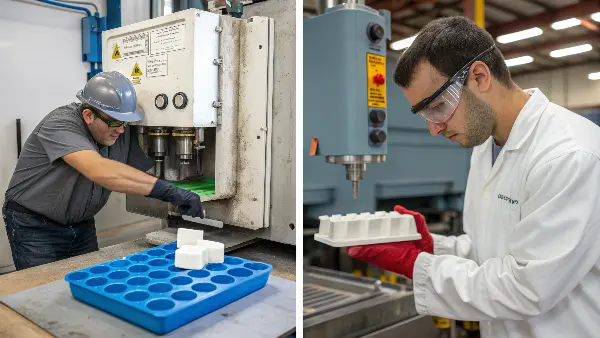
Let me continue the story about Alex. After he validated his CNC prototypes, he needed 150 enclosures for a product launch event. The final design was locked in, but his company wasn’t ready to commit to the $10,000 steel mold needed for injection molding. This is the exact scenario where I always recommend urethane casting.
First, we took one of his master CNC prototypes and used it to create a silicone mold. This process is much faster and cheaper than machining a steel tool. The silicone mold cost him about $500. Once the mold was ready, we could cast parts from a wide range of polyurethane resins that mimicked the properties of final production plastics, like ABS or polycarbonate. We even matched his company’s specific brand color.
He got his 150 parts in about two weeks. The parts looked and felt just like a final product, which was perfect for his trade show booth.
Here’s how they stack up for low-to-mid volume needs:
| Feature | Urethane Casting | Injection Molding |
|---|---|---|
| Best For Volume | 10 – 200 parts | 1,000 – 1,000,000+ parts |
| Tooling Material | Soft Silicone | Hard Steel or Aluminum |
| Tooling Cost | Low (~$200 – $1,500) | High (~$5,000 – $50,000+) |
| Tooling Life | Short (produces ~20-50 parts) | Very Long (100,000+ parts) |
| Lead Time | Fast (1-3 weeks) | Slow (4-12 weeks) |
| Piece Part Price | Medium | Very Low |
The trade-off with urethane casting is the limited life of the silicone mold. Each mold can typically only produce about 25 parts before it starts to degrade. So for Alex’s 150 units, we had to create 6 silicone molds. But even with that, the total cost was a fraction of a single injection mold tool. It’s the perfect intermediate step.
Can You Injection Mold Urethane?
You love the flexible, rubbery feel of the urethane parts from casting, and now you want to mass-produce them. People often ask me if we can just use that same "urethane" in our injection molding machines. It’s a logical question, but it highlights a common point of confusion.
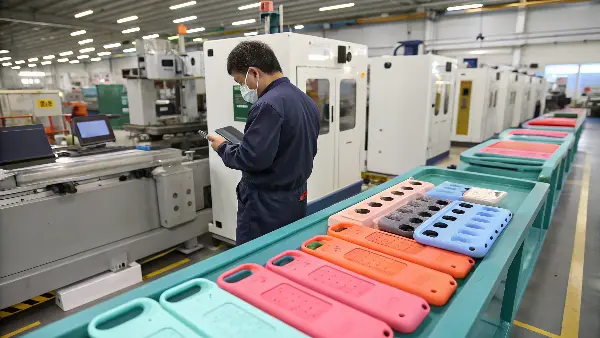
Yes, you absolutely can injection mold urethane, but it’s a specific type called Thermoplastic Urethane (TPU). This is different from the thermoset polyurethanes used in urethane casting. TPU is a versatile, rubber-like plastic that can be melted and injected like other thermoplastics. It’s perfect for creating flexible, durable parts in high volumes, such as phone cases or soft-touch grips.
This is one of those areas where the terminology gets tricky. It’s important to understand the two main families of plastics to see why this matters.
Thermoset vs. Thermoplastic
- Thermosets: This is what’s used in urethane casting. Think of it like baking a cake. You mix liquid components (a resin and a curative), and a chemical reaction occurs, causing it to harden permanently. You can’t melt it back down and reuse it.
- Thermoplastics: This is what’s used in injection molding. Think of it like an ice cube. You can melt it into a liquid, freeze it (cool it) into a solid shape, and then melt it again. Materials like ABS, Polycarbonate, and Thermoplastic Urethane (TPU) fall into this category.
So when we talk about injection molding "urethane," we are talking about TPU. It offers that amazing elasticity and abrasion resistance that people associate with urethane, but in a form our machines can process.
We frequently use TPU for overmolding projects. For example, we’ll first mold a hard plastic handle from ABS and then place that handle into a second mold. We then inject soft TPU around it to create a comfortable, non-slip grip. You see this everywhere, from power tool handles to toothbrush grips. It’s a fantastic process.
So, if you developed your product using cast urethane parts and want to scale to injection molding, you can’t use the exact same liquid chemistry. But you can select a grade of TPU that closely matches the hardness (durometer) and performance qualities of your original prototype. It’s a transition we manage for clients all the time.
What are the 5 Main Types of Plastic Molding?
We’ve talked a lot about injection molding, but it’s not the only game in town. Clients sometimes come to me with a project, like a bottle or a large hollow panel, that isn’t right for injection molding. Knowing the other options helps you think more creatively about your design.
While there are many methods, the five most common types of plastic molding are injection molding, blow molding, rotational molding, compression molding, and extrusion. Each one is designed for a specific part geometry and production scale. Choosing the right one is essential for creating a cost-effective and functional plastic part, whether it’s a solid gear or a hollow tank.
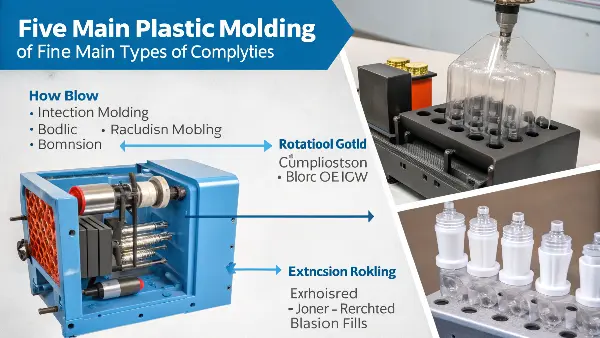
Let’s break down these five main players. Understanding their strengths will empower you to design parts that are optimized for manufacturing. I see injection molding as the most versatile, but the others are powerful tools for specific jobs.
An Overview of the 5 Molding Processes
| Molding Type | How It Works | Best For Creating… | Common Products |
|---|---|---|---|
| 1. Injection Molding | Molten plastic is forced under high pressure into a closed metal mold. | Complex, solid parts with high precision and tight tolerances. | LEGO bricks, phone cases, car dashboards, medical devices |
| 2. Blow Molding | A hollow tube of hot plastic (a parison) is placed in a mold and inflated with air, pushing it against the mold walls. | Hollow parts with thin walls. | Water bottles, milk jugs, shampoo containers, automotive ducts |
| 3. Rotational Molding | Plastic powder is placed in a hollow mold, which is then heated and rotated on two axes. The powder melts and coats the inside of the mold. | Very large, hollow, and stress-free parts with uniform wall thickness. | Kayaks, large water tanks, playground slides, traffic cones |
| 4. Compression Molding | A pre-measured amount of molding material (a "charge") is placed into a heated, open mold cavity. The mold is then closed, and pressure is applied to force the material to fill the cavity. | Flat or moderately curved parts, often from thermoset materials. | Electrical wall plates, silicone keypads, dinnerware |
| 5. Extrusion | Molten plastic is pushed continuously through a die, which has a specific cross-sectional profile. | Long, continuous parts with a consistent shape. | Pipes, PVC window frames, straws, weather stripping, plastic film |
As a mold maker, my world is primarily injection molding. It offers incredible detail and speed for mass production. However, if a client comes to me with a plan to make a 2,000-liter water tank, I’ll be the first to tell them that rotational molding is their answer. If they want to make soda bottles, it’s blow molding all the way. Knowing the right process is just as important as having the right design.
Conclusion
Choosing between CNC machining, urethane casting, and injection molding isn’t about finding the "best" method. It’s about aligning the right process with your project’s specific stage, quantity, and budget. By understanding these core differences, you can navigate from prototype to production with confidence and efficiency.