
Parents worry constantly about the safety of toys, and recalls can destroy a brand overnight. You need a rigorous testing strategy to prevent dangerous defects before they reach a child’s hands. Failing to test correctly puts your reputation and your customers at risk.
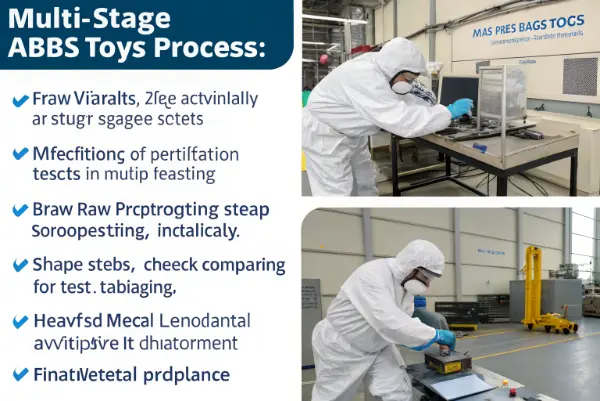
Testing ABS toys requires a multi-stage process starting with raw material verification (FTIR analysis) to ensure chemical purity. It continues with physical durability tests like drop and impact testing during prototyping, and ends with finished product checks for sharp edges and heavy metal compliance (RoHS/REACH) to meet global safety standards.
But knowing the basic definition isn’t enough when you are managing a complex production line. You need to know exactly when to test and what to look for at every stage. I have seen too many projects fail because they skipped a simple material check early on. Let’s look at the specific methods we use to guarantee safety.
How Do We Verify the Quality of Raw ABS Material Before Molding?
Using contaminated or low-grade plastic is the fastest way to ruin a production run. If the raw material is weak or contains banned substances, no amount of good design can save the final toy. You must catch these issues before the pellets even enter the hopper.
We verify raw ABS material quality primarily through Melt Flow Index (MFI) testing to ensure consistent processing properties and FTIR spectroscopy to confirm chemical composition. We also conduct moisture analysis to prevent cosmetic defects and structural weakness caused by wet resin during the injection molding process.
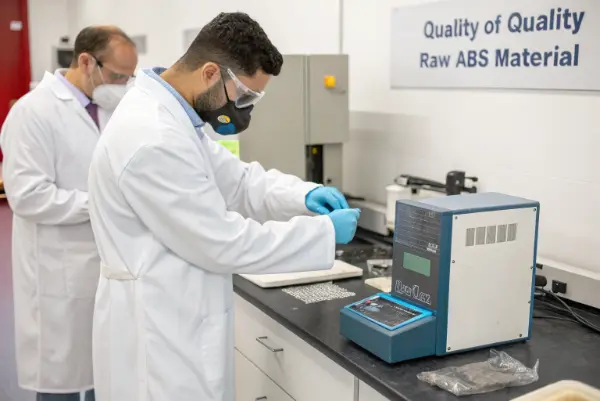
At CavityMold, I always tell my clients that the mold is only as good as the material you put into it. When we receive a batch of ABS (Acrylonitrile Butadiene Styrene), we don’t just trust the supplier’s datasheet. We verify it.
First, we look at the Melt Flow Index (MFI). This tells us how easily the plastic flows when melted. If the MFI is too high, the parts might be brittle. If it is too low, we get short shots (incomplete parts). We need the flow to match the mold design perfectly.
Second, we check for moisture. ABS is hygroscopic, meaning it absorbs water from the air. If you mold wet ABS, you get splay marks (silver streaks) on the surface, but worse, the polymer chains break down. This makes the toy weak. We use a moisture analyzer to ensure the water content is below 0.1% before processing.
Third, we use FTIR (Fourier Transform Infrared Spectroscopy). This sounds complex, but it is just a chemical fingerprint check. It confirms that the "ABS" is actually ABS and not mixed with cheaper polystyrene or recycled contaminants.
| Test Method | Purpose | Why it Matters for Safety |
|---|---|---|
| MFI Test | Checks flow rate | Ensures part density and structural integrity. |
| Moisture Analysis | Checks water content | Prevents brittleness and internal cracking. |
| FTIR Scan | Checks chemical ID | Avoids toxic contaminants and wrong material usage. |
What Physical Stress Tests Are Necessary for Molded Parts?
Children play rough, and a toy that shatters into sharp pieces is a major liability. You need to simulate the abuse a toy will receive in the real world. Testing the physical strength of the molded parts is non-negotiable for safety compliance.
Physical stress tests for ABS toys include drop testing from specific heights to check for shattering, compression testing to ensure the toy supports weight, and tension testing on attached small parts. These tests confirm that the injection molding process created a strong, cohesive bond within the plastic.
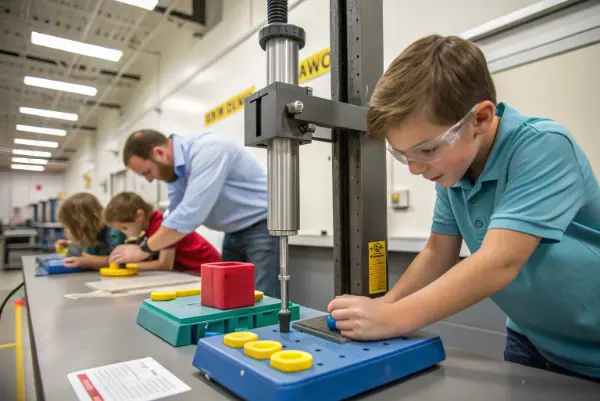
Once the parts come out of the mold, we move to destructive testing. This is the fun part, but it is also serious business. We need to know the breaking point.
The most common test is the Drop Test. We take a sample toy and drop it onto a concrete floor from varying heights (usually 1 meter to 1.5 meters). We do this multiple times in different orientations. Does it crack? Does a small part fly off? ABS is chosen for its toughness, so it should survive. If it shatters like glass, we know the molding parameters (like cooling time or injection pressure) were wrong.
We also perform Torque and Tension Tests. If the toy has components that twist or pull (like the arm of an action figure), we apply force. International standards like EN71 or ASTM F963 have specific force requirements. If a small part detaches with less than the required force, it becomes a choking hazard.
Finally, we look at Impact Resistance. This is different from dropping. We might drop a heavy weight onto the toy. This simulates a child stepping on the toy. ABS has excellent impact resistance, but bad knit lines (where plastic flows meet) can create weak spots. We test these specific areas to ensure the mold design placed the gate in the right spot.
- Key Stress Factors:
- Impact: Sudden shock (dropping).
- Compression: Steady pressure (stepping).
- Tension: Pulling force (tugging parts).
- Torque: Twisting force (rotating joints).
How Do We Detect Chemical Hazards in Finished ABS Toys?
Physical strength doesn’t matter if the toy is toxic. Regulations regarding chemical safety are strict and constantly changing. You must ensure your finished products are free from heavy metals and harmful plasticizers to pass customs and keep children safe.
We detect chemical hazards using X-ray Fluorescence (XRF) screening for rapid heavy metal detection and GC-MS analysis for identifying organic pollutants like phthalates. These tests ensure the final product complies with strict regulations like RoHS, REACH, and CPSIA regarding lead, cadmium, and other toxins.
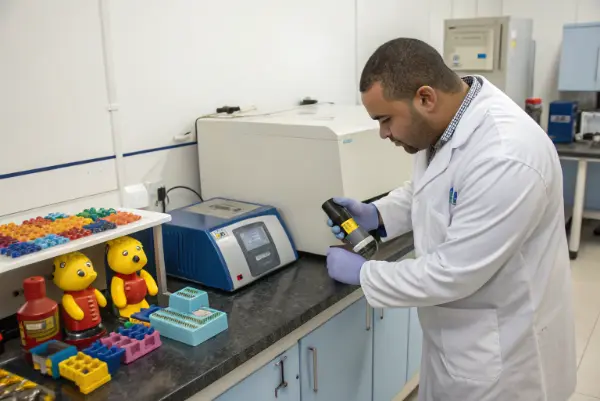
Chemical testing is often invisible, but it is critical. In my experience, this is where many projects get stuck at customs. You cannot see lead or cadmium with your eyes.
We start with XRF (X-ray Fluorescence). This is a handheld gun that we point at the toy. It gives us a quick read on heavy metals. It tells us immediately if there is Lead (Pb), Mercury (Hg), or Cadmium (Cd) in the plastic or the paint. This is a fast, non-destructive way to screen every batch.
However, XRF isn’t enough for everything. For organic chemicals, we need GC-MS (Gas Chromatography-Mass Spectrometry). This is a lab test. We use this to look for phthalates. While phthalates are more common in soft PVC, they can contaminate ABS through additives or recycled material. We also check for brominated flame retardants, which are banned in many children’s products.
We also test for migration of elements. It is not just about what is in the plastic, but what comes out if a child sucks on it. We soak the toy in a solution that mimics stomach acid. Then we analyze the liquid. If the toy releases toxins, it fails.
- Common Chemical Regulations:
- RoHS: Restriction of Hazardous Substances (EU).
- REACH: Registration, Evaluation, Authorization and Restriction of Chemicals (EU).
- CPSIA: Consumer Product Safety Improvement Act (USA).
- Prop 65: California specific toxicity warnings.
Conclusion
Testing ABS toys is a comprehensive journey that safeguards your users and your brand. From verifying the raw material with FTIR to drop-testing molded parts and screening for chemicals with XRF, every step matters. At CavityMold, we integrate these checks into our process to ensure every mold we make produces safe, compliant toys.