
Choosing the wrong plastic material can ruin your production timeline and budget. You are likely overwhelmed by the technical data sheets for ABS, Polycarbonate (PC), and PMMA (Acrylic). This guide simplifies the complex comparison of safety, strength, and clarity to help you decide.
When choosing between ABS, PC, and PMMA, consider your primary need: ABS is the cost-effective, impact-resistant choice for general housing; PC offers superior strength and heat resistance for demanding environments; and PMMA provides the highest optical clarity and UV stability for transparent applications. Select PC for safety, PMMA for looks, and ABS for general utility.
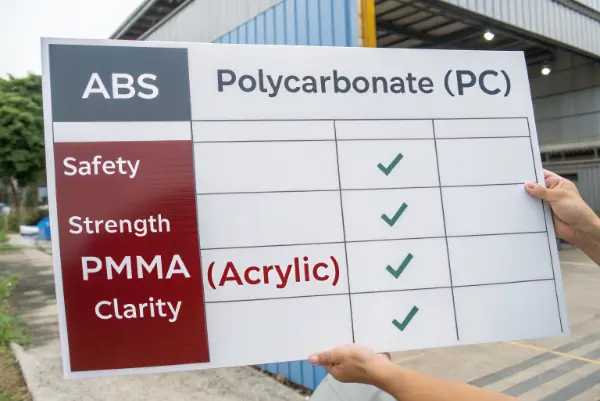
It is not just about picking the strongest plastic. It is about balancing cost, manufacturability, and end-user safety. I have seen many projects fail because a designer chose a material based only on one factor. Let’s break down the specific differences so you can make the right call for your mold.
How Do Mechanical Properties Differ Between These Materials?
You need a material that can withstand the physical stress of your product’s lifecycle. If you choose a weak material, the product will crack during shipping or use. Conversely, over-engineering with an expensive, super-strong plastic when it is not needed hurts your profit margins.
Polycarbonate (PC) is the clear winner for impact strength, being virtually unbreakable and significantly stronger than both ABS and PMMA. ABS offers decent impact resistance and flexibility, making it durable for everyday abuse, while PMMA is brittle and prone to cracking under heavy stress, though it is rigid and holds its shape well.
Let’s look closer at the mechanical trade-offs. As engineers, we often get stuck on "tensile strength" numbers, but real-world application matters more.
Polycarbonate (PC) is the beast here. It is used in bulletproof glass for a reason. If your product is a handheld device that might get dropped on concrete, like a rugged scanner or a specialized medical tool, PC is your best bet. It absorbs energy well without shattering. However, it can be sensitive to scratching.
ABS (Acrylonitrile Butadiene Styrene) is the "workhorse." It is not as strong as PC, but it is tough. It has a bit of "give" or ductility. This means if you stress it, it might bend a little before it breaks. This is why Lego bricks are made of ABS. They need to snap together and endure play. It is perfect for consumer electronic housings where extreme impact isn’t likely, but daily wear and tear is.
PMMA (Polymethyl Methacrylate / Acrylic) is interesting. It is very rigid. It feels high quality and hard. But, it has low impact resistance. If you hit it with a hammer, it will shatter like glass. It is not suitable for parts that will face mechanical shock.
Here is a breakdown of how they compare mechanically:
| Feature | ABS | Polycarbonate (PC) | PMMA (Acrylic) |
|---|---|---|---|
| Impact Strength | Medium-High | Very High (Best) | Low |
| Flexibility | Moderate | Moderate | Low (Brittle) |
| Scratch Resistance | Low | Low | High (Best) |
| Machinability | Excellent | Good | Fair |
| Best Use | Electronic housings, toys | Safety goggles, rugged cases | Display screens, lenses |
When I consult with clients, I ask: "Will this drop from a table or a rooftop?" If it is a table, ABS works. If it is a rooftop, use PC. If it just sits on a shelf and needs to look pretty, PMMA is fine.
Which Material Offers the Best Optical Clarity?
If your product involves screens, lenses, or light guides, transparency is the most critical factor. Using a cloudy or yellowing plastic will make your high-tech device look cheap and malfunction. You need a material that transmits light efficiently and stays clear over time.
PMMA is the undisputed leader in optical clarity, transmitting up to 92% of visible light, which is even clearer than glass. Polycarbonate is also transparent but transmits slightly less light (around 88%) and can have a slight tint. ABS is naturally opaque and is not suitable for transparent applications unless you use specific, expensive clear grades.
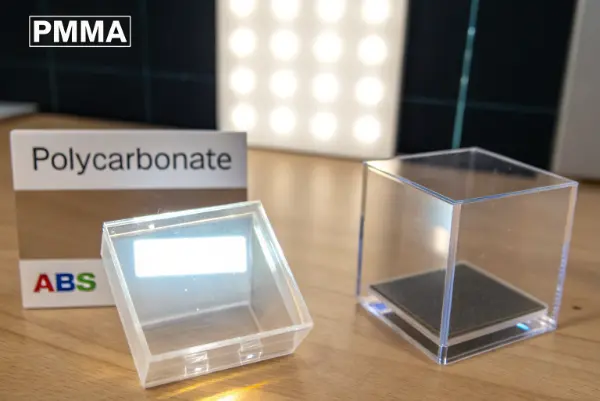
Optical properties go beyond just "seeing through" the part. It involves how the material handles light over years of use.
PMMA is often called "organic glass." I remember working on a project for a high-end automotive taillight. The client considered PC for strength, but we pushed for PMMA. Why? Because PMMA does not yellow easily under UV light. It stays crystal clear. If you are designing outdoor lighting covers, retail display cases, or lenses, PMMA is the superior choice. It also polishes up very well if it gets scratched.
Polycarbonate is transparent, but it is not as clear as PMMA. It has higher haze. More importantly, standard PC has poor UV resistance. If you leave a clear PC part in the sun for a year without a UV coating, it turns yellow and gets brittle. You have probably seen old car headlights that look foggy—that is often PC degrading. You can add UV stabilizers to PC, but that adds cost. Use PC for transparency only if you absolutely need the impact strength (like in safety goggles).
ABS is naturally ivory or white and opaque. While "transparent ABS" (MABS) exists, it is expensive and never achieves the glass-like clarity of PMMA or PC. It is usually used for translucent buttons or medical devices where you just need to see fluid levels, not read text through it.
If visual aesthetics and light transmission are your priority, PMMA wins. If you need transparency plus protection, PC is necessary, but be ready to pay for coatings.
How Do They Compare in Chemical Resistance and Safety?
Safety involves both the chemical stability of the material and its flammability in the end environment. Ignoring chemical compatibility leads to stress cracking, and ignoring flammability ratings can lead to regulatory failures. You must match the material to the chemicals it will touch and the safety standards it must meet.
Polycarbonate generally has poor resistance to chemicals and solvents, making it prone to cracking when cleaned with harsh agents. PMMA is also sensitive to solvents like alcohol but handles environmental weathering well. ABS has moderate chemical resistance but can be attacked by acetone; however, PC often has better inherent flame retardancy compared to the flammable nature of untreated ABS and PMMA.
This is where projects often get tricky. I once had a client design a medical device case in Polycarbonate. It was strong and clear. But the hospital cleaned it with strong alkaline cleaners. The PC developed "crazing" (tiny cracks) and failed within weeks.
Chemical Resistance:
- ABS: It resists acids and alkalis fairly well. However, it dissolves instantly in Acetone. This is actually useful for bonding parts together (solvent welding), but bad if the environment has solvents.
- PC: It is very sensitive. Hydrocarbons, ketones, and even some oils in cosmetics can cause stress cracking in Polycarbonate. If your user applies lotion and touches the device, PC might degrade over time.
- PMMA: It is similar to PC in weakness. It reacts poorly to alcohol and strong solvents. However, it handles environmental factors like salt spray very well.
Safety and Flammability:
- PC: This is usually the safest option for electronics. Many PC grades are inherently self-extinguishing. They often meet UL94 V-0 ratings (meaning the burning stops within 10 seconds). This is why PC is mandatory for many electrical connectors and power supply housings.
- ABS: It burns easily. To make it safe for electronics, manufacturers add flame retardants (FR-ABS). These additives can reduce the mechanical strength slightly and make the material harder to mold, but they are necessary for compliance.
- PMMA: It burns efficiently and cleanly, almost like a candle. It is rarely used in high-heat or high-risk electrical areas for this reason.
Food Safety (BPA):
This is a major topic now. Polycarbonate contains Bisphenol A (BPA). Many countries have banned PC for baby bottles and food containers because BPA can leach out. PMMA and ABS are generally BPA-free, though you must check specific FDA-compliant grades. If your product touches food, be very careful with PC.
| Factor | ABS | Polycarbonate (PC) | PMMA (Acrylic) |
|---|---|---|---|
| Solvent Resistance | Poor (Acetone) | Poor | Poor |
| Acid/Alkali Resistance | Good | Fair | Good |
| Flammability | High (needs additives) | Low (Self-extinguishing) | High |
| BPA Content | No | Yes | No |
Which Material Is Most Cost-Effective for Injection Molding?
Budgets are always tight, and material cost is a huge chunk of unit price. Choosing a premium material when a commodity plastic will do is a waste of money. You need to consider not just the raw material price, but also the processing costs and cycle times.
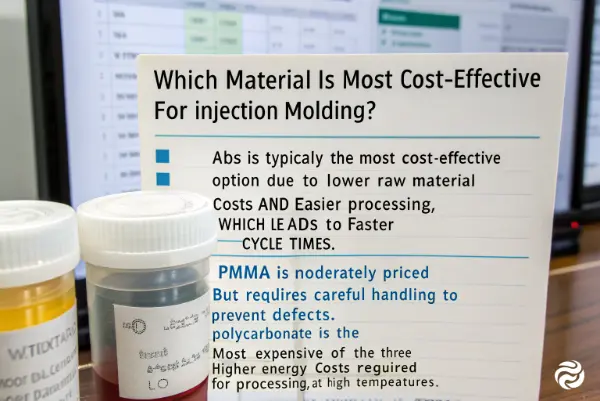
ABS is typically the most cost-effective option due to lower raw material costs and easier processing, which leads to faster cycle times. PMMA is moderately priced but requires careful handling to prevent defects. Polycarbonate is the most expensive of the three, both in raw material price and higher energy costs required for processing at high temperatures.
When we quote molds at CavityMold, the material choice changes the bottom line significantly.
ABS is the cheapest per kilogram. But the savings go deeper. ABS melts easily and flows smoothly into the mold. This allows us to run the injection molding machine faster (shorter cycle time). If we can make 60 parts per hour in ABS versus 40 parts in PC, your unit cost drops drastically. ABS also shrinks predictably, making mold design straightforward.
PMMA is in the middle price range. The challenge here is defects. PMMA shows every flaw. If there is a flow mark or a sink mark, you see it because it is clear. We have to run the mold slower and pack the pressure higher to ensure it looks perfect. This increases the "machine time" cost.
Polycarbonate is expensive.
- Raw Cost: The resin itself costs more.
- Processing: PC needs very high temperatures (up to 300°C or more). This requires more energy.
- Mold Wear: Because PC is stiff and viscous, it wears down the steel mold faster than ABS.
- Drying: PC absorbs moisture from the air. We have to dry it for hours before molding, or the parts will be ruined with silver streaks. This adds utility costs.
Decision Guide:
- Low Budget + Opaque Part: Use ABS. It is the industry standard for a reason.
- Medium Budget + Clear Part: Use PMMA.
- High Budget + High Performance: Use PC. Only pay for PC if you need the heat resistance or impact strength.
Also, consider waste. ABS can be recycled and reground easily. We can often mix a small percentage of regrind back into the process to save you money (if your specs allow it). PC degrades more when recycled, so we have to be more careful, leading to potentially more waste cost.
Conclusion
To select the right material, match the specific stress and visual requirements to the plastic’s strengths. Use ABS for general housings and cost savings; choose Polycarbonate (PC) for high impact, heat resistance, and safety; and select PMMA for superior optical clarity and UV stability.