
Are you designing parts that look great in CAD but fail under real-world stress? This often happens when material properties are an afterthought, leading to costly redesigns, production delays, and a product that just doesn’t perform. The key is to let material science guide your design from day one.
To optimize a part’s design based on material properties, you must first define its function and the loads it will endure. Next, select a material that satisfies these demands for strength, durability, and cost. Use tools like Finite Element Analysis (FEA) and topology optimization to refine the part’s geometry, removing unnecessary material while maintaining structural integrity. Finally, always validate the design with physical testing to confirm it meets all performance requirements before production.
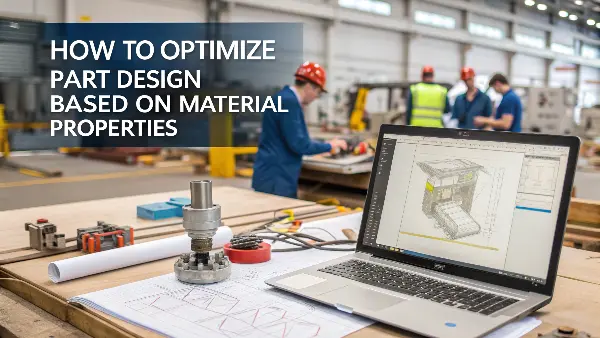
That’s the high-level roadmap I’ve followed for over two decades in mold making. Getting this right saves time, money, and a lot of headaches. But the real magic happens when you understand the details of each step. Let’s break down how to truly connect material choice with design excellence, ensuring your parts aren’t just made, but made right.
How do material properties affect design?
Ever chosen a material based on a single property like strength, only to have the part fail in a completely unexpected way? You might ignore critical factors like UV resistance or thermal expansion, leading to brittle parts or warping. A holistic understanding of material properties is essential for a robust design.
Material properties fundamentally dictate the rules and limitations of your part design. A material’s strength determines the necessary wall thickness and support structures. Its thermal properties influence designs for heat management. Even its processability affects what’s possible geometrically, like minimum wall thickness or draft angles for injection molding. Every property, from stiffness to chemical resistance, imposes constraints that shape the final form and function of your part.
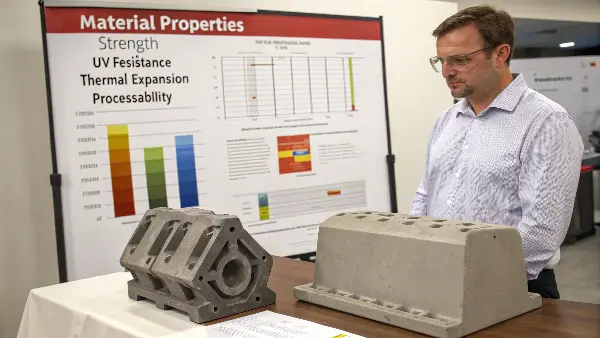
I remember a project early in my career for a client who needed a housing for an outdoor sensor. We initially focused purely on impact strength using a standard ABS. The prototypes were strong, but after a few months of field testing, they became brittle and discolored. We overlooked the impact of UV radiation and chose a material without proper UV stabilizers. It was a classic case of a single-minded focus. We switched to an ASA (Acrylonitrile Styrene Acrylate) formulation, which is like ABS but with far superior weather resistance, and the problem was solved. This taught me that a design isn’t just about geometry; it’s a conversation with the material.
Let’s break this down further:
-
Mechanical Properties: These are the most obvious drivers. Tensile strength, stiffness (flexural modulus), and impact resistance directly tell you how a part will behave under load. A low-stiffness material like Polypropylene will require thicker walls and more ribbing than a high-stiffness material like glass-filled Nylon to achieve the same rigidity.
-
Thermal Properties: The Coefficient of Thermal Expansion (CTE) is crucial. If your part is assembled with metal components, a plastic with a high CTE will expand and contract more than the metal, potentially causing stress, warping, or failure at the interface. Heat Deflection Temperature (HDT) tells you the temperature at which a part starts to deform under a specific load. It’s a non-negotiable factor for parts near motors or electronics.
-
Environmental Properties: Will your part be exposed to chemicals, oils, or sunlight? A Polycarbonate part might offer great clarity and impact strength, but it will degrade quickly if exposed to certain cleaning agents. This is where you consider materials like HDPE or PP for chemical resistance.
Here is a simple table to illustrate how properties change design choices for the same part, let’s say a simple handheld enclosure:
| Property | Material A: ABS | Material B: Polycarbonate (PC) | Design Implication |
|---|---|---|---|
| Impact Strength | Good | Excellent | PC allows for a thinner wall design for the same drop test rating. |
| UV Resistance | Poor (requires additives) | Moderate (can yellow over time) | If it’s an outdoor product, neither is ideal without a coating or a better material like ASA. |
| Chemical Resistance | Moderate | Poor (sensitive to some oils/solvents) | The design must shield internal PC parts from potential chemical exposure. |
| Cost | Lower | Higher | An ABS design might be slightly thicker but more cost-effective for the same function. |
Ultimately, every material has its own "rulebook." Your job as a designer is to read that book before you start drawing.
What are the methods of design optimization?
You have a functional design, but you know it’s over-engineered—too heavy and too expensive to manufacture. This excess material and weight eats directly into your profit margin and makes your product less competitive in the market. Simply shaving off material randomly is a recipe for disaster. You need a systematic approach.
Key design optimization methods include Finite Element Analysis (FEA), Topology Optimization, and Design for Manufacturing and Assembly (DFMA). FEA simulates how a part reacts to real-world forces, revealing stress concentrations. Topology optimization uses algorithms to systematically remove non-essential material, creating strong, lightweight organic shapes. DFMA focuses on refining the design to make it cheaper and easier to produce and assemble.

These aren’t just fancy software tools; they are powerful methodologies for creating better products. I worked with a project manager, a guy much like Alex, on a medical device arm. The initial design was a big, bulky aluminum piece. It was strong but heavy and expensive to machine. We knew it could be better.
First, we started with Finite Element Analysis (FEA). We applied the expected loads in the simulation and instantly saw where the stress was concentrated—mostly at the joints and mounting points. Large sections in the middle of the arm showed almost no stress at all. This simulation gave us a "stress map" of our part.
Next, we used Topology Optimization. We fed the FEA results into the optimization software and defined our goals: maintain stiffness but reduce weight by 30%. The software then ran iterations, "carving away" digital material from the low-stress areas identified by the FEA. The result was a skeletal, almost alien-looking structure. It looked strange, but the simulation proved it was just as strong as the original blocky design.
Finally, we applied Design for Manufacturing (DFM) principles. The pure, "optimized" shape was too complex for cost-effective casting or molding. We worked to simplify the organic curves into manufacturable surfaces, added draft angles, and standardized the fillets, creating a final design that was lightweight, strong, and manufacturable. The final plastic part, made from a glass-filled polymer, was 40% lighter and 60% cheaper to produce than the original aluminum concept. It’s a perfect example of using these methods in harmony.
How do you optimize material selection for performance?
Choosing a material from a datasheet based on one or two key values is a dangerous oversimplification. You pick a material with high tensile strength, but you don’t realize its poor fatigue life means it will fail after repeated use. This narrow focus can lead to products that fail prematurely and unexpectedly.
To optimize material selection, you must move beyond single data points and evaluate properties within the context of the part’s entire lifecycle. This involves using tools like material selection charts (Ashby plots) to visually compare trade-offs between properties like strength vs. density or stiffness vs. cost. The goal is to identify a small group of candidate materials that offer the best balance of performance, processability, and cost for your specific application.
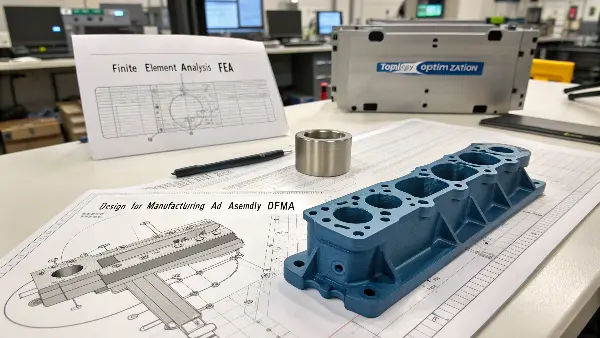
I often tell my clients to think like a detective. You’re not just looking for a "strong" material; you’re looking for a material that can withstand specific loads, in a specific environment, for a specific number of cycles, at a specific cost. Each property is a clue.
A powerful tool I recommend is the Ashby chart. These charts plot one material property against another, like strength versus density. By drawing a "selection box" on the chart that meets your minimum requirements for both properties, you can instantly see which classes of materials are suitable. For example, if you need a material that is both very strong and very light, the chart will guide you toward composites or certain metal alloys, while clearly showing that most common plastics won’t meet both criteria.
Let’s walk through a simplified thought process for selecting a material for a snap-fit clip:
-
Identify Key Performance Indicators (KPIs): The clip needs to bend without breaking (high strain-to-failure), return to its original shape (good elastic recovery), and withstand thousands of cycles (high fatigue resistance). It also needs to be cheap.
-
Initial Screening with Ashby Charts: We’d look for materials with a low Young’s Modulus (for flexibility) but high elastic limit. This will point us toward polymers instead of metals or ceramics. We can then use another chart to compare fatigue strength versus cost for different polymers.
-
Narrowing Down the Candidates: This process might narrow our options to Acetal (POM), Nylon (PA), and Polypropylene (PP).
-
Contextual Evaluation:
- Acetal (POM): Excellent spring-back and fatigue resistance. A top contender.
- Nylon (PA): Strong and tough, but it absorbs moisture, which changes its dimensions and mechanical properties. If the part operates in a humid environment, this could be a problem.
- Polypropylene (PP): Very flexible and has excellent fatigue life (think of the "living hinge" on a container lid), and it’s very cheap. However, its strength and stiffness are lower than POM or PA.
By considering the full context, we can make an informed trade-off. For a high-performance clip in a stable environment, POM is likely the winner. For a low-cost, disposable application, PP is the clear choice.
What techniques do you use to optimize design for performance and cost?
You’re constantly being pushed to develop products that perform better than the last generation but cost less to make. Simply making parts cheaper by using inferior materials is a race to the bottom that damages brand reputation. True optimization is about achieving both performance and cost savings through intelligent design.
The key is to balance performance and cost by focusing on material, process, and geometry simultaneously. Techniques include material consolidation to reduce part count, utilizing advanced manufacturing processes like injection molding to create complex net-shape parts, and applying DFM principles to simplify geometry, add uniform wall thickness, and include features like ribs and gussets to add strength only where needed. This holistic approach cuts costs without sacrificing quality.
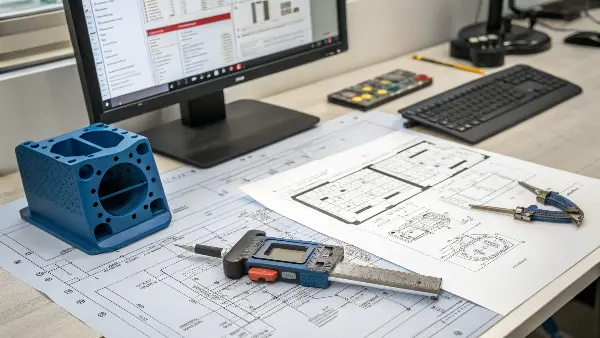
One of the most powerful techniques I’ve used to cut costs is part consolidation. I once worked on a project that originally consisted of five separate metal and plastic pieces that had to be assembled with screws and adhesives. The assembly process was slow and expensive. By redesigning it as a single, complex injection-molded part using a glass-filled polymer, we eliminated four parts and all the associated assembly labor and hardware. The single new part was engineered with snap-fits, integrated bosses, and ribs. It was stronger, lighter, and the total cost per unit dropped by over 50%.
Another critical technique is designing for the manufacturing process. For injection molding, this means:
- Uniform Wall Thickness: This is the golden rule. It prevents sink marks, warping, and uneven cooling, which reduces cycle time and scrap rates. Where thickness must change, it should be gradual.
- Using Ribs and Gussets: Instead of making an entire wall thick for strength, you can keep it thin and add thin ribs for support. This uses far less material and cools much faster, directly translating to cost savings. A well-placed rib can increase stiffness dramatically with minimal material addition.
- Draft Angles: This is non-negotiable. Adding a slight taper to vertical walls allows the part to be ejected from the mold easily. Without it, you get scuffs, broken parts, and a slow, inefficient process.
Here’s how these elements combine to balance performance and cost:
| Technique | Performance Benefit | Cost Benefit |
|---|---|---|
| Part Consolidation | Eliminates failure points between assembled parts, often creating a stronger, lighter unit. | Reduces tooling costs for multiple parts, eliminates assembly labor and hardware costs. |
| Ribs & Gussets | Increases stiffness and structural integrity precisely where needed without adding bulk. | Minimizes material usage and shortens cooling/cycle times, lowering the cost per part. |
| Uniform Wall Thickness | Improves dimensional stability and mechanical performance of the final part. | Reduces scrap rates due to defects like sink and warp, and allows for faster cycle times. |
By thinking about cost and performance as two sides of the same coin, and not competing goals, you can unlock incredible value. It’s not about making things cheap; it’s about making them smart.
Conclusion
Optimizing a part’s design is not a linear process but a dynamic balancing act. It requires a deep understanding of how material properties, design geometry, and manufacturing processes all interact. By using a systematic approach, you can create products that are not only high-performing but also cost-effective and reliable.