
Creating plastic products for the kitchen is a tricky business. You worry about safety regulations, chemical leaching, and whether your chosen material will actually pass inspection. If you get this wrong, you risk product recalls and damaging your brand’s reputation forever.
Food-contact ABS requires specific formulations that differ from standard industrial grades. To be safe, the ABS resin must be FDA-compliant or EU-certified (like Regulation No 10/2011), meaning the monomers—Acrylonitrile, Butadiene, and Styrene—are strictly controlled to prevent harmful migration into food. Manufacturers must use certified additives and colorants during the molding process.
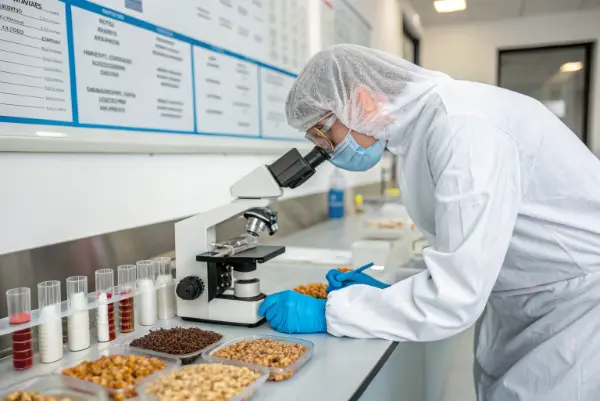
It is not enough to just pick a plastic that looks good. You need to understand the chemistry and the rules behind it. I have seen too many projects fail because someone assumed "plastic is plastic." Let’s walk through exactly what makes ABS safe or unsafe for your next food-related project.
Is ABS safe for food contact?
You see ABS everywhere, from LEGO bricks to car dashboards, so you might assume it is fine for a lunchbox. But standard ABS contains chemical residues that can be harmful if they touch food. Using generic ABS for kitchenware is a major safety gamble you should not take.
Yes, ABS can be safe for food contact, but only if you use a specific "food-grade" formulation. Standard ABS is not safe because potential residual chemicals from the manufacturing process can migrate into food. Food-grade ABS is manufactured under stricter controls to ensure these chemical levels are well below safety limits set by health organizations.
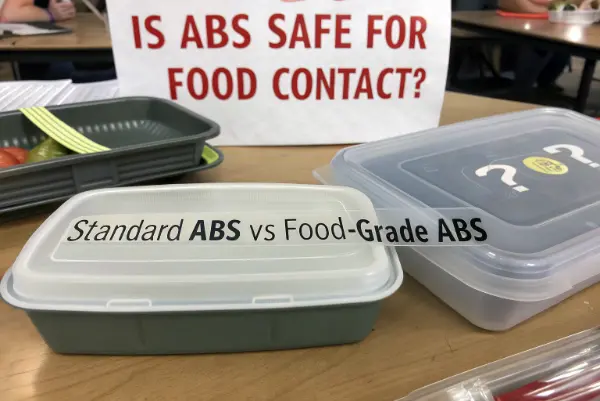
Let’s break this down further because "safe" is a relative term in manufacturing. When we talk about standard ABS, we are looking at a material prized for its toughness and impact resistance. However, the polymerization process often leaves behind trace amounts of styrene and acrylonitrile monomers. In a car part, this does not matter. In a salad spinner, it matters a lot.
The critical difference lies in the migration limits. When plastic touches food, especially hot or acidic food, tiny molecules want to move from the plastic into the meal. This is called leaching.
Here is a quick look at the risks associated with the components of ABS if not properly controlled:
The Risks of Non-Compliant ABS Components
| Component | Function in Plastic | Potential Risk in Food Contact |
|---|---|---|
| Acrylonitrile | Provides chemical resistance and heat stability. | Can be toxic and carcinogenic if leached in high amounts. |
| Butadiene | Provides impact resistance (toughness). | Generally less risk of migration, but purity is essential. |
| Styrene | Provides rigidity and glossy finish. | Can mimic hormones (endocrine disruptor) and affect human health. |
To make ABS "food safe," resin suppliers use special production lines. They run additional purification steps to strip out those loose monomers. They also ensure that any additives—like mold release agents or stabilizers—are on the "White List" of approved substances. I recall a project where a client used certified resin but uncertified pigment. The whole batch failed testing. You have to look at the entire recipe, not just the base ingredient.
What are the requirements for food contact surfaces?
Designing a product is hard enough without navigating a maze of legal text. You might feel overwhelmed by the sheer volume of regulations from different countries. Ignoring these surface requirements can lead to hygiene issues, bacterial growth, and immediate rejection by quality control inspectors.
Food contact surfaces must be smooth, non-absorbent, and free of cracks to prevent bacterial buildup. They must resist corrosion from food acids and cleaning chemicals. Furthermore, the material must not change the taste, smell, or composition of the food, ensuring that the product remains chemically inert during use.
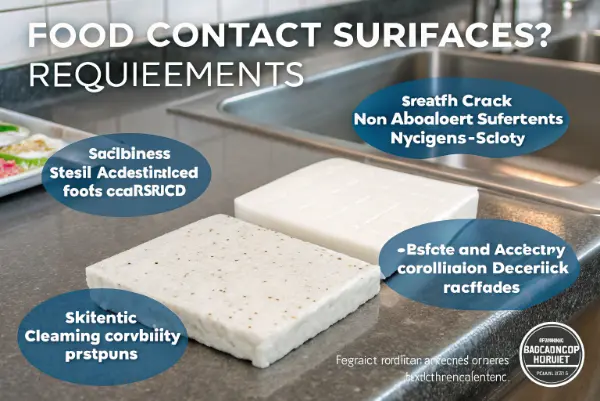
When we engineer a mold at CavityMold for a food-contact part, we are not just looking at dimensions. We are looking at the microscopic surface quality. The requirements for the surface are just as strict as the requirements for the chemical composition. If a surface is rough, it traps food particles. If it traps food, bacteria grow.
Here is what you need to consider from a design and molding perspective:
1. Surface Texture and Finish
The standard for food surfaces is usually a high polish or a very specific texture that is easy to clean.
- Avoid porous textures: Bacteria love pores. ABS is naturally non-porous, but poor molding parameters can cause voids.
- Draft Angles: You need good draft angles not just to get the part out of the mold, but to ensure the surface does not drag and create micro-scratches where germs hide.
2. Chemical Resistance
Food is chemically active. Tomato sauce is acidic. Curry has oils. Alcohol acts as a solvent.
- Acid Resistance: The surface must not degrade when exposed to vinegar or citrus.
- Fat Resistance: Oils can sometimes cause stress cracking in lower-quality plastics.
3. Thermal Stability
This is a big one for ABS. ABS softens at lower temperatures compared to PEEK or PSU.
- Usage Temperature: If the product goes in a dishwasher (around 80°C), standard ABS might warp. You might need a high-heat food-grade variant.
- Cycle Testing: The surface must survive repeated heating and cooling without crazing (developing fine cracks).
| Requirement | Why it Matters | Design Implication |
|---|---|---|
| Cleanability | Prevents pathogen growth. | Large radii on corners; no blind spots. |
| Inertness | Stops flavor transfer. | Use high-purity resin grades. |
| Durability | Prevents chips falling into food. | Optimize wall thickness for strength. |
What is FDA compliant for food contact?
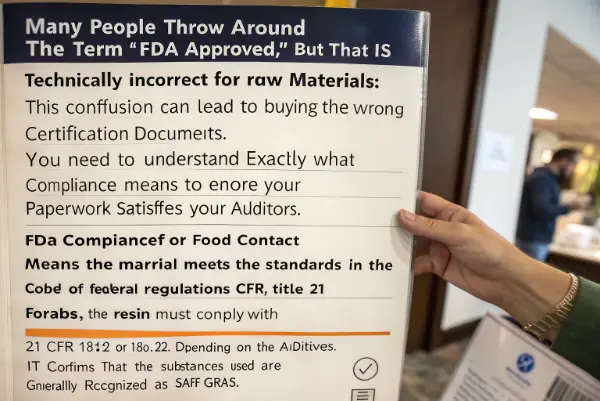
Many people throw around the term "FDA Approved," but that is technically incorrect for raw materials. This confusion can lead to buying the wrong certification documents. You need to understand exactly what compliance means to ensure your paperwork satisfies your auditors.
FDA compliance for food contact means the material meets the standards in the Code of Federal Regulations (CFR), specifically Title 21. For ABS, the resin must comply with 21 CFR 181.32 or 180.22, depending on the additives. It confirms that the substances used are Generally Recognized As Safe (GRAS).
This is where the paperwork gets heavy, but as a project manager, you have to get this right. The FDA (U.S. Food and Drug Administration) does not "approve" a specific spoon or bowl. They approve the substances used to make it.
When we source material for a client, we look for a "Letter of Guaranty" from the resin supplier. This letter states that the resin formulation aligns with specific sections of the FDA code.
Breaking Down 21 CFR for ABS
The Code of Federal Regulations is massive. For ABS, you are usually looking at:
- 21 CFR 177.1020: This covers Acrylonitrile/Butadiene/Styrene co-polymers.
- 21 CFR 177.1030: This covers Acrylonitrile/Butadiene/Styrene/Methyl Methacrylate.
- 21 CFR 177.1050: This covers Acrylonitrile/Styrene copolymer modified with butadiene/styrene elastomer.
It sounds confusing, I know. But basically, these codes dictate:
- Monomer Limits: How much residual acrylonitrile is allowed (usually extremely low, parts per billion).
- Extraction Limits: They simulate food contact using solvents (like alcohol or heptane) and measure what comes out of the plastic.
The "Food Safe" Symbol vs. Compliance
Just because you put a fork and glass symbol on a mold does not make it compliant. That symbol is a claim you make. The FDA compliance is the proof behind that claim.
Critical Thinking on Compliance:
It is not just the resin. Did you use a mold release spray? If that spray is not FDA compliant, your compliant ABS part is now contaminated. Did you use a recycled runner system? Regrind usage is strictly controlled in food contact applications. Usually, you cannot use more than a small percentage, or none at all, to guarantee traceability.
At CavityMold, we keep a "chain of custody" for these materials. We prove that the pellet that went into the hopper is the same pellet that the FDA paperwork describes.
What are the materials used in food contact?
You might decide after reading this that ABS is too much trouble. You are wondering what other options exist that might be cheaper or better. Comparing materials helps you make the right choice for cost, temperature resistance, and durability.
Common food-contact materials include Polypropylene (PP) for containers, Polyethylene (HDPE/LDPE) for cutting boards, and Polycarbonate (PC) for tough, clear bottles. ABS is chosen specifically when you need a high-gloss finish, high impact strength, and rigidity that softer plastics like PP or PE cannot provide.
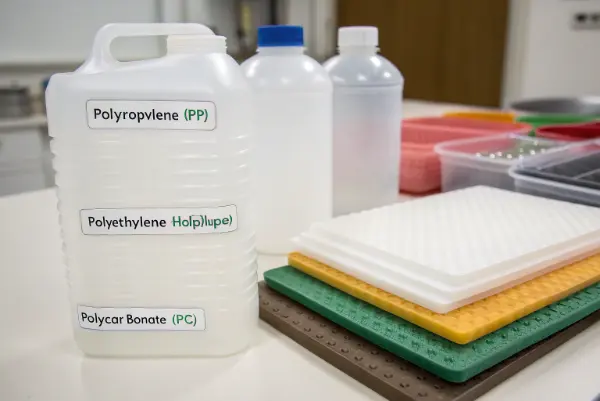
Choosing the right material is a balance of performance and safety. While we are focusing on ABS, it is helpful to see where it fits in the wider family of food-safe plastics. I often advise clients to switch materials if ABS is not strictly necessary, or to stick with ABS if they need that premium feel.
Here is a comparative analysis to help you decide:
1. Polypropylene (PP)
- Pros: Very resistant to chemicals, high melting point (dishwasher safe), inexpensive.
- Cons: It feels "cheap" or waxy. It is semi-transparent, not crystal clear. It is softer than ABS.
- Best for: Tupperware, yogurt cups, microwaveable containers.
2. High-Density Polyethylene (HDPE)
- Pros: tough, moisture resistant, very safe.
- Cons: Opaque (milky look), surfaces scratch easily, lower heat resistance than PP.
- Best for: Milk jugs, cutting boards, squeeze bottles.
3. Polycarbonate (PC)
- Pros: incredibly tough (bulletproof glass material), crystal clear.
- Cons: Contains BPA (Bisphenol A). Many countries have banned PC for baby bottles because of BPA concerns.
- Best for: Large water cooler bottles, industrial food housing.
4. Food Grade ABS
- Pros: Takes color beautifully, very shiny surface, rigid, feels high-quality in the hand.
- Cons: Not transparent (usually opaque), lower chemical resistance than PP, strict regulatory testing needed.
- Best for: Coffee machine housings, rigid kitchen tools, blender bases, high-end lunch boxes.
Material Selection Matrix
| Feature | PP | HDPE | PC | ABS (Food Grade) |
|---|---|---|---|---|
| Clarity | Hazy | Opaque | Clear | Opaque |
| Stiffness | Low | Medium | High | High |
| Heat Resist | High | Low | High | Medium |
| Cost | Low | Low | High | Medium |
| BPA Free? | Yes | Yes | No | Yes |
When Alex, a project manager I know, was designing a new electric pepper grinder, he initially wanted PC for clarity. But the BPA issue was a risk. He looked at PP, but it felt too flimsy. He settled on Food-Grade ABS for the body because it felt durable and looked premium, and he used a small acrylic window for visibility. It was the perfect compromise.
Conclusion
To summarize, ABS is safe for food contact only if you use certified food-grade resins that comply with FDA or EU regulations. You must design for smooth, cleanable surfaces and carefully select additives. While other plastics like PP or HDPE are common, ABS offers superior rigidity and finish for premium kitchen products.