
You have finished your ABS injection molding run, but the parts look unfinished. They are dull, scratch easily, and might fail under UV light. This is a common pain point for project managers. If you do not treat the surface correctly, you risk product failure and customer returns.
Surface treatment for ABS plastic involves applying physical or chemical processes to modify the surface properties. This includes techniques like painting, plating, and chemical smoothing to enhance aesthetics, durability, and UV resistance. The "safe" methods focus on processes that do not degrade the ABS chemical structure, ensuring the part maintains its structural integrity while gaining necessary protection.
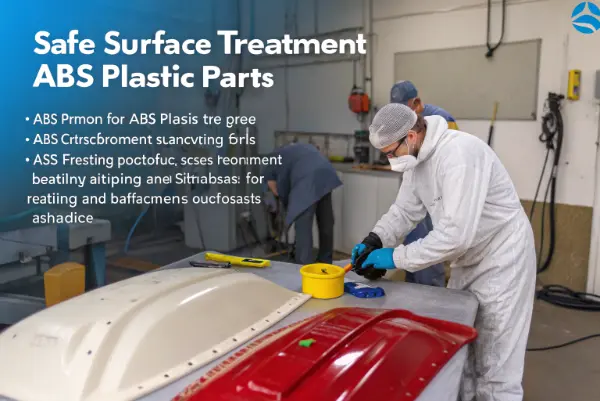
Choosing the right finish is not just about making the part look pretty. It is about function and longevity. In my years at CavityMold, I have seen perfectly molded parts ruined by incompatible solvents or poor coating choices. Let’s look at exactly how to treat these surfaces safely and effectively.
What is the surface treatment of plastic?
Plastic parts often come out of the mold with minor defects or a basic finish that doesn’t meet the final product requirements. You might see flow lines or a lack of texture. If you leave the plastic raw, it might look cheap or wear out too quickly in the hands of the user.
Surface treatment of plastic is a secondary manufacturing process used to alter the surface of a molded part. This can be additive (adding paint or plating), subtractive (polishing or sanding), or altering (chemical etching). The goal is to improve appearance, adhesion, hardness, or resistance to environmental factors like chemicals and sunlight.
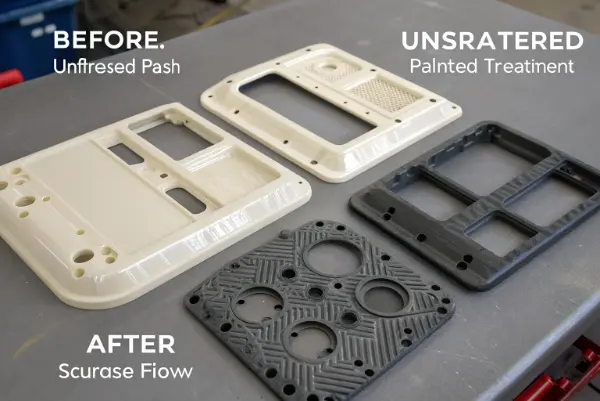
To understand surface treatment better, we need to break it down into categories. Not all plastics react the same way. ABS (Acrylonitrile Butadiene Styrene) is tough, but it is sensitive to certain solvents. Therefore, the "treatment" must be matched carefully to the material.
Physical vs. Chemical Treatments
When we talk about treating ABS, we generally look at two main paths:
| Treatment Type | Method | Description | Pros | Cons |
|---|---|---|---|---|
| Physical | Sanding/Polishing | Using abrasives to smooth the surface. | Cheap, easy to control. | Labor intensive, removes material. |
| Physical | Sandblasting | Shooting media at the part to create texture. | Uniform matte finish. | Can warp thin parts. |
| Chemical | Vapor Smoothing | Using Acetone vapor to melt the surface slightly. | Glossy, glass-like finish. | Dangerous fumes, loss of detail. |
| Chemical | Plating (Chroming) | Depositing metal layers onto the plastic. | Metallic look, conductive. | Expensive, complex process. |
Why do we treat surfaces?
- Aesthetics: This is usually the first reason. A raw injection molded part might have "knit lines" where plastic flows meet. Painting or texturing hides these marks.
- Adhesion: If you need to glue the part or print a logo on it, the surface energy might be too low. Treatments like plasma or corona treatment increase surface energy, allowing inks to stick.
- Protection: ABS degrades in sunlight. It turns yellow and gets brittle. A proper surface treatment acts as a shield against UV rays.
I remember a project we did for an outdoor sensor housing. The client wanted raw ABS to save money. We advised them against it. Six months later, the housings were cracking in the sun. We switched to a UV-resistant coating, and the problem was solved. This shows that surface treatment is an engineering necessity, not just a decoration.
What is the protective coating for ABS plastic?
ABS is a great material for indoor electronics, but it has a major weakness: it has poor resistance to weathering and chemicals. If you expose raw ABS to harsh environments, it will fail. You need a barrier that seals the plastic away from the elements.
A protective coating for ABS is a layer applied to the surface to shield the substrate from damage. The most common protective coatings are Polyurethane (PU) paints and Acrylic lacquers. These coatings provide excellent UV resistance, scratch protection, and chemical resistance, effectively extending the lifespan of the ABS part significantly.
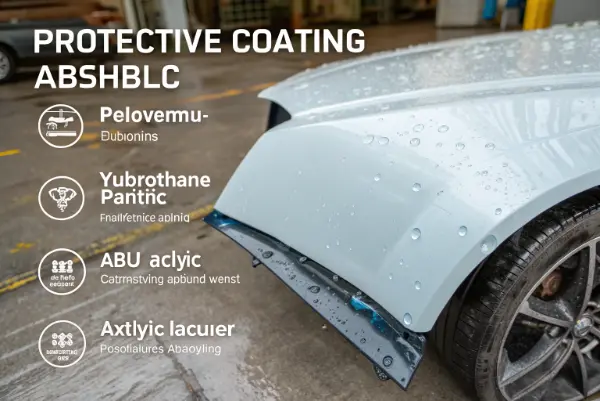
Selecting the right coating is critical. You cannot just grab any spray paint from the hardware store. Some paints contain solvents that will attack the ABS, causing stress cracking.
Types of Protective Coatings
Let’s dive deeper into the specific chemistries that work well with ABS.
1. Polyurethane (PU) Paint
This is the gold standard for many consumer electronics.
- Why it works: PU paints form a hard, durable skin. They are flexible enough to move with the plastic if it expands or contracts slightly.
- Application: It is usually a two-part system (paint plus hardener). It requires a clean environment to spray.
- Benefit: It offers the best balance of hardness and UV protection.
2. Acrylic Lacquer
This is often used for automotive parts or high-gloss finishes.
- Why it works: It dries fast and bonds very well to ABS without needing a harsh primer.
- Application: Easy to spray, but requires many thin coats.
- Benefit: It is easy to polish to a high shine.
3. UV-Cured Coatings
For high-volume production, this is a very efficient method.
- Why it works: The coating stays wet until it is hit with a UV light, then it hardens instantly.
- Application: Requires a specialized conveyor line with UV lamps.
- Benefit: extremely fast cycle times and very hard surfaces.
Critical Considerations for Coating ABS
When I work with clients on defining the coating specs, I always check three things:
- Solvent Sensitivity: ABS dissolves in acetone and is attacked by esters. The carrier solvent in your paint must be compatible. If the solvent is too "hot" (aggressive), it will eat into the surface. If it is too mild, it won’t bite into the surface for adhesion.
- Surface Preparation: You must remove mold release agents. These are oils sprayed into the mold to help the part pop out. If you paint over them, the paint will flake off. We use a washing process with isopropyl alcohol (IPA) to ensure the surface is chemically clean.
- Thickness: A coating that is too thick will ruin the dimensional accuracy of the part. If you have tight tolerances for assembly, a 50-micron paint layer might cause fitment issues. We always account for coating thickness in the mold design phase.
What is the best sealant for ABS plastic?
Sometimes you do not want to paint the whole part. Maybe you just need to seal a gap, or you want a clear coat to protect a specific area. If you use the wrong sealant, it will not stick, or worse, it will melt the plastic.
The best sealant for ABS plastic depends on the specific application, but generally, Silicone sealants and Polyurethane sealants are the top choices. Neutral-cure silicone is safe and flexible, while polyurethane sealants offer stronger adhesion and paintability. Avoid acetoxy silicones as the acetic acid can sometimes cause issues with sensitive additives in the plastic.
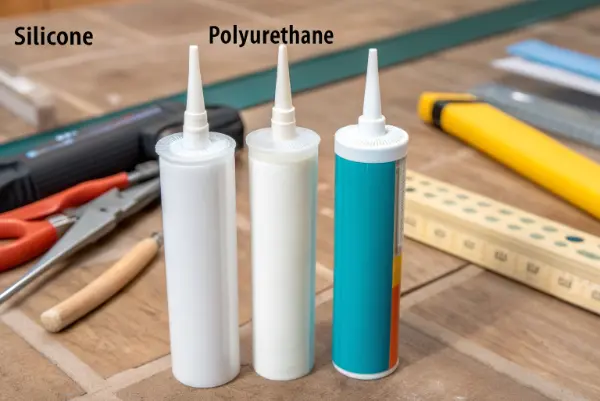
Defining the "best" sealant requires us to look at the environment the part will live in. Is it underwater? Is it under high heat?
Breaking Down Sealant Options
Here is a breakdown of common sealants and how they interact with ABS.
| Sealant Base | Compatibility with ABS | Best Use Case | Notes |
|---|---|---|---|
| Silicone (Neutral Cure) | Excellent | Waterproofing, outdoor gaskets. | Does not shrink much. Cannot be painted over. |
| Silicone (Acid Cure) | Poor/Risky | Bathrooms (Ceramic/Glass). | Smells like vinegar. The acid can attack metals or degrade plastics over time. |
| Polyurethane (PU) | Very Good | Structural sealing, high wear areas. | Very tough. Can be painted. Harder to apply than silicone. |
| MS Polymer | Good | General purpose construction. | A hybrid between silicone and PU. Good UV resistance. |
Why Adhesion Fails
I have seen projects fail because the sealant peeled right off the ABS. This usually happens for two reasons:
- Low Surface Energy: ABS has a relatively high surface energy compared to Polypropylene (PP), but it can still be tricky. The sealant needs to "wet out" the surface. If the sealant beads up like water on a waxed car, it won’t stick.
- Chemical Incompatibility: Some sealants contain plasticizers. These chemicals make the sealant flexible. However, these plasticizers can migrate out of the sealant and into the ABS. This can cause the ABS to soften or crack over time. This is called "plasticizer migration."
How to Ensure a Good Seal
To get the best result, follow this process:
- Abrade the Surface: Lightly sand the area where the sealant will go. This increases the surface area for the sealant to grab onto.
- Clean with IPA: As mentioned before, grease is the enemy. Clean it thoroughly.
- Use a Primer: For critical applications, like a waterproof electronics case, use a primer designed for plastics. It acts as a bridge between the ABS and the sealant.
We recently produced a handheld scanner case. The client used a cheap silicone to seal the lens. It fogged up the inside of the lens because of the off-gassing. We switched them to a high-grade, neutral-cure silicone, and the issue vanished. Quality materials matter.
Can you use epoxy on ABS plastic?
You might have a broken part or need to bond two ABS pieces together structurally. You reach for the epoxy resin on your shelf. But is this safe for the plastic, and will it actually hold the load?
Yes, you can use epoxy on ABS plastic, but it is not the most effective bonding agent for this specific material. While epoxy is strong, it is rigid, whereas ABS is slightly flexible. This mismatch can cause the bond to peel. For a permanent bond, solvent welding (like ABS cement) or cyanoacrylate (Super Glue) is often superior, but epoxy works for filling voids.
Epoxy is a thermoset plastic. Once it cures, it is hard as a rock. ABS is a thermoplastic. It can move and flex. This difference is the main challenge.
When to Use Epoxy vs. Solvent Weld
It is important to understand the mechanics of the bond.
Epoxy Bonding (Mechanical Bond)
Epoxy works by sticking to the surface roughness. It does not melt the plastic.
- Pros: It is great for filling gaps. If you have a large chip in a part, epoxy putty can rebuild it. It is chemically resistant.
- Cons: The peel strength is low on ABS. If you bend the part, the epoxy might pop off.
Solvent Welding (Chemical Bond)
This uses a solvent (like MEK or Acetone) to melt the surface of both ABS parts. When the solvent evaporates, the two parts become one single piece of plastic.
- Pros: The bond is as strong as the original material. It is seamless.
- Cons: It cannot fill large gaps. It is messy and the fumes are strong.
How to Make Epoxy Work on ABS
If you must use epoxy (perhaps for potting electronics inside an ABS case), you need to cheat the system.
- Flame Treatment: This is a technique we use in the factory. We pass a flame quickly over the ABS surface. It oxidizes the surface, increasing surface energy. This helps the epoxy wet out and stick much better.
- Roughing: You absolutely must sand the surface with 80-grit sandpaper. You need deep scratches for the epoxy to lock into.
- Flexibilized Epoxy: Look for epoxy formulations that are modified to be flexible. These are often sold as "plastic repair epoxies." They can absorb the thermal expansion and contraction of the ABS without cracking.
A Real-World Example
I once had a client trying to encapsulate a battery pack inside an ABS housing using standard rigid epoxy. During drop testing, the epoxy shattered and separated from the ABS walls. The battery rattled inside.
We changed the process. We sandblasted the inside of the ABS case to create texture. Then, we switched to a urethane-based potting compound instead of epoxy. Urethane bonds better to ABS and is flexible. The drop test results were perfect. This proves that while you can use epoxy, there is often a better tool for the job.
Conclusion
Treating the surface of ABS parts is a balance of chemistry and mechanics. Whether you are painting for UV protection, sealing for water resistance, or bonding for assembly, you must respect the material properties of ABS. Do not use aggressive solvents, always prepare the surface by cleaning and roughing, and choose flexible coatings that match the plastic’s nature. At CavityMold, we ensure every step, from the mold design to the final finish, is executed with precision. By following these safe methods, you ensure your products look professional and last for years in the field.