
Medical product failures are expensive and dangerous, and choosing the wrong material is often the root cause. You might feel overwhelmed by the strict regulations and confusing testing standards required for medical devices. We can simplify this process and help you choose the right Polyethylene (PE) material that meets safety standards.
USP Class VI PE materials are specific types of Polyethylene that have passed the most rigorous biological reactivity tests set by the United States Pharmacopeia (USP). These tests involve implanting the material into animal tissue to ensure it causes no toxic reaction. This certification is crucial for medical devices that will have direct, long-term contact with the human body.

I remember a project a few years ago where a client almost selected a standard industrial-grade PE for a surgical tool casing. They thought all PE was the same. We caught it just in time, but it highlighted a massive gap in understanding. In this article, I will walk you through exactly what USP Class VI means, why it matters for PE materials, and how it differs from FDA approval, so you can specify your next mold with total confidence.
What is a class VI material?
You need materials that won’t harm patients, but identifying "safe" plastics isn’t always straightforward. Without a clear classification system, you risk using biocompatible materials that fail under specific biological conditions. Understanding the specific tier of "Class VI" eliminates this risk and ensures patient safety.
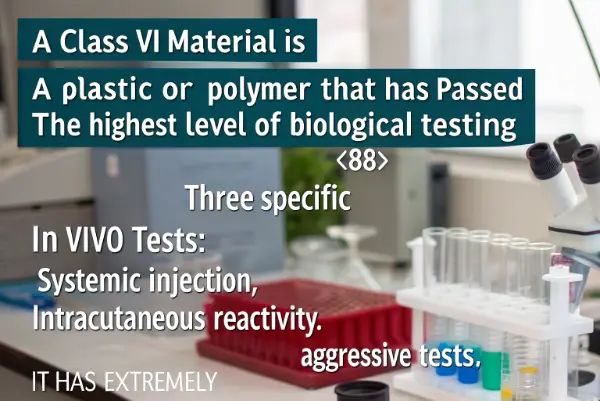
A Class VI material is a plastic or polymer that has passed the highest level of biological testing outlined in USP Chapter <88>. It involves three specific in vivo tests: systemic injection, intracutaneous reactivity, and muscle implantation. If a material passes these aggressive tests, it proves it has extremely low toxicity and is safe for direct bodily contact.
Let’s break this down further because "Class VI" gets thrown around a lot in our industry without people really knowing the details. The United States Pharmacopeia (USP) categorizes materials into six classes, from I to VI. Class I is the easiest to pass, and Class VI is the strictest.
When we talk about Class VI, we are talking about the "Gold Standard" for medical plastics. It is not just about the chemical composition on paper; it is about how the material behaves inside a living organism.
Here is a breakdown of the specific tests a material must pass to earn this title:
| Test Name | Purpose | Methodology Summary |
|---|---|---|
| Systemic Injection Test | Checks for toxic reactions in the whole body. | Extracts of the material are injected into mice or rabbits. The animals are observed for 72 hours for any abnormal signs or weight loss. |
| Intracutaneous Test | Checks for local irritation on the skin/tissue. | Extracts are injected just under the skin of rabbits. The injection sites are checked for redness or swelling over 72 hours. |
| Implantation Test | Checks reaction to direct tissue contact. | A sample of the actual solid material (not an extract) is implanted into the muscle tissue of a rabbit for at least 5 days (often up to 7 days). |
Why does this matter to you as a project manager? Because if your product datasheet says "USP Class VI," it means the raw resin supplier has already spent the money and time to prove the material is biologically inert. It saves you from guessing. However, keep in mind that processing the material—heating it, molding it, adding colorants—can sometimes change its properties. That is why at CavityMold, we always recommend verifying the final molded part, not just the raw pellet.
What are the USP class VI requirements?
Knowing a material is "Class VI" is good, but not knowing the specific criteria can still lead to compliance issues during audits. If you cannot explain the testing requirements to your quality assurance team, your project approval might get delayed. You need to know the specific conditions the material must survive.
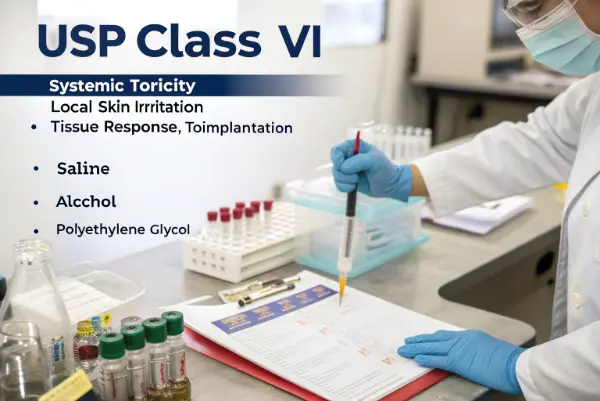
The requirements for USP Class VI certification mandate that the material shows no significant biological reaction in three key areas: systemic toxicity, local skin irritation, and tissue response to implantation. The material extracts used in testing must be prepared using specific solvents like saline, alcohol, and polyethylene glycol to ensure comprehensive safety checks.
We need to look closer at these requirements because the "solvents" part is often overlooked. When labs test these materials, they don’t just put a piece of plastic in an animal. They try to extract potential toxins out of the plastic using different liquids. This simulates how the body might react to the plastic in different environments (like blood, fat, or water).
The requirements are strict about temperature and time, too. The extraction usually happens at elevated temperatures (like 50°C, 70°C, or even 121°C) for a set number of hours. This stresses the material. If the PE material degrades and releases chemicals during this hot extraction, it fails.
Here are the critical success factors for meeting these requirements:
- Zero Toxicity Signs: In the Systemic Injection test, the animals must show no significantly greater reaction than the animals injected with a blank control solution.
- Minimal Irritation: In the Intracutaneous test, the average reaction score (erythema/edema) must not exceed the control sample average by more than 1.0.
- Capsule Formation: In the Implantation test, the macroscopic reaction (what you can see with the naked eye) around the implant site is evaluated. A "pass" means the tissue encapsulates the plastic cleanly without massive inflammation or necrosis (tissue death).
I have seen projects stall because the design team added a new colorant to a Class VI base resin. They assumed the mixture was still Class VI. It wasn’t. The new additive leached out during the solvent extraction test and caused a reaction. The requirement applies to the final formulation. If you change the recipe, you have to re-evaluate the requirements. This is why we are obsessed with material traceability at CavityMold.
What are the materials used in medical grade plastic?
You might assume all medical plastics are the same, but choosing the wrong polymer type for the wrong application leads to part failure. PE is just one option, and knowing where it fits among other medical-grade materials helps you optimize cost and performance. Selecting the right polymer family is the first step in the design process.
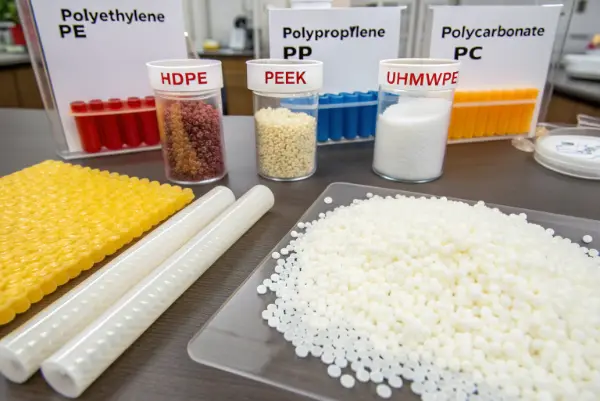
Medical grade plastics include a wide range of polymers such as Polyethylene (PE), Polypropylene (PP), Polycarbonate (PC), and PEEK. Specifically for PE, variations like HDPE (High-Density Polyethylene) and UHMWPE (Ultra-High Molecular Weight Polyethylene) are frequently used in implants and tubing due to their excellent chemical resistance and low friction properties.
Let’s focus specifically on Polyethylene (PE) within the medical context, as that is our main topic, but it helps to see where it sits in the broader family. Medical plastics are generally chosen based on three things: Sterilization capability, Mechanical strength, and Biocompatibility.
PE is a star performer because it is tough and very slippery (low coefficient of friction). This makes it amazing for things that move, like artificial joints.
Here is a comparison of common medical plastics we mold:
| Material | Key Property | Common Medical Use |
|---|---|---|
| LDPE (Low-Density PE) | Flexible and transparent. | Flexible tubing, IV bags, packaging films. |
| HDPE (High-Density PE) | Stiff and chemically resistant. | Pharmaceutical bottles, surgical implants, rigid containers. |
| UHMWPE | Extremely tough and wear-resistant. | Orthopedic implants (like hip and knee liners). |
| Polypropylene (PP) | High heat resistance (autoclavable). | Syringes, test tubes, surgical trays. |
| Polycarbonate (PC) | Clear and impact resistant. | Oxygenators, surgical instruments, housings. |
| PEEK | High performance, bone-like strength. | Spinal cages, dental implants (very expensive). |
When we mold PE for medical clients, we have to be very careful about shrinkage. PE shrinks a lot more than Polycarbonate. If Alex (that’s you!) designs a mold for PC and then switches to HDPE at the last minute to save money, the parts will be too small.
Also, consider sterilization. HDPE handles Gamma radiation well, but it can become brittle if the dose is too high. It handles Ethylene Oxide (EtO) gas very well. However, standard LDPE cannot handle the high heat of an autoclave (steam sterilization). It will melt. So, if your device needs to be steam-cleaned by a doctor, you usually cannot use basic PE; you might need PP or a specialized grade. Choosing the material is not just about "Class VI"; it is about the lifecycle of the product.
Is USP class VI FDA approved?
There is a common confusion that "USP Class VI" and "FDA Approved" are the same thing, which can lead to legal and compliance disasters. Thinking a Class VI certificate covers your FDA obligations is a dangerous mistake. You need to understand the distinct difference between a material standard and a regulatory clearance.
No, USP Class VI is not the same as FDA approval. USP Class VI is a testing standard for the biological safety of raw materials, while FDA approval is a regulatory clearance for a specific medical device or a material used in food contact. A material can be USP Class VI certified but still needs separate FDA validation for use in a finished medical device.
This is probably the most common question I get from junior engineers. They send me a datasheet and say, "It’s Class VI, so it’s FDA approved, right?" I always have to stop them there.
Think of it like this:
- USP Class VI is like a background check for the ingredient. It proves the plastic pellets are not toxic.
- FDA Approval (or 510(k) clearance) is a driver’s license for the car. It proves the final device works and is safe for the public.
The FDA does not actually "approve" materials in the way people think. They don’t have a list of "FDA Approved Plastics" for medical implants. Instead, the FDA reviews the entire device. When you submit your device to the FDA, you tell them, "I used this specific PE material." Then, you show them the USP Class VI test results to support your claim that the material is safe.
Here is a critical distinction regarding "FDA Compliance" you will see on datasheets:
- FDA 21 CFR 177.1520 (Food Contact): Many PE materials are listed as "FDA Compliant." This usually refers to food contact regulations. It means you can make a milk jug out of it. It does not automatically mean you can make a heart valve out of it.
- Device Master File (MAF): Some material suppliers submit a Master File to the FDA. This is a secret file with all the material’s details. If you use their material, you can ask the FDA to look at that file. This speeds up your device approval. This is much more valuable than just a "Class VI" label.
So, while USP Class VI is a requirement for many medical applications, it is not the final approval. It is a stepping stone. You need Class VI to get FDA clearance, but Class VI alone is not a "get out of jail free" card.
Conclusion
Selecting USP Class VI PE materials is vital for patient safety and regulatory success. We explored that Class VI represents the highest biocompatibility testing standard, involving systemic, intracutaneous, and implantation tests. Remember, while Class VI confirms material safety, it is distinct from final FDA device approval. CavityMold ensures your molds honor these strict material requirements.