
Is your latest food packaging project stuck because you are unsure about material safety regulations? You are not alone. Picking the wrong plastic can lead to recalls, lawsuits, and huge financial losses. This guide simplifies the complex world of FDA-approved polyethylene (PE) to keep your production safe and compliant.
FDA-approved PE materials for food contact are specific grades of polyethylene—such as HDPE, LDPE, and LLDPE—that meet the rigorous safety standards set by the U.S. Food and Drug Administration under 21 CFR 177.1520. These materials are certified to not leach harmful substances into food, making them safe for direct contact in applications like food containers, cutting boards, and packaging films.
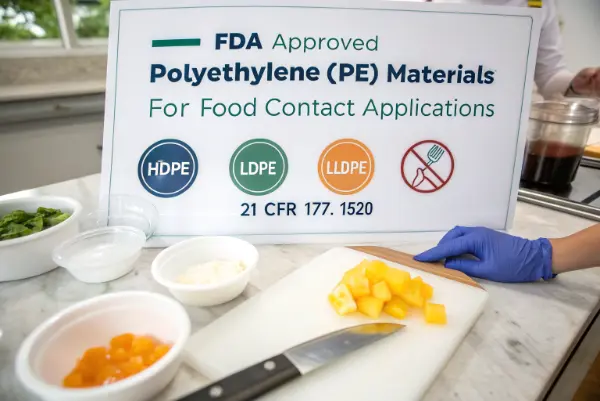
Navigating the landscape of food safety regulations can feel overwhelming, especially when you just want to get your mold into production. I remember a project a few years back where a client nearly used a standard industrial PE grade for a lunchbox line. It looked the same as the food-grade version, but it lacked the certification. We caught it just in time, but it highlighted how easy it is to make a mistake. In the following sections, we will break down exactly which materials you should use, what compliance really means, and how to verify everything before you cut steel for your molds.
What are the food contact materials?
You might look at a plastic spoon and just see plastic, but from a manufacturing perspective, the definition is much stricter. Are you confused about what actually counts as a "food contact material" (FCM)? Understanding this definition is the first step to ensuring your product is legal and safe for consumers.
Food contact materials are any materials that are intended to come into contact with food, including packaging, cutlery, processing equipment, and storage containers. These materials must be inert enough not to change the food’s composition or taste. Common examples include plastics (like PE and PP), rubber, metal, ceramics, and paper, provided they meet specific regulatory safety standards.
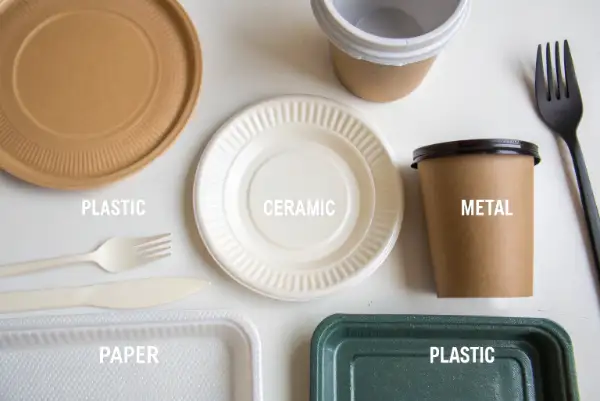
Let’s dig a little deeper into this. When we talk about Food Contact Materials (FCMs) in the molding industry, we are usually focusing on the interaction between the polymer and the food product. It is not just about toxicity; it is about migration. Migration is the transfer of chemical substances from the material into the food.
There are different categories we need to consider:
Categories of Food Contact
- Direct Contact: This is the most obvious one. Think of a cutting board, a soda bottle, or the inside layer of a chip bag. The food touches the plastic directly.
- Indirect Contact: This is often overlooked. It might be the outer layer of a box or a part of a machine that processes food but doesn’t hold it. Even these materials have regulations because substances can still migrate.
- Incidental Contact: This covers items that might briefly touch food by accident during processing.
Why does this matter for PE?
Polyethylene is the most common plastic in the world. However, industrial-grade PE might contain additives—like slip agents, antioxidants, or colorants—that are not safe for human consumption. If you use a generic PE for a food container, those additives can seep into the food. This is why we strictly categorize specific "grades" as FCMs.
| Material Type | Common Food Application | Key Property |
|---|---|---|
| HDPE | Milk jugs, cutting boards | Rigid, chemical resistant |
| LDPE | Squeeze bottles, bread bags | Flexible, transparent |
| LLDPE | Cling wrap, thin films | High puncture resistance |
When we design a mold at CavityMold, we always ask: "What is the food interaction?" If it is acidic food (like tomato sauce) or fatty food (like butter), the rate of migration changes. We need to select the PE grade that resists that specific environment.
Which material is recommended for food contact surfaces?
Choosing a material is not just about passing a test; it is about performance in the real world. Are you wondering which specific PE variant is the absolute best for surfaces like countertops, cutting boards, or conveyor belts? The answer depends heavily on durability and hygiene requirements.
For rigid food contact surfaces like cutting boards and processing tables, High-Density Polyethylene (HDPE) is the most highly recommended material. It offers excellent chemical resistance, does not absorb moisture, resists bacterial growth, and is durable enough to withstand knife cuts without dulling blades. It is the industry standard for commercial food preparation areas.
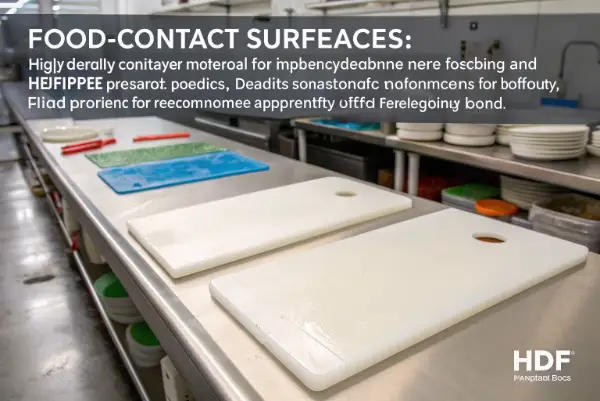
I have had many conversations with project managers like Alex who struggle to choose between HDPE and other plastics like Nylon or PP for surfaces. While Nylon is tough, it absorbs moisture. Moisture leads to bacteria. That is a nightmare for food safety audits. HDPE wins almost every time for solid surfaces because it is hydrophobic—it hates water.
Here is a breakdown of why we lean towards specific materials for surfaces:
1. High-Density Polyethylene (HDPE)
This is the workhorse. It is rigid and tough.
- Pros: It is very resistant to acids and bases. You can wash it with strong industrial cleaners without damaging the surface. It does not splinter easily.
- Cons: It has a lower heat tolerance than materials like Polypropylene (PP). You cannot put it in a high-temperature oven.
2. Low-Density Polyethylene (LDPE)
We rarely use this for rigid surfaces like cutting boards.
- Usage: It is too soft. If you cut on it, you will slice right through it.
- Best For: We recommend this for squeeze bottles or flexible lids, not work surfaces.
3. Ultra-High Molecular Weight Polyethylene (UHMW-PE)
This is the premium option.
- Performance: It has even better wear resistance than HDPE.
- Application: We use this for conveyor belt guides or chute liners in food factories where friction is high. It is more expensive, but it lasts longer in high-stress environments.
When you are designing a product, think about the cleaning cycle. Will the surface be steam cleaned? Will it be scrubbed with abrasive pads? HDPE stands up well to physical scrubbing. At CavityMold, we ensure the surface finish of the mold is polished correctly. A rough mold surface on an HDPE part creates microscopic valleys where bacteria can hide. We aim for a smooth finish to make cleaning easier for the end-user.
What is FDA compliant for direct food contact?
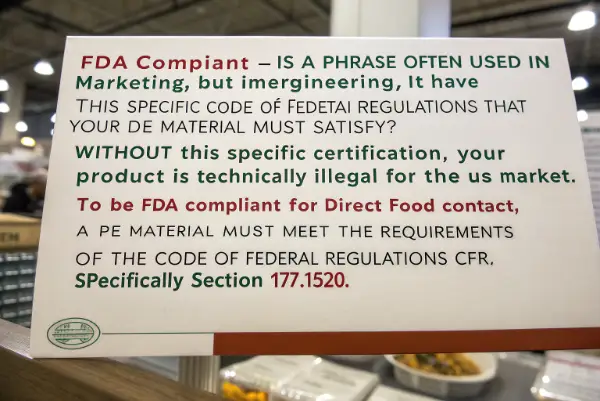
"FDA Compliant" is a phrase thrown around loosely in marketing, but in engineering, it has a precise legal meaning. Do you know the specific code of federal regulations that your PE material must satisfy? Without this specific certification, your product is technically illegal for the US market.
To be FDA compliant for direct food contact, a PE material must meet the requirements of Title 21 of the Code of Federal Regulations (CFR), specifically section 177.1520. This regulation dictates the allowable olefin polymers, the permitted additives, and the maximum extractable fraction limits in solvents like xylene and hexane.
I recall a situation where a customer wanted to use a "recycled" PE for a food container to be more sustainable. They claimed it was FDA compliant because the original source material was compliant. This is a dangerous trap. Once plastic is processed and recycled, it is no longer automatically compliant. The FDA has very strict rules about "No-Objection Letters" (LNOs) for recycled plastics. For virgin material, the rules are clearer, but strict.
Decoding 21 CFR 177.1520
This document is dense, but here are the parts you actually need to worry about as a buyer or designer:
- Base Resin: The polymer itself (ethylene) must be safe.
- Additives: This is where most failures happen. You might have a safe base resin, but if the manufacturer adds a UV stabilizer or a colorant that is not on the "GRAS" (Generally Recognized As Safe) list, the whole material fails compliance.
- Migration Tests: The material undergoes testing. They soak the plastic in solvents (simulating food) at various temperatures. If too much chemical "stuff" comes out of the plastic, it fails.
The Difference Between "Food Grade" and "FDA Compliant"
People use these interchangeably, but they are different.
- Food Grade: The material is suitable for food use. It is a general term.
- FDA Compliant: The material has legal standing in the USA.
Also, consider the "Conditions of Use." The FDA classifies how the plastic can be used.
- Condition A: High temperature heat sterilization (e.g., over 212°F).
- Condition C: Hot filled or pasteurized above 150°F.
- Condition E: Room temperature filled and stored.
If you pick a PE resin that is compliant for Condition E (room temp) but your customer puts it in the microwave or dishwasher, you might have a problem. The material might warp or leach chemicals at high heat. When we select a resin at CavityMold, we check the datasheet specifically for these conditions. We want to make sure the material matches the user’s lifestyle, not just the shelf storage.
How do I find a list of FDA approved products?
Finding the right resin feels like searching for a needle in a haystack. Do you know where to look to verify that the specific resin grade you want to use is actually on the approved list? Relying on a supplier’s verbal promise is risky; you need documentation.
You can find a list of FDA-approved food contact substances by searching the FDA’s "Inventory of Effective Food Contact Substance (FCS) Notifications" database on their official website. Additionally, resin manufacturers (like Dow, ExxonMobil, or Sabic) provide Regulatory Data Sheets (RDS) or Product Stewardship documents for each grade, explicitly stating compliance with FDA 21 CFR 177.1520.
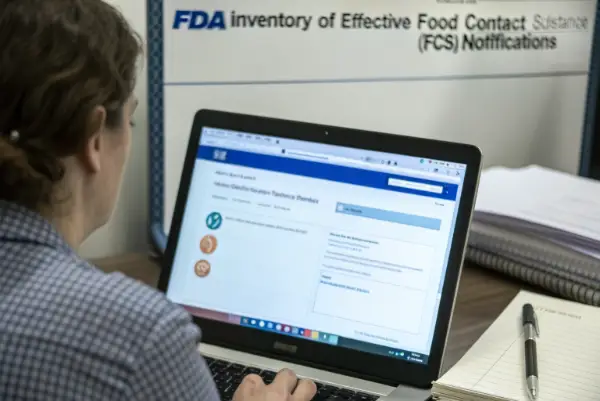
Checking these lists is a routine part of my job. I never trust a brochure. Marketing teams write brochures; lawyers and scientists write the Regulatory Data Sheets (RDS). I always tell my team: "Show me the RDS." If a supplier cannot produce a signed document stating FDA compliance within 24 hours, we switch suppliers. It is that simple.
Step-by-Step Verification Process
Here is how you can verify a material yourself:
- Ask for the CAS Number: Every chemical substance has a Chemical Abstracts Service number. This is more accurate than a trade name.
- Use the FDA Website: Go to the FDA.gov site. Search for "Food Contact Substance Notification." Enter the supplier’s name or the chemical name.
- Check the Supplier Datasheet: This is usually faster. Go to the resin manufacturer’s website. Look for documents labeled:
- Regulatory Data Sheet
- Product Stewardship Bulletin
- Statement of Compliance
Common Red Flags
When you are sourcing materials, watch out for these warning signs:
- "FDA Compliant Ingredients": This is tricky. A material can be made of compliant ingredients but manufactured in a dirty facility. You want the final product to be compliant.
- No Batch Consistency: Some cheaper suppliers might have one compliant batch and then change the formula slightly for the next one to save money. We stick to major global brands for food-contact PE because their consistency is reliable.
The Role of the Mold Maker
You might think this is just your problem, but it is our problem too. At CavityMold, we need to know the exact grade because different PE grades shrink differently. An FDA-grade HDPE might shrink more than a standard industrial grade. If we build the mold to the wrong shrinkage rate, your parts will be out of tolerance.
Furthermore, we have to ensure our process does not contaminate the material. We use food-safe mold release agents and lubricants on the machines when running FDA parts. If we use a standard industrial grease on the ejector pins and it touches your part, that FDA compliance is void. It is a chain of custody, and we take our link in that chain very seriously.
Conclusion
Choosing the right FDA-approved PE material is critical for safety and legal compliance. You must look for materials like HDPE or LDPE that meet 21 CFR 177.1520 standards. Always verify the specific resin grade through the supplier’s Regulatory Data Sheets and ensure your manufacturing partner understands the hygiene requirements. Safety starts with the right material choice.