
Are you struggling with inconsistent results when molding Polyethylene parts? Many project managers face warping, poor surface finishes, or cycle times that destroy profit margins. This usually happens because the unique shrinkage and flow properties of PE were ignored during the initial design phase.
Designing for Polyethylene (PE) injection molds requires specific attention to high shrinkage rates, adequate cooling systems, and proper gate placement. Because PE is a semi-crystalline material, it shrinks significantly (1.5% – 3.0%) as it cools. You must compensate for this in the tool design to maintain dimensional accuracy and prevent warping.
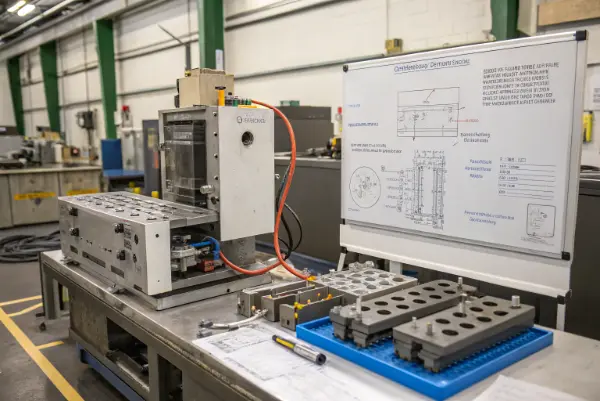
Getting the design right the first time is crucial. I remember a project a few years back where a client ignored cooling channel placement for a simple HDPE crate. The result was a cycle time that was double what they estimated, costing them thousands. Let’s look at how we can avoid those mistakes and master the specific needs of Polyethylene.
How does material shrinkage affect mold sizing?
Polyethylene is notorious for shrinking more than amorphous plastics, which can ruin your final dimensions if you aren’t careful. If you design the mold to the exact size of the final part, your product will come out too small every single time. This frustration is avoidable.
You must apply a shrinkage factor between 1.5% and 3.0% when designing the mold cavity for Polyethylene. High-Density Polyethylene (HDPE) typically shrinks more than Low-Density Polyethylene (LDPE). You need to calculate this specific percentage based on the exact grade of resin and apply it to the mold dimensions before cutting steel.
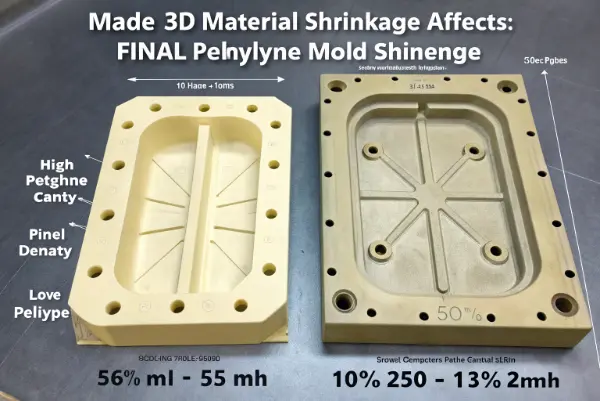
Let’s dig deeper into this because shrinkage is the biggest killer of PE projects. Polyethylene is a semi-crystalline polymer. This means when it cools down, its molecular chains organize themselves very tightly. This tight organization causes a reduction in volume.
If you are used to working with ABS or Polycarbonate, which might shrink 0.5%, PE will surprise you. The shrinkage isn’t always uniform, either. It shrinks differently in the direction of the flow compared to across the flow. This anisotropic shrinkage leads to warping if your wall thickness varies too much.
When I work on a design at CavityMold, I always check the specific data sheet from the material supplier. Generic "PE" numbers aren’t good enough. Here is a quick breakdown of how different types generally behave:
| Material Type | Typical Shrinkage Rate | Common Application | Key Design Adjustment |
|---|---|---|---|
| LDPE | 1.5% – 2.0% | Squeeze bottles, lids | Less compensation needed, but watch for flash. |
| LLDPE | 1.5% – 2.5% | Flexible tubing, buckets | Needs careful ejection design due to flexibility. |
| HDPE | 2.0% – 3.0% (sometimes 4%) | Crates, structural parts | Needs aggressive cooling to control crystallization. |
You also need to consider the packing pressure. Higher packing pressure can reduce shrinkage slightly, but it increases internal stress. Therefore, the mold design must allow for uniform wall thickness. If one section is thick and another is thin, they will cool and shrink at different rates. This differential shrinkage pulls the part out of shape. Always keep walls uniform.
Why is cooling system design critical for Polyethylene?
Heat retention in the mold is the primary enemy of cycle time and part stability in PE molding. If your cooling channels are poorly placed or too small, the semi-crystalline structure won’t form correctly. This leads to parts that warp immediately after ejection.
You need to design aggressive cooling circuits that cover as much of the mold surface as possible, especially in thick areas. Because Polyethylene has a high specific heat, it holds onto heat energy longer than other plastics. Efficient cooling channels reduce crystallization variance, which keeps the part flat and shortens the cycle time.
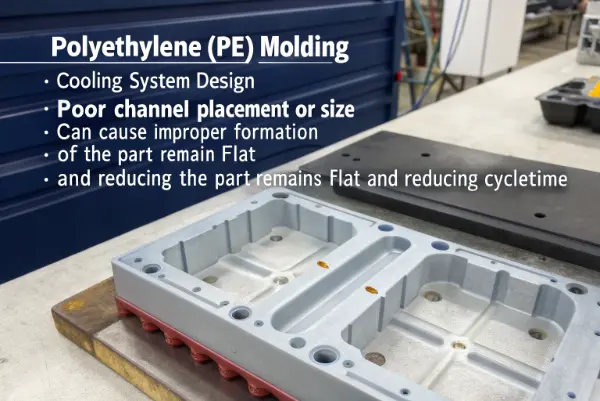
Cooling is where you make or lose money on a PE mold. Since Polyethylene needs to remove a lot of heat to solidify, "standard" cooling layouts often fail. I have seen molds where the cooling lines were just straight drills through the mold base, far away from the cavity. The result? The cycle time was 45 seconds when it should have been 20.
We need to use conformal cooling or very strategic baffles and bubblers. The goal is to keep the mold surface temperature uniform. If one side of the mold is hot (say, 50°C) and the other is cold (20°C), the plastic crystals will grow differently. The side with larger crystals (the hot side) will shrink more. This creates internal stress that bends the part toward the hotter side.
Here is a checklist I use when reviewing cooling designs for PE:
- Channel Diameter: Use larger channels (at least 10mm-12mm) to ensure turbulent flow. Turbulent water grabs heat much faster than smooth, laminar flow.
- Distance to Cavity: Keep water lines as close to the molding surface as structurally safe (usually 1.5x the channel diameter).
- Circuit length: Keep circuits short. If water travels too far, it gets hot by the end of the loop, and you lose cooling efficiency.
- Beryllium Copper: For deep cores or corners where water can’t reach, use Beryllium Copper inserts. They transfer heat 3 to 4 times faster than tool steel.
By controlling the temperature, you control the crystallinity. By controlling the crystallinity, you control the dimensions.
What type of gate works best for PE materials?
Choosing the wrong gate type can cause ugly surface marks, high stress near the entry point, or difficulty in filling the part. Some designers treat gates as an afterthought, but for PE, the high viscosity sensitivity means the gate location dictates the flow pattern.
You should generally use larger gates for Polyethylene compared to free-flowing materials like Nylon to allow for rapid filling and proper packing. Edge gates and direct sprue gates are common, but hot runner systems are often the best choice for PE to eliminate waste and improve cycle speeds. The gate location must ensure flow is unidirectional.
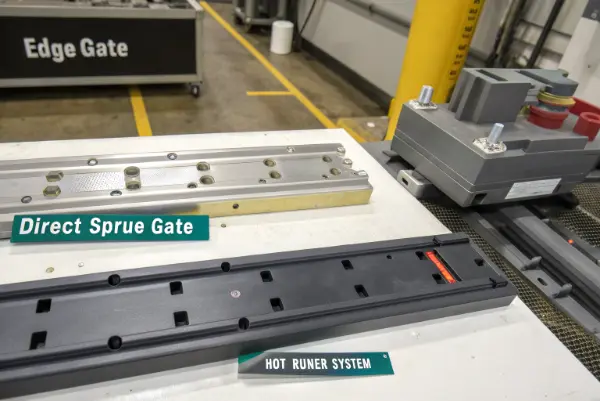
The gate is the doorway for the plastic. If the door is too small, you have to push very hard to get the material in. This "push" creates shear heat. While PE is tough, excessive shear can degrade the material or cause jetting, where a snake-like stream of plastic shoots into the cavity and looks terrible.
For Polyethylene, I prefer using Hot Runner systems whenever the budget allows. PE is very stable thermally, so it sits well in a hot manifold without burning. A hot tip gate right onto the part eliminates the runner waste. Since PE is a commodity material often used for high-volume parts (like caps or containers), saving that scrap material adds up to huge savings over a year.
If you must use a cold runner, consider these factors:
- Gate Location: Place the gate at the thickest section of the part. Plastic flows from thick to thin. If you gate at a thin section, the material will freeze off before you can pack out the thick sections, leading to sink marks.
- Venting: Because we fill PE fast, the air needs to escape fast. Place vents at the end of the flow path. If the air gets trapped, it gets compressed and burns the plastic (diesel effect).
- Gate Size: A small gate freezes too quickly. You need the gate to stay liquid long enough to "pack" the part to compensate for that 2% shrinkage we talked about earlier. If the gate freezes early, shrinkage takes over and the part pulls away from the mold walls.
I often advise clients to use "Submarine Gates" or "Tunnel Gates" for automatic degating, but only if the PE grade is flexible enough to shear off cleanly without leaving a vestige that interferes with assembly.
How do you manage ejection to prevent deformation?
Polyethylene is soft and flexible, especially right after the mold opens. If your ejection system pushes too hard in one spot, the ejector pins will punch right through the part or leave deep white stress marks. This ruins the aesthetic and structural integrity.
You must design an ejection system with a large surface area, using stripper plates or air poppets instead of just standard pins. Because warm Polyethylene is soft, standard pins can pierce the part. Air ejection is particularly effective for PE buckets or containers to break the vacuum seal without mechanical force.
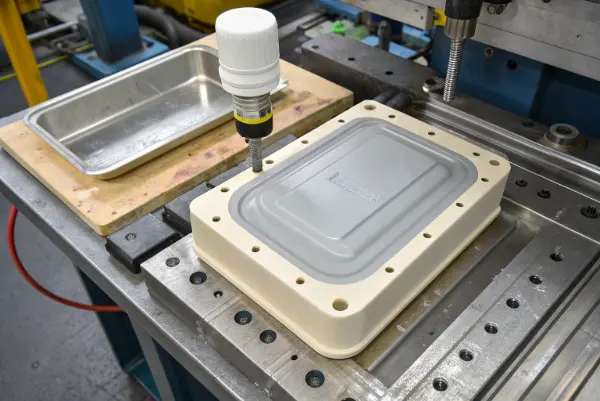
This is a classic problem with PE. You open the mold, the part is still 80°C, and it feels like rubber. If you use small 3mm pins to push it out, those pins act like needles. I have seen parts where the pins pushed halfway through the plastic wall, creating "white stress marks" that customers hate.
To fix this, we need to spread out the force. Here are the methods I recommend for PE:
- Stripper Plates: This is the best method for round parts or caps. The entire ring around the part lifts up. It pushes on the edge of the part, which is usually the strongest area. This applies force 360 degrees around the part, so there is zero distortion.
- Air Poppets: For deep draw parts like trash cans or buckets, a vacuum forms between the steel and the plastic. You can’t pull it off easily. We pump compressed air between the core and the part. This breaks the vacuum and gently blows the part off the core.
- Large Flat Pins: If you must use pins, use the largest diameter possible. Or use "blade ejectors" on the ribs. The goal is to lower the "PSI" (Pounds per Square Inch) of force on any single point of the plastic.
Draft angles are also part of ejection. PE is sticky. It tends to shrink onto the core. You need generous draft angles (at least 1 degree, preferably 2 degrees) to help the part release. If the draft is too shallow, the ejection system has to fight the friction, and the soft PE part will lose that fight every time. Texturing the mold surface can also help break the vacuum, but ensure the texture is drafted correctly so it doesn’t create an undercut.
Conclusion
Designing molds for Polyethylene requires mastering shrinkage rates, aggressive cooling, proper gating, and gentle ejection. By respecting the semi-crystalline nature of PE and its soft properties when warm, you can avoid warping and ensure consistent, high-quality production runs. Precision in the design phase prevents headaches on the factory floor.