
Safety incidents can ruin production schedules and damage your reputation overnight. You face pressure to deliver quality parts quickly, but rushing often leads to overlooked hazards. Ignoring safety protocols in Polyethylene (PE) molding puts your team at risk and threatens the long-term viability of your projects.
Safe manufacturing practices for PE injection molding involve comprehensive temperature control to prevent material degradation, strict ventilation protocols to manage fumes, and rigorous machine guarding. It also requires regular maintenance of hydraulic systems and proper PPE usage to protect operators from high heat and pressure hazards typical in processing polyethylene.
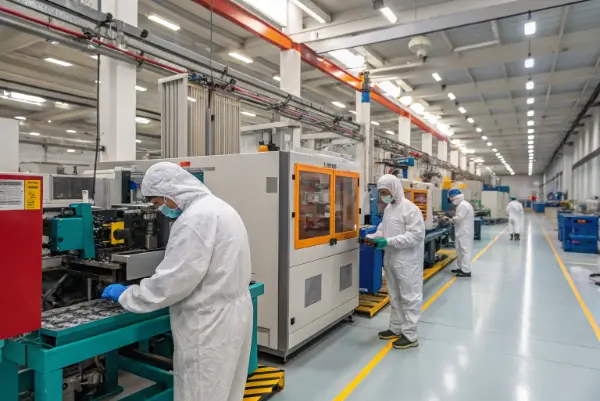
It is easy to think safety is just common sense. But in my years at CavityMold, I have seen even experienced teams make small mistakes that lead to big problems. We need to look closer at the specific risks of PE molding and how to manage them effectively.
How Can Temperature Control Prevent Safety Hazards?
Overheating Polyethylene can lead to dangerous pressure buildups and harmful gas emissions. If you do not monitor your barrel temperatures precisely, you risk material degradation that compromises part quality and operator safety. This instability can turn a standard run into a hazardous situation very quickly.
Temperature control prevents safety hazards by maintaining the polymer within its stable processing window, usually between 180°C and 280°C for PE. Proper thermal management prevents the release of volatile gases caused by decomposition and eliminates the risk of "blowback" or nozzle explosions due to excessive internal pressure buildup.
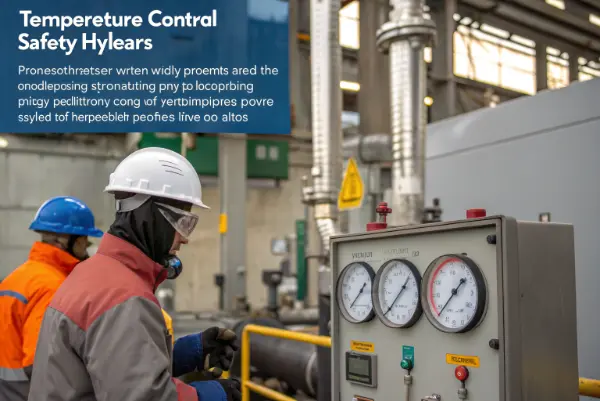
We need to understand that temperature is not just about melting plastic. It is about chemical stability. When I started in this industry, I once saw a nozzle leak because the heat profile was wrong. It was a scary moment. Since then, I treat temperature control as a safety feature, not just a quality feature.
Breaking Down Thermal Risks
When we talk about PE, we are dealing with a material that is generally stable. However, "stable" does not mean "invincible." When the temperature spikes, the molecular chains break down. This creates gases. In a closed barrel, gas equals pressure.
Here is a breakdown of what happens at different temperature stages:
| Temperature Stage | Material Behavior | Safety Risk | Corrective Action |
|---|---|---|---|
| Below 180°C | Material is too viscous (thick). | High injection pressure needed; risk of hydraulic hose burst. | Increase heater band temperature gradually. |
| Optimal (190°C – 260°C) | Smooth flow, stable melt. | Minimal risk; standard operation. | Monitor thermocouples regularly. |
| Above 280°C | Material degradation begins. | Fumes released; possible discoloration. | Reduce barrel heat; purge material immediately. |
| Above 300°C | Severe decomposition. | Explosion risk; toxic smoke. | Emergency stop; evacuate area; ventilate. |
Critical Thinking on Thermal Safety:
You must install redundant monitoring systems. Do not rely on a single thermocouple. If one sensor fails, the machine might keep heating until disaster strikes. At CavityMold, we use dual-loop control systems. This ensures that if the primary sensor reads low erroneously, the secondary sensor catches the overheat condition and shuts down the heater bands.
Also, consider residence time. Even at the right temperature, if PE sits in the barrel too long, it degrades. This is heat history. You must size your shot capacity correctly. If you are using a machine with a 500g capacity for a 50g part, the plastic sits in the heat too long. This degrades the material and increases safety risks.
Why Is Proper Ventilation Critical for PE Molding?
Fumes from heated plastic can cause respiratory issues and long-term health problems for your workforce. Even though PE is considered less toxic than PVC, processing it still releases volatile organic compounds (VOCs). Without proper airflow, these invisible dangers accumulate in the factory floor environment.
Proper ventilation is critical because it removes thermal decomposition byproducts and potential additives that off-gas during the melting phase. Effective local exhaust ventilation (LEV) at the nozzle and mold open areas captures fumes at the source, ensuring air quality meets occupational health standards and keeps operators healthy.
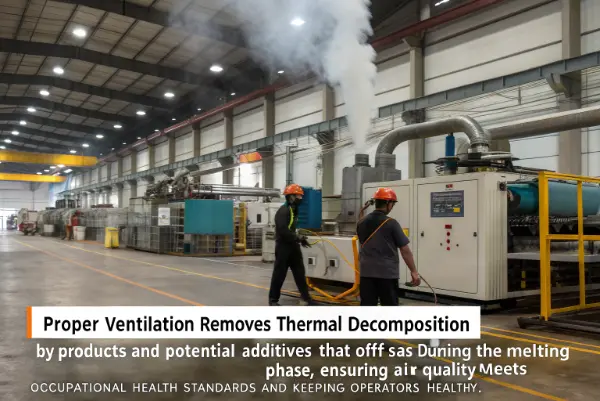
I remember walking into a shop floor years ago that had a distinct "waxy" smell. That smell was airborne PE particles. It seemed harmless at the time, but the operators complained of headaches. We installed direct extraction hoods the next week. The air cleared, and the headaches stopped.
The Hidden Dangers of "Safe" Plastics
Many people think Polyethylene is safe because it is used in food containers. But manufacturing is different from end-use. When you melt PE, you might also be melting additives. These include:
- Colorants
- Stabilizers
- Flame retardants
These additives can release toxic fumes even if the base PE does not.
Ventilation Strategies
We need a layered approach to air quality. Relying on open windows is not enough.
Source Capture (The Gold Standard):
This means placing a suction hood directly over the nozzle and the clamping unit. When the mold opens, the hot plastic releases gas. The hood catches it immediately. This is the most effective method.General Dilution:
This involves large fans exchanging the air in the whole room. It helps, but it is not a complete solution. It just spreads the fumes out before removing them.Maintenance of Filtration:
A ventilation system is only good if the filters are clean. Clogged filters reduce airflow. I recommend a monthly check of all HVAC systems in the molding area.
Checklist for Air Quality:
- Are hoods positioned within 12 inches of the emission source?
- Is the airflow velocity sufficient to capture vapors (usually 100-150 fpm)?
- Are make-up air units bringing in fresh air to replace what is exhausted?
If you ignore this, you lower team morale and invite health inspections. It is a simple investment that pays off in worker health.
What Mechanical Safeguards Are Necessary?
Injection molding machines exert tremendous clamping force that can crush limbs in an instant. If you bypass safety gates or ignore sensor failures, you are inviting catastrophic injuries. Mechanical safeguards are the physical barrier between a human and tons of steel closing at high speed.
Mechanical safeguards, specifically interlocked safety gates, are necessary to stop the machine cycle instantly if an operator accesses the mold area. These systems must include redundant electrical, hydraulic, and mechanical stops to ensure that the clamping unit cannot close while a person is interacting with the machine.
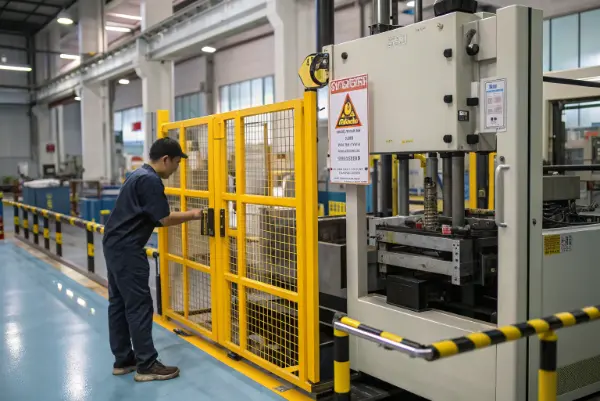
Safety gates are non-negotiable. I have seen operators try to bypass them to "speed up" a stuck part removal. This is a fireable offense in my book. We cannot trade fingers for cycle time. The machine must be smarter than the operator in this regard.
The Three Layers of Protection
A standard injection molding machine should have three distinct safety interlocks. If one fails, the others must work. This is the "Safety in Depth" principle.
Electrical Interlock:
When the gate opens, a switch breaks the control circuit. The computer knows the gate is open and forbids the "close mold" command.Hydraulic Interlock:
This is a valve. When the gate opens, this valve physically blocks the oil flow to the clamp cylinder. Even if the computer malfunctions and says "close," the oil cannot get there.Mechanical Safety Bar (The Drop Bar):
This is a physical metal bar. It drops between the platens when the gate opens. If the hydraulic and electrical systems both fail and the mold tries to close, the moving platen hits this bar and stops. It is a brute-force safety measure.
Understanding Kinetic Energy Risks
It is not just the closing mold. It is the injection unit too. The nozzle moves forward to touch the mold (sprue bushing). This is a pinch point. There should be a guard here too.
Also, consider the robot. If you use automated pickers, they move fast. They need their own fencing. A robot arm hitting a person can cause severe blunt force trauma.
Table: Machine Guarding Zones
| Zone | Hazard | Required Safeguard |
|---|---|---|
| Mold Area | Crushing (Clamping force). | Interlocked sliding gate (front and rear). |
| Nozzle Area | Burning / Pinching. | Fixed or interlocked metal shield. |
| Ejector System | Pinching. | Coupling guard (prevents access to coupling rods). |
| Material Hopper | Falls / Burns. | Railings on platforms; lids on hoppers. |
Regularly test these stops. At CavityMold, we test the "Emergency Stop" buttons and gate interlocks at the start of every shift. It takes two minutes, but it ensures everyone goes home safe.
How Do You Manage Hydraulic Pressure Safety?
High-pressure hydraulic lines can burst and cause injection injuries or massive fires. If you fail to inspect hoses and fittings regularly, you risk a catastrophic system failure. Hydraulic fluid is hot and under pressure, making it one of the most volatile elements in the molding shop.
You manage hydraulic pressure safety by conducting routine inspections of all hoses, seals, and fittings for wear or leaks. Using burst-protection sleeves on hoses and ensuring pressure relief valves are calibrated correctly prevents system over-pressure and contains hazardous fluid sprays in the event of a line rupture.
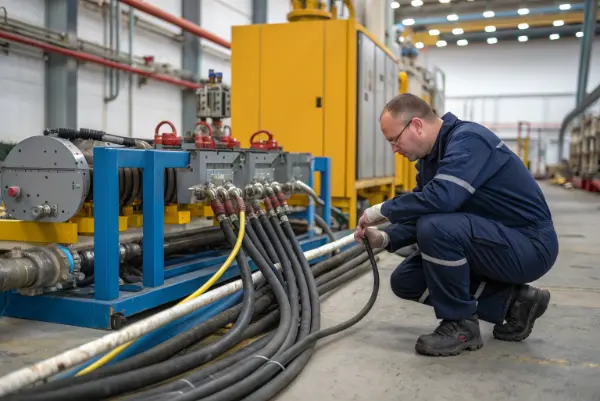
Hydraulic leaks are messy, but "injection injuries" are the real nightmare. This happens when a pinhole leak shoots a thin stream of oil at high pressure. It can pierce skin like a needle. It looks like a small cut, but the oil poisons the tissue underneath. It requires immediate surgery.
Maintenance is Safety
We often view maintenance as a way to keep machines running. We need to view it as a way to keep people safe. A worn hose is a ticking time bomb.
Key Inspection Points:
- Abrasion: Look for hoses rubbing against metal frames. The outer rubber wears down, exposing the wire mesh. Once the mesh is exposed, the hose must be replaced.
- Hardness: Hoses should have some flex. If they feel rock hard or crack when you squeeze them, heat has destroyed the rubber. Replace them.
- Leaks: Never use your hand to search for a leak while the machine is on. Use a piece of cardboard. If oil hits the cardboard, you found the leak without injecting oil into your hand.
Fire Safety and Hydraulics
Hydraulic oil is flammable. If a hose bursts and sprays oil onto a hot heater band (remember, they are 200°C+), you have an instant fire.
Strategies to Mitigate Fire Risk:
- Shielding: Put metal covers over the barrel heater bands. This prevents oil spray from hitting the ignition source.
- Fire-Resistant Fluids: Consider using glycol-based fluids instead of mineral oil. They are more expensive but much harder to ignite.
- Cleanliness: A dirty machine hides leaks. Keep the machine pit and frame clean. If you see a puddle, you know you have a new problem.
At CavityMold, we treat the hydraulic system with respect. We change hoses on a schedule, not just when they break. This preventative approach saves downtime and prevents accidents. Safety is not an accident; it is a choice we make every day.
Conclusion
Manufacturing safety in PE injection molding requires a disciplined approach to temperature, ventilation, mechanical guarding, and hydraulics. By respecting the limits of the material and the power of the machinery, we protect our most valuable asset: our people. Consistent vigilance ensures production stays efficient and accident-free.