
Are you managing a product launch and find the technical jargon of injection molding a bit overwhelming? This complexity can lead to costly miscommunications with suppliers and derail your project timeline. This guide breaks it all down, giving you the fundamental knowledge to confidently lead any molding project.
Understanding injection molding involves knowing the mold’s key parts, like the A and B sides, and the core process. The process has four main stages: clamping, injection, cooling, and ejection. Mastering these fundamentals helps ensure your plastic parts are made correctly, on time, and within budget. This outline provides a clear map of the entire process from start to finish.
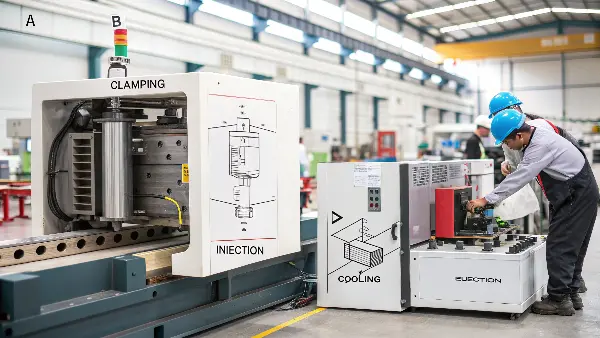
Now that you have the big picture, let’s explore the details. This is where projects either succeed or fail. The first critical element to understand is the mold itself, as it is the foundation for everything that follows. So, let’s start by breaking down the anatomy of the tool that makes it all possible.
What are the parts of the injection mold?
You often hear technical terms like "sprue," "runner," and "gate" in meetings. Not being completely sure how they all connect can make it difficult to have detailed discussions with your manufacturing partners. This uncertainty can lead to misunderstandings that affect mold design and final part quality. Let’s demystify the mold by breaking down its essential components.
An injection mold is a precision tool with several key parts. It includes the cavity and core, which form the part’s final shape. A feed system, comprising the sprue, runners, and gates, guides molten plastic into the cavity. Once the part solidifies, an ejector system pushes it out. Other vital components are the mold base, cooling channels, and alignment pins, all working together for consistent production.
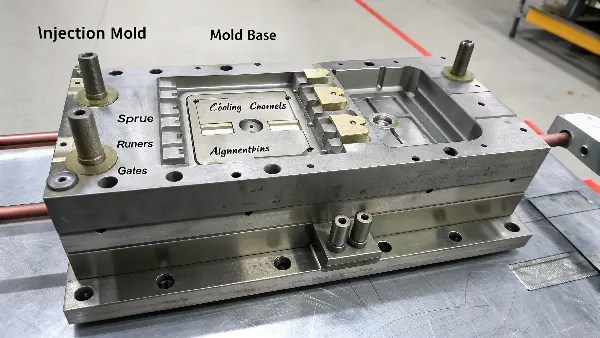
As a project manager, you don’t need to be a mold designer, but knowing the main components helps you ask the right questions. At CAVITYMOLD, we believe an informed partner is a great partner. Let’s look at the function of each part so you can communicate your project needs more effectively.
The Anatomy of a Mold Tool
The mold is more than just a block of steel; it’s a sophisticated assembly where every component has a specific job. Think of it as a high-precision puzzle.
- The Mold Base: This is the foundation that holds all other components together. It’s the steel frame that gets mounted onto the injection molding machine.
- Cavity and Core: These are the heart and soul of the mold. The cavity is the fixed half that typically forms the exterior, cosmetic surface of your part. The core is the moving half that forms the interior features. When they come together, they create the space your part is formed in.
- Feed System: This is the pathway for the molten plastic. It starts with the sprue, where plastic enters from the machine’s nozzle. The plastic then travels through runners, which are channels cut into the steel, until it reaches the gates—the precise openings into the cavity.
- Ejector System: Once the part is cool, it needs to be removed. The ejector system, which includes ejector pins, pushes the finished part out of the core half of the mold.
- Cooling System: Channels are drilled through the mold plates to allow a coolant (usually water) to circulate. Efficient cooling is critical for reducing cycle time and preventing part defects.
| Component | Primary Function |
|---|---|
| Mold Base | Provides the structural frame for all other parts. |
| Cavity & Core | Together, they form the final shape of the plastic part. |
| Feed System | Delivers molten plastic from the machine to the cavity. |
| Ejector System | Pushes the finished, cooled part out of the mold. |
| Cooling System | Regulates mold temperature for consistent part quality. |
Understanding these parts helps you pinpoint potential issues in discussions about part design or production challenges.
What is the A and B side of a mold?
You’re in a DFM (Design for Manufacturability) review and the engineers keep mentioning the "A-Side" and "B-Side." You nod along, but what do these terms really mean for your part? Confusing the two can lead to design flaws where cosmetic surfaces have unwanted marks from ejector pins. Let’s clarify this simple but crucial concept.
The "A-Side" of an injection mold is the stationary half, also known as the cavity side, which typically forms the cosmetic or exterior surface of the part. The "B-Side" is the moving half, also called the core side. It usually forms the interior, functional features of the part and houses the ejector system, which pushes the finished part out after it has cooled.
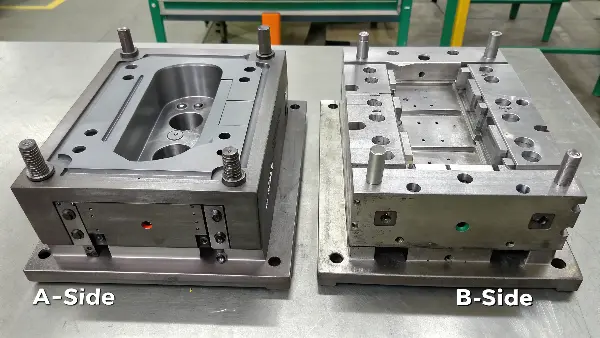
Understanding the distinction between the A and B sides is fundamental to good part design. When you design a new component, you have to decide which features go on which side. For example, any text, logos, or smooth finishes you want on the outside of a product’s casing should almost always be on the A-Side. This is because the B-Side contains the ejector pins, which can leave small, circular marks on the part’s surface.
A-Side vs B-Side: More Than Just Halves
The division of a mold into an A-Side and a B-Side is driven by the mechanics of the injection molding machine. The A-Side attaches to the fixed platen of the machine, where the nozzle injects the plastic. The B-Side attaches to the moving platen, which pulls away to open the mold and allow for part ejection.
Let’s break down their typical roles:
A-Side (Cavity Side):
- Stationary: It remains fixed during the molding cycle.
- Cosmetic Focus: Often forms the "show" surface of the part—the side the end-user will see and touch. Textures and polished finishes are typically applied here.
- Sprue Connection: The sprue bushing, where plastic first enters the mold, is located on this side.
B-Side (Core Side):
- Moving: It pulls away from the A-Side to open the mold.
- Functional Focus: This side usually forms the internal, structural features of the part, such as ribs, bosses, and snaps.
- Houses Ejection: The ejector system is built into the B-Side. When the mold opens, the part sticks to the core on this side, allowing the pins to push it out cleanly.
When I first started in this industry, I remember reviewing a design for a simple electronics enclosure. The logo was mistakenly placed on the B-Side. During the prototype run, we found small ejector pin marks right in the middle of the company brand. It was a simple mistake, but it cost us time and money to correct the mold. That lesson taught me to always confirm part orientation with our clients. For a project manager like you, verifying which side is which during the design phase is a simple check that can prevent major headaches later.
What are the four stages of injection molding?
You’ve approved a mold design, but now you need to understand the production timeline. Your supplier talks about "cycle time," but what exactly happens during one cycle? Not knowing the stages makes it hard to grasp why small design changes can significantly impact production speed and cost. Let’s break down the four key stages of the process.
The injection molding process consists of four primary stages that repeat in a cycle. First is Clamping, where the two halves of the mold are pressed together with immense force. Second is Injection, where molten plastic is forced into the mold cavity. Third is Cooling, where the part solidifies into its final shape. The final stage is Ejection, where the mold opens and the finished part is removed.
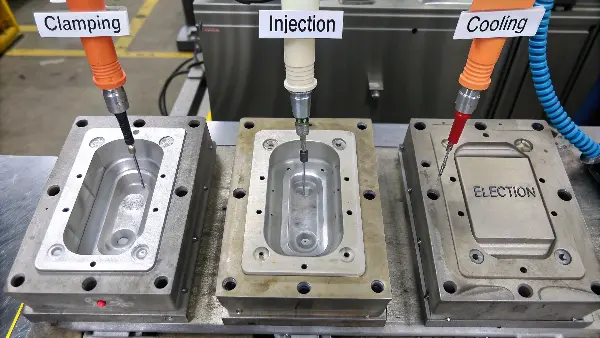
The total time it takes to complete these four stages is called the "cycle time." As a project manager, this is a critical metric for you because it directly determines how many parts can be produced per hour and, therefore, the final cost per part. A few seconds saved in any of these stages can add up to huge savings on a large production run. Understanding each stage helps you appreciate where efficiencies can be gained or where potential problems might arise.
Dissecting the Molding Cycle
Let’s walk through what happens at each stage. Imagine we’re making a simple plastic housing.
Stage 1: Clamping
Before any plastic is injected, the two halves of the mold tool (the A-Side and B-Side) must be securely closed. A hydraulic or electric clamping unit on the molding machine pushes the B-Side against the A-Side, holding them together with tons of force. This force is essential to counteract the immense pressure from the injected plastic, preventing it from leaking out of the mold cavity and creating "flash" (a thin, unwanted layer of plastic on the part).
Stage 2: Injection
With the mold clamped shut, plastic pellets from a hopper are fed into a heated barrel. A large screw inside the barrel melts and mixes the plastic, then pushes it forward. This molten plastic is injected at high pressure through the sprue, runners, and gates, completely filling the mold cavity. The amount of plastic and the injection speed are carefully controlled to ensure the part is fully formed without defects.
Stage 3: Cooling
This is often the longest stage in the cycle. Once the cavity is filled, the molten plastic must cool and solidify into the shape of the mold. Coolant circulating through channels in the mold removes heat from the plastic. The cooling time depends on the type of plastic, the thickness of the part’s walls, and the efficiency of the mold’s cooling system. Optimizing this stage is key to a faster cycle time, but cutting it too short can lead to warped or weak parts.
Stage 4: Ejection
After the part has cooled enough, the clamping unit opens the mold, separating the A and B sides. The part stays on the B-Side (the core). The ejector system then activates, pushing the part off the core. The part falls into a collection bin or is removed by a robotic arm, and the machine is ready to start the next cycle by clamping the mold shut again.
What are the 5 steps of injection molding?
You understand the four main stages, but how does this translate into a practical workflow from a project manager’s perspective? Seeing the process as just four automated stages can miss the human and preparatory steps involved. A slightly different, expanded view can help you manage your projects more effectively. Let’s frame it as five practical steps.
From a production standpoint, the injection molding process can be seen in five practical steps. It begins with 1. Loading & Melting the plastic pellets. Next is 2. Injection, where the molten plastic fills the mold. Then comes 3. Packing & Holding to compensate for shrinkage. After that is 4. Cooling, where the part hardens. The final step is 5. Ejection, removing the part and resetting for the next cycle.
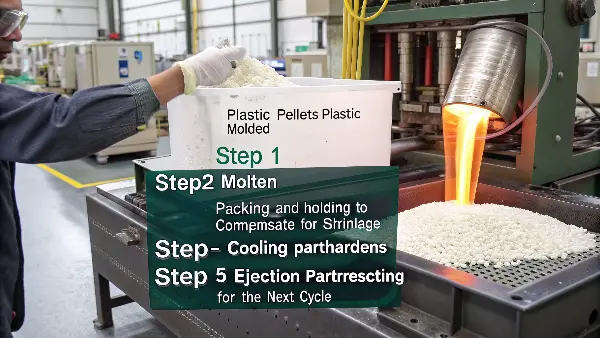
This five-step model provides a more detailed look at what happens inside the machine barrel and cavity. The distinction between "Injection" and "Packing & Holding" is especially important for parts that require high dimensional accuracy. For a project manager like you, knowing these nuances helps you understand why process parameters are so critical and how they relate directly to the quality of the final product.
A Deeper Dive into the Process Flow
While the four-stage model gives a great overview, breaking it down into five steps helps clarify the physics of what’s happening with the plastic itself. At CAVITYMOLD, we fine-tune each of these steps to ensure every part meets specification.
Step 1: Loading & Melting
This is the preparation stage. Plastic pellets are gravity-fed from a hopper into the barrel of the injection molding machine. As the screw rotates, it conveys the pellets forward along the barrel. Heater bands outside the barrel melt the plastic, and the shearing action of the screw helps ensure it becomes a consistent, homogenous melt at the precise temperature required for the specific material.
Step 2: Injection
Once enough molten plastic has accumulated at the front of the screw, the screw moves forward like a plunger. It injects the plastic into the clamped mold at a controlled speed and pressure. The goal is to fill the cavity quickly and evenly, typically filling it about 95-99% full during this step.
Step 3: Packing & Holding (The Precision Step)
This step is crucial for part quality. After the initial injection fills the cavity, the machine switches from a high-speed injection to a pressure-holding phase. It continues to apply pressure to "pack" more plastic into the cavity. This compensates for the material shrinkage that naturally occurs as the plastic cools. Without this step, you would get sink marks, voids, or parts that are not true to their intended dimensions.
Step 4: Cooling
As mentioned before, cooling is when the part solidifies. During this phase, the screw retracts and begins melting the plastic for the next shot while the current part is still cooling in the mold. This parallel processing helps to minimize the overall cycle time. The mold temperature is carefully controlled to ensure the part cools at the right rate.
Step 5: Mold Opening & Ejection
Once the part is solid, the mold opens, and the ejector pins push the part out. The machine is now ready to begin the next cycle immediately. The efficiency of ejection is vital; if parts stick or are damaged during this step, it can halt production entirely.
Thinking about the process in these five steps gives you a clearer picture of how we control for quality and precision at every stage.
Conclusion
We’ve covered the complete outline of injection molding, from the core components of a mold to the detailed stages of the production cycle. Understanding the A and B sides, the four main stages, and the five practical steps gives you the essential knowledge to manage your projects confidently.