
Struggling with surface defects on your molded parts that ruin their aesthetic appeal? These imperfections can lead to rejected batches and damage your brand’s credibility. The secret to a flawless product lies in mastering the mold polishing process, which turns a good part into a great one.
To master mold polishing, you must use a systematic approach. Start with rough grinding to remove machining marks, then progress through finer abrasive stones, papers, and diamond pastes. Each step refines the surface, removing scratches from the previous stage. The final buffing with soft cloths and fine diamond paste creates the desired high-gloss, mirror-like finish. This multi-stage process ensures a flawless surface on your final molded parts.
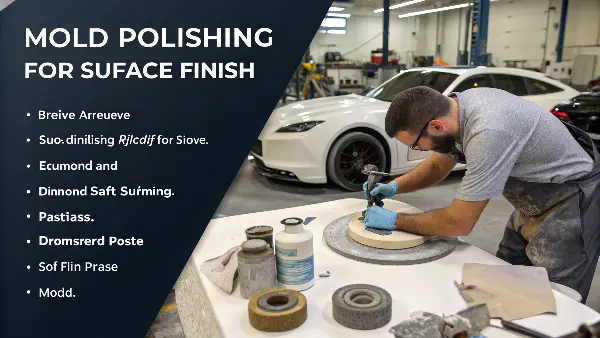
Achieving that perfect, glossy finish on a plastic part is incredibly satisfying. But it’s not just about making things look good. A superior surface finish is a hallmark of quality engineering and has a direct impact on the performance and lifespan of both the part and the mold. It all begins with understanding why this process is so fundamental.
So, let’s break down what it takes to get it right.
Why is mold polishing so critical for product quality?
Thinking of mold polishing as just an extra, time-consuming step? Rushing this process can lead to parts sticking in the mold, increased cycle times, and a cheap-looking final product. Understanding its true value is the key to justifying the effort for consistently superior results.
Mold polishing is critical because the mold’s surface directly imprints onto the final product. A perfectly polished mold ensures a flawless aesthetic finish, free from scratches or dull spots. Beyond looks, a smooth surface helps parts eject easily, reducing cycle times and preventing damage. It also improves material flow and minimizes wear and tear on the mold itself, extending its operational life and ensuring part consistency.
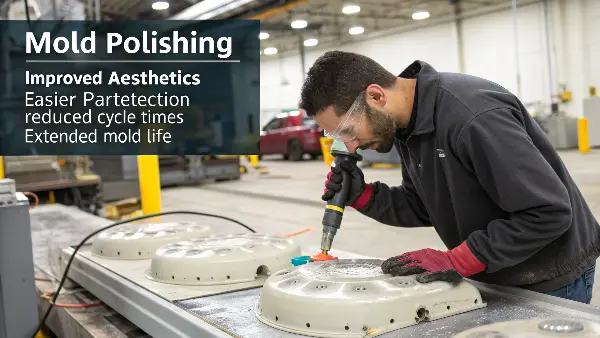
I’ve seen firsthand how a project can succeed or fail based on the quality of the mold surface. It’s about so much more than just a shiny finish. The real value is in how it impacts the entire manufacturing process, from the first shot to the last.
I remember a project we handled for a medical device company. The part was a clear polycarbonate housing. The initial test run produced parts with a slight haze and visible flow lines. The client, rightfully, was concerned. We double-checked the material, the injection parameters, everything. The issue was traced back to microscopic scratches left in the mold from a rushed polishing job by a previous supplier. We pulled the mold, took it back to our workshop, and performed a meticulous multi-stage diamond polish. The next run was crystal clear. That experience taught me an unforgettable lesson: the mold surface is the product surface.
Beyond Aesthetics: The Functional Benefits
A smooth, highly polished mold cavity isn’t just for show. It provides critical functional advantages that directly impact your bottom line. Firstly, it significantly improves part ejection. A mirror-like surface has a very low coefficient of friction, meaning plastic parts release from the mold with minimal resistance. This reduces the need for high ejector pin forces, which can cause stress marks, warping, or even damage to the part. It also allows for shorter cycle times because you’re not waiting for a stubborn part to release.
Secondly, a polished surface enhances resin flow. Molten plastic flows more easily and evenly across a smooth surface, ensuring the cavity fills completely without issues like short shots or weld lines, especially in complex geometries or thin-walled parts. This leads to greater consistency from part to part.
Impact on Mold Longevity and Maintenance
A well-polished mold is a well-protected mold. The smooth surface is less prone to corrosion and residue buildup from plastic additives and gases. Cleaning the mold between production runs becomes faster and easier, minimizing downtime. More importantly, the reduced friction during ejection means less wear and tear on the mold itself. Pitting, dragging, and other forms of surface degradation are significantly reduced, which extends the operational life of your expensive tool. A small investment in proper polishing upfront pays for itself many times over in tool life and reduced maintenance costs.
| Feature | Poorly Polished Mold | Well-Polished Mold |
|---|---|---|
| Part Aesthetics | Scratches, dull spots, flow marks | Flawless, high-gloss finish |
| Part Ejection | Sticking, requires high force | Smooth, easy release |
| Cycle Time | Longer due to ejection issues | Optimized and faster |
| Mold Wear | High friction causes faster wear | Minimal wear, longer tool life |
| Maintenance | Difficult to clean, residue buildup | Easy to clean, less downtime |
What are the essential tools and materials for mold polishing?
Ready to start polishing but overwhelmed by the sheer number of tools and compounds available? Using the wrong equipment can do more harm than good, creating new scratches instead of removing them. Knowing what to use and when is the foundation of any successful polishing job.
The essential tools for mold polishing include a set of abrasive stones (from 220 to 1200 grit), sandpaper or emery cloth, and diamond polishing compounds in various micron sizes (e.g., from 45 down to 1 micron). You’ll also need polishing machines like ultrasonic polishers or rotary handpieces, along with felt bobs, wooden sticks, and soft cloths. Kerosene or a specific polishing fluid is used as a lubricant.
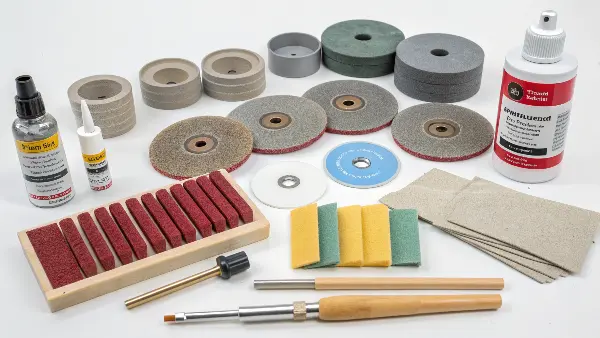
Walking into our polishing department is like entering a sculptor’s studio. You see an incredible array of tools, each with a specific purpose. Early in my career, I thought you could just grab some sandpaper and get to work. I quickly learned that it’s a disciplined craft where the right tool choice at each stage determines the final outcome. Just like a chef needs the right knives, a polisher needs a full range of abrasives to take a rough surface to a mirror finish.
The Abrasive Progression: From Stones to Diamond Paste
The core principle of mold polishing is a gradual reduction of surface roughness. You can’t jump straight to the final buffing stage. The process starts with coarser materials and methodically moves to finer ones.
Abrasive Stones (Grinding Stones): These are the workhorses for the initial stage. They are used to remove the rough milling, EDM, or grinding marks left from the machining process. You typically start with a coarser grit, like a 220 or 320, and work your way up through 400, 600, and sometimes even 800 or 1200 grit. The key here is to use a consistent, overlapping motion and to change direction with each new grit to ensure you’re removing the scratches from the previous stone, not just deepening them.
Sandpaper / Emery Cloth: After the stones, you move to sandpaper. This step helps to further refine the surface and remove the finer scratches left by the last stone. It’s often wrapped around a small block or stick to maintain a flat surface. You’d follow a similar progression, maybe starting from 600 grit and going up to 1500 or 2000.
Diamond Compounds (Pastes): This is where the magic happens and the mirror finish begins to appear. Diamond paste is essentially microscopic diamond particles suspended in a paste or slurry. It comes in different concentrations and micron sizes. You might start with a 15-micron paste and work your way down to 6-micron, 3-micron, and finally a 1-micron paste for a true ‘Grade A’ mirror finish. The paste is applied with felt bobs, wooden sticks, or soft cloths, often attached to a rotary or ultrasonic tool.
Power Tools and Lubricants
While manual polishing is essential for control, power tools drastically speed up the process.
- Ultrasonic Polishers: These are fantastic for detailed work and tight corners. They use high-frequency vibrations to move a small ceramic or metal tool tip, providing precise and efficient polishing in areas that are hard to reach by hand.
- Rotary Handpieces (Micromotors): These tools are like a dentist’s drill and are used with felt bobs or brushes to apply diamond paste over larger surfaces. Speed control is critical here; too much speed can generate heat and damage the mold surface.
- Lubricants: You should never polish on a dry surface. Lubricants like kerosene or specialized polishing fluids are crucial. They help to flush away the metal and abrasive particles (swarf), prevent the abrasive from getting clogged, and keep the surface cool. Using the right lubricant ensures a cleaner, more efficient polishing action.
How do you achieve a step-by-step mirror finish on a mold?
You have all the right tools, but how do you combine them into a repeatable process? Just randomly polishing won’t work and can create an uneven surface. You need a structured, step-by-step plan to ensure you achieve a flawless mirror finish every time.
To achieve a mirror finish, follow a systematic process. Begin with rough stoning (220-400 grit) to remove machine marks. Progress to fine stoning (600-1200 grit) and then sandpaper (up to 2000 grit), changing polishing direction 90 degrees with each grit change. Finally, use diamond pastes with felt bobs, starting from a coarse micron (e.g., 15) and moving down to the finest (e.g., 1-3) for the final buff.
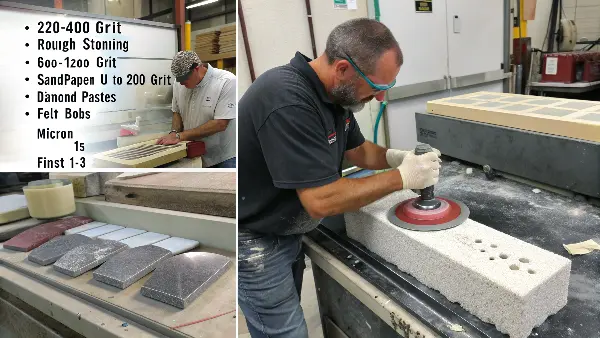
I love watching our senior technicians work on a high-polish mold. It’s a process of intense focus and patience. They have a rhythm. They’ll work an area with one grit, clean it meticulously, inspect it under a lamp, and only then move to the next finer grit. They always say, "You’re not adding a shine, you’re removing scratches." That mindset is everything. Each step is only about removing the scratches from the step before. If you try to skip a step, you’ll be fighting those deeper scratches at the end, and you’ll never get a perfect finish.
Phase 1: Preparation and Rough Polishing
The journey to a mirror finish begins with an honest assessment of the surface. You must remove all the underlying imperfections before you can even think about shine.
- Cleaning and Inspection: Before you do anything, thoroughly clean the mold surface with a solvent to remove any oil, grease, or debris. Inspect the surface under good lighting to identify the deepest machine marks, EDM scale, or defects. This tells you where to start.
- Rough Stoning (Grits 220-400): This is the foundation of the entire process. Using a coarse abrasive stone (e.g., 320 grit) and a lubricant, work in a consistent direction (e.g., horizontally) until all the original machine marks are gone. The entire surface should have a uniform finish composed only of the scratches from your stone.
Phase 2: Intermediate Polishing
This phase is about refining the surface and preparing it for the final mirror polish. Patience here is key.
- Fine Stoning (Grits 600-1200): Switch to a finer stone (e.g., 600 grit). Now, change your polishing direction by 90 degrees (e.g., vertically). Polish until all the horizontal scratches from the previous step are replaced by finer, vertical scratches. Clean the surface and repeat this process with progressively finer stones, always changing direction. This crisscross pattern ensures you remove the previous layer of scratches completely.
- Sandpaper Application (Grits 400-2000): Once you’ve finished with the finest stone, move to waterproof sandpaper. Again, start with a coarser grit (like 400 or 600, depending on your last stone) and continue the 90-degree-shift pattern. Work your way up to 1500 or 2000 grit. The surface should now have a very smooth, matte, or semi-gloss appearance.
Phase 3: Final Mirror Polishing
This is the final and most delicate stage, where the real shine comes to life. Contamination is your biggest enemy here.
- Diamond Paste Application (15 to 3 micron): Clean the mold surface meticulously. Any stray grit from the previous steps will ruin your finish. Apply a coarse diamond paste (e.g., 15 micron) with a hardwood stick or a hard felt bob on a rotary tool. Use a circular or overlapping motion. Polish until you have a uniform, semi-reflective surface. Clean thoroughly. Repeat the process with finer pastes (e.g., 9 micron, then 6, then 3), using a new, clean felt bob for each grade.
- Final Buffing (1-3 micron): For the highest mirror finish (SPI A-1), use the finest diamond paste (1 or 3 micron) on a soft wool or cotton bob. Use very light pressure and a slow speed on your rotary tool. Let the compound do the work. The goal here is to remove the very last microscopic swirls and bring out a deep, flawless luster. After this step, the mold surface should be a perfect mirror.
How do SPI finish standards guide your polishing work?
You’ve polished a mold, and it looks shiny, but is it "shiny enough"? How do you communicate surface finish requirements clearly with your team or your supplier? Using subjective terms like "shiny" or "smooth" leads to confusion and inconsistent results. This is where industry standards come in.
SPI (Society of the Plastics Industry) finish standards provide a universal language for defining mold surface finishes. They are graded from A-1 (a flawless, mirror-like diamond buff) to D-3 (a rough blasted texture). These standards ensure everyone—from the designer to the molder—understands the exact finish required, eliminating guesswork and guaranteeing the desired product outcome. This is crucial for matching part appearance and function to design specifications.
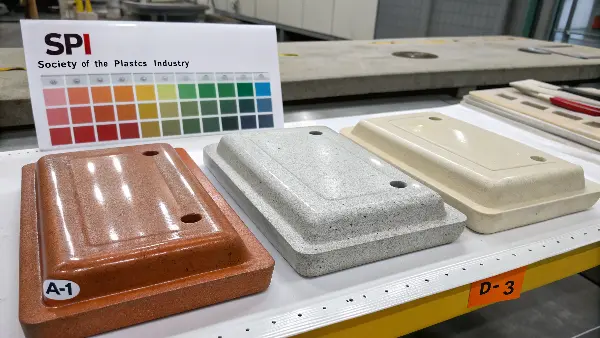
I can’t tell you how many times a new client has just said they want a "nice finish." What does that mean? For a car dashboard part, "nice" might be a textured matte finish. For a cosmetic compact, it means a perfect mirror. This is why the first thing we do during a project kickoff with someone like Alex, the Project Manager, is to define the required SPI finish for each cosmetic surface. It removes all ambiguity. We’re not just polishing to make it look good; we are polishing to meet a specific, measurable standard like "SPI A-2" or "SPI B-1."
Breaking Down the Four Main SPI Categories
The SPI standards are logically organized into four main categories based on the final surface treatment applied to the mold. Each category has different grades.
| Category | Grade Examples | Description & Polishing Method | Typical Application |
|---|---|---|---|
| A (Glossy) | A-1, A-2, A-3 | Mirror-like, high gloss finishes achieved with fine diamond paste buffing. A-1 is the highest grade. | Lenses, mirrors, high-end cosmetic packaging, optical components. |
| B (Semi-Glossy) | B-1, B-2, B-3 | Semi-gloss finish achieved using fine-grit sandpaper (e.g., 600-grit for B-1). No diamond buffing. | Parts that need a good appearance but not a perfect reflection. Consumer electronics housings. |
| C (Matte) | C-1, C-2, C-3 | Matte (dull) finish achieved with fine stone polishing (e.g., 600-grit stone for C-1). No sandpaper. | Industrial parts, internal components where aesthetics are not critical. |
| D (Textured) | D-1, D-2, D-3 | Textured finish achieved by dry blasting with materials like sand or glass beads. No polish. | Parts requiring a non-slip or specific textured feel, like tool handles or dashboards. |
How to Choose and Specify the Right Finish
Choosing the right finish is a balance between aesthetic requirements, functional needs, and cost. A higher finish like A-1 requires significantly more skilled labor and time, making it the most expensive.
- Function First: Does the part need to be optically clear? You need an A-grade finish. Does it need a grip? A D-grade texture is best. Will a smooth surface help with part ejection? A B-grade finish might be sufficient.
- Aesthetics and Branding: For premium consumer products, a high-gloss A or semi-gloss B finish communicates quality. For parts that are hidden from view, a C-grade finish is more cost-effective.
- Material Considerations: Some materials, like polycarbonate, show surface imperfections very easily and benefit from a high-polish finish. Others, like glass-filled nylon, have a naturally rougher surface texture, so aiming for an A-1 finish would be a waste of time and money.
When you specify a finish, be precise. Instead of saying "a glossy finish," say "SPI A-2 finish." This communicates to your mold maker that you require a surface polished with a #3 diamond buff. Providing a physical sample plaque with the desired finish is even better. This ensures there are no misunderstandings and you get exactly the part you designed.
Conclusion
Mastering mold polishing is a blend of art and science. It requires patience, the right tools, and a systematic process. By understanding the critical role of polishing and adhering to standards like SPI, you can ensure every part meets its aesthetic and functional requirements, resulting in higher quality products.