
Are you struggling to make sense of injection molding quotes? The costs can seem complex and unpredictable, making it difficult to budget for your project and feel confident in your decisions. Let’s break it down so you can take control of your manufacturing budget.
The total cost of injection molding is primarily driven by two main components: the one-time cost of creating the mold (tooling) and the recurring cost per part produced. Factors like part complexity, material choice, mold material, and production volume are the most significant variables that influence your final quote. Understanding these elements is key to optimizing your project’s budget.
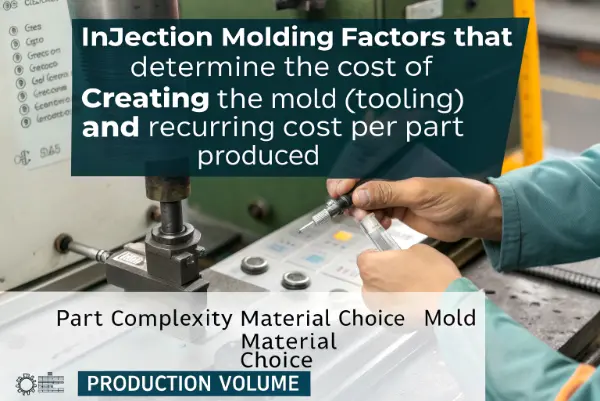
When I first talk to new clients, I often find they’re focused on that single, all-in price per part. But to truly understand the value and manage your budget effectively, you have to look at the process in two distinct phases: the significant upfront investment in the mold, and the ongoing cost of producing each part. This separation is the first step to mastering your molding costs. Let’s start with the biggest initial investment: the tool itself.
How Much Does the Injection Mold Itself Actually Cost?
That initial quote for the mold can be a shock. Seeing a figure in the tens of thousands of dollars can feel like a huge hurdle before you’ve even produced a single part. This major upfront investment can make or break a project’s viability. Let’s demystify that price tag.
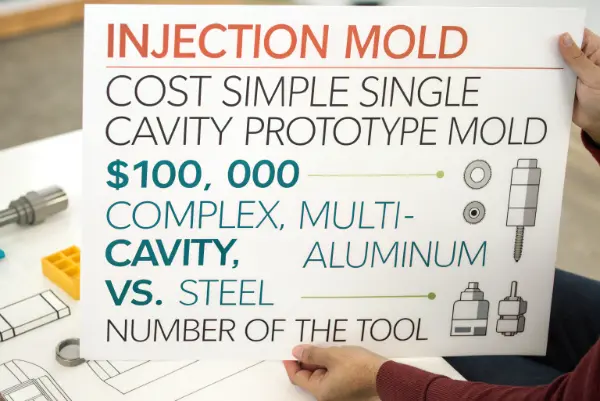
The cost of an injection mold can range from a few thousand dollars for a simple, single-cavity prototype mold to over $100,000 for a complex, multi-cavity, high-production mold. Key factors determining this price are part complexity, part size, mold material (like aluminum vs. steel), number of cavities, and the expected lifespan of the tool.
I remember a project manager, let’s call him Alex, who came to us with a design for a consumer electronics housing. He had a quote from another supplier that seemed astronomically high, and he couldn’t understand why. When we looked at his design, it became clear. The part had several undercuts, intricate textures, and extremely tight tolerances. These features are what make a mold expensive.
Why Part Complexity is the Biggest Driver
A simple, open-and-shut mold is the most affordable. But as soon as your part has features that can’t be formed by the two halves of the mold simply closing and opening, the cost climbs. Features like side holes, clips, or internal threads require complex mechanisms called side-actions or lifters. These are essentially mini-molds within the main mold that move into place and then retract to create the feature. Each one adds significant design, machining, and fitting time, which directly translates to cost.
Choosing the Right Mold Material
The material used to make the mold is another critical cost factor. It’s a trade-off between upfront cost and long-term durability. For low-volume runs or prototypes, aluminum is a great option. For high-volume mass production, hardened steel is the only way to go.
| Mold Material | Typical Lifespan (Shots) | Upfront Cost | Best For |
|---|---|---|---|
| Aluminum 7075 | 5,000 – 10,000 | Low | Prototyping, Low-volume |
| P20 Steel | 50,000 – 400,000 | Medium | Medium to High-volume |
| H13 Steel | 500,000 – 1,000,000+ | High | Mass Production, Abrasive Materials |
| S136 Stainless | 1,000,000+ | Very High | High-polish, Medical-grade |
Cavitation: One vs. Many
Finally, consider cavitation—the number of identical parts the mold can produce in a single cycle. A single-cavity mold is cheaper to build, but your per-part cost will be higher because you’re only making one part at a time. A multi-cavity mold (with 2, 4, 8, or more cavities) has a much higher upfront cost but dramatically lowers your per-part cost and speeds up production. The right choice depends entirely on your projected total volume.
What Factors Influence the Per-Part Production Cost?
You’ve invested in the mold, and it’s ready to go. Now, the focus shifts to the ongoing production costs. These recurring expenses can quietly eat away at your profit margins if they aren’t carefully managed from the start. Knowing the variables allows you to optimize your production run for long-term value.
The per-part cost in injection molding is mainly influenced by the raw material choice, the machine cycle time, and the total order volume. More expensive resins, longer cycle times (due to complex parts or cooling needs), and smaller production runs will all result in a higher price for each individual part you produce.
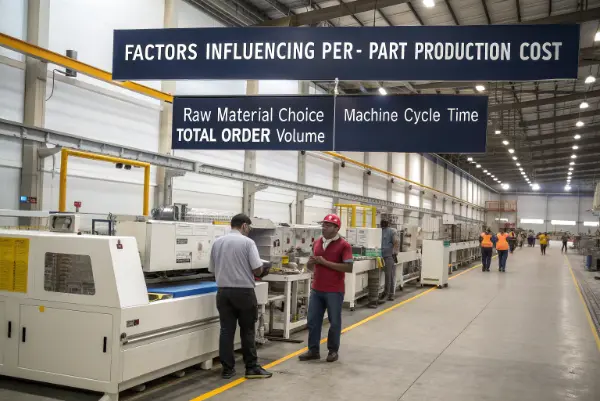
Once the mold is built, the cost equation changes. Now, we’re talking about the price for each item that comes off the production line. This is where material selection and machine efficiency become the heroes of your budget.
The Impact of Material Selection
The resin you choose is a direct, tangible cost in every single part. While a common material like Polypropylene (PP) might cost around $1-2 per kilogram, a high-performance engineering resin like PEEK could be over $70 per kilogram. The price difference is immense. I worked on a project for a medical device company that required a biocompatible, sterilizable material. The material cost was high, but it was non-negotiable for the application. For a simple consumer good, however, choosing a slightly less-premium but perfectly adequate material can save a fortune over a production run of a million units. You need to balance the functional requirements of your part—strength, flexibility, temperature resistance, UV stability—with the cost of the raw material.
Machine Time is Money
The other major factor is the cycle time. This is the total time it takes for the injection molding machine to clamp the mold, inject the plastic, cool the part, open the mold, and eject the part. It can range from a few seconds to over a minute. Longer cycle times mean less output per hour, so the cost of machine time and labor gets spread over fewer parts, increasing the per-part cost. What makes a cycle time long?
- Part Size: Large, thick parts take much longer to cool.
- Material Choice: Some resins require longer cooling periods.
- Mold Complexity: Molds with many side-actions can slow down the open/close sequence.
The Power of Volume
Finally, economy of scale is a powerful force. Setting up the machine, drying the material, and dialing in the process takes time and effort, regardless of whether you’re running 1,000 parts or 100,000. These setup costs are amortized over the production run. For a small batch, that setup cost significantly inflates the per-part price. For a large batch, it becomes almost negligible. This is why the per-part price drops significantly as your order quantity increases.
Are There Hidden Costs I Should Be Aware Of?
You’ve calculated your tooling and per-part costs, but the final invoice has unexpected charges. These "hidden" fees can disrupt your budget and create friction with your supplier. The key is to know what to ask about upfront so there are no surprises later on.
Yes, there can be several hidden or overlooked costs. These often include mold maintenance and repair, part finishing and secondary operations (like assembly or printing), quality control inspections, and packaging and shipping. Discussing these potential expenses with your manufacturer from the beginning is crucial for creating an accurate, all-inclusive budget.
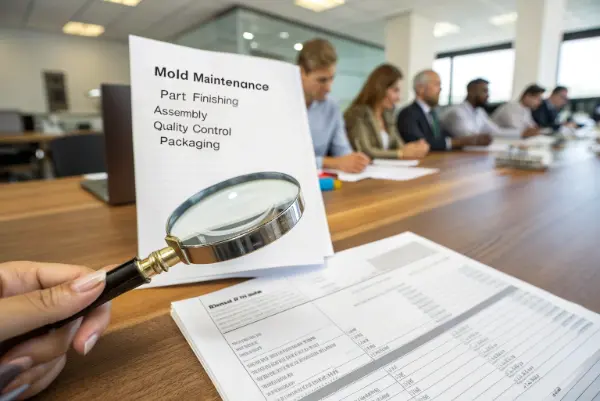
A few years ago, a client came to us frustrated with their previous supplier. The quote they approved was competitive, but the final cost was nearly 30% higher. The supplier had tacked on fees for mold maintenance, special packaging, and part assembly that were never discussed initially. This is why at CavityMold, we believe in total transparency. A good partner will help you see the full picture from the start.
Mold Maintenance and Repair
Molds, especially high-volume steel ones, are precision machines that experience wear and tear. Parting lines can wear down, ejector pins can break, and cooling channels can get clogged. Regular maintenance is essential to keep the mold running and producing consistent parts. Some manufacturers include a certain level of maintenance in their agreement, while others charge for it separately. For a mold expected to produce a million parts, you should absolutely budget for scheduled maintenance and potential repairs. Always ask: "What is your policy on mold maintenance and repair, and what costs should I anticipate over the life of the tool?"
Secondary Operations and Finishing
Does your part need to be perfect right out of the mold, or does it require additional work? These post-molding processes are a common source of extra costs.
| Secondary Operation | Description | Impact on Cost |
|---|---|---|
| Gate Removal | Manually or automatically trimming the small nub where plastic entered the part. | Can add labor cost if done manually. |
| Assembly | Joining multiple molded parts together, often with sonic welding or adhesives. | Significant labor or automation cost. |
| Pad Printing/Painting | Adding logos, text, or color to the surface of the part. | Adds material and labor costs per part. |
| Texturing | Applying a specific surface finish to the mold to create a textured part. | Primarily an upfront tooling cost, but can affect cycle time. |
Quality, Packaging, and Shipping
How will your parts be checked for quality? Basic dimensional checks might be standard, but if you require advanced CMM reports or 100% inspection, this will be an added service. Similarly, if your parts need to be individually bagged, placed in custom trays, or specially boxed to prevent damage, this will cost more than simply bulk-packing them in a large box. Finally, don’t forget the cost to get the finished goods from the factory to your warehouse.
How Can I Effectively Reduce My Overall Injection Molding Costs?
You understand the cost drivers, but how can you actively reduce them? Simply choosing the cheapest quote isn’t the answer, as that can lead to poor quality and long-term problems. The real solution lies in smart design choices and strategic planning from the very beginning.
To effectively reduce injection molding costs, focus on design for manufacturability (DFM). Simplify your part geometry, avoid undercuts, use uniform wall thicknesses, and select the most cost-effective material that meets your needs. Additionally, partnering with an experienced manufacturer for DFM feedback and planning your production volumes strategically can lead to significant savings.
The biggest leverage you have on cost is during the design phase. Once the steel for a mold is cut, making changes becomes incredibly expensive. I always tell my clients, "An hour of design optimization is worth a hundred hours of troubleshooting in production."
Master Design for Manufacturability (DFM)
DFM is the practice of designing parts to be as easy and efficient to manufacture as possible. This is your number one tool for cost reduction.
- Eliminate Undercuts: As we discussed, undercuts require complex, expensive mold actions. If you can redesign a clip or hole to be formed without a side-action, you can drastically cut tooling costs. For example, using a "snap clip" design that can be molded with a straight pull is a classic DFM trick.
- Maintain Uniform Wall Thickness: Parts with both very thick and very thin sections are difficult to mold. The thick sections take a long time to cool, increasing cycle time. They can also cause cosmetic defects like sink marks. Aim for a consistent wall thickness throughout your part.
- Use Generous Draft Angles: A small taper (draft) on vertical walls allows the part to be ejected from the mold easily. Without it, the part can scrape against the mold, causing cosmetic issues and slowing down the cycle. A 1-2 degree draft is standard.
Smart Material and Planning Choices
Beyond the part design itself, your strategic decisions play a huge role.
- Don’t Over-Specify Materials: Be realistic about your part’s requirements. Do you really need a high-performance resin that can withstand 200°C if your product will only ever see room temperature? Consult with a material expert to find the "sweet spot" of performance and price.
- Prototype Intelligently: Before committing to a $50,000 steel tool, consider a lower-cost prototype mold. It allows you to test your design, fit, and function with real molded parts. I’ve seen clients save tens of thousands by catching a design flaw with a $3,000 aluminum prototype tool, allowing them to fix the design before cutting expensive steel.
- Partner with Your Molder: Bring your manufacturer into the conversation early. A good partner like CavityMold can provide invaluable DFM feedback that can save you a fortune. We see hundreds of designs and can often spot opportunities for simplification that aren’t obvious to a product designer. This collaboration is the key to mastering your molding costs.
Conclusion
Understanding the costs of injection molding boils down to separating the one-time tooling investment from the recurring per-part price. By focusing on design simplification, smart material selection, and early collaboration with your manufacturer, you can demystify the process and gain full control over your project’s budget.