
Struggling with inconsistent quality in your nylon parts? Defects like warping, flash, and brittleness can derail production schedules and drive up costs. The good news is that most of these frustrating issues have clear causes and proven solutions you can implement today.
To troubleshoot common nylon injection molding defects, focus on three key areas: material handling, process parameters, and mold design. Properly drying the nylon is critical to prevent moisture-related issues like splaying and brittleness. Optimizing injection pressure, temperature, and cooling time can solve problems like sink marks and warpage. Finally, ensure your mold has adequate venting and a well-designed gate to prevent flash and incomplete fills.
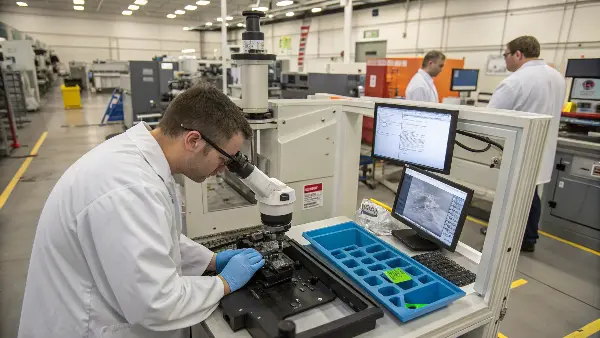
I get it. Nylon can be a tricky material to work with, especially given its unique properties. Over my years at CAVITYMOLD, I’ve seen countless projects get stuck because of a few persistent problems. These challenges can be a real headache for project managers like you, who are under pressure to deliver perfect parts on time. But the truth is, once you understand why nylon behaves the way it does, fixing these defects becomes a systematic process, not guesswork. Let’s break down the most common issues one by one, so you can get your production back on track and deliver the high-quality parts your clients expect.
Is Excess Moisture Causing Splay Marks and Brittleness in Your Nylon Parts?
Seeing silver streaks or splay marks on your nylon parts? These cosmetic flaws are often a sign of a bigger problem – moisture degradation. This hidden issue can make your parts weak and brittle, leading to unexpected failures down the line. Luckily, proper material drying is a straightforward fix.
Yes, excess moisture is a primary cause of splay marks (silver streaks) and brittleness in nylon parts. Nylon is highly hygroscopic and must be dried to a moisture content below 0.2% (often 0.1-0.15%) before processing. Using a desiccant dryer at the correct temperature (around 80°C / 175°F) for at least 4 hours is essential. Undried material will hydrolyze in the barrel, breaking down polymer chains and causing severe defects.
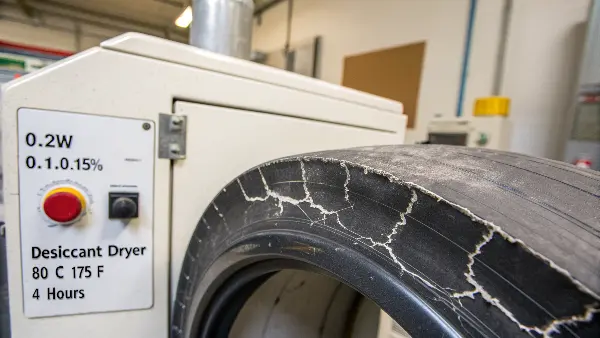
The Science Behind the Problem
Nylon’s love for water is its biggest challenge. The technical term is "hygroscopic," meaning it actively absorbs moisture from the surrounding air. When these wet pellets enter the hot barrel of an injection molding machine, the water turns to steam. Under intense heat and pressure, this water triggers a chemical reaction called hydrolysis, which literally breaks the long polymer chains that give nylon its strength. The visible result is splay marks or silver streaks on the surface, which is the steam trying to escape. The invisible, and more dangerous, result is a part with drastically reduced impact strength and durability.
I remember a project with a client in Germany making automotive clips. Their parts kept failing impact tests, snapping with very little force. We traced it back to their drying process. They were using a simple hot air dryer, which just circulates humid air. That’s not enough for nylon. Once they switched to a desiccant dryer with a low dew point, which uses dry air to pull moisture out, the problem vanished overnight. It’s a fundamental step you can’t skip.
Achieving the Perfect Dryness
To prevent these issues, you need a precise and controlled drying process. Here are the key parameters:
| Parameter | Recommended Setting | Why It Matters |
|---|---|---|
| Moisture Content | < 0.2% (Ideally < 0.15%) | Anything higher will cause hydrolysis and defects. |
| Dryer Type | Desiccant Dryer | Hot air ovens don’t remove humidity; they just heat the wet material. |
| Drying Temp | 80-85°C (175-185°F) | Hot enough to release moisture without degrading the nylon. |
| Drying Time | 4-8 hours | Depends on initial moisture level. Don’t rush this step. |
| Dew Point | -29°C (-20°F) or lower | This measures the dryness of the air in the desiccant dryer. Lower is better. |
Why Are Your Nylon Parts Shrinking or Warping Unevenly?
Are your finished nylon parts failing to meet critical dimensional specs? Warpage can make assembly with other components impossible and leads to a high scrap rate, which wastes valuable time and expensive material. Understanding nylon’s semi-crystalline nature is the key to controlling this frustrating problem.
Nylon parts shrink and warp unevenly due to their semi-crystalline nature. As nylon cools, its molecules form ordered crystal structures, causing significant and non-uniform volume reduction. This is made worse by inconsistent cooling, improper packing pressure, or poor part geometry (e.g., varying wall thicknesses). To fix this, you need to ensure uniform cooling across the mold, adjust holding pressure and time, and optimize the mold gate location and size.
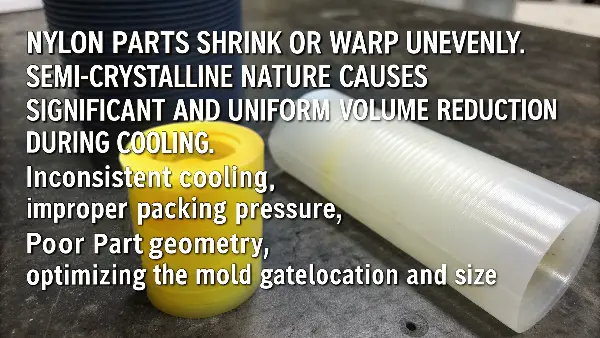
The Root Cause: Crystallinity
When nylon is in its molten state inside the machine, its molecular chains are tangled and random, like a bowl of spaghetti. This is the amorphous state. As it cools and solidifies in the mold, parts of these chains fold up and pack together into dense, ordered structures called crystallites. This transition from a random to an ordered state causes the material to shrink significantly—much more than fully amorphous plastics like ABS.
Warpage occurs when this shrinking process happens unevenly across the part. Thicker sections of a part cool more slowly than thinner sections. This extra time allows more, or larger, crystals to form, which leads to a higher local shrinkage rate. This difference in shrinkage between thick and thin areas creates internal stress that physically pulls and twists the part out of shape as it cools.
Corrective Actions for predictable parts
We were working on a large housing for a piece of industrial equipment. The warpage was so bad the two halves wouldn’t fit together. The client was blaming the material. We ran a mold flow analysis and showed that the problem was differential cooling. By adding dedicated cooling channels closer to a specific thick rib and increasing the holding time by just a few seconds, we could control the shrinkage. The parts came out perfectly straight. It’s rarely the material’s fault alone; it’s how you process it.
Here’s how to tackle it:
- Process Adjustments: The goal is to "pack out" the part. After the initial injection, apply a lower, sustained "holding" or "packing" pressure. This pushes more molten material into the mold to compensate for shrinkage as it occurs. Ensure the holding time is long enough—at least until the gate freezes solid.
- Mold Temperature Control: Uniformity is everything. While a warmer mold (e.g., 80°C / 175°F) can sometimes reduce stress, the most important thing is that the temperature is consistent across both halves of the mold. Hot spots and cold spots are a primary cause of warpage.
- Smart Part Design: The best fix is often done before the mold is even made. Design parts with uniform wall thickness whenever possible. If a section needs to be stronger, use ribs or gussets for support instead of making the whole wall thicker. This design approach is a core principle of Design for Manufacturability (DFM).
How Can You Prevent Sink Marks and Voids in Thick Nylon Sections?
Noticing ugly surface depressions or finding internal bubbles in your parts? Sink marks and voids not only compromise the appearance of your product but can also create significant weak points, leading to structural failures. The solution lies in carefully managing how the part cools and solidifies.
To prevent sink marks and voids, you must compensate for nylon’s volumetric shrinkage as it cools. The key is to apply sufficient holding pressure for an adequate amount of time, pushing more material into the cavity as it shrinks. You should also ensure the gate is large enough and placed at the thickest section to avoid premature freezing. Reducing melt temperature and increasing mold temperature can also help by managing the cooling rate.
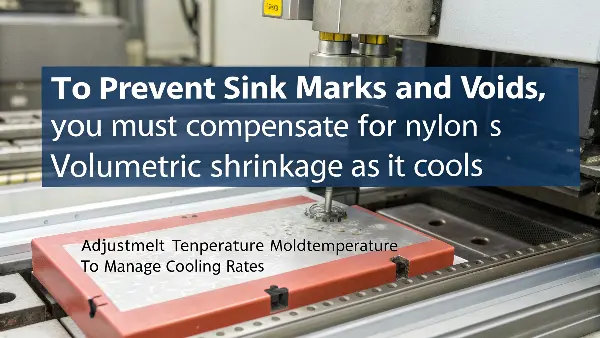
The Shrinkage Story Continues
Sink marks and voids are another direct result of nylon’s high shrinkage rate. The mechanism is simple: the outer surface of the part touches the cool mold wall and freezes first, forming a solid skin. The inside, however, is still molten. As this molten core begins to cool and shrink, it pulls inward. If the outer skin is still soft enough, it gets pulled in with the core, creating a surface depression called a sink mark. If the outer skin is already too rigid to be pulled inward, the shrinking core can detach from itself, creating a vacuum bubble, or a void, inside the part.
Sink marks are primarily a cosmetic issue, but voids are a serious structural defect that can drastically weaken the part, especially in an area with a screw boss or a snap-fit.
Process and Design Fixes
The solutions revolve around either feeding more material to the shrinking areas or redesigning the part to eliminate the problem.
- The Power of Packing and Holding: This is your number one tool. Once the mold is filled, the packing and holding phase pushes extra material into the cavity to compensate for shrinkage. You need enough pressure for enough time. The holding time must be long enough for the gate to freeze solid. If the gate freezes before the part is fully packed out, you lose all ability to fix the sink.
- Strategic Gate Design: Because holding pressure is so important, the gate’s design and location are critical. The gate must be the last part to freeze. This means it should be large enough to not freeze prematurely and, ideally, located at the thickest section of the part. This allows you to directly pack out the area most prone to sinking.
- Design for Manufacturability (DFM): The most elegant solution is to design the problem away. Instead of having a thick section, can you "core it out"? I once consulted on a part with a huge, thick boss for a screw insert that had a terrible sink mark. We recommended a simple mold modification to add a core pin that hollowed out the boss from the back. The sink mark disappeared, the part was lighter, and the cycle time even dropped because it cooled faster. It’s a great example of how a small design change can solve a big processing problem.
What’s the Best Way to Eliminate Flash on Nylon Molded Parts?
Finding thin, unwanted webs of plastic along your part’s seam lines? This defect, known as flash, not only looks unprofessional but also requires costly and time-consuming manual trimming, which can hurt your bottom line and slow down deliveries. A few key adjustments to your process and mold can fix it for good.
The best way to eliminate flash is by balancing your injection pressure and clamp force, while also ensuring your mold’s parting line is perfectly sealed. Nylon has very low viscosity when molten, so it easily seeps into tiny gaps. Reduce injection pressure/speed first. If that doesn’t work, increase clamp tonnage. Also, check the mold for wear or damage on the parting line surfaces and ensure vents aren’t too deep.

Why Nylon is Prone to Flash
The main reason flash is common with nylon is its very low viscosity in the molten state. Think of it like a liquid: honey is high viscosity, while water is low viscosity. Molten nylon flows more like water. This means it can force its way into the tiniest of gaps in the mold, such as the parting line where the two halves of the mold meet, or into vents that are too large.
A project manager from an Australian company, Alex, once came to us with a flash issue on a tiny connector. His team had tried everything with the process parameters. I asked them to send us the mold. We put a bit of machinist’s blue dye on one half of the parting line, clamped the mold shut, and then opened it. We saw exactly where the dye hadn’t transferred, indicating a microscopic gap. A tiny bit of wear, barely visible to the eye, was the culprit. A quick surface grind to restore a perfect seal and the mold was as good as new.
A Systematic Approach to Fixing Flash
Flash can be caused by the process, the mold, or the machine. Here’s a logical way to troubleshoot it:
| Symptom | First Check | Second Check | Third Check |
|---|---|---|---|
| Flash Occurs | Reduce Injection Pressure / Speed | Increase Clamp Tonnage | Inspect Mold Parting Line |
| Details | Lower the force pushing the plastic. | Ensure the force holding the mold shut is enough. | Look for damage, dirt, or wear. |
| Flash Persists | Lower Melt Temperature | Check Vent Depth | Check Machine Platen Parallelism |
| Details | Higher temps lower viscosity even further. | Vents for nylon should be tiny (~0.01 mm). | Ensure the clamp force is being applied evenly. |
Start with the easiest things to change—the process parameters. If adjusting pressure, speed, and temperature doesn’t work, then you need to look at the clamp force and finally, inspect the physical condition of the mold itself. This methodical approach will solve the problem far more efficiently than random adjustments.
Are Your Nylon Parts Too Brittle or Cracking After Molding?
Are your supposedly tough and durable nylon parts snapping easily under stress? This unexpected brittleness can lead to catastrophic field failures, damaging your product’s reliability and your company’s reputation. Identifying the root cause—whether it’s moisture, heat, or stress—is the first step to a durable solution.
Brittleness in nylon parts is usually caused by one of three things: material degradation from excessive heat or moisture, insufficient moisture content after molding, or high levels of molded-in stress. Check that the material is properly dried but not over-dried or overheated in the barrel. After molding, allow parts to absorb ambient moisture (conditioning) to regain toughness. Also, reduce injection pressures and speeds to minimize internal stress.

Finding the Source of Weakness
Brittleness in nylon is a complex issue because it can have several overlapping causes. You need to investigate a few areas to pinpoint the true source of the problem. Often, it’s a combination of factors that turns a tough material into a fragile part.
This can be confusing because we’ve already discussed how too much moisture before molding is bad. But after molding, the reverse is true. Nylon gets its famous toughness from absorbing a small amount of moisture from the air, which acts as a plasticizer. A part that is "dry-as-molded" will be naturally brittle until it has had time to condition.
A Checklist for Restoring Toughness
To diagnose and fix brittleness, you need to check for material degradation, post-molding conditioning, and internal stress from the molding process itself.
| Potential Cause | How to Check | Solution |
|---|---|---|
| Hydrolysis (Wet Material) | Look for splay marks. Test material moisture content. | Dry nylon to < 0.2% moisture using a desiccant dryer before molding. |
| Thermal Degradation | Check for yellowing/browning. Smell for a burnt odor. | Lower the melt temperature. Reduce the barrel residence time (use a press sized correctly for the shot). |
| Lack of Conditioning | Test parts right off the press vs. parts from a day ago. | Allow parts to condition naturally for 24-48 hours, or accelerate by soaking them in warm water. |
| Molded-In Stress | Look for cracks near gates or sharp corners. | Reduce injection pressure/speed. Increase mold temperature. Add generous radii to all sharp corners in the design. |
Start by confirming your drying process is correct. Then, check your processing temperatures and residence time to rule out heat degradation. If those are fine, take a freshly molded part and one that has been sitting for a day and compare their flexibility. If the older part is much tougher, you simply need to implement a conditioning step. Finally, if all else fails, look at reducing molded-in stress through process changes and design improvements, like softening sharp internal corners.
Conclusion
Mastering nylon injection molding comes down to control. Control the moisture before processing, control the temperatures and pressures during processing, and control the part and mold design from the start. Address these key areas, and you’ll solve the vast majority of defects, ensuring strong, reliable, and dimensionally accurate parts every time.