
Choosing the wrong mold steel can lead to costly tool failures, poor part quality, and production delays. Imagine your high-volume production halting because the mold core wore out prematurely. Understanding the key factors helps you select the perfect steel from the start, ensuring a smooth project.
To select the right mold steel, you must match the material to your specific application. Consider the type of plastic resin (is it abrasive or corrosive?), the required production volume, and the desired surface finish. For high-volume projects with abrasive plastics, use hardened steel like H13. For prototypes or low volumes, a pre-hardened steel like P20 is often sufficient. Always balance durability with budget to get the best value.
Choosing the right steel can feel like a complex puzzle. There are so many options, and making the wrong choice can have big consequences down the line. We’ve been helping project managers like you solve this puzzle for over a decade. It all starts with understanding the fundamentals of your tool. Let’s break it down so you can feel confident in your next mold steel specification.
What Are the Fundamental Differences Between Core and Cavity Steel Requirements?
It’s tempting to think the core and cavity are the same, but they face very different stresses. This oversight can lead to cosmetic defects or cooling problems. We ensure your tool is engineered with both halves optimized for their unique roles, preventing these issues before they start.
The cavity forms the cosmetic outer surface, so its steel must have excellent polishability and corrosion resistance. The core forms the internal features and often handles part ejection. Its steel needs good toughness, machinability for complex details, and high thermal conductivity to ensure efficient cooling. The core often runs hotter than the cavity, making heat dissipation critical for cycle times and part quality.
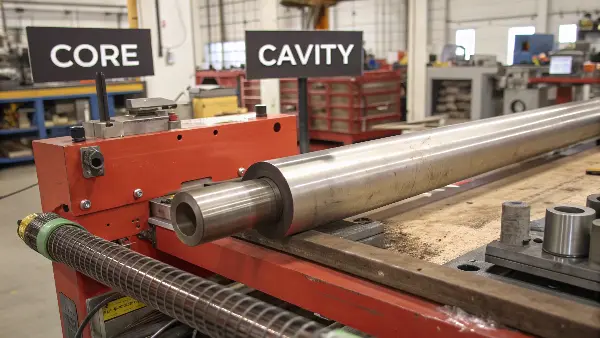
When we build a mold, we don’t just see two blocks of steel. We see the "A-Side" (cavity) and the "B-Side" (core), each with a specific job.
The Cavity: The Face of Your Product
The cavity side of the mold creates the exterior surface of your plastic part. This is what your customer sees and touches.
- Polishability is King: For parts that need a glossy, cosmetic finish, the cavity steel must be able to take a mirror polish. Steels like NAK80 or S136 are fantastic for this. A few years ago, we worked on a project for a consumer electronics housing. The client wanted a perfect, high-gloss finish. We specified S136 for the cavity, and the resulting parts were flawless. Using a standard P20 would have never achieved that level of clarity and shine.
- Corrosion Resistance: This side is exposed to air and moisture every time the mold opens. If you’re using a resin like PVC that releases corrosive gases, the steel must resist rust to protect that perfect finish.
The Core: The Unsung Hero
The core forms the internal geometry of the part. It’s often more complex than the cavity, with features like ribs, bosses, and holes for screws.
- Machinability and Toughness: The core might have lifters, slides, and intricate cooling channels machined into it. The steel needs to be tough enough to support these complex features without cracking under pressure but also easy enough to machine accurately. H13 offers great toughness after heat treatment.
- Heat Dissipation: The core is surrounded by hot plastic, so it tends to get hotter than the cavity. Efficient cooling is essential for controlling part dimensions and keeping cycle times low. Steels with good thermal conductivity are a huge advantage here. We often design complex, conformal cooling channels in the core to pull heat away from tricky spots. For a medical device project, we once used a core made from a beryllium copper alloy in a specific area just to improve cooling and prevent a part from warping.
Thinking about the core and cavity as two distinct components with different needs is the first step to building a truly robust and efficient mold.
How Do Different Plastic Materials Influence Your Mold Steel Choice?
Your chosen plastic resin can either play nice with your mold or actively try to destroy it. Abrasive or corrosive resins can wear down a standard steel mold fast, causing expensive downtime. We help you choose a steel that stands up to any material.
Abrasive plastics like glass-filled nylon require high-wear-resistance steel like hardened H13 or S136. Corrosive plastics like PVC demand stainless mold steel (e.g., S136) to prevent rust and maintain surface finish. For general-purpose resins like polypropylene, a cost-effective pre-hardened P20 works well. Clear parts needing a mirror finish require highly polishable steel like NAK80 to achieve optical clarity.
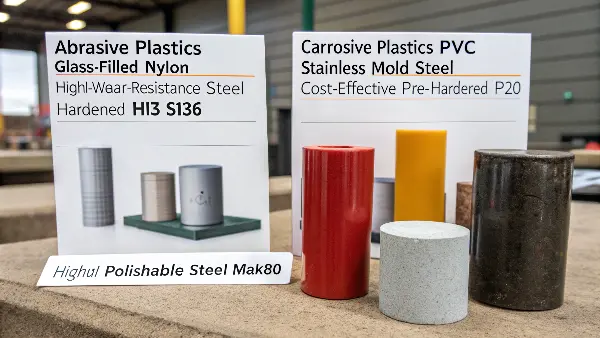
The plastic resin you inject is one of the biggest factors in deciding which steel to use. Think of it as choosing the right tires for your car based on the road conditions. You wouldn’t use racing slicks in the snow. The same logic applies here.
I remember a client who came to us after another supplier built them a P20 mold for a part made with 30% glass-filled nylon. They were trying to save on the initial cost. After only 50,000 cycles, the gates were completely worn out, and the part dimensions were out of spec. We had to remake the core and cavity inserts using hardened H13 steel. The new tool ran over 1 million cycles without an issue. The initial savings cost them far more in downtime and rework.
Matching Steel to Resin Properties
Different plastics attack molds in different ways. Here’s how we break it down:
-
Abrasive Resins (e.g., Glass-Filled, Mineral-Filled PA, PBT): These plastics contain hard fibers that act like sandpaper, wearing away the steel with every shot. This is especially true in high-flow areas like the gate. For these, you need a very hard, wear-resistant steel.
- Our Go-To Steels: Hardened H13, S7, or even D2 for extreme cases.
-
Corrosive Resins (e.g., PVC, CPVC, some Flame-Retardant additives): When heated, these plastics release gases that can cause rust and etch the mold surface. This is a disaster for cosmetic parts or parts that need a tight seal.
- Our Go-To Steels: Stainless grades are non-negotiable here. We use S136 or 420SS. They are designed to resist corrosion and maintain their polish.
-
High-Polish Resins (e.g., PC, PMMA, SAN): For clear lenses, light pipes, or high-gloss housings, the steel must be extremely clean and capable of being polished to a mirror finish (SPI A-1 or A-2).
- Our Go-To Steels: NAK80 or S136. These steels have a very uniform microstructure with no microscopic pits, which allows for a perfect, defect-free polish.
-
General-Purpose Resins (e.g., PP, PE, PS, ABS): These plastics are very gentle on the mold. They are not abrasive or corrosive. This gives you more flexibility and allows for more cost-effective steel choices.
- Our Go-To Steels: P20 is the workhorse here. It’s affordable, machines well, and is durable enough for hundreds of thousands of cycles with these easy-to-mold materials.
Here is a simple table to help:
| Plastic Type | Key Challenge | Recommended Steel |
|---|---|---|
| Glass-Filled Nylon | Abrasive Wear | Hardened H13 |
| PVC | Corrosion | S136 (Stainless) |
| Polycarbonate (Clear) | High Polish | NAK80, S136 |
| Polypropylene (PP) | General Purpose | P20 |
Choosing the steel without first considering the resin is a recipe for failure. Always let the material guide your decision.
How Does Production Volume Impact Mold Steel Selection?
You specified a mold for 1 million parts, but it starts failing at 100,000. This common nightmare happens when the steel choice is mismatched with the production volume. We ensure your tool is built to last for the entire project life cycle.
For low volumes or prototypes (<50,000 shots), use cost-effective materials like P20 steel or even 7075 aluminum to prioritize speed and lower initial cost. For medium volumes (up to 500,000 shots), P20 offers a great balance of cost and durability. For high volumes (500,000+ shots), you must invest in hardened tool steels like H13 or S136 to ensure longevity, minimal maintenance, and a low cost-per-part.
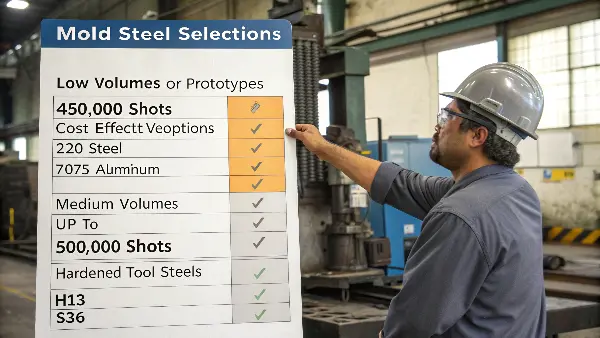
The expected life of your mold is a simple but critical question. Are you making 1,000 parts for a test run or 2 million parts for a major product launch? The answer completely changes the economics of your mold steel choice. It’s all about the total cost of ownership, not just the upfront price.
Categorizing Molds by Volume
We generally think about molds in three categories based on production quantity:
-
Class 105: Prototype Molds (Under 10,000 shots)
For very low quantities, speed and low initial cost are the main goals. You need to get parts in hand quickly to test a design. Hardness and longevity are not major concerns.- Typical Materials: 7075 Aluminum is a top choice. It’s very easy and fast to machine, saving a lot of time and money. Softer P20 steel can also be used.
- The Trade-off: Aluminum molds wear quickly and can be damaged easily, but for a few thousand parts, they are a perfect fit.
-
Class 103-104: Medium-Volume Molds (10,000 to 500,000 shots)
This is the sweet spot for many projects. The tool needs to be reliable and durable, but it doesn’t need to last forever. You need a good balance between performance and cost.- Typical Materials: P20 is the champion in this category. It’s delivered pre-hardened to about 30 HRC, so it doesn’t require heat treatment after machining. It’s tough enough for most general-purpose plastics and offers a great value proposition.
-
Class 101-102: High-Volume Molds (500,000+ shots)
When you’re running millions of cycles, the mold is a long-term asset. The initial cost of the steel is less important than its durability and the cost-per-part over the entire production run. Downtime for repairs is extremely expensive.- Typical Materials: Hardened tool steels are a must. H13, heat-treated to 48-52 HRC, is the industry standard for high-volume tools. For corrosive or high-polish parts, fully hardened S136 is the way to go.
- The Investment: These steels cost more and require a precise heat treatment process, but they pay for themselves many times over through reduced maintenance and a tool life that can exceed a million cycles.
A project manager for a medical device company once told me, "We need 2 million of these parts, and failure is not an option." For them, choosing S136 stainless steel was an easy decision. The higher upfront cost was a small insurance policy to guarantee the long-term, clean, and reliable production they required.
What Are the Most Common Mold Steels and Their Best Applications?
P20, H13, S136… the names can sound like a secret code. Choosing blindly can lead to a mold that’s too soft, too brittle, or rusts unexpectedly. We help you decode the options and pick the perfect steel for the job.
P20 is a versatile, pre-hardened steel for low-to-medium volume molds. H13 is a hardened tool steel with excellent wear resistance, ideal for high-volume production and abrasive materials. S136 is a stainless steel offering high corrosion resistance and polishability, perfect for medical parts or molding PVC. NAK80 is a precipitation-hardened steel known for its superb out-of-the-box mirror polish capabilities and stability.
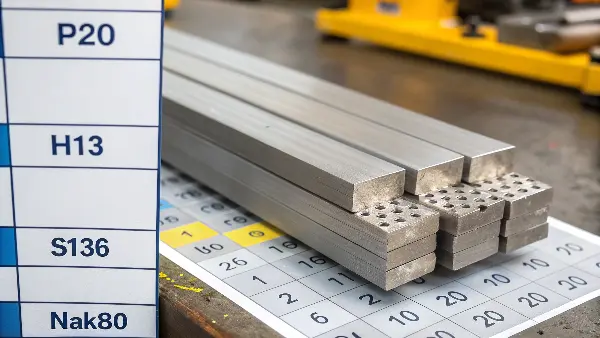
While there are hundreds of specialty steels available, you’ll find that a few key types cover the vast majority of injection molding applications. Understanding these four will empower you to make an informed decision for nearly any project you encounter. I’ve worked with these materials for years, and each has a personality and a purpose.
P20: The Versatile Workhorse
This is the most common mold steel in the world, and for good reason. It’s the jack-of-all-trades.
- Key Feature: It comes pre-hardened from the steel mill to around 30-32 HRC. This means we can machine it and put it directly into service without the need for a separate, high-temperature heat treatment process. This saves time and eliminates the risk of the steel warping during hardening.
- Best For: Medium production runs (up to 500,000 cycles) with non-abrasive plastics like ABS, PP, or HDPE. It’s also great for large mold bases and holders.
- Drawback: It is not very wear-resistant or corrosion-resistant. Don’t use it with glass-filled materials or PVC.
H13: The High-Volume Champion
When you need a mold to run and run, H13 is the answer.
- Key Feature: This is a tool steel that is machined soft, then heat-treated to achieve a high hardness of 48-52 HRC. This makes it incredibly tough and resistant to wear from abrasive plastics and the stresses of high-pressure injection.
- Best For: High-volume production (1 million+ cycles), die-casting, and molding abrasive, fiber-filled plastics.
- Drawback: It requires a very controlled heat treatment process. If done improperly, the steel can become brittle or warp. It will also rust if not properly maintained.
S136: The Clean and Polished Protector
When your parts need to be perfect and free of contamination, S136 is our go-to material.
- Key Feature: It is a stainless steel, meaning it has excellent corrosion resistance. It can also be heat-treated to a high hardness (around 50 HRC) and can be polished to a true optical mirror finish.
- Best For: Medical and food-grade applications, molding corrosive PVC, and making clear lenses or high-gloss parts.
- Drawback: It is more expensive and can be more challenging to machine than P20 or H13.
NAK80: The Polishing Star
If the primary requirement is a flawless, "out of the box" mirror finish, NAK80 is unmatched.
- Key Feature: This steel is precipitation-hardened to ~40 HRC from the mill. It does not require any additional heat treatment, so it’s dimensionally very stable. Its real magic is its uniform grain structure, which allows for exceptional polishing with very little effort.
- Best For: Ultra-high-polish applications like lenses, light pipes, and premium cosmetic components.
- Drawback: It is a premium steel with a higher cost. Its hardness is fixed at 40 HRC, which is not as high as a fully hardened H13.
Here’s a quick reference table:
| Steel Type | Hardness (Typical) | Key Feature | Best Application |
|---|---|---|---|
| P20 | 30-32 HRC | Pre-hardened, good value | Medium volume, general plastics |
| H13 | 48-52 HRC (Hardened) | High toughness & wear resistance | High volume, abrasive plastics |
| S136 | 48-52 HRC (Hardened) | Corrosion resistant, high polish | Medical, PVC, optical parts |
| NAK80 | 38-42 HRC | Exceptional polish, no heat treat | Premium cosmetic & optical parts |
Conclusion
Selecting the right mold steel isn’t just a technical detail; it’s a critical business decision that impacts your product’s quality and cost. By carefully considering your plastic material, production volume, and part requirements, you can build a reliable and cost-effective tool. At CavityMold, we help make this process simple.