
Struggling to get consistent results with High-Density Polyethylene (HDPE)? Defects like warping and sink marks can derail your project timelines and budgets. It often feels like a guessing game, leading to frustration and wasted resources. Mastering the core parameters is the key to stopping this cycle.
To optimize HDPE injection molding, you need to balance temperature, pressure, and cooling. Set the melt temperature between 180°C and 280°C, adjusting for the specific HDPE grade and flow rate. Use sufficient injection pressure for a complete fill, followed by a carefully set holding pressure to manage shrinkage. A controlled and consistent cooling cycle is critical to prevent warping and ensure dimensional stability in the final part.
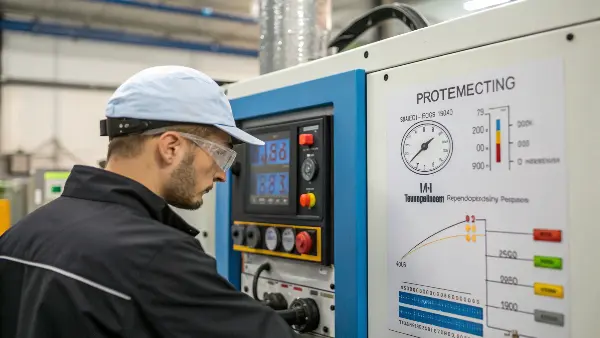
Getting these settings right is what separates a successful production run from a pile of scrap. HDPE is a fantastic material—durable, chemically resistant, and cost-effective. But its semi-crystalline nature means it behaves differently during molding than amorphous plastics like ABS or polycarbonate. It has a higher and more defined shrinkage rate. This can be challenging if you don’t know how to manage it. Over the years, I’ve seen many projects struggle simply because these fundamental parameters were not properly tuned. Let’s break down each one so you can get reliable, high-quality HDPE parts every time.
What Is the Ideal Melt Temperature Range for HDPE?
Are your HDPE parts coming out brittle or with flow marks? An incorrect melt temperature is often the culprit. Set it too low, and the plastic won’t flow properly. Set it too high, and you risk degrading the material, which weakens the final product and ruins its appearance.
The ideal melt temperature for HDPE is between 180°C and 280°C (356°F to 536°F). For higher melt flow index (MFI) grades, stick to the lower end of this range to prevent flash. For lower MFI grades that are more viscous, you will need a higher temperature to ensure the mold fills completely. Always start with the material supplier’s datasheet recommendations and adjust from there.
Choosing the right temperature is a balancing act. It’s not just about getting the plastic to melt; it’s about achieving the perfect flow characteristics for your specific mold and part geometry. I remember a project for a client in Australia who needed to produce large storage containers. We initially struggled with incomplete fills, or "short shots." The parts were large, and the plastic had to travel a long way. The team on-site was hesitant to increase the temperature, fearing material degradation. After reviewing their process, we realized the temperature was too low for the HDPE grade they were using, which had a low MFI. We gradually increased the barrel temperatures, and the problem was solved. The key is to understand how temperature affects both the material and the process.
Finding the Sweet Spot
The goal is to find a temperature that allows the material to flow easily without causing it to break down. If the temperature is too low, the viscosity of the melt is too high. This requires higher injection pressure to fill the mold, which can cause stress in the part. If the temperature is too high, the material can degrade. This breaks the polymer chains, reducing the part’s strength and impact resistance. It can also cause discoloration, often a yellowish or brownish tint.
Temperature’s Impact on the Final Part
A proper melt temperature directly influences the final product’s quality. Here’s a simple breakdown of what to look for.
| Parameter | Effect of Being Too Low | Effect of Being Too High |
|---|---|---|
| Melt Temperature | Short shots, flow lines, weld lines, high internal stress. | Material degradation, discoloration, flash, longer cooling time. |
| Part Appearance | Dull surface finish, visible flow patterns. | Glossy but potentially burnt surface, gas marks. |
| Mechanical Properties | Brittle, poor impact strength due to weak weld lines. | Reduced toughness and tensile strength due to polymer breakdown. |
At CAVITYMOLD, we always recommend starting in the middle of the recommended range from the datasheet and making small adjustments. Monitor the parts as they come out of the machine. This hands-on approach, combined with the technical data, will lead you to the perfect setting.
How Does Injection Pressure Influence HDPE Part Quality?
Are you dealing with sink marks or flash on your HDPE parts? These opposite problems are often caused by incorrect injection and holding pressures. Too little pressure causes under-packing and sinks, while too much causes flash, where material seeps out of the mold’s parting line.
Injection pressure must be high enough to fill the mold cavity completely and quickly, overcoming resistance to flow. This is followed by a lower holding pressure, which packs the part and compensates for shrinkage as it cools. For HDPE, a typical injection pressure is 80-140 MPa, with holding pressure set at 40-60% of that initial peak pressure.
Pressure is just as important as temperature. Think of it as a two-stage process. The first stage, injection pressure, is about speed and getting the material into every corner of the mold. The second stage, holding pressure, is a slower, more deliberate phase. Its job is to push more material into the cavity to compensate for the significant shrinkage HDPE experiences as it solidifies. I’ve seen many teams focus only on the initial injection and then wonder why their parts have voids or sink marks. They were missing the crucial holding phase. Getting this two-stage pressure profile right is vital for achieving dense, dimensionally accurate HDPE parts.
The Two Phases of Pressure
Understanding the difference between injection and holding pressure is key. They serve distinct purposes and must be set independently.
-
### Injection Pressure (First Stage)
This is the peak pressure applied to push the molten plastic from the screw into the mold cavity. The main goal here is to fill about 95-99% of the mold as quickly as possible without causing defects. The required pressure depends on the part’s wall thickness, flow length, and the HDPE’s viscosity. Thinner walls and more viscous materials require higher injection pressures. -
### Holding Pressure (Second Stage)
Once the mold is nearly full, the process switches from the "fill" phase to the "pack and hold" phase. The pressure is reduced to the holding pressure. This pressure is maintained for a set time while the gate is still molten. It allows more material to be packed into the cavity to compensate for the volume reduction that occurs as HDPE cools and crystallizes. Without adequate holding pressure, you’ll see sink marks over thick sections and incorrect part dimensions.
Here’s a quick guide to troubleshooting pressure-related issues.
| Defect Observed | Likely Pressure Problem | How to Adjust |
|---|---|---|
| Short Shots | Injection pressure is too low. | Increase injection pressure or speed. |
| Flash | Injection or holding pressure is too high; clamp force is too low. | Reduce holding pressure; verify clamp force is sufficient for part area. |
| Sink Marks | Holding pressure is too low or holding time is too short. | Increase holding pressure or extend holding time. |
| Warping | Uneven packing from inconsistent holding pressure. | Optimize holding pressure to ensure uniform packing. |
Finding the right balance often involves a bit of trial and error. Start with a moderate injection pressure and a holding pressure around 50% of that. Then, adjust based on the parts you produce.
What Is the Right Injection Speed for Molding HDPE?
Do you see flow marks, jetting, or burn marks on your HDPE parts? Your injection speed might be the cause. Moving too slowly can cause premature cooling and ugly flow lines. Moving too fast can trap air and degrade the material, resulting in burns and blisters.
A moderate-to-fast injection speed is generally recommended for HDPE to ensure the mold fills before the material freezes. However, the speed must be controlled to avoid issues. Profile your injection speed, starting slower to fill the gate area gently, then accelerating to fill the main body, and finally slowing down again at the end of the fill to prevent over-packing and flash.
Injection speed determines how fast the molten plastic enters the mold cavity. It is directly linked to both pressure and temperature. A faster speed generates more shear heat, which lowers the material’s viscosity and can help it flow better. But this same shear can also break down the polymer chains if it’s too aggressive. We once worked on a thin-walled container project where the initial settings produced perfect-looking parts. But when we tested them, they were brittle. The injection speed was too high, causing extreme shear that damaged the HDPE’s molecular structure. By profiling the speed—starting slow, then fast, then slow again—we filled the part quickly without degrading the material.
Shear Rate and Its Effects
When you push plastic through a narrow gate or thin-walled section, you create shear. This is the friction between layers of the flowing plastic.
-
### Shear Heating
This friction generates heat. A little shear heat can be good, as it temporarily reduces the plastic’s viscosity, helping it fill the mold. This is why you can sometimes lower the barrel temperature if you use a faster injection speed. However, too much shear heat, from an excessively high speed or a poorly designed gate, will degrade the HDPE. This leads to weakened parts, discoloration, and gassy defects like silver streaks or burn marks. -
### Controlling Speed with Profiling
Modern injection molding machines allow you to program different speeds for different parts of the screw’s travel. This is called speed profiling. A common strategy for HDPE is a slow-fast-slow profile.- Slow Start: Use a slow speed as the plastic first enters the mold through the gate. This prevents "jetting," where the material shoots across the cavity like a string, and ensures a good surface finish near the gate.
- Fast Fill: Increase the speed to fill the main cavity quickly. This maintains melt pressure and temperature, ensuring strong weld lines where flow fronts meet.
- Slow End: As the cavity becomes nearly full, slow down again. This gives air a chance to escape through vents and prevents the mold from being slammed shut, a phenomenon called "diesel effect" that causes burn marks. It also helps you precisely control the switchover to holding pressure.
Think of injection speed not as a single setting, but as a tool to control how the plastic behaves inside the mold.
Why Is Cooling So Crucial for HDPE Molding?
Are your HDPE parts warping or failing dimensional checks even when other parameters seem right? The problem likely lies in your cooling process. Because HDPE has a high and non-uniform shrinkage rate, how you cool the part is as important as how you inject it.
Cooling is critical for HDPE because it governs the crystallization process, which directly impacts shrinkage, warpage, and cycle time. A controlled and uniform cooling process, with mold temperatures typically between 20°C and 60°C (68°F to 140°F), is necessary to manage these effects and produce stable, consistent parts. Cooling can account for over 70% of the total cycle time.
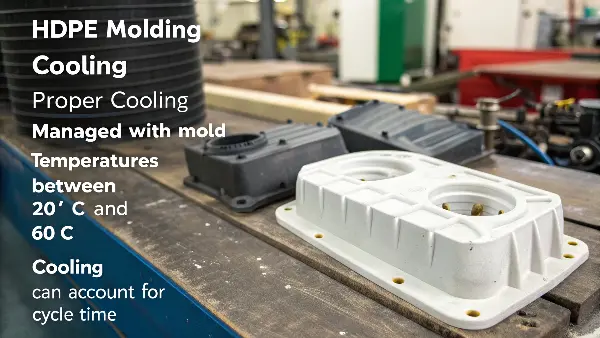
With many plastics, cooling is just about getting the part solid enough to eject. With semi-crystalline materials like HDPE, it’s about managing a phase change. As HDPE cools, its molecular chains organize themselves into ordered, crystalline structures. This process releases heat (latent heat of crystallization) and causes a significant volume reduction—shrinkage. If one part of the mold is cooler than another, that area will shrink faster and more completely, pulling on warmer sections and causing the part to warp. At CAVITYMOLD, we spend a lot of time designing cooling channels in our molds to ensure they remove heat evenly. It’s a non-negotiable step for high-precision HDPE molding.
Managing Crystallization and Shrinkage
The rate and uniformity of cooling directly control how crystals form in the HDPE.
-
### The Role of Mold Temperature
A warmer mold (e.g., 50°C) allows for a slower cooling rate. This gives the polymer chains more time to organize, resulting in higher crystallinity. Higher crystallinity leads to a stiffer, stronger, but also slightly more brittle part with higher overall shrinkage. A colder mold (e.g., 20°C) freezes the material quickly, resulting in lower crystallinity. The part will be more flexible and tougher but may have more internal stress. The key is consistency. The mold temperature must be stable and uniform across the entire cavity surface. -
### Cooling Time
Cooling time must be long enough for the part to solidify completely and be rigid enough to withstand the forces of ejection without deforming. Given HDPE’s properties, this is often the longest portion of the injection molding cycle. Trying to shorten the cooling time too much is a common mistake that leads to warped or distorted parts. It’s better to have a slightly longer cycle time with a 100% good part rate than a short cycle that produces 20% scrap.
Here’s how cooling parameters affect the final part.
| Parameter | Effect of Poor Control | Best Practice |
|---|---|---|
| Mold Temperature | Non-uniformity causes warpage. Too cold can trap stress. | Maintain a stable and uniform temperature using a mold temperature controller. |
| Cooling Time | Too short leads to post-ejection warping and dimensional instability. | Set based on the thickest wall section. Allow part to be fully rigid before ejection. |
| Cooling Channel Design | Hot spots in the mold lead to sink and voids. | Design channels to follow the part geometry and ensure even heat extraction. |
For any critical HDPE application, investing in good mold cooling design is paramount. It pays for itself through lower scrap rates and more consistent production.
How Can You Effectively Control HDPE Shrinkage and Warping?
Are you tired of parts that look good coming out of the mold, only to twist and warp as they cool? Shrinkage and warpage are the biggest challenges with HDPE, but they are controllable. It requires a holistic approach, looking at material, part design, mold design, and processing parameters together.
To control HDPE shrinkage and warping, use a uniform wall thickness in your part design. Design the mold with effective and uniform cooling channels. In processing, use adequate holding pressure and time to compensate for material shrinkage as it solidifies. Maintaining a consistent mold temperature is also essential to ensure the part cools and shrinks evenly, preventing internal stresses that lead to warpage.
This is where everything we’ve discussed comes together. Warping doesn’t just happen; it’s a physical manifestation of uncontrolled shrinkage. HDPE can shrink by as much as 1.5% to 4%, and if this shrinkage isn’t uniform, the part will warp. I once reviewed a project where a long, flat HDPE lid was consistently bowing in the middle. The processing parameters were perfect. The problem? The part design had thick ribs on one side and a thin wall on the other. The thick sections cooled slower and shrank more, pulling the entire part out of shape. We worked with the designer to core out the ribs, achieving a more uniform thickness, and the problem was solved without touching the machine settings.
A Four-Pronged Strategy
Controlling shrinkage and warping requires a systematic approach. You can’t fix a design flaw by just tweaking the holding pressure.
-
### 1. Part Design
This is the first line of defense.- Uniform Wall Thickness: This is the golden rule. Avoid thick and thin sections in the same part. If you need ribs for strength, design them to be no more than 50-60% of the wall thickness they are attached to.
- Generous Radii: Use smooth transitions and fillets instead of sharp corners. Sharp corners create stress concentrations and can cause differential cooling.
-
### 2. Mold Design
The mold is your tool for controlling the process.- Gate Location: Place gates in a way that the plastic flows from thick sections to thin sections. This allows the thick sections to be packed out effectively during the holding phase.
- Cooling System: As we discussed, a well-designed, uniform cooling system is non-negotiable. It’s often worth using mold flow simulation to verify your cooling strategy before cutting steel.
-
### 3. Material Selection
Not all HDPE is the same. Some grades have fillers (like glass fiber or talc) that significantly reduce shrinkage. If you are struggling with a standard grade, consider if a filled grade could work for your application. -
### 4. Processing Parameters
This is where you fine-tune the results.- Holding Pressure & Time: This is your primary tool for combating shrinkage. Use enough pressure and time to pack out the part as it solidifies.
- Mold & Melt Temperature: Higher temperatures generally lead to higher shrinkage. Keeping temperatures as low as practical while still achieving a good fill can help minimize the overall shrinkage you have to manage.
- Cooling Time: Ensure the part is stable before ejecting it.
By addressing all four of these areas, you move from fighting defects to proactively engineering quality into your HDPE parts.
Conclusion
Optimizing HDPE injection molding isn’t about a single secret setting. It’s about a systematic understanding of temperature, pressure, speed, and cooling. By carefully balancing these core parameters, you can master HDPE’s unique behavior and consistently produce high-quality, dimensionally stable parts that meet your project’s toughest requirements.