
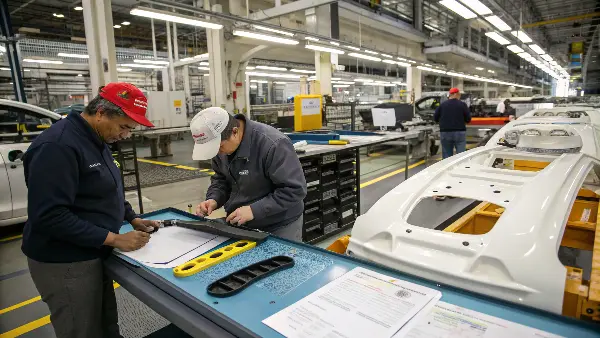
Your automotive project demands parts that can withstand intense heat, chemicals, and mechanical stress. Choosing the wrong material or process can lead to part failure, costly recalls, and production delays. Mastering nylon injection molding gives you the confidence to deliver durable, high-performance components every time.
To master nylon injection molding for automotive applications, you must focus on two key areas: material selection and process control. This involves selecting the right nylon grade, like PA6 or PA66, often with glass fiber reinforcement, based on thermal and mechanical needs. Then, you must meticulously control processing parameters, especially material drying, mold temperature, and injection pressures to ensure part quality.
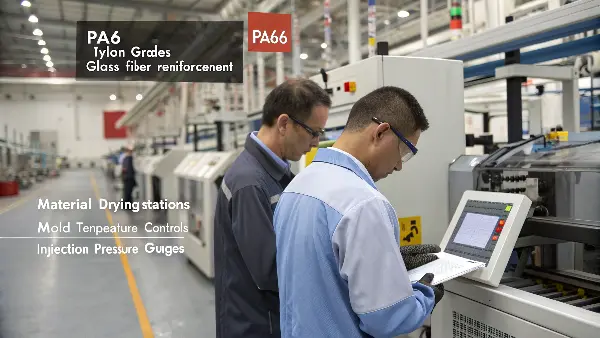
The automotive industry relies heavily on nylon for a reason. It offers an incredible balance of strength, temperature resistance, and cost-effectiveness. But I’ve seen firsthand that this material can be tricky. It’s not as forgiving as polypropylene or ABS. Small mistakes in material handling or machine settings can quickly lead to big problems. Understanding the "why" behind each step is what separates a successful project from a failed one. Let’s break down the critical elements you need to get right to produce flawless nylon automotive components.
Why Is Choosing Between PA6 and PA66 So Critical for Automotive Parts?
You look at two material datasheets, PA6 and PA66. They appear similar, and the price difference might tempt you to choose the cheaper option. But making the wrong choice can lead to a critical under-hood component warping from heat or an exterior part cracking on impact.
Choose PA66 for applications demanding higher heat resistance and stiffness, such as under-hood components like engine covers or radiator end tanks. Opt for PA6 for parts requiring better impact strength and a superior surface finish, like decorative wheel covers or fuel caps. The choice is critical because their distinct molecular structures directly dictate their performance in the demanding automotive environment.

At CavityMold, we often get questions about which nylon is "better." The answer is always, "It depends on the application." PA6 and PA66 are both polyamides, but their chemical makeup is slightly different, which has a huge impact on their behavior. PA66 has a more tightly packed, crystalline structure, which gives it a higher melting point and better stiffness, especially at elevated temperatures. PA6 is a bit more flexible and absorbs impact better.
The real game-changer is the addition of reinforcements like glass fibers (GF). Adding 30% glass fiber to PA66 (creating PA66-GF30) dramatically increases its strength and heat resistance. This makes it a go-to material for intake manifolds and structural brackets. However, adding fibers also changes its shrinkage and can make it more abrasive on the mold.
Here’s a quick comparison to help guide your decision:
| Property | Polyamide 6 (PA6) | Polyamide 66 (PA66) | Why It Matters for Automotive |
|---|---|---|---|
| Heat Deflection Temp. | Lower | Higher | Crucial for under-hood parts exposed to engine heat. |
| Stiffness (Flexural Modulus) | Good | Excellent | Determines how much a part will bend under load. |
| Impact Strength | Excellent | Good | Important for parts that may experience bumps or collisions. |
| Water Absorption | Higher | Lower | Affects dimensional stability and mechanical properties over time. |
| Surface Finish | Excellent | Good | Key for visible interior and exterior trim pieces. |
| Cost | Lower | Higher | Impacts the overall budget of the component. |
I remember a project involving an engine cooling fan shroud. The initial design used PA6, which was cost-effective. But during testing, we noticed slight warping near the radiator connection. The part wasn’t failing, but it wasn’t meeting the tight dimensional specs. We switched to a PA66 with 15% glass fiber. It provided that extra bit of thermal stability without a huge cost increase and solved the problem completely. This is why a deep understanding, not just a datasheet glance, is so important.
What Special Considerations Does Nylon Require in Automotive Mold Design?
You’ve specified a great mold design that works perfectly for other common plastics like ABS or polypropylene. When you try to run nylon, however, you’re suddenly dealing with flash all over the part, unexpected warpage, or pieces that just won’t eject properly. The problem isn’t the design itself, but that it wasn’t tailored for nylon’s unique properties.
Nylon mold design must primarily account for its low viscosity and high, non-uniform shrinkage. This demands extremely tight mold tolerances to prevent flash, larger and more numerous vents to allow gas to escape, and a well-designed cooling system to manage warpage. Gate location and size are also critical to ensure balanced fill and proper packing, preventing cosmetic and structural defects.

When we design a mold for a nylon automotive part, our mindset is different from the start. Nylon flows like water when it’s melted. This low viscosity means it will find any gap in the mold, no matter how small. If the two halves of the mold don’t seal perfectly, you’ll get flash—thin sheets of unwanted plastic around the part’s edge. This means the mold machining and fitting must be flawless.
Then there’s shrinkage. Nylon, especially glass-filled grades, shrinks significantly as it cools. More importantly, it shrinks differently depending on the direction of plastic flow and the wall thickness. This differential shrinkage is the main cause of warpage. To counter this, we design the mold with:
Key Mold Design Features for Nylon
- Strategic Cooling Channels: We can’t just run a simple cooling circuit. We have to place cooling lines carefully to ensure the entire part cools down at the same rate. For complex parts, we often recommend conformal cooling, where the channels follow the part’s contour for ultimate temperature control. A hot mold (80°C or higher) is essential for nylon to achieve proper crystallinity, so the cooling system is really a "temperature control" system.
- Robust Venting: As nylon is processed, it can release moisture and other gases. If these gases are trapped in the mold cavity, they cause burn marks, incomplete parts (short shots), and weak weld lines. We design vents—shallow channels typically 0.015-0.03 mm deep—along the parting line and near the last places to fill, giving the gas a path to escape.
- Correct Gate Design and Location: The gate is where the plastic enters the cavity. For nylon, its size and location dictate how the part fills. We often place the gate at the thickest section of the part. This allows us to apply packing pressure effectively to compensate for shrinkage, minimizing sink marks. For glass-filled nylon, we have to be careful that the gate isn’t so small that it degrades the fibers, weakening the part.
I recall working on a set of interior door handles. The initial design had a single gate, but the parts were warping. By switching to a hot runner system with three valve gates, we could control the fill pattern precisely. It allowed us to fill and pack the part evenly, eliminating the stress that caused the warpage. It’s these specific design choices that make or break a nylon project.
What are the Key Processing Parameters to Control for Flawless Nylon Parts?
Your material choice is perfect, and your mold is expertly designed. Yet, when you start production, the parts coming off the line are brittle, have splay marks on the surface, or don’t match the dimensions you specified. This can be frustrating and costly, leading to high scrap rates. The issue isn’t the material or the tool; it’s that the injection molding machine settings aren’t dialed in for nylon’s specific needs.
The three most critical processing parameters for nylon are material drying, melt temperature, and mold temperature. Because nylon is hygroscopic, it must be thoroughly dried to a moisture content below 0.2% to prevent brittleness. Precise control of melt and mold temperatures is then essential for achieving proper material flow, full crystallization, and the final part’s desired strength and dimensional stability.
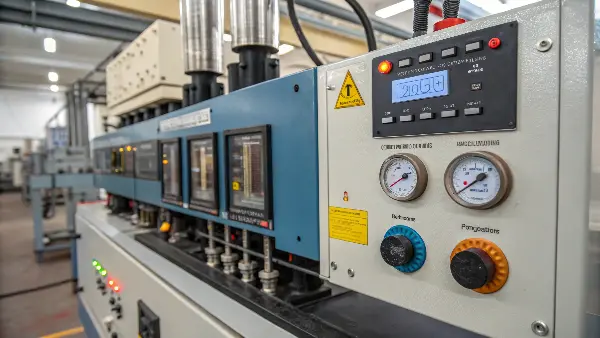
Over my career, I’ve learned that you can’t treat nylon like other plastics. It’s sensitive, and you have to respect its chemistry. Getting the process right is a matter of discipline and paying attention to the details.
The Three Pillars of Nylon Processing
-
Drying: The Unbreakable Rule
Nylon loves water. It’s hygroscopic, meaning it absorbs moisture from the air. If you try to mold nylon pellets that haven’t been properly dried, the water in the plastic will turn to steam at processing temperatures. This violent reaction, called hydrolysis, breaks the polymer chains. The result? You get parts with silver streaks (splay) on the surface that are incredibly brittle, even if they look fine otherwise. We insist on drying nylon in a desiccant dryer for at least 4 hours at around 80-90°C. For critical applications, we use a moisture analyzer to confirm the moisture content is below 0.2% (or 0.1% for some grades) before it ever goes into the machine. This is the single most common cause of failure in nylon molding. -
Mold Temperature: The Key to Stability
Many processors are tempted to run the mold cool to shorten cycle times. This is a huge mistake with nylon. Nylon needs a hot mold (typically 80°C to 120°C) to achieve its full crystalline structure. This structure is what gives the material its hardness, chemical resistance, and dimensional stability. Molding nylon in a cold tool results in a part that is more amorphous. It might look okay coming out of the machine, but it will continue to shrink and warp for days or even weeks afterward. For any automotive part requiring tight tolerances, a hot mold is non-negotiable. -
Melt Temperature & Injection Speed: The Balancing Act
You have to keep the nylon within its ideal melt temperature window. Too cold, and it won’t flow properly, leading to weak weld lines where two flow fronts meet. Too hot, and the material starts to degrade, releasing gases and losing its mechanical properties. At the same time, injection speed matters. A fast injection can fill the part quickly before thin sections freeze, but too fast can cause shear burn. It’s a careful balance that often requires a "fill profile"—starting slow, speeding up to fill the bulk of the part, and slowing down again at the very end to prevent flashing.
Getting these three things right—dry material, a hot mold, and a balanced injection process—accounts for 90% of the success in molding high-quality nylon automotive parts.
How Do You Troubleshoot the Most Common Defects in Nylon Automotive Parts?
Production is running smoothly, and then it happens. You start seeing parts that are warped, have ugly sink marks, or snap easily. Every bad part is a drain on your profit and a threat to your delivery schedule. The key is to not panic, but to have a systematic way to identify the cause and implement the right solution quickly.
To troubleshoot common nylon defects, start with the most probable causes. For warpage, first check for uneven mold temperatures or drastic changes in wall thickness. Address sink marks by increasing packing pressure or enlarging the gate. For brittleness, your number one suspect is always wet material; verify your drying process immediately. A methodical approach will save you time, material, and headaches.
Troubleshooting on the factory floor can feel chaotic. I’ve found that the best approach is to change only one thing at a time, starting with the easiest and most likely solution. In our experience at CavityMold, most issues with nylon trace back to a few core areas: moisture, temperature, or pressure.
I can’t tell you how many times a client has called us about brittle parts, convinced the mold is bad. The first question I always ask is, "How are you drying your material, and have you checked the moisture content?" Nine times out of ten, their dryer isn’t working properly or they skipped the drying step to save time.
Here is a structured guide we use to diagnose and solve the most frequent problems with nylon parts.
Troubleshooting Guide for Nylon Defects
| Defect | Potential Causes | Solutions to Try (In Order of Likelihood) |
|---|---|---|
| Warpage / Distortion | 1. Uneven Cooling: Mold halves are at different temperatures. 2. Part Design: Non-uniform wall thickness. 3. Process: Overpacking the part or poor gate location. |
1. Check mold temps. Use a pyrometer to verify both sides are even and at the recommended temperature (e.g., 80°C+). 2. Consult with the designer about uniforming walls. 3. Decrease packing pressure or time; consider moving the gate. |
| Sink Marks | 1. Insufficient Packing: Not enough material pushed in to compensate for shrinkage. 2. Gate Freezes Early: Gate is too small, solidifying before packing is complete. 3. Process Temps: Melt or mold temp is too high. |
1. Increase packing pressure and/or time. 2. Enlarge the gate diameter. 3. Lower melt temperature slightly. |
| Brittleness | 1. WET MATERIAL: This is Cause #1. Hydrolysis has broken the polymer chains. 2. Degradation: Material spent too long in the hot barrel. 3. Cold Mold: Insufficient crystallization. |
1. DRY THE MATERIAL. Verify moisture is <0.2% with an analyzer. Check dryer performance. 2. Reduce barrel residence time or lower melt temperature. 3. Increase mold temperature to the recommended level. |
| Flash | 1. Process: Injection or packing pressure is too high. 2. Tooling: Mold parting line is dirty or damaged. 3. Machine: Not enough clamp tonnage to hold the mold shut. |
1. Reduce injection speed or packing pressure. 2. Clean the parting line surface. Inspect for any dings or wear. 3. Increase clamp tonnage. |
By following a logical process like this, you can solve problems efficiently. It turns a crisis into a problem-solving exercise and ensures you get back to producing good parts as quickly as possible.
Conclusion
Mastering nylon molding for automotive parts is not about a single secret. It’s about a disciplined approach. Success hinges on selecting the right material for the job, designing a mold that respects nylon’s unique behavior, and controlling the process with precision, especially when it comes to drying and temperature.