
Are you trying to use HDPE for thin-wall applications but keep running into issues like incomplete fills and warping? These frustrating problems can lead to costly delays and make you question if HDPE is even viable. But what if you could push past these limits with the right strategies?
Yes, you can absolutely master thin-wall molding with HDPE. The solution lies in a three-part strategy: using high-melt-flow HDPE grades, designing a specialized mold to maximize flow, and fine-tuning the injection process. Specifically, focusing on larger gates, strategic venting, and a robust cooling system is essential to manage HDPE’s unique properties and produce strong, consistent parts.
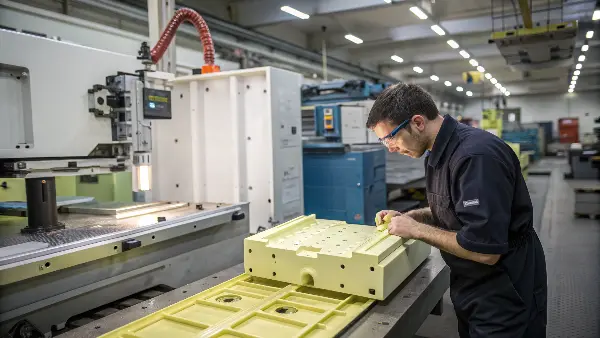
That’s the quick overview, but achieving real mastery requires a much deeper dive into the specifics. Over more than a decade, we’ve learned that success with thin-wall HDPE isn’t about one magic fix; it’s about systematically solving each challenge the material presents. Let’s walk through the key questions we’ve had to answer to get it right.
Why Does HDPE Behave So Differently Than PP in Thin Walls?
Do you find yourself expecting HDPE to behave just like polypropylene, only to be met with short shots and processing headaches? This common assumption leads to failed trials and wasted resources, making you feel stuck. The key is to stop treating them the same and start understanding their core differences.
HDPE’s higher viscosity and unique molecular structure make it more resistant to flow than PP, especially in thin sections. It demands higher injection pressures and precise temperature control. Additionally, its semi-crystalline nature requires a carefully managed cooling process to prevent shrinkage and warpage, a more significant challenge than when using many standard polypropylene grades designed for thin-wall applications.
To truly get a handle on this, you have to look beyond the surface. I remember a project with a client developing a new line of reusable food containers. They were trying to use a mold designed for PP to run HDPE parts, and the results were disastrous—less than 80% of the parts were filling completely. The project manager, someone with a background a lot like yours, was convinced the material was faulty. But the problem wasn’t the material; it was the approach.
HDPE’s resistance to flow, technically known as its rheology, is the main culprit. We need to look at a few key properties to see why.
Material Property Breakdown
First, the Melt Flow Index (MFI) tells you how easily a plastic flows at a specific temperature and pressure. For thin-wall molding, you need a very high MFI. While you can find PP grades with MFIs of 60 or higher, standard HDPE grades are often much lower. To succeed with thin-wall HDPE, you must source a specialized grade with an MFI of 30 g/10 min or more.
Second is Molecular Weight Distribution (MWD). A narrow MWD, common in high-performance HDPE, can result in better physical properties like impact strength, but it often makes the material more viscous and harder to process. This trade-off between final part performance and processability is a constant balancing act.
Here’s a simplified comparison to illustrate these differences:
| Property | Thin-Wall HDPE Grade | Thin-Wall PP Grade | What It Means for You |
|---|---|---|---|
| Melt Flow Index (MFI) | 30 – 50 g/10 min | 40 – 70 g/10 min | HDPE requires more force to fill thin sections. |
| Shrinkage Rate | High (1.5% – 2.5%) | Medium (1.0% – 2.0%) | Your mold must be designed to account for more shrink. |
| Processing Temp | ~230 – 280°C | ~220 – 260°C | Higher heat is needed to make HDPE flow properly. |
| Flexural Modulus | Higher | Lower | HDPE parts will feel stiffer and more rigid. |
Understanding these fundamental differences is the first step. You can’t force HDPE to act like PP. You have to adapt your mold design and your process to accommodate its unique personality.
How Can Mold Design Overcome HDPE’s Flow Resistance?
Are you designing molds for HDPE using the same rules you use for other materials? If so, you’re likely creating a system that works against the material, causing high stress and inconsistent parts. This frustrating cycle can be broken by designing the mold specifically for HDPE’s challenging flow characteristics.
An optimized mold for thin-wall HDPE must feature a high-flow runner system, correctly sized gates, and extensive venting. Hot runner systems with valve gates are ideal for precise control. Gates should be placed to ensure the shortest flow path, and robust venting channels along the parting line and with ejector pins are critical to allow trapped air to escape quickly.
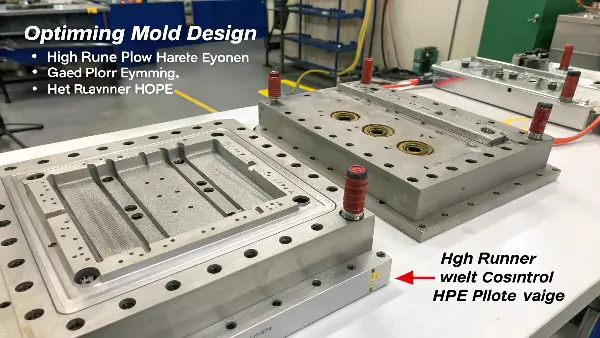
Design is where you win or lose the battle. If your mold isn’t built to help the material, no amount of process tweaking will save you. A few years ago, we were tasked with creating a mold for a 1-liter thin-wall pail. The wall thickness was just 0.6mm. For a part that large with such thin walls, every detail of the mold design was critical. We knew from experience that a standard design wouldn’t stand a chance.
The solution came down to three core areas of the mold design that we had to get perfect.
1. Runner and Gating System
The journey of the molten plastic from the nozzle to the cavity needs to be as easy as possible. For HDPE, this means:
- Hot Runners: We almost exclusively use hot runner systems for thin-wall HDPE. They keep the material at an optimal temperature right up to the gate, which drastically reduces the pressure needed to fill the part. A cold runner would sap too much heat and pressure before the plastic even enters the cavity.
- Valve Gates: Valve gates give you precise control over when and how the plastic enters the cavity. This helps prevent cosmetic defects like jetting and allows for better packing pressure control, which is vital for managing HDPE’s high shrinkage.
- Gate Location and Size: The gate is the doorway to your part. For HDPE, it needs to be wide and placed to ensure the plastic flows in a single, uniform direction. For the 1-liter pail, we used a large central hot drop to fill the base first and let the material flow evenly up the walls.
2. Venting Strategy
If the air inside the cavity has nowhere to go, the plastic can’t get in. It’s that simple. HDPE flows fast under high pressure, so the air needs to escape just as quickly.
- Parting Line Vents: We design continuous vents around the entire perimeter of the part at the parting line, typically 0.015-0.025 mm deep. This is small enough to stop the plastic from flashing but large enough to let air out.
- Vented Ejector Pins: In areas far from the parting line, like the bottom corners of a container, we use vented ejector pins. These pins have small channels ground into their sides, creating an escape route for trapped air pockets that would otherwise cause burn marks or short shots.
3. Structural Rigidity and Ejection
The high pressures involved—often exceeding 20,000 PSI—can cause the mold plates to flex.
- Robust Mold Base: Your mold needs to be built like a tank. We use high-hardness tool steels like H-13 and ensure there are enough support pillars to prevent any deflection under pressure. If the mold flexes even slightly, it can alter the wall thickness and cause part failure.
- Stripper Ring Ejection: For symmetrical parts like cups and pails, a stripper ring is often better than ejector pins. It pushes the part off the core evenly around the entire rim, preventing the thin, warm part from deforming or tearing during ejection.
By focusing on these design elements, you create a path of least resistance for the material, turning a difficult process into a reliable one.
How Do You Fine-Tune The Process for Flawless HDPE Parts?
You have a perfect mold and the right HDPE grade, but your parts are still coming out warped or brittle. It’s frustrating when you’ve invested so much and still aren’t getting results. The final piece of the puzzle is dialing in the machine settings, as even a perfect mold can’t compensate for a flawed process.
To perfect the process for thin-wall HDPE, you must use high injection speeds to fill the cavity before the material freezes, followed by precise packing pressure to manage shrinkage. Maintain a high melt temperature to keep viscosity low, but balance it with an aggressive, uniform cooling cycle. Any imbalance in this sequence will lead to defects like warpage or weak spots.
Processing thin-wall HDPE is a delicate dance between speed, pressure, and temperature. I often compare it to cooking a perfect steak: you need a very high heat to get a good sear on the outside (fast injection), but then you have to manage the internal temperature carefully to cook it just right (packing and cooling). A few degrees or a few seconds off, and the result is ruined.
Let’s break down the critical machine parameters you need to control.
The Injection Phase: Speed is Everything
The "injection velocity" or "fill speed" is paramount. Because thin-wall sections cool down almost instantly, you have to inject the molten HDPE into the cavity as fast as the machine will allow.
- Stage 1: Filling. We aim to fill 95-98% of the part in a fraction of a second. This high-speed injection generates shear heat within the plastic itself, which helps lower its viscosity and push it into the furthest corners of the mold before it solidifies. A slow injection will result in a "short shot," where the part doesn’t fill completely.
- Stage 2: Packing. Once the cavity is full, we switch from speed control to pressure control. This is the "packing" or "holding" phase. For HDPE, with its high shrinkage rate, this phase is crucial. We apply a specific amount of pressure to force more material into the cavity to compensate as the part cools and shrinks. Without proper packing, you’ll get sink marks and voids.
The Temperature Balancing Act
Temperature control is a game of trade-offs.
- Melt Temperature: You need a hot melt to ensure the HDPE flows easily. We typically run HDPE between 230°C and 280°C. Too low, and the viscosity is too high. Too high, and you risk degrading the material, which reduces its strength and can cause discoloration.
- Mold Temperature: This is where it gets tricky. A warm mold helps the plastic flow better, but a cold mold helps the part solidify faster, reducing cycle time. For HDPE, we often use a meticulously designed cooling system with multiple zones. We might run the core slightly cooler than the cavity to encourage the part to shrink onto the core for easier ejection. The key is uniformity. Any hot or cold spots on the mold surface will cause differential shrinkage, which is the primary cause of warpage. Think of it like a car with one brake working harder than the others—it’s going to pull to one side. The same thing happens with your part if cooling is uneven.
Here is a typical process window for a thin-wall HDPE part:
| Parameter | Typical Value | Reason |
|---|---|---|
| Injection Speed | Very High (e.g., >200 mm/s) | Fills the cavity before the plastic freezes off. |
| Injection Pressure | High (up to 25,000 PSI) | Overcomes the material’s resistance to flow. |
| Packing Pressure | 40-60% of Injection Pressure | Compensates for high material shrinkage to prevent sinks and voids. |
| Melt Temperature | 230 – 280°C | Lowers viscosity for better flow without degrading the material. |
| Mold Temperature | 15 – 40°C | Balances flow with a fast cooling cycle; must be uniform. |
| Cycle Time | 3 – 8 seconds | Driven by cooling time; efficiency here is key to profitability. |
Getting these parameters right requires patience, experience, and a systematic approach. We always start with a baseline setting and adjust one variable at a time, documenting the effect on the final part. It’s this methodical process that turns a challenging material into a reliable and profitable product.
Conclusion
Mastering thin-wall HDPE is not about discovering one secret but about applying a complete system. By choosing the right material, engineering a mold built for flow, and fine-tuning your process for speed and precision, you can overcome the challenges and produce high-quality, lightweight, and durable parts successfully.