
Are you constantly juggling the demands of cost, quality, and deadlines for your projects? The pressure to find the perfect manufacturing partner is immense, and the debate between nearshoring to Mexico or sourcing from China only adds to the complexity. You need a solution that truly delivers.
Yes, a strategic Chinese mold supplier like CavityMold can often provide a superior overall value proposition. By leveraging a highly developed manufacturing ecosystem, advanced technology, and economies of scale, we can deliver high-precision molds, especially complex multi-cavity designs, at competitive prices and with surprisingly fast lead times that challenge the proximity advantages of Mexican suppliers.
The decision between sourcing from China versus Mexico is one I discuss with project managers almost every week. It’s not just about numbers on a spreadsheet; it’s about risk, reliability, and finding a partner who understands your project’s unique needs. Many people see Mexico’s proximity to North America and assume it’s the default best choice. But the global manufacturing landscape is more nuanced than that. Let’s break down the real factors at play so you can make a truly informed decision for your next project.
Is it cheaper to manufacture in Mexico or China?
Are you trying to lower your tooling costs without sacrificing quality? You might assume Mexico is the automatic winner on price because of shipping, but hidden costs and production efficiencies can quickly change the entire calculation and impact your budget.
China is often cheaper for complex, high-precision molds and high-volume production runs. This is due to a deeply integrated supply chain, a massive skilled labor pool, and government-supported infrastructure that drives down costs. Mexico may offer lower landed costs for simpler, bulky products where shipping from Asia is a major expense.

When we talk about cost, we have to look at the total cost of ownership, not just the initial quote. I remember a project manager from an Australian company, let’s call him Alex, who came to us with a project for a complex housing for a consumer electronic device. He had a quote from a Mexican supplier that seemed slightly cheaper upfront.
However, once we dug into the details, the picture changed. Our ability to create a high-cavitation mold meant his piece price would be significantly lower over the production run. Furthermore, our experience in Shenzhen’s electronics ecosystem meant we could source specific high-grade steel and components for the mold at a fraction of the cost his Mexican supplier could.
Let’s break down the cost components more clearly:
| Cost Factor | China (CavityMold) | Mexico | Key Considerations |
|---|---|---|---|
| Tooling (Mold Cost) | Highly Competitive | Competitive, but can be higher for complex molds | China’s specialization and scale often lead to lower costs for intricate, multi-cavity, or high-precision molds. |
| Labor Cost | Low, but rising | Historically low, but rising due to demand | The key is labor efficiency. Chinese workers in specialized fields are often more productive, offsetting wage differences. |
| Material Costs | Excellent | Good | China is a global hub for raw materials like steel and specialty plastics, providing cost and availability advantages. |
| Shipping & Tariffs | Higher shipping cost to NA | Lower shipping cost to NA | USMCA offers tariff advantages for Mexico. This is a clear win for Mexico, but must be weighed against production savings. |
| Total Cost | Often lower for complex or high-volume projects | Often lower for simple, bulky projects | You must calculate the full picture: mold cost + piece price + shipping + tariffs. |
In Alex’s case, the total cost of ownership with us at CavityMold was nearly 15% lower over the product’s lifecycle. It’s a perfect example of why you can’t judge a book by its cover, or a quote by its initial price.
Is Mexico more productive than China?
You’re facing a tight deadline and need your molds delivered fast. Does Mexico’s shorter shipping route to North America automatically mean it’s more productive and you’ll get your parts sooner? The answer isn’t as simple as looking at a map.
In terms of manufacturing productivity, China often has a significant edge. Major hubs like Shenzhen operate with incredible efficiency, leveraging advanced automation, a massive and highly skilled workforce, and integrated supply chains that run 24/7. While Mexico’s shipping is faster to the US, China’s rapid prototyping and production speed can frequently result in a shorter overall project timeline.
Productivity isn’t just about how fast a container ship can cross the ocean. It’s about the entire process, from the day you send the CAD file to the day you have a finished mold ready for production. I’ve seen this firsthand for over a decade. The ecosystem we operate in here in Shenzhen is built for speed and efficiency.
A few years ago, we worked with a German automotive client who needed a complex mold for an interior component. Their timeline was extremely aggressive. They were also evaluating a supplier in Mexico, believing the nearshoring option would be faster. However, their Mexican option quoted an 8-week lead time for the tool. We quoted 5 weeks. They were skeptical, but we were able to deliver on that promise.
How? It comes down to a few key factors that define modern Chinese manufacturing productivity:
- Technology and Automation: Our workshops are filled with high-speed CNC machines, advanced EDMs, and precise measurement tools that often run around the clock. This level of automation reduces manual errors and dramatically speeds up the mold-making process.
- Integrated Supply Chain: If I need a specific type of hot runner system or a special coating for a mold, I can have a supplier deliver it within hours, not days or weeks. This hyper-local, specialized supply chain is a massive advantage that is hard to replicate.
- Workforce Skill and Agility: Our engineers and technicians have spent their careers making molds. They can look at a design, anticipate problems, and suggest improvements that save time and money. This deep expertise allows for rapid problem-solving.
This table shows a clearer comparison:
| Productivity Factor | China (Shenzhen Hub) | Mexico |
|---|---|---|
| Prototyping Speed | Extremely fast (days) | Moderate (can take weeks) |
| Tooling Lead Time | Highly efficient, especially for complex molds | Improving, but can lag on complex tools |
| Supply Chain | Deeply integrated and hyper-specialized | Growing, but less mature for components |
| Workforce | Massive, highly skilled, and experienced | Skilled, but can face shortages |
For the German client, our speed meant they could start production three weeks earlier, a massive win for their product launch. This shows that true productivity is about the entire system, not just one part of it.
What are the advantages and disadvantages of manufacturing in Mexico?
Nearshoring to Mexico seems like the perfect solution on paper, doesn’t it? It offers a way to simplify your supply chain and avoid long-distance shipping. But to make a smart decision, you need to look at both sides of the coin honestly.
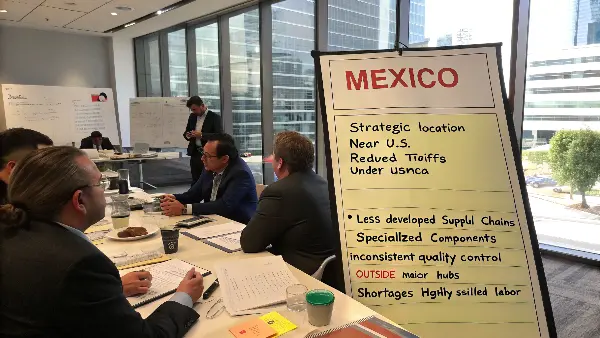
Mexico’s primary advantages are its strategic location next to the U.S. and its benefits under the USMCA trade agreement, which reduces tariffs and shipping times. Key disadvantages can include a less-developed supply chain for highly specialized components, potential inconsistencies in quality control outside of major hubs, and shortages of highly skilled labor for complex manufacturing.
I always advise my clients to be objective. While CavityMold is based in China, I understand that for certain projects, Mexico can be a great fit. It’s not about being "pro-China" or "anti-Mexico"; it’s about being "pro-success" for your project. If you are making large, simple plastic containers where shipping is the dominant cost, Mexico might be your best bet.
However, for the kind of precision work we do—like intricate molds for medical devices or consumer electronics—the details matter immensely. I worked with a project manager who shifted production of a simple component to Mexico and was very happy. But when they tried to move a more complex assembly involving multiple precision parts, they ran into trouble. Their Mexican supplier struggled to source the specific electronic components needed and couldn’t match the tooling precision they were used to from us. They ended up keeping the complex work in China while using Mexico for the simpler parts.
This "China+1" strategy is becoming very common. It’s a smart way to balance risk and leverage the strengths of each region. Here’s a balanced look at Mexico’s pros and cons:
The Case for Manufacturing in Mexico
| Advantages | Disadvantages |
|---|---|
| Proximity to North America | Supply Chain Gaps |
| Drastically reduces shipping times and costs. | Less mature ecosystem for specialized raw materials and components compared to Asia. |
| USMCA Benefits | Skilled Labor Shortages |
| Favorable tariff and trade conditions for the US and Canada. | While the workforce is growing, there can be a shortage of engineers and technicians with deep experience in highly complex tooling. |
| Intellectual Property | Infrastructure Variability |
| Stronger IP protection framework under USMCA. | Quality of roads, ports, and power can be inconsistent outside of established industrial zones. |
| Growing Industrial Base | Quality Control Consistency |
| Significant investment is flowing into the country, improving capabilities. | Can be a challenge; requires rigorous vetting and on-the-ground management to ensure standards are met consistently. |
Understanding this balance is key. Mexico is a powerful and rising manufacturing player, but it’s important to match its strengths to your project’s specific needs. For high-tech, precision-dependent projects, the deep ecosystem in China often remains the more reliable choice.
Will Mexico overtake China in manufacturing?
With all the talk of nearshoring and diversifying supply chains, it’s a big question on every project manager’s mind. Are we seeing a fundamental shift where Mexico will become the world’s new factory? It’s a compelling idea, but the reality is far more complex.
While Mexico’s manufacturing sector is booming and capturing new investment, it is very unlikely to overtake China’s dominant position in the foreseeable future. China’s manufacturing power is built on immense scale, an unparalleled supply chain ecosystem, massive domestic demand, and advanced technological infrastructure that Mexico cannot replicate quickly.
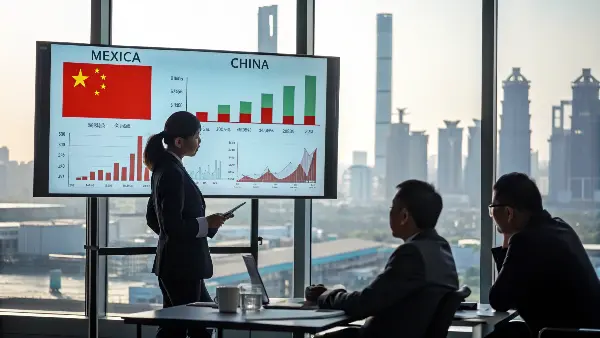
I believe we are moving away from a world with one single "factory" to a world with multiple specialized hubs. The conversation is changing from "China vs. Mexico" to "China and Mexico." Smart companies are not abandoning China; they are adopting a "China+1" strategy. They keep their complex, high-value, or high-volume manufacturing with trusted partners like us in China and use Mexico as a complementary hub for regional assembly or for products where logistics are the main cost driver.
Think about the sheer scale. The manufacturing output of Shenzhen alone is larger than that of the entire country of Mexico. This isn’t just about factories; it’s about the entire network that supports them. It’s the raw material suppliers, the component makers, the logistics experts, the machine builders, and the millions of skilled workers. This ecosystem took decades to build and creates efficiencies that are incredibly difficult to match.
Here’s my perspective on the future roles of each country:
| Feature | China’s Future Role | Mexico’s Future Role |
|---|---|---|
| Specialization | Hub for high-tech, complex manufacturing, R&D, and projects requiring deep supply chains (e.g., electronics, medical, advanced molds). | Hub for North American assembly, bulky goods, and industries sensitive to logistics costs (e.g., automotive, appliances). |
| Scale | Will remain the leader in mass production and volume, driven by its own massive domestic market and global exports. | Will continue to scale as a regional powerhouse, but not on a global scale comparable to China. |
| Strategy for Buyers | The core partner for innovation, complex components, and cost-effective, high-volume production. | The "plus one" in a "China+1" strategy, used to de-risk supply chains and serve the North American market efficiently. |
So, will Mexico overtake China? No. Will it become a more important and powerful player in global manufacturing, especially for the North American region? Absolutely. The smart approach for a project manager like you is not to pick a side, but to understand the strengths of each and build a flexible, global supply chain that uses the best partner for each specific job.
Conclusion
The choice between China and Mexico isn’t a simple one. It’s about finding the right partner for your specific needs. While Mexico offers clear logistical benefits for North America, a strategic Chinese supplier like CavityMold often delivers a superior combination of cost, quality, and speed for complex mold manufacturing.