

Injection molding is most valuable when a part will be repeated at volume and the mold can convert one controlled process into many consistent parts. Its advantages include repeatability, complex geometry, integrated features, multi-cavity output, broad thermoplastic choice, and a finished surface straight from the tool. Those benefits only appear when the design, material, tooling, machine, and inspection plan are aligned.

What are the main advantages of injection molding?
| Advantage | Why it matters to a buyer | What must be controlled |
|---|---|---|
| Repeatable parts | A validated mold and process can produce consistent geometry across a production run | Material lot, mold temperature, cavity balance, pack, cooling, and inspection |
| Complex geometry | Ribs, bosses, snaps, textures, and other features can be formed in one operation | Draft, wall transitions, shutoffs, slides, lifters, vents, and ejection |
| High output | Multi-cavity tools and short cycles can reduce labor per part at the right volume | Machine capacity, cycle stability, automation, mold maintenance, and quality checks |
| Surface finish | Texture, polish, and molded-in detail can reduce secondary finishing | Steel finish, parting line, gate vestige, resin appearance, and handling |
| Material range | Many thermoplastics and specialist grades can be matched to the application | Grade data, drying, thermal history, shrinkage, chemical exposure, and end use |
1. Repeatability and production economics
The mold is a fixed investment, while resin and machine time are incurred per shot. As volume increases, the tooling cost can be spread across more parts. The break-even point is not a universal unit count: it depends on tool complexity, cavity count, cycle time, material price, scrap, inspection, and the cost of alternative processes. Compare total program cost, not only quoted part price.
Repeatability comes from a stable process window. Autodesk’s fill, pack, and cool process reference is a useful reminder that filling, packing, and cooling are connected decisions rather than isolated machine settings.
2. Complex features in one molded part
Injection molding can combine walls, ribs, bosses, snap fits, lettering, and textures without assembling separate pieces. That can reduce labor and improve alignment. It can also make the mold more complex. A rib may need a vent and draft; a side hole may require a slide; a snap feature may increase ejection force; and a thick boss can create sink or voids.
Review draft, wall thickness, radii, gate, weld-line location, cooling, and ejection before the design is released. A feature that is cheap in CAD may be expensive in steel or may narrow the production window.
3. Speed, automation, and consistent quality
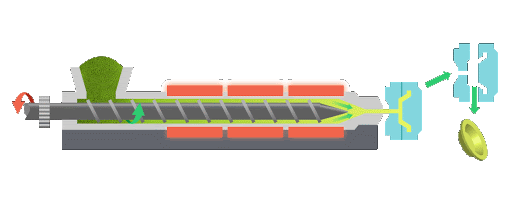
Once the mold is qualified, the machine can repeat the injection, pack, cool, and eject sequence with limited manual handling. Robots, conveyors, vision systems, and assembly operations can be added where the product and volume justify them. Automation does not fix a poor mold design; it can instead make a defect repeat faster. Validate the tool and process before adding output pressure.
When injection molding is not the best fit
- Very low quantities where tooling cannot be amortized.
- Designs that are still changing significantly.
- Parts with geometry that is easier to machine, print, thermoform, or cast.
- Applications where the selected polymer cannot meet temperature, chemical, fatigue, or dimensional requirements.
- Projects that need a finished part before a production mold can be designed and sampled.
Prototype tooling, CNC machining, additive manufacturing, or another process may be a better bridge while the design is being proven. The right choice depends on the required quantity, accuracy, surface, material, and test objective.
Advantages are realized through DFM
- Define function, appearance, material, volume, and critical dimensions.
- Review draft, walls, ribs, bosses, inserts, parting line, gates, vents, cooling, and ejection.
- Use flow or mold analysis where filling balance, weld lines, warpage, or clamp force is a meaningful risk.
- Build the tool with a documented T1 plan and measure the features that control fit and function.
- Freeze the process window and maintenance checks before scaling output.
Explore Cavity Mold’s injection molding process, mold-making capabilities, and engineering support. When you are ready to compare a production route, contact Cavity Mold with the CAD, volume, material, and inspection requirements.
When an advantage becomes a project risk
Each benefit has a control condition. High output needs a stable cycle, balanced tool, machine capacity, maintenance, and quality response. Complex features need draft, shutoffs, ejection, cooling, and inspection access. A multi-cavity tool reduces unit cost only when cavities fill and cool consistently enough to avoid sorting or unequal wear.
- Repeatability: define the dimensional and functional characteristics that must remain stable.
- Feature integration: check whether a combined feature creates an undercut, weak shutoff, or difficult inspection.
- Output: compare cavity count, cycle, automation, changeover, maintenance, and scrap.
- Material: confirm the grade meets the environment and process window.
Compare total program cost, change risk, and validation effort over the intended life. Use the cost estimator for an initial discussion, then submit part and volume assumptions to the engineering team.