

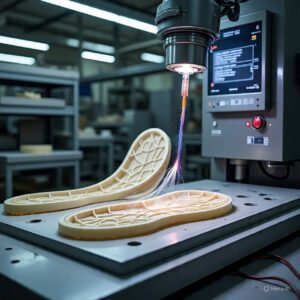

TPU like other thermoplastic elastomers (TPEs) are great choices for producing parts
that have the recyclability of thermoplastics and the resilience, flexibility and viscoelastic
properties of rubbers and elastomers. This results in a material that is heat processible and
recyclable while still retaining the desirable properties of thermosetting rubbers.
The applications of TPU spans several industries; footware, automotives, household
appliances, electronics, biomedicine and construction, are some of the fields TPU has
applied. With Injection molding being the most widely applied technology for large scale
manufacturing of parts in a highly reproducible and repeatable way, most TPU based parts in
the market are produced using injection molding.
It is also worth noting that TPU is more expensive than the regular commodity plastics
like PP or ABS so you really want to minimize waste in the form of scraps and rejects as
much as possible. One of the main ways these occurs in the injection molding of TPU is
when there are flow and adhesion issues.
In this article we discuss how to overcome flow and adhesion related issues associatd
with injection molding of TPU parts. We look at how these issues are related to the
properties of TPU and the ways to address them.
Tribological and Rheological Properties of TPU
After a TPU product is formed, the user gets the benefits of TPU properties in the
product. In the injection molding process, the engineer or operator gets to deal with TPU in
both the molten state and the solidified state.This is noteworthy because some of the
properties that make TPU a good choice in many applications, can be the key challenge in
the injection molding process.
The adhesive nature of TPU is a great advantage in applications such as footwear or
grip handles. TPU has a relatively very low glass transition temperature (Tg). It therefore
retains its flexibility even at low temperatures. These attributes combined means that if
proper measures are not put in place, TPU will, by its nature/chemistry, stick to the mold,
cooling won’t help much, and its flexibility won’t make simple ejector pins that useful.
Shear Thinning and Temperature dependent Flow in TPU
Different grades of TPU will show slightly varying flow behaviour. TPU typically shows
shear thinning properties with melt viscosity varying between 50 and 4000mPa.s.The melt
viscosity varies with temperature more significantly than most thermoplastics. Since the viscosity drops significantly under shear forces, this shear thinning behaviour must be
considered in the gate design and cavity filling process.
TPU degradation may occur if processing at high temperature and this can significantly
affect the flow properties. Therefore shear rate and temperature are two key factors to keep
close control of to avoid flow issues and related defects in TPU mold design.
Measuring Adhesion in the Mold
To control a parameter, one first has to be able to measure it. The ability to measure
adhesion of TPU in an injection mold is a relatively recent development and is not so widely
applied in the industry.
There have been efforts to develop both a practical apparatus and an analytical method
to quantify adhesion force in a mold. While simulation tools can be used to predict
temperature, flow and pressure at different points in a mold to much details, adhesion forces
are more challenging to simulate and predict. So controlling adhesion in a mold still largely
depends on the mold maker’s hands-on knowledge and experience.
TPU Grades
Like other rubbers and indeed other polymers, TPU properties vary with grades. The
mold maker should collaborate with the manufacturer and engineers to determine the most
suitable grade for the product shape, size, and intended application as well as
manufacturability.
One grade might be better suited to achieve a particular geometry than others. A lot of
time and resources can be saved by choosing the right grade.
Injection molding grade will have a density of around 1.09g/cm and a [melt temperature](https://www.mdpi.com/2076-3417/14/20/9614)
of around 200oC and Tg of -38oC. Melt temperature of TPU grades can vary between
180oC and 210oC while the Tg can vary between -50oC and -30oC. Your mold maker will
discuss the type of TPU grade you are using and targeted application in order to achieve
optimal mold design.
Mold Design Considerations
A mold designer has several parameters and features to work with when optimizing a
mold for processing TPU. The quality and efficiency of the final mold will be a combination of
several factors. The table below presents from recommendations from diverse sources. The
specific mold design will depend on your particular requirement so discuss this with your mold maker.
| Mold Features/Parameters | Tips/Recomendations |
|---|---|
| Draft angle | TPU needs to be relatively high. Recommended 3 to 5 degrees |
| Wall thickness | TPU is often used for parts with thin walls due to its high flexibility so design mold features accordingly for thin walls |
| Mold Temperature | Should be tightly controlled to prevent air traps, adhesion and flow problems |
| Vents | TPU prone to pressure build up and air traps so venting should be implemented |
| Gate placement | Key consideration should be to avoid air traps |
| Part size | Keep as small as possible to meet the desired application |
| Overmolds | TPU adhesion depends on compatibility with the second material |
| Ejector pins | The widest diameter possible and place in least visible and most rigid section of the part |
| Gate size | Larger gates result in larger adhesion forces |
| Melt temperature | Higher temperature, higher adhesion forces |
| Injection speed | Lower Injection speed, higher adhesion forces |
| Surface finish | Matte or textured for minimal surface contact |
| Surface energy | Lower surface energy, lower adhesion |
| Additional features | Stripper plates, compressed air, ejector blades and sleeves |
Ejection of TPU Part
The tendency for adhesion issues can make ejection of TPU parts more complex than
other polymers. Flexible TPU are even more challenging to effectively eject than rigid ones.
So where possible go for the most rigid TPU that will suit the target application.
Nonetheless, investing in a well designed mold with optimal ejection system can
significantly save time and costs and improve the overall efficiency of the injection molding
process for TPU.
To achieve this, the mold maker exploits options like using the widest pin possible,
multiple ejector pins, and implementing additional features like lifters and compressed air to
aid ejection.
Ejector pins are a great help for rigid parts partly because that little force applied at a
spot will spread across the rigid part and become kinetic energy that pushes the part out of
the mold. With TPU, particularly the highly flexible grade, the force mostly gets absorbed.
Such that a simple push from an ejector pin might not be enough to eject even simple parts.
Draft angles are higher for TPU, usually between 3 and 5 degrees.
TPU is a relatively tough and flexible material so it generally can withstand a good
amount of stress during ejection. However when there is excessive adhesion between the
part surface and the mold cavity surface, defects such as tearing, white marks due to
material yielding from excessive stretching and breakage can occur when the mold is not
well designed and optimized for TPU.
Mold Release Agents
It would be nice to have a simple fix like simply applying something on the surface of the
mold cavity to reduce adhesion. As the name implies mold release agent does this to some
extent and helps with the demoulding process.
The mold release agent can be applied either as a component of the resin formulation
or applied on the surface of the mold cavity. Applying the mold release agent to the resin has
the advantage of not having an additional step in the cycle. However adding the mold
release agent to the resin may alter the mechanical properties of the part. This may also
affect the thermal properties of the melt and result in flow problems down the line.
When added to the surface of the cavity it does not directly affect the resin formulation.
However the downside to this is the reduced efficiency of the process by virtue of adding
another step with improved chance of error. There is the likelihood of the mold release agent
not being evenly spread and resulting in flow problems in the cavity surface which in turn
lead to defects.
Furthermore, mold release agents applied to the mold cavity surface are only good for a
couple of shots after which they must be re-applied. This adds time and additional steps to
the injection molding process.
Mold Coating
In addition to, or as an alternative to mold release agent, the surface of the mold cavity
can be permanently coated to reduce adhesion. Processes like vapor deposition (PVD) can
be used to apply a layer of a metal that better repels TPU than the mold material. You might
ask: “if so why not make the whole mold ut of that material”. The answer is that that material
is much more expensive and it might not have the processibility, or the mechanical and
thermal strength to serve as a mold. However a thin layer of this material, often within a few
microns thickness, can significantly reduce adhesion.
The type of coating used to aid part ejection from mold varies with the type of material. It
is also important to understand the compatibility between the original mold material and the
part material before deciding on mold coating. It would be a waste to add a coating when the
tribology between the part surface and the mold material is actually better than that between
the part surface and the coating.
Cr2N and fluorocarbon films are some of the coatings that have been explored for mold
cavity surfaces. Scientific studies have shown that mold coating can significantly improve
efficiency of the ejection process by as much as 53%.
Overmolds and Inserts
TPU is the most widely used choice for overmolding and insert molding. So your mold
design will likely implement these. This needs to be discussed in detail with the mold maker.
The TPU grade needs to be compatible with the overmold material or inserts.
For the overmolds and inserts that are permanent, you want good adhesion between
TPU and the overmold or the insert material. For the inserts that get separated after ejection
(hand loaded inserts or loose core), you only want slight to moderate adhesion and sufficient
flexibility for easy separation.
Conclusion
The adhesion and flow properties of TPU offer several advantages in its application
across diverse industries. However these may pose challenges in its injection molding that
require complex mold design and tooling. Over the years several solutions havve emerged in
the industry which have significantly improved the efficiency in the injection molding of TPU.