
We all know the distinct, sharp smell of ABS plastic during production. But beyond the bad odor, Volatile Organic Compounds (VOCs) create serious health risks for workers and compliance headaches for managers. If you ignore these emissions, you face regulatory fines and a dangerous factory floor.
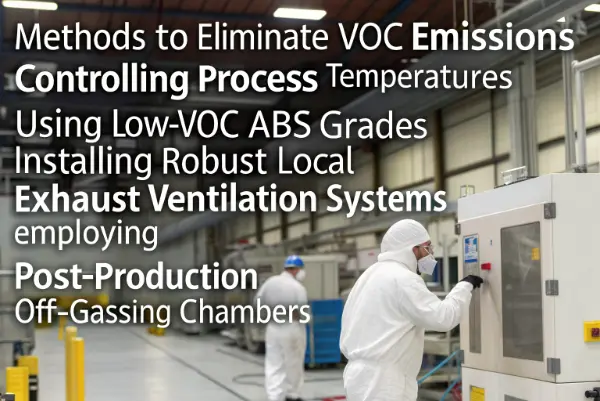
To eliminate VOC emissions in ABS manufacturing, you must control process temperatures precisely to prevent overheating, switch to low-VOC ABS grades, and install robust local exhaust ventilation (LEV) systems. Additionally, implementing post-production off-gassing chambers and regular equipment maintenance ensures that harmful fumes are captured before they enter the breathing zone.
This problem isn’t just about following rules; it is about creating a workspace where people want to work. I remember visiting a client’s facility years ago where the air was so thick you could taste it. It was clear why their staff turnover was high. Today, we have better tools and methods. Let’s look at how we can fix this issue permanently.
Why Do High Processing Temperatures Increase VOCs in ABS?
Many operators push temperatures higher to make the plastic flow faster. However, excessive heat degrades the polymer chains in Acrylonitrile Butadiene Styrene (ABS), releasing trapped monomers like styrene into the air. This mistake compromises air quality instantly.
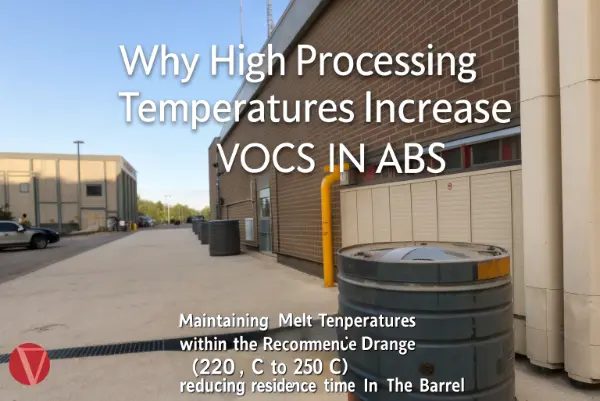
High processing temperatures increase VOCs because thermal degradation breaks down the ABS chemical structure, releasing volatile gases. By keeping melt temperatures within the recommended range (usually 220°C to 250°C) and minimizing residence time in the barrel, you significantly reduce the amount of harmful gas generated at the source.
Let’s dig deeper into the relationship between heat and emissions. It is a balancing act. You need heat to mold, but too much heat destroys the material. I often see project managers like Alex trying to cut cycle times by cranking up the heat. While you might save a few seconds per part, you are creating a chemical hazard.
When ABS overheats, three main components break down:
- Acrylonitrile: Releases cyanide-based compounds (very dangerous).
- Butadiene: Creates rubbery smells and smoke.
- Styrene: The primary source of that sweet, chemical odor and a known health risk.
Here is a breakdown of how to manage temperature to stop this:
Temperature Control Checklist
| Parameter | Recommended Setting | Effect on VOCs |
|---|---|---|
| Melt Temp | 220°C – 250°C | Lower range prevents breakdown. |
| Nozzle Temp | Slightly lower than melt | Prevents drooling and smoking. |
| Mold Temp | 40°C – 80°C | Proper cooling seals the surface faster. |
| Barrel Zones | Ascending profile | Gradual heating reduces thermal shock. |
You must use a precise PID controller. Old machines with fluctuating heater bands are the enemy here. If the machine spikes by 10 degrees, you get a puff of smoke. That smoke is pure VOCs. Also, check your shear heat. High injection speeds create friction heat inside the mold. Even if your barrel settings are perfect, you might be burning the plastic just by pushing it too fast. Slow down the injection speed slightly. It often results in a better surface finish and cleaner air.
Can Ventilation Systems Completely Capture ABS Fumes?
Opening a window is not enough when dealing with industrial injection molding. You need a system that pulls air away from the source immediately. Without targeted extraction, fumes drift throughout the factory, settling on surfaces and entering workers’ lungs.
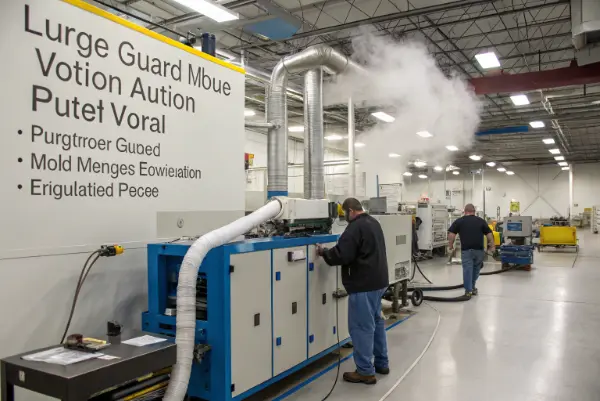
Yes, ventilation systems can capture the vast majority of ABS fumes, but only if they are Local Exhaust Ventilation (LEV) units placed directly above the purge guard and mold area. General room ventilation is too weak; you need high-velocity suction at the emission point to remove contaminants before they disperse.
I have seen many factories rely on big ceiling fans. That just spreads the poison around. You need to think about airflow dynamics. The goal is to create a vacuum effect right where the hot plastic meets the air. This usually happens at the nozzle and when the mold opens to eject the part.
Let’s break down the components of an effective system.
The "Capture at Source" Strategy
- The Hood: This needs to be as close to the mold as possible without blocking the robotic arm or the operator. A canopy hood is okay, but an enclosing hood is better.
- The Ducting: Keep it straight. Every bend in the pipe reduces airflow speed. If the air moves too slowly, heavy particles drop out and clog the ducts, creating a fire hazard later.
- The Filter: You cannot just pump this outside. You need activated carbon filters. ABS fumes are organic; carbon traps them effectively.
- The Fan: It must be powerful enough to overcome the static pressure of the filters.
Here is a comparison of ventilation types:
| System Type | Efficiency | Cost | Best Use Case |
|---|---|---|---|
| General HVAC | Low (20%) | High (Energy) | Cooling the room, not cleaning it. |
| Mobile Filter Unit | Medium (60%) | Low | Spot fixes or temporary runs. |
| Fixed LEV (Canopy) | High (85%) | Medium | Standard injection molding machines. |
| Direct Machine Mount | Very High (95%+) | Medium-High | High-volume production lines. |
If you are a project manager like Alex, you should audit your current setup. Walk to a machine running ABS. Can you smell it? If you can smell it, your system is failing. The smell threshold for Styrene is very low, but strong odors mean high concentrations. Invest in direct-mount extraction units. They sit right on top of the injection unit. They are worth every penny for the safety of your team.
How Do Low-VOC Material Grades Make a Difference?
Sometimes the problem isn’t the machine; it is the material itself. Standard ABS is "dirty" by modern standards. Manufacturers have developed cleaner formulas, but many companies hesitate to switch because of the perceived higher cost.
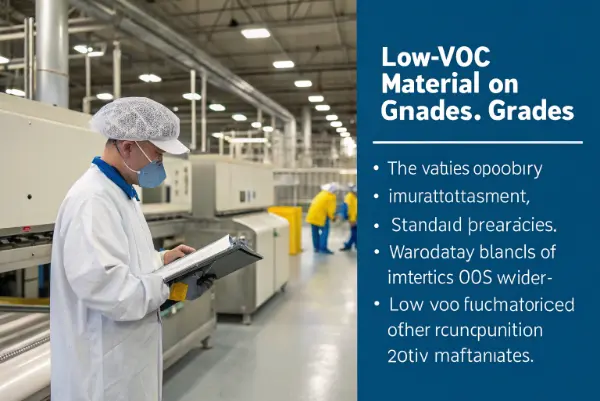
Low-VOC material grades make a huge difference because they are chemically formulated with higher stability and fewer residual monomers. Switching to these "clean" ABS resins can reduce emissions by up to 50% without changing your machinery, effectively solving the problem at the raw material level.
I understand the hesitation to change materials. You have your specs, your shrinkage rates, and your approved vendor list. Changing a material grade feels like a massive risk. But, low-VOC ABS has come a long way. The mechanical properties—impact strength, tensile strength, and gloss—are now almost identical to standard grades.
Here is why you should consider making the switch:
The Chemistry of Clean ABS
Standard ABS is made by polymerizing three monomers. The process is never 100% efficient. There are always "leftovers" (residual monomers) trapped in the pellet. When you melt the pellet, these leftovers boil off first. That is your initial VOC spike.
Low-VOC grades undergo an extra stripping process at the resin factory. They literally vacuum out the bad stuff before they sell it to you. They also add better heat stabilizers. This means the plastic can handle higher temperatures before it starts to degrade.
Benefits beyond safety:
- Less Mold Deposit: Those VOCs don’t just go into the air; they stick to the mold cavity. This creates a waxy buildup that ruins the surface finish. Cleaner material means less mold cleaning downtime.
- Better Part Smell: If you are making consumer electronics or car interiors (like Alex does), the end customer hates the "new plastic smell." Low-VOC grades produce parts that smell neutral much faster.
Implementation Strategy:
Do not swap it all at once. Pick a non-critical part. Run a trial with a low-VOC grade. Measure the air quality during the run. Check the part dimensions. You will likely find that the settings need very minor adjustments. The cost difference is often offset by the reduction in ventilation energy costs and mold maintenance labor. It is a smarter way to manufacture.
Does Pre-Drying ABS Affect VOC Release?
Many people think drying is only for preventing moisture splay and cosmetic defects. They overlook the link between moisture and chemical breakdown. Wet plastic behaves differently in the barrel, leading to more aggressive off-gassing.
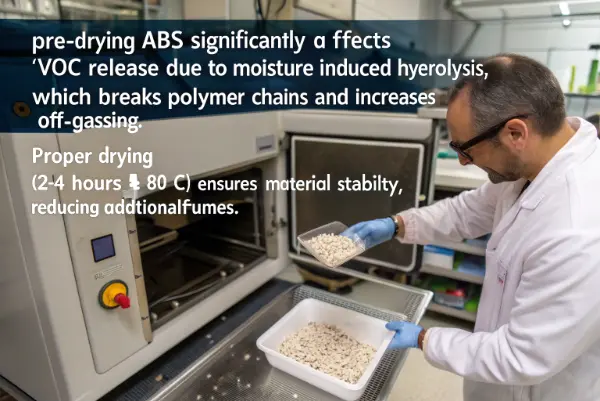
Yes, pre-drying ABS significantly affects VOC release because moisture causes hydrolysis during the melting phase, which chemically severs polymer chains and releases extra volatile gases. Proper drying (usually 2-4 hours at 80°C) ensures the material remains stable during processing, minimizing the creation of additional fumes.
This is a classic "hidden cause" of emissions. I have worked with teams that had great ventilation and perfect temperature settings, but the air was still terrible. We checked the dryer, and it was broken. They were molding wet ABS.
Here is what happens inside the barrel when ABS is wet. It is not just steam coming out. The water molecules at 240°C act like little scissors. They cut the long ABS molecular chains. This is called hydrolysis. When you cut those chains, you create smaller, volatile molecules that fly into the air.
The Drying Protocol for Clean Air
You need to be disciplined about drying. It is not optional for ABS.
- Check Dew Point: Your dryer needs a dew point monitor. It should be -40°C. If the air in the dryer is humid, you aren’t drying anything; you are just heating up wet plastic.
- Airflow filters: Check the air filter on the dryer intake. If it is clogged with dust, the dryer cannot "breathe." This leads to overheating the pellets or not drying them enough.
- Don’t Over-dry: This is the opposite problem. If you leave ABS in the dryer for 12 hours because production stopped, the additives (lubricants and stabilizers) can bake off. When you finally mold that material, it is brittle and releases smoke immediately.
Recommended Drying Table:
| ABS Type | Drying Temp | Time (Hours) | Max Moisture Content |
|---|---|---|---|
| Standard | 80°C – 85°C | 2 – 4 | 0.10% |
| High Heat | 90°C – 95°C | 3 – 5 | 0.05% |
| Flame Retardant | 75°C – 80°C | 2 – 4 | 0.10% |
Use a moisture analyzer. Do not guess. Taking a sample before it goes into the hopper takes five minutes. It saves you from bad parts and bad air. If you are serious about reducing VOCs, the process starts in the dryer, not the mold.
Conclusion
Eliminating VOCs in ABS manufacturing requires a mix of smart engineering and strict discipline. You need to control your melt temperatures, install powerful local extraction, consider cleaner material grades, and ensure your resin is perfectly dry. These steps protect your team and improve your product quality.