
Struggling to decide between High-Density Polyethylene (HDPE) and Low-Density Polyethylene (LDPE) for your next project? You are not alone. Making the wrong choice can lead to structural failures, increased costs, and production delays. This guide simplifies the complex chemical differences into practical advice for manufacturing success.
The main difference lies in their density and molecular structure. HDPE has less branching, making it stronger, stiffer, and more resistant to chemicals, ideal for rigid containers and pipes. LDPE has high branching, making it flexible, transparent, and impact-resistant, perfect for plastic bags, tubing, and squeeze bottles. Choosing the right one depends on whether you need rigidity or flexibility.
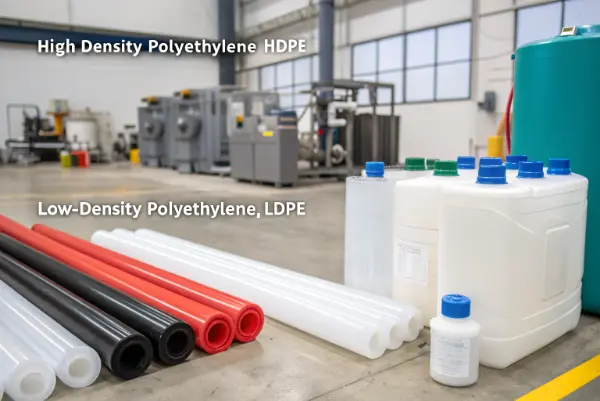
It is easy to assume that all polyethylene is the same, but that is a dangerous assumption in manufacturing. I have seen projects stall because a designer picked a material based on price rather than performance properties. Let’s break down exactly what makes these two polymers different and how to pick the right one for your specific mold.
What Are The Core Property Differences Between HDPE and LDPE?
Understanding material science can be boring, but ignoring density differences will hurt your final product’s quality. If you don’t know why one material is stiffer than the other, you cannot predict how it will behave under stress.
HDPE is known for its high strength-to-density ratio, offering excellent tensile strength and temperature resistance up to 120°C for short periods. LDPE is softer, more ductile, and has a lower melting point (around 105°C), which provides superior flexibility and resilience. HDPE is rigid and opaque, while LDPE is flexible and often translucent.
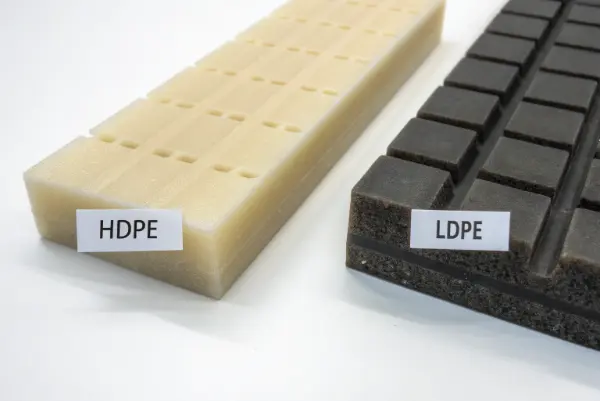
Let’s dive deeper into the physical mechanics. The primary reason these two materials behave differently is their molecular branching. Imagine a messy pile of tree branches versus a stack of straight logs.
- HDPE (High-Density): The polymer chains are straight and pack together tightly (like the stack of logs). This tight packing creates a crystalline structure. This is why HDPE is strong and rigid.
- LDPE (Low-Density): The polymer chains have many side branches (like the messy tree branches). They cannot pack together tightly. This amorphous structure creates space between molecules, allowing for flexibility.
When we look at specific metrics, the gap becomes clear. Here is a comparison of their typical properties:
| Property | HDPE (High Density) | LDPE (Low Density) |
|---|---|---|
| Density | 0.941–0.965 g/cm³ | 0.910–0.940 g/cm³ |
| Tensile Strength | High (Harder to break) | Low (Easier to stretch) |
| Heat Resistance | Up to 120°C (Short term) | Up to 80-90°C (Short term) |
| Transparency | Opaque / Semi-opaque | Translucent / Transparent |
| Stiffness | Semi-rigid to Rigid | Flexible to Soft |
| Chemical Resistance | Excellent | Good |
For Alex, our project manager persona, this matters immensely. If you are designing a casing for an electronic device that needs to snap shut, HDPE offers the rigidity you need. If you are designing a protective boot for a cable connector, LDPE gives you the necessary flex. I remember working on a project where a client used LDPE for a load-bearing clip. It didn’t break, but it deformed immediately under weight. We switched to HDPE, and the problem was solved instantly.
Which Material Is Better for Injection Molding Applications?
Choosing a material is not just about the final product; it is also about how easy the material is to process in the machine. If you choose a material that is hard to mold, your cycle times will increase, and your costs will go up.
Both materials are excellent for injection molding, but they require different processing parameters. HDPE shrinks more (1.5% to 3.0%) and requires higher injection pressures to fill the mold. LDPE flows very easily, shrinks less (1.5% to 2.0%), and is great for high-cavity molds, though it is prone to warping if not cooled evenly.
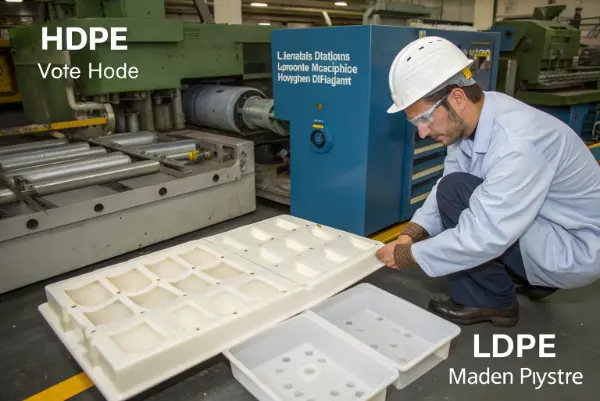
When we get into the details of the injection molding process at CavityMold, we notice distinct behaviors. HDPE is generally more crystalline. This means when it cools down from a liquid to a solid, the molecules try to organize themselves into a very tight pattern. This organization causes the material to take up less space, leading to significant shrinkage.
As a mold designer, I have to account for this. If I design a mold for ABS plastic and then try to shoot HDPE into it, the final part will be too small.
Key Processing Considerations:
- Shrinkage Rates: HDPE shrinks significantly. If your part has thick walls, this shrinkage can lead to sink marks (depressions on the surface). You need to core out thick sections or use blowing agents.
- Warpage: Because HDPE shrinks so much, it introduces internal stress. If one side of the part cools faster than the other, the part will warp or twist. Cooling channel design in the mold is critical here.
- Flowability: LDPE flows like water compared to other plastics. This is great for thin walls, but it also means it is prone to "flash." Flash is when excess plastic leaks out of the mold seam. We need to ensure the mold clamping force is high enough to keep the mold shut tight.
For a project manager like Alex, knowing this helps in the DFM (Design for Manufacturing) stage. If you need tight tolerances, HDPE might be harder to control than other engineering plastics, but it is cheaper. LDPE is forgiving for simple shapes but tricky for precise structural parts. I once advised a client to change their gate location (where plastic enters the mold) simply because they switched from LDPE to HDPE. The flow path needed to change to prevent warping.
What Are The Most Common Applications for HDPE and LDPE?
Theory is useful, but seeing where these materials are actually used helps you visualize your own product. You see these materials every single day, but you probably don’t stop to check the recycling code on the bottom.
HDPE is the standard for rigid packaging like milk jugs, detergent bottles, heavy-duty trash bins, and water pipes due to its durability. LDPE is the standard for flexible items like plastic grocery bags, six-pack rings, squeeze bottles, and wire insulation because it bends without cracking.
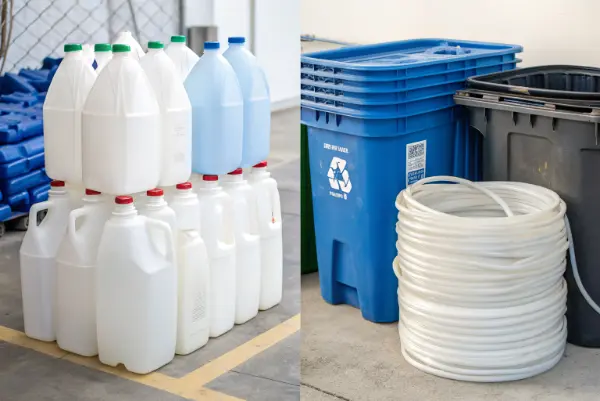
Let’s break down the applications by industry so you can see where your product fits.
1. Consumer Packaging:
- HDPE: Think of your shampoo bottle or a large jug of laundry detergent. You need the bottle to hold its shape when you grab it. HDPE resists the aggressive chemicals in soap and doesn’t collapse.
- LDPE: Think of a ketchup squeeze bottle. You need to be able to crush it to get the sauce out, and it needs to bounce back to its original shape. That "memory" and softness is classic LDPE.
2. Industrial & Construction:
- HDPE: It is used for large water pipes and gas mains. It doesn’t corrode, it resists underground pressure, and it can handle freezing water without bursting. It is also used for plastic lumber (like fake wood decks) because it is tough and weather-resistant.
- LDPE: It is used for films and liners. If you are wrapping a pallet of boxes, that stretch wrap is likely LLDPE (Linear Low-Density Polyethylene), a close cousin. It acts as a moisture barrier on construction sites.
3. Medical & Laboratory:
- HDPE: It is used for tyvek suits (protective clothing) and rigid containers for medical waste. It can be sterilized.
- LDPE: It is used for tubing in IV drips. It needs to be flexible so it doesn’t kink and block the flow of fluid, but it must be chemically inert so it doesn’t react with the medicine.
For Alex, if you are designing consumer electronics casings, you might actually skip both of these and go for ABS or PC. However, if you are designing the internal packaging or a protective bumper for that electronic device, LDPE is a great, low-cost choice. If you are making a rugged outdoor case for that device, HDPE is a strong contender because it resists impact even in cold weather.
Is HDPE or LDPE More Sustainable and Recyclable?
Sustainability is no longer optional; it is a requirement for modern manufacturing. Companies are under pressure to reduce waste, so picking a material that ends up in a landfill is a bad business move.
Both HDPE (Recycling Code #2) and LDPE (Recycling Code #4) are thermoplastics, meaning they can be melted down and reformed, making them highly recyclable. However, HDPE is one of the easiest plastics to recycle and is widely accepted by curbside programs, whereas LDPE films often jam recycling machinery and are less commonly collected.
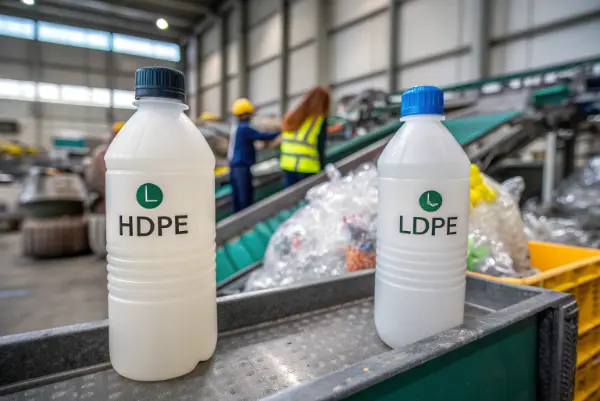
This is a huge factor for global markets. In Europe and Australia, regulations regarding plastic waste are strict.
The Reality of Recycling Streams:
- HDPE (#2): This is the "gold standard" of recycling. It is easy to separate, wash, and grind into pellets. Recycled HDPE (rHDPE) is very popular. We can use rHDPE to make crates, pallets, and even non-food bottles. If your company has "green" goals, using HDPE helps you meet them because the end-of-life path is clear.
- LDPE (#4): While technically recyclable, the logistics are harder. Because LDPE is often used for thin bags and films, it gets tangles in the gears of sorting machines. Many recycling centers reject it. Rigid LDPE parts are easier to handle than films, but the market for recycled LDPE is smaller than for HDPE.
From a manufacturing perspective at CavityMold, we can re-grind waste material (sprues and runners) from both HDPE and LDPE and put it back into the process immediately. This "in-house recycling" reduces material costs significantly. However, you cannot mix them. If you mix HDPE and LDPE, the resulting plastic is weak and inconsistent.
If Alex is managing a project where the "Eco-Friendly" label is a selling point, HDPE is the safer bet. It signals to the consumer that the product is responsible. If you choose LDPE, you might need to provide specific instructions to the user on how to recycle it properly, which adds friction to the user experience.
Conclusion
Choosing between HDPE and LDPE comes down to the specific needs of your product regarding rigidity versus flexibility. HDPE offers strength, temperature resistance, and ease of recycling for rigid parts, while LDPE provides superior flexibility and transparency for squeezable or soft applications. By understanding these core differences, you can ensure smoother production runs and a better final product.