
Selecting the wrong plastic material can ruin your production timeline and blow your budget. You might see two materials that look similar on a spreadsheet, but they behave completely differently in the mold. Many engineers struggle to choose between the two most common thermoplastics in the world.
High-Density Polyethylene (HDPE) is a rigid, strong plastic with a highly crystalline structure, making it perfect for durable containers, pipes, and automotive parts. Low-Density Polyethylene (LDPE) is a flexible, soft material with high branching, ideal for squeeze bottles, tubing, and plastic film. Your choice depends entirely on whether your product needs structural integrity or flexibility.
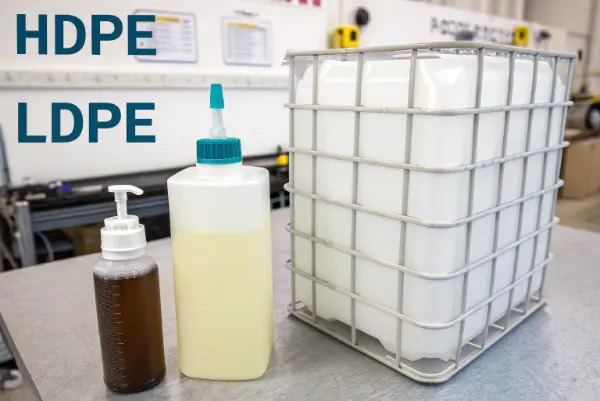
Choosing between these two is not just about looking at a data sheet. You have to understand how they flow, how they shrink, and how they perform in the real world. I have seen projects fail because a designer treated them as interchangeable. Let’s break down the differences so you can make the right decision for your mold.
What creates the difference in their molecular structures?
It is confusing to see two materials made from the same monomer behave so differently. You might wonder why one is hard as a rock and the other is soft as a bag. The answer lies deep inside the chemistry, but it affects everything on your production line.
The difference comes from the polymer chain branching. HDPE consists of straight, unbranched chains that pack tightly together, creating a dense, crystalline structure. LDPE has long, chaotic side branches that prevent tight packing, resulting in a lower density, a softer feel, and much more flexibility.
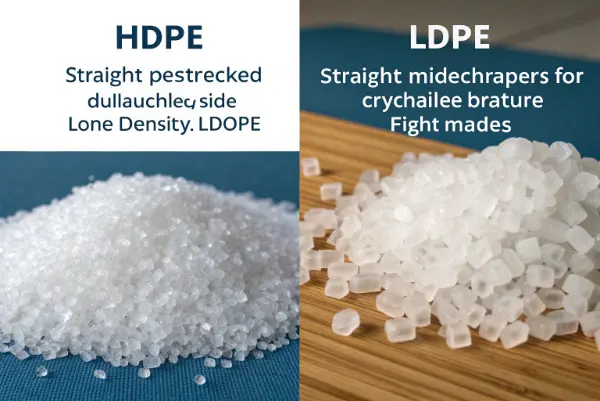
I find that understanding the "architecture" of the plastic helps my clients understand the final product. Imagine you are packing a suitcase.
If you have perfectly folded clothes (HDPE), you can stack them very high and fit a lot into a small space. This is what we call "linear" structure. Because the molecules pack so tightly, the intermolecular forces are strong. This gives HDPE its rigidity and its milky, opaque appearance. The light cannot pass through the dense crystal structures easily.
Now, imagine throwing those clothes into the suitcase in a messy pile (LDPE). They take up more space, and there are gaps of air between them. This is "branching." The polymer chains have side chains that stick out. They cannot get close to each other. This extra space between molecules allows the material to move and stretch. It also lets more light pass through, which is why LDPE is often more transparent than HDPE.
When we design a mold at CavityMold, this molecular difference dictates our entire strategy. The tight packing of HDPE means it wants to crystallize rapidly. This crystallization leads to significant volume changes. The messy structure of LDPE means it changes volume less drastically. If you do not account for this molecular behavior in the design phase, your dimensions will be wrong every time. We have to visualize these invisible chains to predict visible defects.
How do their physical properties compare for durability and flexibility?
You need a product that survives the real world, but "strength" means different things in different contexts. A part that needs to hold a heavy load fails if it is too soft. A part that needs to survive a drop fails if it is too brittle.
HDPE offers superior tensile strength and stiffness, making it the best choice for rigid containers and structural components that must hold their shape. LDPE excels in impact resistance and ductility, meaning it can stretch and absorb shock without breaking, which is essential for flexible lids and snap-fits.
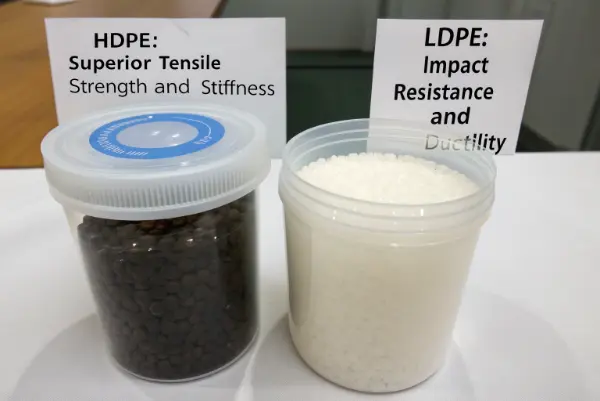
I often ask my clients, "What happens when you hit this with a hammer?" It sounds simple, but it reveals the difference between stiffness and toughness.
HDPE is stiff. It resists deformation. If you make a shampoo bottle out of HDPE, you can stack them on a pallet, and the bottom bottles will not crush. It has a high strength-to-density ratio. However, because it is so rigid, it is prone to "stress cracking." If you put HDPE under constant tension, tiny cracks can form over time. This is a common failure mode I see in poorly designed caps.
LDPE is the opposite. It is not stiff, but it is tough. If you drop an LDPE part, it bounces. It absorbs the energy. This makes it incredible for things like snap-on lids. You need the material to stretch over a lip and then snap back. HDPE might snap the lid in half; LDPE will stretch and recover.
Here is a quick breakdown I use when discussing this with project managers like Alex:
| Feature | HDPE (High Density) | LDPE (Low Density) |
|---|---|---|
| Stiffness | High (Rigid) | Low (Flexible) |
| Tensile Strength | 20-30 MPa | 8-10 MPa |
| Impact Strength | Lower | Higher |
| Transparency | Semi-Opaque / Opaque | Translucent / Transparent |
| Feel | Waxy, Hard | Soft, Rubbery |
We also need to talk about "creep." This is the tendency of a solid material to move slowly or deform permanently under mechanical stress. LDPE has very low resistance to creep. If you put a heavy weight on an LDPE box, it will eventually bulge and sag. HDPE holds its shape much longer. This physical trade-off is the first thing we look at when we review your 3D files.
What are the critical injection molding challenges for each?
Designing the part is only half the battle; you still have to manufacture it. You cannot just swap these materials in the machine and expect the same result. The way they flow and cool creates specific problems that we must manage.
HDPE has a high shrinkage rate (1.5% to 3.0%) due to crystallization, which can lead to severe warping if cooling is uneven. LDPE has lower shrinkage but is prone to sticking in the mold because it is soft and rubbery, often requiring special ejection systems or surface textures.
This is the area where my team spends the most time. The processing window for these two materials is distinct.
Let’s talk about shrinkage first. This is the nightmare for any mold maker. HDPE shrinks a lot. Because it is crystalline, as it cools from a liquid to a solid, the molecules organize themselves and take up much less space. If you have a part with thick sections and thin sections, the thick parts cool slower. This difference causes internal stress. The result is warpage. Your flat box becomes a banana. We have to design the cooling channels in the mold very carefully to fight this. We might even use cooling fixtures after the part comes out of the mold to hold it flat.
LDPE shrinks less, usually around 1.5% to 2.0%. But LDPE has a different problem: it is sticky. Imagine trying to push a piece of warm chewing gum out of a metal box. It does not want to let go. We often have to use air poppets or stripper plates instead of standard ejector pins. If we use pins on warm LDPE, the pins might just punch right through the soft plastic.
Cycle time is another factor. HDPE sets up faster. Because it crystallizes, it becomes rigid quickly, and we can eject it sooner. This is great for high-volume production. LDPE stays soft for longer. We have to leave it in the mold for extra seconds to ensure it is hard enough to eject without deforming.
I once had a client who wanted to switch a trash can design from HDPE to LDPE to make it "softer." We had to completely redesign the ejection system because the new material was just collapsing when the robot tried to grab it. These are the manufacturing realities that define your unit cost.
Which material handles temperature and chemicals better?
Your product will not sit in a lab; it will sit in a freezer, a hot car, or a factory floor. You need to know if the material will survive contact with harsh liquids or extreme weather. A failure here is usually catastrophic.
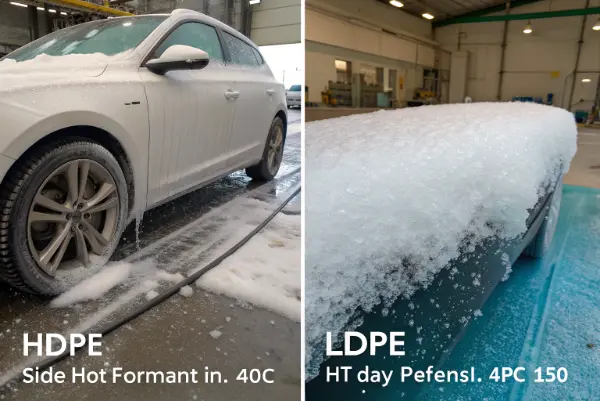
HDPE offers better heat resistance and can withstand temperatures up to 120°C for short periods, making it suitable for hot-fill applications. LDPE maintains its toughness in freezing temperatures, resisting brittleness down to -40°C, which is why it is the standard for frozen food packaging.
I always ask my clients about the end-use environment immediately. It saves time later.
If you are packaging food that gets cooked or sterilized, HDPE is usually the winner. It has a higher melting point. You can put it in a dishwasher, and it generally survives. It is also excellent for chemical resistance. I have made molds for huge chemical tanks using HDPE. It resists acids, alcohols, and bases very well. It is essentially inert. That is why milk jugs are HDPE; the lactic acid does not bother it.
However, HDPE has a weakness: Oxidizing agents. Strong oxidizers can break it down.
LDPE is the king of the cold. If you put an HDPE container in a deep freeze and then drop it, there is a chance it might crack. It undergoes a "glass transition" where it becomes brittle. LDPE stays flexible even when it is incredibly cold. This is why bags of frozen peas are made of LDPE. They need to handle the impact of shipping while frozen solid.
Here is how I break down the chemical and thermal resistance:
HDPE Strengths:
- Resists higher heat (good for sterilization).
- Excellent barrier to moisture (keeps dry things dry).
- Great against solvents and detergents.
LDPE Strengths:
- Excellent in extreme cold (does not shatter).
- Good moisture barrier (though slightly less than HDPE).
- Very low water absorption.
There is also the issue of "Environmental Stress Cracking Resistance" (ESCR). If a plastic is under stress (like a tight cap) and you expose it to a surfactant (like soap), it can crack. LDPE generally has better ESCR than standard HDPE. If your product is a squeeze bottle for soap, LDPE is safer. If you use HDPE, we have to choose a specific copolymer grade designed to resist cracking.
Conclusion
Choosing between HDPE and LDPE comes down to the specific needs of your application. If you need structural rigidity, heat resistance, and high tensile strength, HDPE is your best option. If you need flexibility, impact toughness, and performance in freezing temperatures, LDPE is the correct choice. At CavityMold, we help you navigate these trade-offs to ensure your mold produces perfect parts every cycle.