
Managing a project timeline is tough, and the lead time for a new mold is often a big unknown. This uncertainty can throw your entire production schedule off track, causing costly delays. I’m here to give you a clear breakdown of the timeline, so you can plan your projects with confidence.
The lead time for a standard plastic injection mold typically ranges from 4 to 12 weeks. This timeline can vary significantly based on the mold’s complexity, size, and the number of cavities. Simpler, single-cavity molds might be ready in a month, while complex multi-cavity or large-format molds can take three months or more. Clear communication and efficient design reviews are key to keeping the process on schedule.
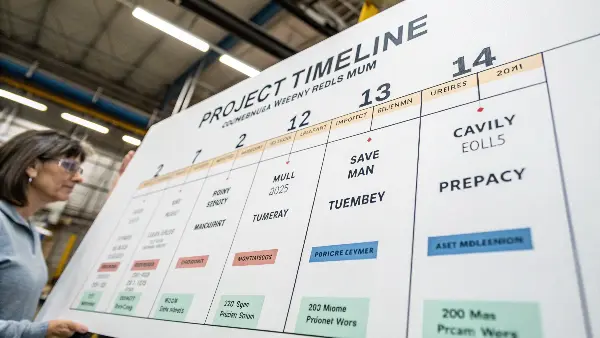
Getting a handle on that 4 to 12-week window is crucial for any project manager. It’s not just a block of time; it’s a series of critical steps, each with its own timeline. Understanding what happens during this period helps you manage expectations and work more effectively with your mold-making partner. Let’s break down the process and look at the factors that can make your mold project faster or slower.
What factors influence the lead time for an injection mold?
You’re trying to finalize a project plan, but the mold lead time is a vague estimate. This makes it hard to commit to deadlines and manage stakeholder expectations, putting your project at risk. Let me show you what factors really control the timeline, so you can build a more accurate schedule.
The primary factors influencing mold lead time are part design complexity, mold size and structure, the steel material used, and the number of cavities. A complex part requires intricate machining, increasing time. Similarly, a large, multi-cavity mold demands more resources than a simple prototype mold. The choice of steel also plays a role, as harder steels like H13 take longer to machine than softer ones like P20.
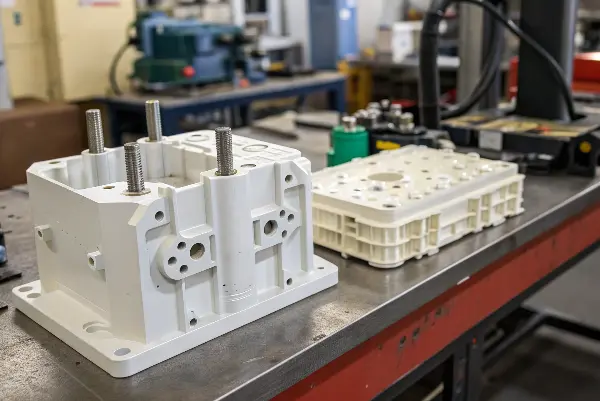
Understanding these factors is the first step, but seeing how they interact is even more important. A project manager I worked with, Alex, needed a mold for a new electronics enclosure. The part had many undercuts and a high-gloss finish requirement. Initially, he hoped for a 6-week turnaround. By looking at these factors together, we could see why it would be closer to 10 weeks. Let’s break down these key variables in more detail.
Part and Mold Design
The design of your plastic part is the single biggest driver of the mold-making timeline. A simple, open-and-shut design is straightforward. But once you add features like undercuts, slides, lifters, or threaded sections, the complexity of the mold’s mechanics increases exponentially. Each of these features requires extra components and precise assembly, adding days or even weeks to the manufacturing process. Similarly, the number of cavities matters. A single-cavity prototype mold is much faster to build than a 32-cavity production mold that needs to ensure perfect balance and consistency across all parts.
Mold Material and Size
| The physical characteristics of the mold itself are also a major factor. The choice of steel is a trade-off between durability and machinability. | Steel Type | Typical Use | Machining Time | Lifespan |
|---|---|---|---|---|
| Aluminum | Prototyping | Fast | ~5,000 shots | |
| P20 Steel | Low-Mid Volume | Moderate | ~50,000 shots | |
| H13 Steel | High Volume | Slow | ~1,000,000+ shots | |
| S136 Steel | High Polish/Corrosive | Slow | ~1,000,000+ shots |
As you can see, choosing a harder, more durable steel like H13 for a high-volume production run will extend the CNC machining time compared to a softer P20 steel. The overall size of the mold also matters. A larger mold simply requires more steel, more machine time, and more complex logistics to handle and assemble, all of which add to the total lead time.
How long does it take to make a plastic injection mold?
You’ve approved the part design and now you need to know the real timeline for getting the mold made. The process can seem like a black box, making it difficult to report progress to your team. I’ll walk you through the step-by-step manufacturing journey from a block of steel to a finished tool.
The mold-making process is a multi-stage journey that typically takes 4 to 12 weeks. It starts with Design for Manufacturability (DFM) and mold design, which can take 1-2 weeks. This is followed by CNC machining, EDM, and fitting, consuming another 2-8 weeks. Finally, mold trial, texturing, and final adjustments can add another 1-2 weeks before the mold is ready for shipment and mass production.
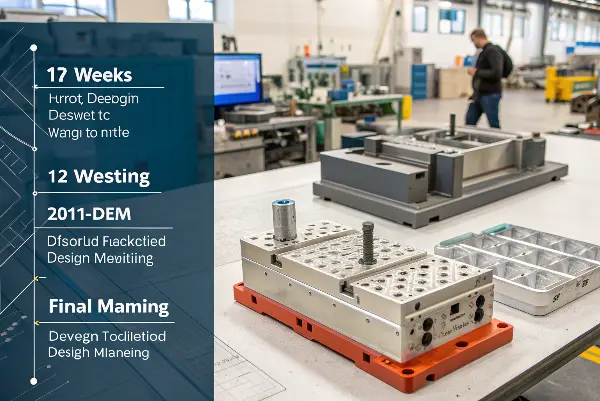
Each stage in the mold-making process is critical and builds upon the last. A delay in one step can have a ripple effect on the entire timeline. I once had a project where the client requested a significant design change after the steel had already been cut. We had to go back to the CNC stage, which added two weeks to the schedule. This highlights why a locked-in design is so important. Let’s look at the typical stages and their average durations.
Stage 1: Design and Preparation (1-2 Weeks)
This is the foundational stage where all the planning happens.
- DFM Analysis: My team and I analyze your part design to ensure it’s optimized for molding. We look for potential issues like improper draft angles, thick wall sections, or un-moldable features. This collaborative review process prevents costly errors down the line.
- Mold Design: Once the part design is finalized, our engineers create a detailed 3D model of the mold itself. This includes the core, cavity, runner system, cooling channels, and ejection system. You will receive this design for review and approval before any steel is cut.
Stage 2: Machining and Assembly (2-8 Weeks)
This is where the physical mold starts to take shape. The duration here depends heavily on the mold’s complexity.
- CNC Machining: Large CNC machines cut the main core and cavity blocks from raw steel. This is often the longest part of the manufacturing process.
- EDM/Wire Cutting: For fine details, sharp internal corners, or complex features that CNC machines can’t create, we use Electrical Discharge Machining (EDM).
- Fitting and Assembly: Technicians meticulously hand-fit all the components—slides, lifters, ejector pins, and cooling lines. This requires incredible precision to ensure the mold operates smoothly.
Stage 3: Trial and Refinement (1-2 Weeks)
The final stage is all about testing and validation.
- Mold Trial (T1): We mount the finished mold into an injection molding machine and produce the first batch of sample parts (T1 samples).
- Inspection and Adjustments: We measure these samples against your specifications. Minor adjustments are almost always needed to fine-tune dimensions or improve part quality. This may require small modifications to the steel.
- Texturing/Polishing: If your part requires a specific surface finish, like a matte texture or a high-gloss polish, it’s applied after the trial and approval of the part dimensions. The mold is then ready for production.
What is the cycle time in plastic injection molding?
You’ve got your new mold, but now the question shifts to production speed. How fast can you get your parts? Misunderstanding cycle time can lead to inaccurate cost estimates and missed delivery dates. I’ll explain what cycle time is and why it’s a critical metric for your manufacturing plan.
Cycle time in plastic injection molding is the total time required to produce one complete part or set of parts. It includes the injection time, holding time, cooling time, and mold open/ejection time. A typical cycle time can range from 15 seconds for a simple, small part to over a minute for a large, complex component. This metric directly impacts production capacity and the final cost per part.
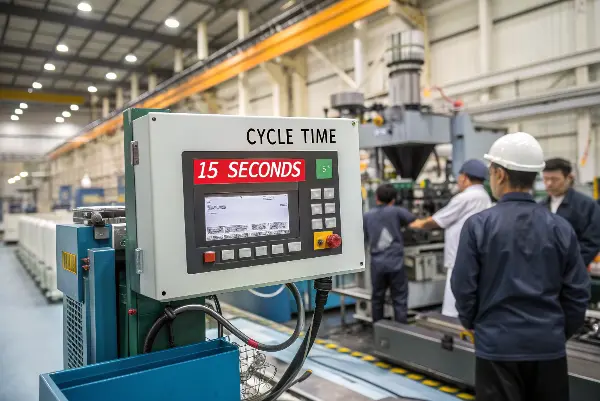
It’s important to remember that mold lead time and cycle time are two completely different things. Lead time is a one-time investment to build the tool. Cycle time is the repeating metric that will define your production efficiency and costs for the life of the product. When I work with clients, optimizing cycle time is a key part of our DFM process. A few seconds saved per cycle can translate into thousands of dollars over a production run of a million units. Let’s dive deeper into the components of this crucial metric.
Breaking Down the Cycle
The total cycle time is a sum of several distinct phases, each contributing to the final result. Understanding these phases helps identify opportunities for optimization.
- Injection Time: This is the phase where the screw pushes molten plastic into the mold cavity. It’s usually very fast, often lasting just a few seconds. The speed is determined by the part size, wall thickness, and material viscosity.
- Holding (or Packing) Time: After the cavity is filled, pressure is maintained to pack more material in and compensate for shrinkage as the plastic cools. This is critical for part accuracy and preventing sink marks.
- Cooling Time: This is almost always the longest part of the cycle. The plastic must solidify enough to be ejected without deforming. Cooling time is heavily influenced by the part’s wall thickness—a thicker part needs much more time to cool. Efficient cooling channel design in the mold is key to minimizing this phase.
- Mold Open & Ejection Time: Once the part is cool, the mold opens, the ejector pins push the part out, and the mold closes again, ready for the next cycle. This phase is typically quick, but can be slowed by complex ejection sequences or if a robot is used to handle parts.
| Here is how these phases typically compare: | Phase | Percentage of Cycle Time (Approx.) | Key Influencing Factor |
|---|---|---|---|
| Injection | 5-10% | Part Volume, Material Flow | |
| Holding | 10-20% | Material Shrinkage, Part Quality | |
| Cooling | 50-70% | Wall Thickness, Mold Temperature | |
| Mold Open/Eject | 5-15% | Machine Speed, Ejection System |
By focusing on the longest phase—cooling—we can often make the biggest impact on reducing the overall cycle time.
What is the hold time in injection molding?
You’re reviewing T1 sample reports and see terms like "hold time" and "hold pressure." These settings seem technical, but they have a direct impact on your final part’s quality and dimensions. Not understanding their purpose can make it hard to troubleshoot issues like sink marks or warping.
Hold time, also known as packing time, is the phase in the molding cycle after the mold is filled where pressure is maintained on the molten plastic. This forces more material into the cavity to compensate for shrinkage as the plastic cools and solidifies. Proper hold time is critical for achieving correct part dimensions, weight, and preventing cosmetic defects like sink marks.
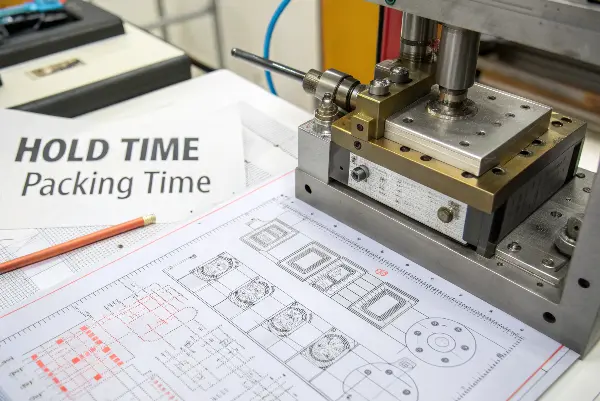
Think of hold time as the follow-through after the initial injection. The injection phase gets the plastic into the mold quickly, but the hold phase is what ensures the part is dense, dimensionally stable, and cosmetically perfect. It’s a delicate balance. Too little hold time, and you get parts with sink marks and voids. Too much, and you risk overpacking the mold, which can cause parts to stick, flash, or have high internal stress. Let’s look at how we determine the right hold time and what happens when it’s not set correctly.
Finding the Sweet Spot
Determining the optimal hold time isn’t just a guess; it’s a scientific process we perform during mold trials called a gate seal study.
- The Goal: The purpose of the hold phase is to keep applying pressure until the gate—the small opening where plastic enters the cavity—freezes solid. Once the gate is sealed, no more material can enter or leave the cavity, and the hold phase has done its job.
- The Process: We start by molding parts at different hold times, beginning with a very short time and increasing it incrementally. For each setting, we carefully weigh the part. Initially, as we increase hold time, the part weight will also increase because more plastic is being packed into the cavity.
- The Result: We plot the part weight against the hold time. The weight will rise and then plateau. The point at which the weight stops increasing is the moment the gate has sealed. The optimal hold time is set just beyond this point to ensure a consistent and stable process.
Consequences of Improper Hold Time
| Setting the hold time incorrectly can lead to a variety of part defects, which is why getting it right is so important for consistent quality. | Setting | Potential Defects | Visual Cue |
|---|---|---|---|
| Too Short | – Sink marks – Voids/Bubbles – Short shots – Warpage | Parts look shrunken or have depressions over thick areas. | |
| Too Long | – Flashing (plastic seeps out) – Overpacking (high stress) – Ejection difficulty – Dimensional oversized | Parts have thin fins of excess plastic at the parting line. |
Getting the hold time right is a core part of establishing a robust and repeatable manufacturing process. It’s a key parameter we lock in to guarantee that every part we produce for you is as good as the first.
Conclusion
Understanding the timeline for making a mold and the details of the production cycle is key to successful project management. From the 4-12 week lead time for tool creation to the seconds that make up a cycle time, each phase matters for your budget and schedule.