
Struggling to get your plastic part design right for manufacturing? Poor design choices lead to costly mold rework, production delays, and flawed parts. Understanding the fundamental basics of injection molding design is the first step to avoiding these headaches and ensuring a smooth project.
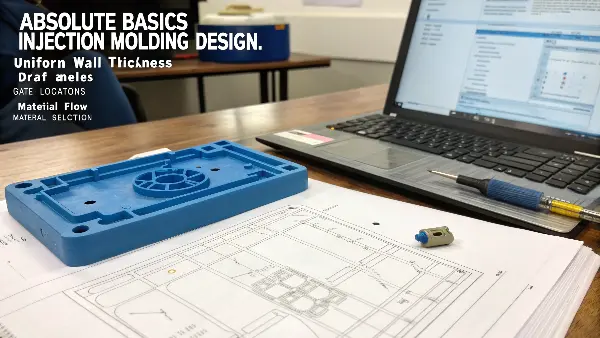
The basics of injection molding design involve creating a part that can be manufactured efficiently and effectively. This means considering factors like uniform wall thickness, draft angles for easy ejection, gate location for proper material flow, and material selection. Getting these right from the start saves time, reduces costs, and results in a high-quality final product. These principles ensure your design is manufacturable and performs as intended without production issues.
That’s the high-level view, but I know you’re looking for more detail. As a project manager, you need to understand the ‘how’ and ‘why’ behind these principles. Let’s break it down further, starting with the process itself. Once you see how the machine works, the design rules will make a lot more sense.
What Are the 5 Core Steps of the Injection Molding Process?
Ever wonder what actually happens inside that giant machine after you send off your design files? Not knowing the process can make it hard to troubleshoot issues or communicate effectively with your manufacturing partner. Let’s walk through the five core steps together, so you can visualize exactly how your part is made.
The five core steps of injection molding are: clamping, injection, dwelling, plasticizing, and ejection. First, the mold halves are clamped shut. Then, molten plastic is injected into the mold cavity. It cools and solidifies under pressure. While cooling, the machine prepares the next plastic shot. Finally, the mold opens, and the finished part is ejected. This cycle repeats thousands of times to produce your parts.

I find that the best project managers, like my friend Alex in Australia, have a solid grasp of the manufacturing process itself. It helps them spot potential design issues before they become expensive problems. Understanding these five steps is the foundation for everything else in injection molding design. Let’s look at each one more closely.
Step 1: Clamping
Before anything else happens, the two halves of the mold tool must be securely closed. This is done by a powerful clamping unit. Clamping force, measured in tonnage, is critical. It has to be strong enough to hold the mold closed against the immense pressure of the molten plastic being injected. If the clamp force is too low, the mold can flash, meaning a thin layer of plastic escapes at the parting line, creating an ugly and often unusable part.
Step 2: Injection
With the mold clamped shut, the injection phase begins. Plastic pellets are melted in a heated barrel and pushed forward by a reciprocating screw. This molten plastic, called the "shot," is forced under high pressure through a nozzle, into the sprue and runners of the mold, and finally through the gate into the part cavity. The speed and pressure of this injection are carefully controlled to ensure the cavity fills completely and uniformly.
Step 3, 4, and 5: A Detailed Look
The next phases happen very quickly and often overlap, so it’s helpful to see them in a structured way.
| Step | Action | Key Considerations for Design |
|---|---|---|
| Dwelling & Cooling | The injected plastic is held under pressure (packing/dwelling) to compensate for material shrinkage as it cools and solidifies. | The cooling time is the longest part of the cycle. Uniform wall thickness is crucial for consistent cooling and to prevent warping. |
| Plasticizing | As the part cools, the screw rotates and draws in new plastic pellets, melting and preparing them for the next shot. | The total cycle time depends heavily on cooling and plasticizing. Thicker sections significantly increase this time and your part cost. |
| Ejection | Once the part is solid enough, the clamping unit opens the mold. Ejector pins then push the finished part out of the mold cavity. | Draft angles are essential here. Without a slight taper on the walls, the part will stick to the mold, causing damage during ejection. |
This entire cycle, from clamping to ejection, can take anywhere from a few seconds to over a minute, depending on the part’s size, complexity, and wall thickness.
What Are the Three Most Critical Design Considerations for Injection Molds?
You have a perfect 3D model, but will it actually work as an injection-molded part? A great digital design can fail spectacularly in production if key manufacturing principles are ignored. This oversight can lead to frustrating delays and budget overruns. Let’s focus on the three most critical design considerations you must get right.
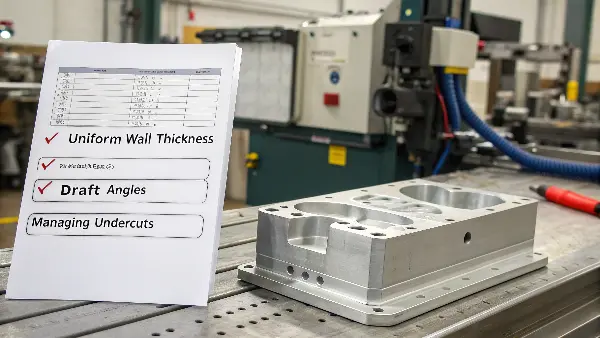
The three most critical design considerations are uniform wall thickness, draft angles, and managing undercuts. Maintaining consistent wall thickness prevents defects like sink marks and warping. Draft angles, or tapers on vertical walls, are essential for easy part ejection from the mold. Properly addressing undercuts, which are features that prevent direct ejection, is vital to avoid complex and costly mold mechanisms.
When I started in this business over a decade ago, I learned a tough lesson about these three rules. We had a client with a beautiful design for an electronics enclosure. It looked great on screen, but they had designed it with zero draft and wildly varying wall thicknesses. The first production run was a disaster. The parts warped, had terrible sink marks, and many broke during ejection. We had to do expensive mold rework, and the project was delayed by weeks. That experience taught me to check these three things first, every single time.
1. Uniform Wall Thickness
This is the golden rule of plastic part design. The goal is to keep the thickness of all walls as consistent as possible throughout the part. When molten plastic cools, it shrinks. If one section is much thicker than another, the thick section will cool slower and shrink more, pulling on the adjacent thinner section. This causes problems like:
- Sink Marks: Small depressions on the surface of the part opposite a thick section.
- Warping: The part distorts and bends as it cools due to uneven stresses.
- Voids: Internal bubbles or hollow spots within a thick section.
To avoid this, core out thick sections or use ribs to add strength instead of adding mass. If you must have a change in thickness, make the transition gradual and smooth, not abrupt.
2. Draft Angle
Imagine trying to pull a perfect cylinder out of a tight-fitting cylindrical hole. The friction along the entire surface makes it stick. This is what happens in a mold if you have walls that are perfectly perpendicular to the mold’s opening direction (90-degree walls). A draft angle is a small taper, typically 1 to 2 degrees, applied to these walls. This tiny angle ensures that as soon as the mold begins to open, the part separates cleanly from the mold surface. Without draft, the part will scrape against the mold during ejection, causing cosmetic scratches and potentially damaging the part or the mold itself. The deeper the part, the more critical draft becomes.
3. Undercuts
An undercut is any feature of your design that prevents the part from being directly ejected from the mold. Think of a snap-fit latch or a hole on the side of a part. These features get "hooked" onto the mold core. While it’s possible to create parts with undercuts, they require a more complex mold with a mechanism called a side-action or lifter. These mechanisms physically move a piece of the mold out of the way before ejection. They add significant cost, complexity, and potential failure points to the mold tool. Your first goal should always be to design out undercuts if possible. If they are absolutely necessary for the part’s function, work closely with your molder to design an effective and reliable solution.
What Are the Key Rules of Thumb for Injection Molding Design?
Feeling overwhelmed by all the technical details? It’s easy to get lost in complex DFM (Design for Manufacturability) reports. Not having a simple checklist of best practices can lead to making common, avoidable mistakes. So, let’s boil it all down to a few easy-to-remember rules of thumb that will serve you well on every project.
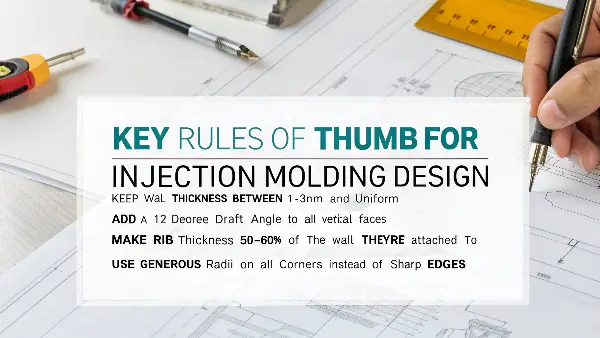
Key rules of thumb for injection molding include: keep wall thickness between 1-3mm and uniform, add a 1-2 degree draft angle to all vertical faces, and make rib thickness 50-60% of the wall they’re attached to. Also, use generous radii on all corners instead of sharp edges to improve plastic flow and reduce stress. Following these simple guidelines will drastically improve the manufacturability of your parts.
I often tell new engineers on my team to print out these rules and pin them to their wall. They seem simple, but they are the product of decades of experience in the industry. These rules are less about rigid commands and more about a mindset. The goal is always to help the molten plastic do its job easily. If you make it easy for the plastic to flow into the mold, fill it completely, cool evenly, and exit cleanly, you’ll get a great part. Forcing the material to do something it doesn’t want to do—like turn a sharp corner or fill a massive thick section—is where all the problems start.
The Power of Radii
Sharp internal corners are a huge source of stress in a plastic part. They act as "stress concentrators," making the part much weaker and more likely to crack under load. They also make it harder for the molten plastic to flow smoothly into every part of the mold cavity. The rule is simple: add a radius to every corner, inside and out. A good rule of thumb for an inside corner radius is to make it at least 0.5 times the wall thickness. An outside corner radius would then be the inside radius plus the wall thickness. This simple change dramatically improves material flow and creates a much stronger, more durable final part.
Principles of Ribs and Bosses
Ribs are thin, wall-like features used to add strength and stiffness to a part without adding thickness and mass. Bosses are cylindrical features typically used for mounting or as locating points for screws. Both are essential design elements, but they need to follow specific rules to avoid causing defects.
| Feature | Design Rule | The "Why" Behind It |
|---|---|---|
| Ribs | Keep rib thickness to 50-60% of the main wall thickness. | If a rib is too thick, it acts like a thick section and will cause a sink mark on the opposite surface of the main wall. |
| Keep rib height to less than 3 times the wall thickness. | Tall, thin ribs can be difficult to fill with plastic and can break during ejection. | |
| Bosses | Core out the boss to maintain uniform wall thickness. Add gussets at the base for support. | A solid boss is a very thick section that will cause severe sinking. Gussets add strength without adding mass. |
| Isolate bosses from side walls whenever possible. | This prevents thick sections where the boss meets the wall, which would also create sink marks. |
By following these fundamental guidelines, you can avoid the most common pitfalls and design parts that are robust, cost-effective, and ready for high-volume manufacturing.
Conclusion
Understanding these basics—the 5-step process, critical design considerations like wall thickness and draft, and key rules of thumb—is the foundation of successful injection molding. It bridges the gap between your design and a high-quality, manufacturable part, saving you and your company time, money, and frustration.