
You need high-volume production, but traditional methods are too slow. You worry about inconsistent quality and rising costs per part. What if there was a way to achieve speed, precision, and cost-effectiveness all in one process, ensuring your project’s success?
Injection molding is an excellent choice for mass production due to its speed, repeatability, and low cost per part. It allows for complex geometries and a wide range of materials. However, its main drawbacks are high initial tooling costs and long lead times for mold manufacturing, making it less suitable for low-volume projects or frequent design changes.
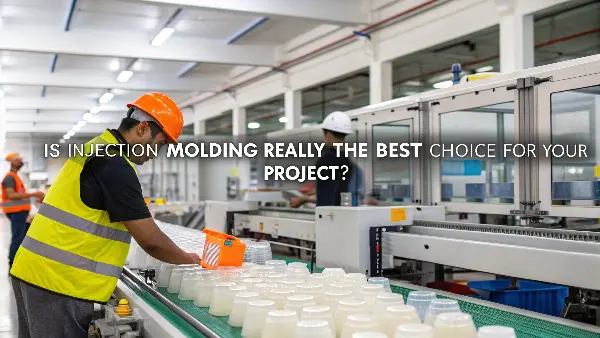
I’ve spent over a decade in this industry, and I’ve seen firsthand how injection molding can make or break a project. The decision to use it goes beyond just the part itself. It really starts with the core of the process: the mold. Let’s break down what you need to know to make the right call and see if this process fits your needs.
What Are the Pros and Cons of Injection Molding Tooling?
The mold is the heart of injection molding, but its cost can be a huge hurdle. Investing a large sum upfront feels risky, especially when you need to be sure about the return. You need a tool that guarantees perfect parts for years, not one that fails after a few thousand cycles.
The primary advantage of injection molding tooling is its durability for high-volume production, creating millions of identical parts with high precision. This longevity makes the cost-per-part extremely low over time. The main disadvantage is the significant upfront investment in design and fabrication, which can range from thousands to hundreds of thousands of dollars, along with long lead times for manufacturing the tool itself.
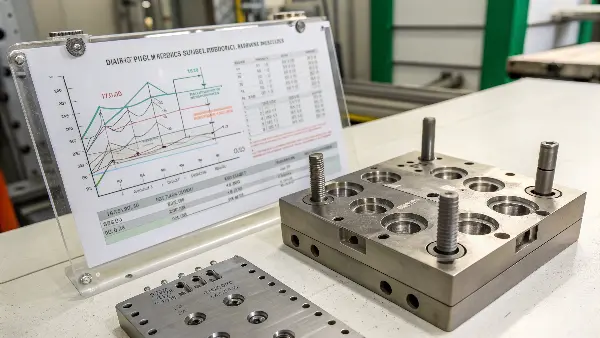
When we talk about injection molding, the mold—or the tooling—is the most critical asset. It’s a specialized piece of equipment that dictates the quality, speed, and cost of your final product. I remember a project with a client in the automotive sector. They needed a million components with very tight tolerances. The initial mold cost was over $80,000, which caused some hesitation. But when we broke down the math, the cost per part was just a few cents. The tool paid for itself many times over.
The main advantage is simple: durability and precision for mass production. A well-made steel mold can last for millions of cycles. This means once the initial investment is covered, your part cost drops dramatically. This tooling also allows for incredible complexity. Features like undercuts, threads, and fine textures can be integrated directly into the mold, which saves a lot of time on secondary operations.
The cons, however, are just as significant. The initial cost is the biggest barrier. This isn’t something you decide on lightly. The design and manufacturing process for a high-quality mold is complex and time-consuming. It involves precise CNC machining, EDM, and hand-finishing by skilled toolmakers. This process can take anywhere from a few weeks to several months, which is a major factor in your project timeline. Any design change after the tool is made is also difficult and expensive. It’s not like 3D printing where you can just tweak a CAD file. Modifying hardened steel requires time and expertise.
What Are the Key Disadvantages of Injection Molding?
You’ve got a fantastic product design, but now you face a reality check. The high upfront costs and long lead times of injection molding could kill your budget and timeline. You worry that if the market doesn’t respond well, you’ll be stuck with an expensive, useless tool.
The key disadvantages of injection molding are the high initial tooling investment and long lead times, which make it unsuitable for prototypes or low-volume runs. Design changes are costly and difficult once the mold is created. The process also has limitations regarding part size, and certain complex geometries can introduce defects like sink marks or warp if not designed carefully, which requires significant expertise to prevent.
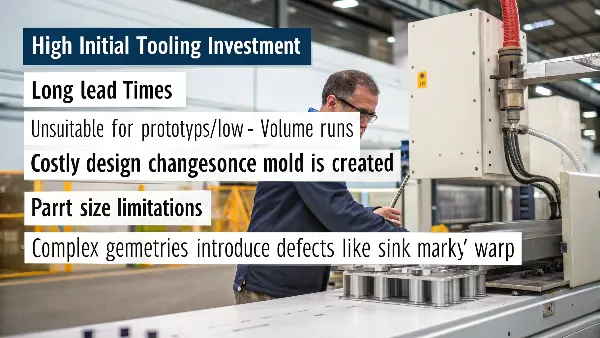
While injection molding is a powerhouse for production, it’s not the right fit for every job. I often advise new clients to be very clear about their production goals before committing. The initial investment is, by far, the biggest hurdle. A complex mold can cost as much as a small house. If you only need a few hundred or even a few thousand parts, the cost per piece will be astronomical. This is why we almost never recommend injection molding for prototyping. Use 3D printing or CNC machining for that. Get your design perfect first, then invest in the tool.
Another big issue is the lead time. From finalizing the design to getting the first articles from the mold can take months. This delay can be a problem in fast-moving markets. You have to plan your product launch schedule around the mold manufacturing timeline. Once that mold is cut from steel, you’re committed. If you discover a design flaw or want to make a "small tweak," it’s often not small at all. Modifying a hardened steel mold is a complex re-machining process. It’s expensive and adds even more delays. I’ve seen simple changes cost thousands of dollars and add weeks to a project. This lack of flexibility is a major drawback compared to other manufacturing methods. Finally, there are design constraints to consider.
Common Design-for-Manufacturing (DFM) Issues
To avoid problems, your part must be designed specifically for injection molding. Here are some common issues we look out for:
- Wall Thickness: Walls must be uniform. If they are too thick, you get sink marks and long cooling times. If they are too thin, the mold may not fill properly.
- Draft Angles: Part surfaces parallel to the direction of mold opening need a slight angle (draft) so the part can be ejected easily. Without it, the part can get stuck, causing damage.
- Undercuts: Complex features that prevent the part from being ejected directly require slides or lifters in the mold, which adds significant cost and complexity.
Getting these details right requires experience. It’s why a good DFM analysis before cutting steel is not just a recommendation; it’s essential for success.
What Are the Rules of Thumb for Injection Molding?
You’re ready to start an injection molding project but feel overwhelmed by the technical details. You’re not sure how to design your part correctly or what to expect in terms of cost and time. You need simple, practical guidelines to follow to avoid common and costly mistakes.
Key rules of thumb for injection molding include: maintaining uniform wall thickness (around 1.5-3mm for most plastics) to prevent defects, adding draft angles (1-2 degrees) for easy part ejection, and keeping designs as simple as possible to reduce mold complexity and cost. Also, plan for production volumes over 10,000 units to justify the initial tooling investment and make the process cost-effective.
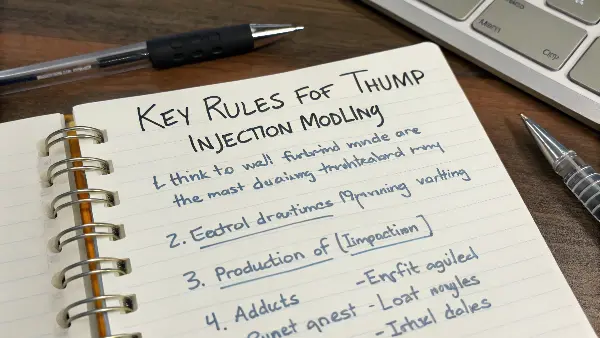
After years of managing molding projects, I’ve found that a few core principles can save you from 90% of potential problems. Think of these as the fundamental rules you can’t ignore. Following them will make your project smoother, cheaper, and faster. The most important rule is uniform wall thickness. When a part has both thick and thin sections, the plastic cools at different rates. The thick sections cool slower and shrink more, which pulls on the adjacent thin sections. This causes ugly defects like sink marks, voids, and warping. Keeping walls consistent is the number one goal for a quality part.
The second rule is to incorporate draft angles. Imagine trying to pull a perfect cylinder out of a tight-fitting hole. It creates a vacuum and friction. Now, imagine the cylinder is slightly tapered like a cone. It pops out easily. That taper is called a draft angle. Every vertical face of your part needs a small draft (usually 1-2 degrees) so it can eject cleanly from the mold. No draft means scratches, ejection pin marks, and in the worst cases, parts getting stuck and damaging the mold.
Finally, remember the KISS principle: Keep It Simple, Stupid. The more complex your part, the more complex the mold. Features like undercuts require side-actions or lifters, which are moving parts within the mold. These add significant cost, complexity, and potential points of failure. If you can achieve the same function with a simpler design that avoids undercuts, you will save a lot of money and headaches. I always push my clients to ask, "Is this feature absolutely necessary?" Often, a small design tweak can eliminate a complex mold mechanism.
Quick Guide: Key DFM Parameters
| Rule of Thumb | Standard Recommendation | Why It’s Important |
|---|---|---|
| Wall Thickness | 1.5 mm – 3 mm | Prevents sink marks, voids, and warp. Ensures uniform cooling. |
| Draft Angle | 1 – 2 degrees per side | Allows for easy part ejection from the mold. Prevents cosmetic damage. |
| Radii / Fillets | Minimum 0.5x wall thickness | Reduces stress concentrations in corners, improving part strength. |
| Undercuts | Avoid if possible | Eliminating undercuts drastically reduces mold cost and complexity. |
| Material Choice | Consult with your molder | The material affects shrink rate, flow, and final part properties. |
Following these guidelines during the design phase is the single best thing you can do to set your project up for success.
What Are the Merits and Demerits of All-Electric Injection Molding?
You’re looking to optimize your production and have heard about all-electric injection molding machines. You wonder if they’re just a fad or a real upgrade over traditional hydraulic machines. The higher initial cost makes you question if the benefits are truly worth the investment for your specific needs.
The primary merit of all-electric injection molding machines is their superior precision, repeatability, and energy efficiency, often reducing power consumption by 50-70%. They are also cleaner and quieter, making them ideal for medical or electronic applications. The main demerit is their higher upfront purchase price compared to hydraulic machines. They may also have lower clamp force capabilities, limiting them for very large parts.
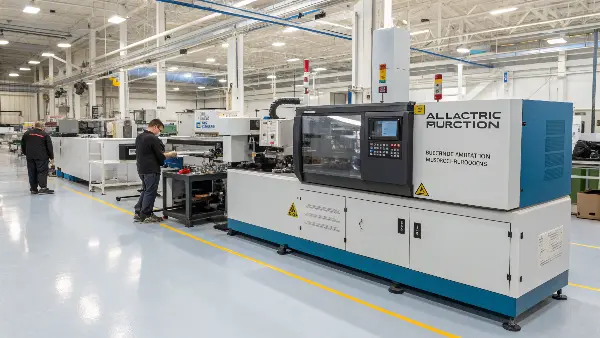
The debate between hydraulic and all-electric machines is a big one in our industry. For decades, hydraulic machines were the standard. They are powerful, reliable, and relatively inexpensive. However, all-electric machines have become a game-changer, and at CAVITYMOLD, we’ve seen the benefits firsthand. The main advantage of all-electric machines is unparalleled precision. Every movement—injection, clamping, and ejection—is controlled by a highly precise, digitally controlled servo motor. This eliminates the variability you sometimes get with hydraulic fluid, which can change viscosity with temperature. For projects with extremely tight tolerances, like medical devices or high-end electronics, this level of control is a huge benefit.
Another major plus is energy efficiency. Hydraulic machines need to run a pump continuously to maintain pressure, even when the machine is idle between cycles. It’s like leaving your car engine running at a red light. All-electric machines only use power when a motor is moving. We’ve seen energy savings of up to 70% after switching from hydraulic to electric for certain jobs. Over the life of the machine, these savings can be substantial and can offset the higher initial purchase price. They are also much cleaner and quieter, as there’s no hydraulic oil to leak or noisy pump running all day. This makes for a better working environment and is almost a requirement for cleanroom manufacturing.
However, all-electric isn’t always the perfect solution. The biggest demerit is the cost. They are significantly more expensive to buy than a hydraulic machine with the same tonnage. Also, for really massive parts that require immense clamping force, hydraulic machines still rule the day. They can achieve higher tonnages more cost-effectively. So, the choice really depends on the application.
Hydraulic vs. All-Electric: A Quick Comparison
| Feature | All-Electric Machine | Hydraulic Machine |
|---|---|---|
| Precision | Extremely high and repeatable. Digital control. | Good, but can vary with oil temperature. |
| Energy Use | Very efficient. Uses power only on demand. | Less efficient. Pump runs continuously. |
| Speed | Faster cycle times due to parallel movements. | Slower, movements are often sequential. |
| Environment | Clean, quiet, no oil. Ideal for cleanrooms. | Prone to oil leaks, noisier operation. |
| Initial Cost | Higher | Lower |
| Best For | Small to medium parts, medical, electronics, tight tolerances. | Large parts, general-purpose molding, lower budgets. |
For a project manager like Alex, choosing a partner who uses modern, all-electric machines can mean better part quality, more consistent deliveries, and potentially faster cycle times.
Conclusion
Injection molding offers incredible efficiency for mass production but requires a significant upfront investment in tooling. The best choice depends on your volume, budget, and design complexity. Weighing the pros and cons carefully ensures you leverage its power without falling into common pitfalls.