
Scaling a product from prototype to millions of units feels like a huge risk. You worry about inconsistent quality, ballooning costs, and blown deadlines. Injection molding provides a reliable, proven path to scale production without those sleepless nights.
Injection molding is ideal for mass production because it combines incredible speed, rock-solid consistency, and a very low cost per part once the initial mold is made. This process allows you to produce millions of identical, high-quality parts from a vast range of materials, making it the most efficient method for high-volume manufacturing.
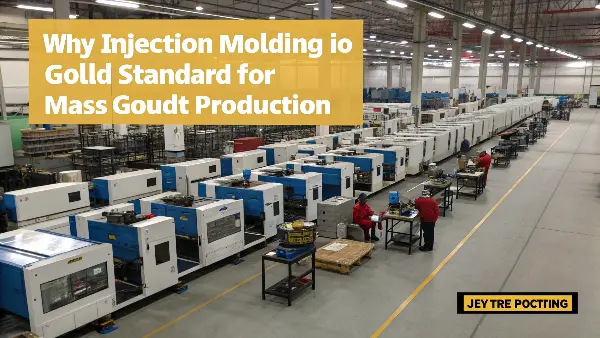
When you’re responsible for bringing a product to market, every decision carries weight. Choosing the right manufacturing process is one of the biggest. We’ve worked with countless project managers like you, helping them navigate this choice. You need more than just a yes or no answer; you need to understand the fundamental reasons why a process works. Let’s break down exactly why injection molding has become the engine of modern mass production.
What makes injection molding so cost-effective for high volumes?
That initial tooling invoice can be intimidating, I know. You look at the number and wonder if the project can support it. But focusing only on that upfront cost is a mistake that can lead you to choose a less efficient process. The real power lies in how that investment pays off over the entire production run.
Injection molding becomes exceptionally cost-effective at high volumes because the high initial mold cost is spread across hundreds of thousands or even millions of parts. This amortization, combined with fast cycle times, low labor requirements, and minimal material waste, drives the cost per individual part down to just pennies.
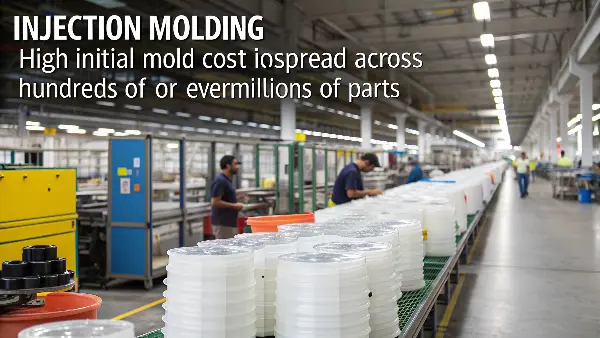
I remember a project manager, Alex, who came to us for a new consumer electronics housing. He was considering CNC machining for the first 50,000 units to avoid the mold cost. I sat down with him and we ran the numbers. Breaking down the total cost reveals the true picture. Your total expense is a combination of two key things: the one-time tooling cost and the recurring per-part cost. While the tooling cost is high, the per-part cost for injection molding is incredibly low.
Let’s look at how this plays out:
Understanding the Cost Breakdown
- Tooling Cost: This is your big upfront investment. It covers the design, machining, and finishing of a high-precision steel mold. This tool needs to withstand immense pressure and temperature for a long time.
- Per-Part Cost: This includes the raw plastic material, the machine time (cycle time), and any labor for post-processing or packing.
The magic happens when you divide the tooling cost by the number of parts you produce.
The Power of Amortization
| Production Volume | Example Tooling Cost | Cost Per Part (Tooling) | Example Per-Part Cost (Material + Cycle) | Total Cost Per Part |
|---|---|---|---|---|
| 1,000 units | $10,000 | $10.00 | $0.50 | $10.50 |
| 10,000 units | $10,000 | $1.00 | $0.50 | $1.50 |
| 100,000 units | $10,000 | $0.10 | $0.50 | $0.60 |
| 1,000,000 units | $10,000 | $0.01 | $0.50 | $0.51 |
As you can see, the impact of the tool cost becomes almost negligible at high volumes. The total cost per part gets very close to the minimal cost of just the material and machine time. This is why injection molding is the undisputed champion for high production runs.
Why is repeatability so crucial in high-volume runs?
You’ve specified a tolerance of ±0.05mm for a critical snap-fit feature. But what happens if part number 500,000 is off by just a little? It might not fit, derailing your assembly line and costing thousands in downtime and rework. Inconsistent parts are a nightmare for any large-scale product.
Repeatability is crucial because it guarantees that every single part, from the first to the millionth, is functionally identical. This prevents assembly problems, reduces defect rates, and ensures a consistent user experience. Injection molding excels at this by using a single, fixed steel mold to shape every part under controlled conditions.
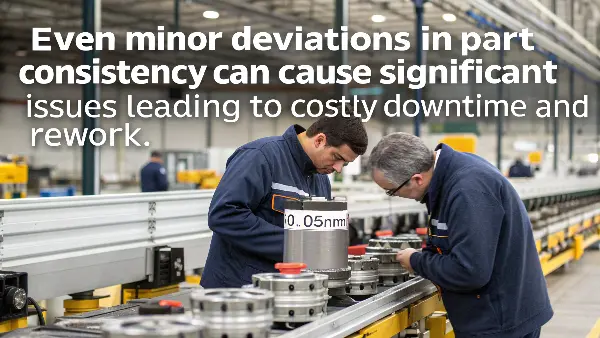
Over the years, I’ve seen that the best designs are often ruined by poor manufacturing execution. It doesn’t matter how brilliant your product concept is if the parts don’t fit together perfectly every time. This is where the core nature of injection molding becomes a project manager’s best friend. The process is built around the principle of exact duplication.
Here’s a deeper look at how it achieves such incredible consistency:
The Role of the Steel Mold
The mold is the heart of the operation. It’s a negative of your final part, machined from hardened steel to incredibly tight tolerances. Because it’s a fixed cavity, every shot of plastic is forced into the exact same shape. Unlike other processes where the tool might wear or the setup might drift, a well-made injection mold is a fortress of consistency. We once built a multi-cavity mold for a medical device cap. That tool has now produced over 15 million parts in the last five years, and the last cap is dimensionally identical to the first.
Precision Process Control
Modern injection molding machines offer precise control over every variable that matters.
- Temperature: We control both the melt temperature of the plastic and the temperature of the mold itself. This ensures the plastic flows and solidifies in a predictable way every time, preventing issues like warping or sink marks.
- Pressure: The injection and holding pressures are finely tuned. This guarantees the mold cavity is completely filled, capturing every fine detail, but not over-packed, which could cause flash or stress the part.
- Time: From injection speed to cooling time, every phase of the cycle is timed to the fraction of a second. This consistent timing is key to a stable process and uniform parts.
This combination of a robust, unchanging tool and a tightly controlled, repeatable process means you can have confidence that every part coming off the line will meet your specifications.
Can you achieve complex geometries with injection molding?
Your design team has just created a beautiful, ergonomic housing. It has integrated clips, reinforcement ribs, and a textured finish, all in one piece. Now you have to figure out how to make it. Trying to produce this with multiple parts and assembly steps would be a complex and costly nightmare.
Yes, injection molding is exceptional for producing highly complex and intricate parts in a single step. Features like reinforcing ribs, snap-fit clips, living hinges, and detailed surface textures can be integrated directly into the mold. This consolidates parts, eliminates secondary assembly steps, and reduces overall production costs.
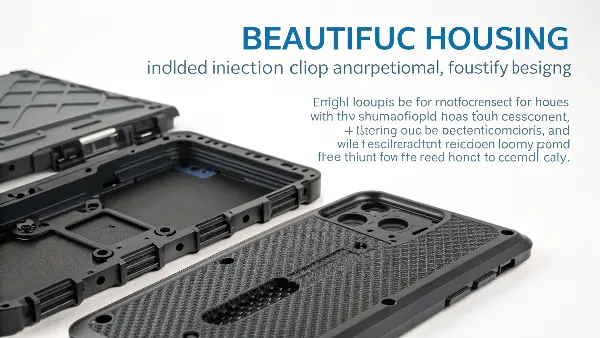
One of the biggest "aha!" moments for designers new to injection molding is realizing the level of complexity they can achieve. It’s not just about making simple shapes in high volume. It’s about making smart shapes that do more work, reducing your Bill of Materials (BOM) and simplifying your supply chain. I worked on a project for an automotive client where we consolidated a five-piece assembly into a single molded part. This not only saved them money on assembly labor but also improved the structural integrity of the final product.
Let’s explore what this means for your product development:
Design for Manufacturing (DFM)
The key to unlocking this potential is through Design for Manufacturing (DFM). By working with an experienced molder early in the design phase, you can optimize your part for the process.
- Part Consolidation: Look for opportunities to combine multiple components into one. This is the single biggest way to slash assembly costs. Can that bracket, screw boss, and cover be molded as a single unit?
- Integrated Features: Add features directly into your part instead of adding them later.
- Snap-Fits: Eliminate the need for screws or adhesives.
- Living Hinges: Create flexible connections, perfect for container lids.
- Bosses & Ribs: Add screw mounting points and increase stiffness without making the part thick and heavy.
- Surface Finishes: You can specify the exact texture you want directly on the mold surface. This can range from high-gloss polished finishes to matte or leather-grain textures, all achieved in-cycle with no secondary processing. We use SPI (Society of the Plastics Industry) standards to define these finishes, ensuring you get exactly the look and feel you want.
A skilled mold maker can create complex tooling with features like side-actions (cams) and lifters to form undercuts and other geometric details that seem impossible at first glance. This capability transforms injection molding from a simple production method into a powerful design tool.
What materials can be used in injection molding?
You need a part that is strong, transparent, and can withstand high temperatures. Another part for the same product needs to be flexible and inexpensive. Sourcing different materials and using different manufacturing processes for each part can complicate your supply chain and create compatibility issues.
Injection molding supports a massive library of thousands of thermoplastic polymers and resins. This allows you to select the perfect material with specific properties for your application, whether you need strength, flexibility, chemical resistance, transparency, or a specific color, all within the same manufacturing process.
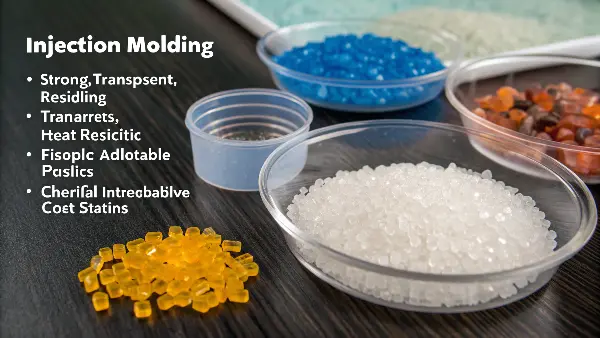
The material versatility of injection molding is a huge, often underestimated, advantage. It’s like having a giant toolbox of properties at your disposal. Instead of designing your part around the limitations of a manufacturing process, you can choose the best material for the job and be confident that it can be molded. We recently helped a client developing outdoor equipment. They needed a rugged housing that could survive impacts and UV exposure. We selected a glass-filled Polycarbonate/ABS blend. For an internal component that needed to be slippery, we used an Acetal (POM) with a PTFE additive. Both parts were made using the same core technology.
Let’s categorize some of the common material families and their uses:
Common Polymer Families
| Material Family | Key Characteristics | Common Applications |
|---|---|---|
| Polypropylene (PP) | Low cost, flexible, good chemical resistance | Packaging, living hinges, automotive components |
| Acrylonitrile Butadiene Styrene (ABS) | Good impact strength, rigidity, easy to process | LEGO bricks, electronics housings, keyboard caps |
| Polycarbonate (PC) | Very high impact strength, transparency, temp resistance | Safety glasses, water bottles, headlight lenses |
| Nylon (Polyamide, PA) | High strength, wear resistance, good for friction | Gears, bearings, zip ties, power tool housings |
| Acetal (POM) | Stiff, low friction, excellent dimensional stability | Bushings, clips, fuel system components |
| Polyethylene (PE) | Very common, flexible, inexpensive | Plastic bags, bottles, toys |
Customizing with Additives
Beyond this, we can fine-tune these base resins with additives to achieve specific outcomes:
- Glass Fibers: Increase stiffness and strength.
- UV Stabilizers: Prevent degradation from sunlight for outdoor products.
- Flame Retardants: Meet safety regulations for electronics (e.g., UL 94 V-0).
- Colorants: Match your exact brand colors.
This enormous material selection means you don’t have to compromise. You can get the exact performance, appearance, and cost you need, making injection molding a uniquely adaptable process for nearly any mass-produced plastic product.
Conclusion
Injection molding isn’t just a manufacturing process; it’s a complete production strategy. It delivers low per-part costs, unwavering consistency, design freedom, and huge material choice. This powerful combination is why it remains the unbeatable choice for bringing products to market at scale, reliably and efficiently.