
Are you struggling to maintain consistency and efficiency on your production floor? It’s frustrating when small inconsistencies lead to big problems like defects, delays, and rising costs. A well-structured manufacturing process sheet is the simple, powerful solution to bring order and predictability to your operations.
A manufacturing process sheet, also known as a route sheet or traveler, is a crucial document that outlines the step-by-step sequence of operations required to produce a part or product. It details the entire journey from raw material to finished good, specifying the machines, tools, settings, and quality checks needed at each stage. It serves as the master plan for your entire production team, ensuring everyone follows the same standardized procedure.
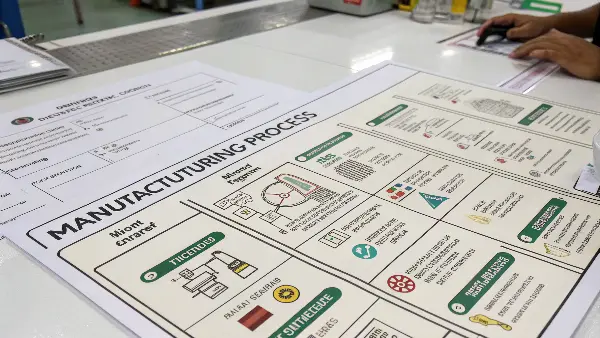
This document is more than just a piece of paper; it’s the backbone of a controlled and efficient manufacturing environment. It’s the difference between structured production and organized chaos. In this post, I’m going to break down exactly what a process sheet is, what goes into it, and how it can transform your quality control. Let’s dive in and see how you can master this fundamental tool.
What key information should be on a manufacturing process sheet?
Have you ever seen an operator staring at a document, completely confused because a critical piece of information is missing? This confusion quickly turns into delays, wasted material, and rework, eating into your project’s profitability. To avoid this, your process sheet must be clear, complete, and unambiguous.
An effective manufacturing process sheet must contain several key pieces of information. This includes administrative data like the part name and number, revision level, and material specifications. It also needs a detailed sequence of operations, specifying the work center or machine for each step, required tooling, operational parameters, and crucial inspection points with tolerances.
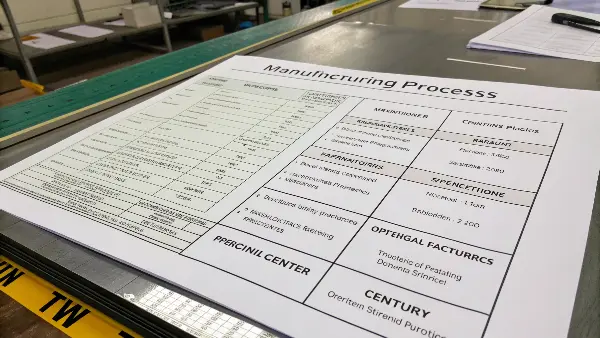
Getting these details right is the first step toward a flawless production run. I remember a project early in my career where we were machining a complex mold core. The process sheet listed the CNC machine but failed to specify the required 5-axis head attachment. The operator, using the standard 3-axis setup, wasted a full day and a very expensive block of P20 steel before the error was caught. That single omission cost us thousands and delayed the project. Since then, I’ve been obsessed with making our process sheets airtight. A truly comprehensive sheet acts as a contract between engineering and production, leaving no room for assumptions.
Let’s break down the essential components you need to include.
Essential Data Categories
A great process sheet organizes information logically so anyone can understand it at a glance. Think of it in three main sections: Part Identification, Operational Sequence, and Quality & Verification.
| Section | Component | Description & Importance |
|---|---|---|
| Part Identification | Part Name & Number | The unique identifier for the component. Prevents mix-ups with similar parts. |
| Drawing & Revision No. | Links the sheet to the correct version of the engineering drawing. Crucial for revision control. | |
| Material Specification | Details the exact type, grade, and size of raw material. Ensures part performance and properties. | |
| Quantity Required | The number of parts to be produced in this batch. Essential for production planning. | |
| Operational Sequence | Operation Number & Description | A numbered list of steps (e.g., "Op 10: Rough Milling," "Op 20: Heat Treatment"). Provides a logical flow. |
| Work Center / Machine ID | Specifies the exact machine or workstation for the operation. Ensures the right equipment is used. | |
| Tooling & Fixtures | Lists all necessary cutting tools, jigs, fixtures, and gauges. Reduces setup time and error. | |
| Machine Parameters | Critical settings like spindle speed, feed rate, or injection pressure. Key to process consistency and part quality. | |
| Quality & Verification | In-Process Inspection | Defines what dimensions or features to check during the process, not just at the end. Catches errors early. |
| Tolerances | The acceptable range for critical dimensions specified on the drawing. This is non-negotiable for quality. | |
| Sign-off & Date | A space for the operator and inspector to sign off on completed steps. Creates accountability and traceability. |
Missing any of these components creates a risk. By ensuring every sheet is complete, you build a robust system that supports your team and protects your bottom line.
How do you create an effective manufacturing process sheet?
Do you find that your team creates process sheets, but operators still make mistakes or don’t follow them? It’s frustrating to invest time in documentation that doesn’t actually improve the process. An effective sheet isn’t just a list of steps; it’s a clear, user-friendly guide built with input from the people who use it.
To create an effective manufacturing process sheet, you must follow a structured approach. Start by gathering all technical data, including engineering drawings and material specs. Then, collaborate with engineers and shop floor operators to break down the production into logical steps. For each step, define the machine, tooling, and specific parameters. Finally, integrate quality check points, review the entire document for clarity, and get it approved before release.
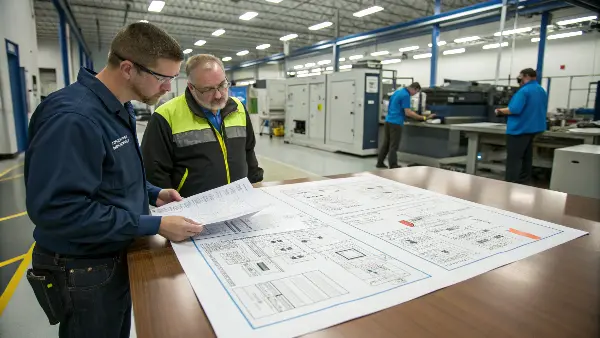
The most common mistake I see is an engineer creating a process sheet in isolation. They create a document that is technically correct but practically useless. It might be too complex, ignore real-world shop floor constraints, or miss a clever trick an experienced operator uses to make the job easier and faster. True effectiveness comes from collaboration. The document should be a living tool that captures the best way to do the job, combining engineering knowledge with hands-on experience. That’s how you create a document that people will actually want to use.
Let’s walk through the steps to build a sheet that works.
Step 1: Gather All Technical Documents
Before you write a single word, you need all the facts. Collect the latest revision of the engineering drawing, the 3D CAD model, the bill of materials (BOM), and any material specification sheets. This information is your source of truth. Double-check that all revision numbers match. There’s nothing worse than manufacturing a batch of parts to an outdated drawing.
Step 2: Define the Sequence of Operations
With the technical data in hand, map out the entire manufacturing journey from start to finish. Think logically. What needs to happen first? Does the part need to be heat-treated before or after final machining? Work with experienced production staff to define these steps. They often have insights into the most efficient sequence. List each operation with a clear, simple description (e.g., "Turn OD," "Drill Holes," "Surface Grind").
Step 3: Assign Resources and Parameters for Each Step
This is where you add the critical details. For each operation you listed, specify:
- Work Center: Which machine, cell, or bench will be used? Be specific (e.g., "Haas VF-4" instead of just "CNC Mill").
- Tooling and Fixturing: List every tool, holder, and fixture required. Include tool numbers if you have a system. This drastically speeds up setup.
- Operating Parameters: This is vital for consistency. For a CNC operation, this includes speeds, feeds, and depth of cut. For injection molding, it’s temperatures, pressures, and cycle times. Don’t leave these to guesswork.
Step 4: Integrate Quality Control Checkpoints
An effective process sheet is also a quality tool. Review the drawing and identify the critical-to-quality (CTQ) dimensions and features. Define specific in-process inspection points within your operational sequence. For example, after "Op 30: Finish Bore," add an inspection step: "Check Bore ID: 25.00mm +/- 0.01mm." Specify the measurement tool to be used (e.g., "bore gauge"). This proactive approach catches deviations before they become scrap.
Step 5: Review, Approve, and Revise
Once the draft is complete, review it with the entire team—engineers, operators, and quality inspectors. Ask them: "Is this clear? Is anything missing? Is there a better way to do this?" This feedback is invaluable. After incorporating changes, have it formally approved. And remember, a process sheet isn’t set in stone. As you find better methods or new tools, update the document. A continuous improvement loop keeps your processes sharp.
How does a process sheet differ from a work instruction?
Are your team members confused about when to use a process sheet versus a work instruction? Using these terms interchangeably creates misunderstandings about the level of detail needed, leading to documents that are either too vague or too complex for their purpose. Clarifying the difference is essential for efficient documentation.
The main difference is scope and detail. A manufacturing process sheet is a high-level overview of the entire production route, showing the sequence of operations and work centers (the "what" and "where"). In contrast, a work instruction is a highly detailed, step-by-step guide on how to perform a single, specific task or operation listed on the process sheet.
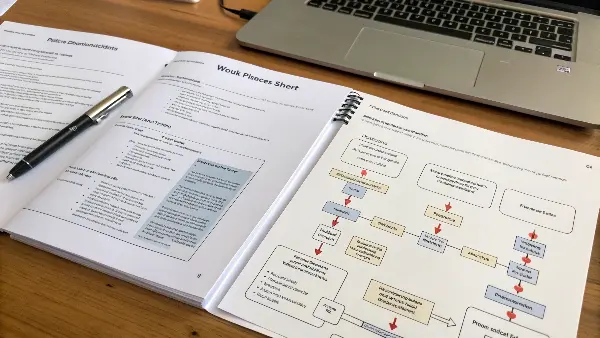
Think of it like a travel itinerary versus a city walking tour guide. The process sheet is your itinerary—it tells you you’re flying from New York to Paris (Operation 10) and then taking a train to Lyon (Operation 20). It gives you the overall plan. The work instruction is the detailed walking tour guide for Paris. It tells you exactly how to get from the Eiffel Tower to the Louvre, step by step, with pictures and specific directions. We once had a new project manager who insisted we put detailed tool-changing instructions on the main process sheet for a mold assembly. The document became a 10-page monster that was impossible to follow. We quickly learned to separate the "what" from the "how" to keep both documents clear and effective.
Here’s a deeper look at the specific differences to help you and your team create the right document for the right job.
A Tale of Two Documents
To make it crystal clear, let’s compare them across a few key attributes. Imagine we are manufacturing a plastic enclosure that requires injection molding and then some secondary assembly.
| Attribute | Manufacturing Process Sheet (The "Route") | Work Instruction (The "Guide") |
|---|---|---|
| Purpose | To outline the complete sequence of manufacturing operations from start to finish. Provides a high-level overview. | To provide detailed, step-by-step guidance on how to correctly and safely perform one specific task. |
| Scope | Covers the entire part lifecycle, from raw material to final inspection. Lists multiple operations. | Covers only a single operation from the process sheet (e.g., "How to operate the ultrasonic welder for Op 40"). |
| Level of Detail | Low to medium. Lists operations, machines, and key parameters but not the minute-by-minute actions. | High. Includes granular details, safety warnings, visuals (photos/diagrams), and specific "click-this, turn-that" commands. |
| Target Audience | Production planners, supervisors, project managers, and operators who need to understand the overall workflow. | The operator performing the specific task. The language and format must be extremely clear and easy to follow on the job. |
| Example Content | 1. Op 10: Injection Molding – Machine IM-05 2. Op 20: Deflashing – Trimming Station 3. Op 30: Insert Installation – Arbor Press #2 4. Op 40: Ultrasonic Welding – Welder UW-01 5. Op 50: Final Inspection | WI for Op 40: Ultrasonic Welding 1. WARNING: Wear safety glasses. 2. Place part half A into fixture nest. 3. Place part half B on top, ensuring alignment pins engage. 4. Press both green palm buttons simultaneously to begin weld cycle. 5. …etc. |
Using both document types correctly is a sign of a mature manufacturing system. The process sheet provides the framework and control for the entire process, while the work instructions empower operators to execute each step perfectly. They don’t compete; they complement each other to create a robust, error-proof system.
What role does the process sheet play in quality control?
Do you feel like you’re constantly fighting fires, dealing with quality issues that seem to appear out of nowhere? This reactive approach is exhausting and expensive, leading to high scrap rates and customer dissatisfaction. The secret to proactive quality is building it into your process, and the process sheet is your primary tool to do it.
The manufacturing process sheet is the foundation of quality control because it enforces standardization. By defining the exact process, parameters, and tooling, it ensures every part is made the same way, every time. It also integrates specific inspection points and tolerances directly into the workflow, transforming quality from a final-step inspection into an ongoing, in-process activity.
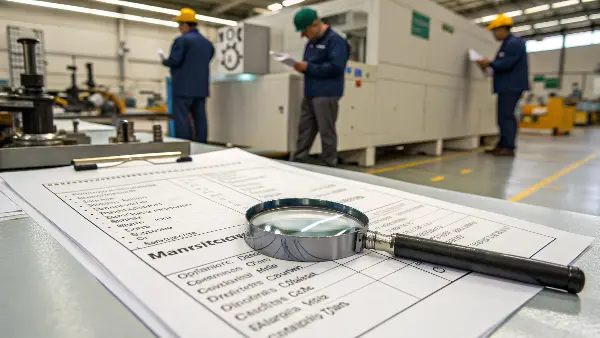
At CAVITYMOLD, our reputation is built on precision. We can’t afford variation when making molds where tolerances are measured in microns. Our process sheets are our non-negotiable playbook. They dictate everything from the CNC roughing strategy to the final polishing sequence. A few years ago, we had an intermittent issue with a mold component not fitting correctly. By reviewing the signed-off process sheets, we traced the problem back to one specific shift on one machine. We discovered the operator was using a slightly different, "faster" polishing technique that was rounding an edge almost imperceptibly. By reinforcing the documented process and adding a specific check-point, the problem vanished. The process sheet didn’t just help us find the problem; it provided the standard we needed to fix it permanently.
Here is how this document becomes the most powerful weapon in your quality arsenal.
1. Driving Standardization and Consistency
The number one enemy of quality is variation. If two operators use different machine settings or a different sequence of steps to make the same part, you will get different results. A process sheet eliminates this freelancing. It establishes the one best way to manufacture the part, based on engineering and experience. This standardization is the first and most critical step in achieving a stable, predictable process that produces consistent, high-quality output. It removes guesswork and ensures that even new operators can perform a task to the same standard as a seasoned veteran.
2. Integrating In-Process Quality Checks (IPQC)
Many companies fall into the trap of relying solely on final inspection. By the time a defect is found here, the part—and all the time and resources invested in it—is already scrap. A strong process sheet builds quality checks directly into the manufacturing flow. For example, it might say:
- After Op 20 (Milling): "Inspector to verify dimension 45.2mm +/-0.05mm before moving to Op 30."
- During Op 50 (Molding): "Operator to perform short-shot check every 50 cycles."
This forces verification at critical stages, allowing for immediate correction if the process drifts out of spec. It’s the difference between preventing defects and simply finding them.
3. Enabling Traceability and Root Cause Analysis
When a defect does occur, your first question is "Why?" A well-maintained process sheet provides the answer. Because each operation is documented and often requires a sign-off from the operator and inspector, you have a complete history of the part’s production journey. If a customer reports a failure six months later, you can pull the process sheet for that batch and see exactly which machine was used, what the parameters were, and who signed off on each step. This detailed record is invaluable for conducting a root cause analysis, identifying exactly where the process broke down, and implementing effective corrective actions. It turns a "mystery" failure into a solvable problem.
Conclusion
In the end, a manufacturing process sheet is far from just another administrative task. It is the central nervous system of your production floor—a dynamic tool that drives consistency, integrates quality, and ensures efficiency. It’s your roadmap from raw material to a perfectly finished product, every single time.