
Are you watching production budgets for your HDPE parts get tighter and tighter? The pressure to cut costs can be intense, but compromising on quality isn’t an option. It feels like you’re stuck between a rock and a hard place, trying to protect your profit margins.
Yes, you can significantly slash costs on HDPE parts without sacrificing quality. The most effective strategies involve optimizing your part design for manufacturability, choosing the right material grade for your specific application, and fine-tuning the injection molding process itself. Focusing on these three areas—design, material, and process—will give you the biggest return and help you achieve substantial savings on your project.
I’ve been in the mold making business for over two decades, and I’ve seen countless projects come across my desk. The ones that succeed in hitting their cost targets always have one thing in common: a smart, holistic approach to optimization from the very beginning. It’s not about one single magic trick; it’s about making deliberate, informed decisions across the board. Let’s break down exactly where you can find these savings and how to implement them effectively.
Could Smart Part Design Cut Your Molding Costs in Half?
Struggling with high quotes for your new HDPE part? You might be looking at complex features and tight tolerances, thinking they are essential. But these complexities are often what drive up tooling and production costs, putting your project over budget before it even starts.
Absolutely. Simplifying your part design is one of the most powerful ways to cut molding costs. By adhering to Design for Manufacturability (DFM) principles—like maintaining uniform wall thickness, using generous radii, and incorporating proper draft angles—you can drastically reduce both mold complexity and production cycle times. A simpler part means a simpler, cheaper mold and faster, more efficient production runs, leading to massive savings.
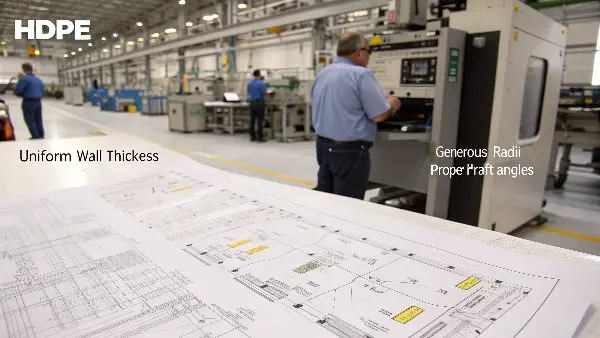
I remember working with a client, let’s call him Alex, who came to us with a design for an electronics housing. It was clever, but full of undercuts and unnecessarily thick sections. The initial tooling quote from another supplier was astronomical. We sat down together and spent a day applying DFM principles. By redesigning a few key areas to eliminate the undercuts and coring out the thick walls, we not only simplified the mold but also cut the projected cycle time by 30%. The final cost was nearly 40% lower than the original estimate, all without affecting the part’s function. This is the power of smart design.
Key DFM Principles for HDPE
To get these kinds of results, you need to focus on a few core areas. It’s about making the part easier for the molten plastic to fill and for the finished part to be ejected from the mold.
Uniform Wall Thickness: This is the golden rule. When walls have different thicknesses, the plastic cools at different rates. This causes internal stress, which leads to warping and sink marks. Keeping walls uniform ensures consistent cooling and a stable, high-quality part. If you need extra strength, use ribs instead of making the whole wall thicker.
Draft Angles: Think about trying to pull a perfect cube out of a tight box. It creates a vacuum and scrapes the sides. A draft angle is a small taper (usually 1-3 degrees) applied to the faces of the part parallel to the mold’s direction of pull. This tiny angle makes it much easier to eject the part, preventing scratches and reducing cycle time.
Radii and Fillets: Sharp internal corners are stress concentrators. They make the part weaker and can cause issues with plastic flow during molding. Adding a smooth, rounded radius to both inside and outside corners helps the plastic flow more easily and distributes stress, creating a stronger part.
Here’s a quick breakdown of how these simple changes impact your costs:
| DFM Principle | Impact on Mold Cost | Impact on Part Cost |
|---|---|---|
| Uniform Wall Thickness | Simpler cooling channels, less complex mold design. | Reduces material usage, faster cycle times, lower defect rate. |
| Adequate Draft Angles | Avoids need for complex ejection mechanisms or surface treatments. | Prevents scratches/drag marks, faster and smoother ejection. |
| Generous Radii/Fillets | Easier to machine the mold cavity and core. | Improves part strength, reduces risk of cracking, better melt flow. |
Is Using Recycled HDPE a Smart Cost-Cut or a Risky Gamble?
Everyone wants to be more sustainable and save money, so using recycled HDPE seems like a perfect solution. But you worry about quality control. What if the material is inconsistent, full of contaminants, or doesn’t perform as well, leading to part failures and angry customers?
Using post-consumer recycled (PCR) HDPE can be a very smart cost-cutting move, provided you do it correctly. The key is to partner with a reputable material supplier who can guarantee the quality and consistency of their recycled resin. For non-critical applications where color consistency and structural load are less important, PCR HDPE offers significant savings. However, for high-performance or food-grade products, sticking with virgin material is often the safer choice.
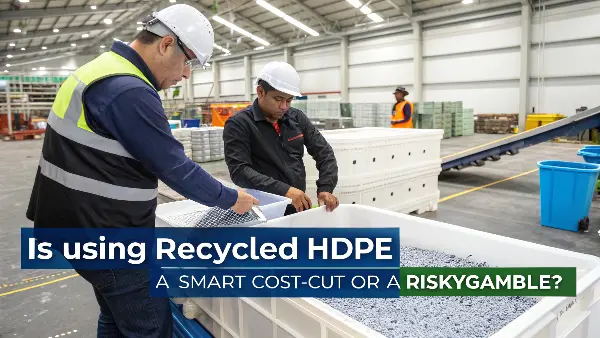
The conversation around recycled materials has changed so much. A decade ago, many of my clients wouldn’t even consider it due to performance concerns. Today, the quality of recycled resins has improved dramatically. We recently worked on a project for a company making commercial flower pots. Strength and function were important, but minor color variations were perfectly acceptable. By using a 75% PCR HDPE blend, they cut their raw material costs by over 20%. The key was a rigorous initial testing phase. We molded samples using several different PCR suppliers to validate performance before committing to a full production run. It’s not a one-size-fits-all solution, but when the application is right, the savings are real.
Weighing the Pros and Cons
Deciding whether to use recycled HDPE requires a careful risk-benefit analysis. It’s not as simple as just ticking the "eco-friendly" box. You have to consider the specific demands of your product.
- Pros of Recycled HDPE:
- Cost Reduction: This is the biggest driver. PCR resins are often significantly cheaper than their virgin counterparts.
- Environmental Benefits: Using recycled material reduces landfill waste, conserves energy, and lowers the carbon footprint of your product. This can also be a powerful marketing tool.
- Cons of Recycled HDPE:
- Inconsistency: The primary risk is variability between batches. Melt flow index (MFI), density, and even color can differ, potentially requiring adjustments to your molding process.
- Contamination: Despite cleaning processes, there’s always a small risk of contaminants, which can cause weak spots or cosmetic defects in the final part.
- Reduced Mechanical Properties: Generally, recycled plastics have slightly lower tensile strength and impact resistance compared to virgin material due to the degradation of polymer chains during reprocessing.
Here’s a guide to help you decide based on your application type:
| Application Type | Suitability for Recycled HDPE | Key Considerations |
|---|---|---|
| Industrial / Utility Parts (e.g., pallets, bins, pipe fittings) | High | Color consistency is low priority. Focus on melt flow and basic structural integrity. |
| Consumer Goods (e.g., non-food containers, toys, outdoor furniture) | Medium to High | Aesthetics matter more. A blend of PCR and virgin might be a good compromise. |
| Packaging (Non-Food) | Medium | Need to test for potential reactions with the contents. Surface finish may be important. |
| Medical or Food-Grade | Low to None | Traceability and purity are paramount. Stick to FDA-approved virgin resins unless using certified food-grade PCR. |
Always request a Certificate of Analysis (COA) from your supplier for any recycled resin you consider using. This document provides data on the material’s properties and is your first line of defense against inconsistency.
Are You Overlooking Cycle Time as Your Biggest Cost-Saver?
You’ve optimized your part design and materials, but your production costs are still too high. You might assume this is just the price of manufacturing. But every extra second your mold stays closed adds up, directly impacting machine time, labor, and energy consumption, quietly inflating your cost per part.
Yes, many companies overlook the massive impact of cycle time reduction. Shaving even a few seconds off each cycle can lead to huge savings over a long production run. This is achieved by optimizing the injection molding process itself—specifically the cooling time, which often accounts for over 70% of the entire cycle. Efficient mold cooling is the single most effective lever you can pull to cut costs at the production stage.
I can’t stress this enough: time is money on the factory floor. I once consulted for a company making millions of simple HDPE caps annually. Their cycle time was 15 seconds, which they thought was pretty good. We analyzed their process and found their cooling time was excessive. We worked with them to re-design the mold’s cooling channels using a conformal cooling layout, which follows the shape of the part more closely. This small change in mold design dropped the cooling time from 10 seconds to just 6. That 4-second reduction in the overall cycle time increased their output by over 35% and saved them hundreds of thousands of dollars a year. It’s a perfect example of how focusing on process efficiency pays off.
Breaking Down the Injection Molding Cycle
To shorten the cycle, you first need to understand its parts. A typical cycle consists of filling, packing, cooling, and ejection. While every phase can be optimized, cooling offers the biggest opportunity.
- Filling Phase: This is when molten plastic is injected into the mold. Optimizing injection speed and pressure ensures the cavity fills completely without defects like short shots or flash.
- Packing Phase: After the cavity is filled, additional pressure is applied to pack more material in, compensating for shrinkage as the plastic cools.
- Cooling Phase: The part solidifies inside the mold until it’s rigid enough to be ejected. This is almost always the longest part of the cycle.
- Ejection Phase: The mold opens, and the ejector pins push the finished part out.
Strategies for Reducing Cooling Time
Since cooling is the bottleneck, this is where your focus should be.
- Optimize Mold Temperature: Running the coolant at the lowest possible temperature can significantly speed up solidification. However, going too cold can cause other issues, like poor surface finish or high internal stress. It’s a balancing act.
- Maximize Coolant Flow Rate: A turbulent flow of coolant is much more effective at removing heat than a smooth, laminar flow. Ensuring your pumps and cooling channels are properly sized to achieve turbulent flow is critical.
- Advanced Mold Cooling Design:
- Conformal Cooling: As mentioned in my story, these channels follow the contours of the part, providing much more uniform and rapid cooling compared to traditional straight-drilled lines. This is a game-changer but increases the initial mold cost.
- High-Conductivity Inserts: Placing inserts made from materials like beryllium-copper alloy in "hot spots" of the mold (like thick sections or ribs) can draw heat away much faster than steel alone.
Here is how these process tweaks translate into real savings:
| Optimization Strategy | Primary Effect | Cost Impact |
|---|---|---|
| Lower Coolant Temperature | Faster heat removal from the part. | Reduces cooling time, lowers cost per part. |
| Increase Coolant Flow | More efficient heat transfer from mold to coolant. | Reduces cooling time, lowers cost per part. |
| Use Conformal Cooling | Uniform and rapid cooling across the entire part. | Significantly shortens cycle time, but higher upfront mold investment. |
Working with an experienced mold maker who understands mold flow simulation and thermal analysis is key to getting this right. We can simulate the cooling process before cutting any steel, ensuring the final mold is built for maximum efficiency.
Conclusion
Optimizing the cost of your HDPE injection molded products isn’t about one big change. It’s a result of smart, integrated decisions. By focusing on efficient part design, making strategic material choices, and relentlessly pursuing a faster cycle time, you can achieve significant savings without compromising product quality.