
Designing for HDPE injection molding can be tricky. Its unique properties often lead to unexpected defects like warpage and sink marks, derailing your project timeline. A failed design means costly mold reworks and production delays, but it doesn’t have to be this way.
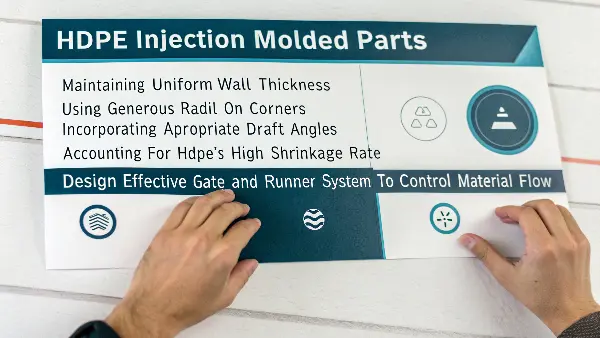
To optimize your design for HDPE injection molded parts, you must focus on key material-specific rules. Maintain uniform wall thickness, use generous radii on corners, and incorporate appropriate draft angles. Most importantly, you need to account for HDPE’s high shrinkage rate by adjusting mold dimensions and designing an effective gate and runner system to control material flow.
Following these high-level guidelines is a great starting point for any project manager or designer. But true mastery comes from understanding the details behind each rule. The success of your HDPE part lies in getting these specifics right from the very beginning.
Let’s dive into the practical, material-specific guidelines that will help you master your next HDPE molding project.
How Does Wall Thickness Affect HDPE Part Quality?
You’ve designed a seemingly perfect HDPE part, but the first samples come back with ugly sink marks and a noticeable twist. This common issue often tracks back to one root cause: inconsistent wall thickness. Don’t let this fundamental error compromise your product’s structural integrity and appearance.
For the best HDPE part quality, always maintain a uniform wall thickness, ideally between 1.5mm to 4.0mm. Avoid abrupt changes in thickness. When a change is unavoidable, use a gradual transition, like a 3:1 taper. This simple rule prevents uneven cooling and shrinkage, which are the primary causes of defects like sink marks and warpage in HDPE.
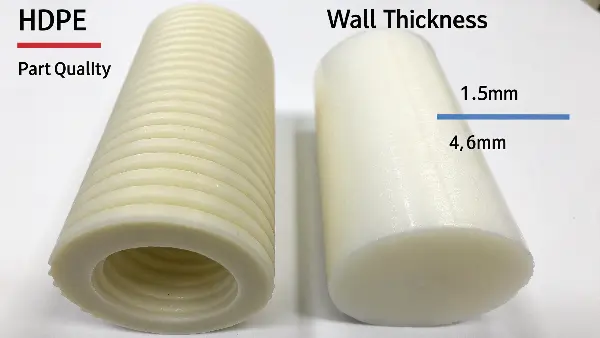
The goal is to have the entire part solidify at the same rate. When you have a thick section next to a thin one, the thin section cools and solidifies first. The thick section, still molten inside, continues to cool and shrink. As it shrinks, it pulls on the already-solid thin section, causing warpage. It can also create a vacuum inside, which pulls the outer surface inward, creating a sink mark. For a material like HDPE with its high shrinkage rate, this effect is much more pronounced. I remember a project involving an outdoor sensor housing. The designer put a thick, solid block on the back for a logo, right next to a standard 2mm wall. The first shots had a massive sink mark right on the logo. We had to go back and core out the feature, creating a uniform wall. It was a simple fix that saved the part’s appearance and taught us a valuable lesson.
The Challenge of Non-Uniformity
The core problem is differential cooling. HDPE needs to cool down and shrink uniformly to maintain its intended shape.
- Thick Sections: Cool much slower than thin sections. The core remains molten longer, and as it finally solidifies and shrinks, it pulls material from the surrounding areas.
- Thin Sections: Cool and harden quickly. If they are adjacent to a thick section that is still shrinking, they will be pulled and distorted, leading to warpage.
Practical Rules for Wall Thickness
To avoid these problems, think about wall thickness as the foundation of your design.
| Guideline | Good Practice | Bad Practice (Causes Defects) |
|---|---|---|
| Consistency | Maintain a single, uniform thickness throughout the part whenever possible. | Abruptly changing from 4mm to 2mm. |
| Transitions | Use a gradual taper or chamfer over a distance of at least 3x the thickness change. | A sharp, 90-degree step between sections. |
| Coring Out | "Core out" thick sections to create hollow features with uniform walls. | Leaving large, solid chunks of plastic. |
| Intersections | At wall intersections, use rounds and fillets to avoid thick material accumulation. | Sharp internal and external corners. |
By following these simple rules, you can design parts that cool evenly, shrink predictably, and come out of the mold looking exactly as you intended.
What Are the Best Practices for Ribs and Bosses in HDPE Parts?
You need to add strength or create mounting points in your HDPE part, so you add some ribs and bosses. But instead of a stronger part, you get sink marks on the opposite surface and cracks around the bosses. This is a common design trap with high-shrinkage materials.
To correctly design ribs and bosses in HDPE, make them thinner than the main wall—ideally 50-60% of the nominal wall thickness. This prevents sink marks on the cosmetic surface. Also, add generous radii at the base of these features and use a draft angle of at least 1-2 degrees. For bosses, support them with gussets if they are tall.
Ribs and bosses are essentially intersections where material accumulates. If a rib is as thick as the wall it’s attached to, the total thickness at the intersection point is much greater. This creates a hot spot that cools slowly, shrinks more, and pulls the main wall inward, creating a sink mark. I once worked on a large HDPE container lid that needed reinforcing ribs. The initial design had ribs that were 90% of the wall thickness. The top surface, which was supposed to be smooth, was covered in visible sink lines directly over every rib. We had to reduce the rib thickness to 60% and add larger radii at the base. The sink marks disappeared, and the part was still plenty strong. It’s a balance between adding strength and not creating new cosmetic or structural problems.
Designing Effective Ribs
Ribs are excellent for adding stiffness without adding significant material or creating thick sections.
- Thickness: The golden rule is to keep the rib thickness between 50% and 60% of the nominal wall thickness. This is the sweet spot for adding support without causing sink.
- Height: Rib height should generally be no more than 3 times the nominal wall thickness. Taller ribs can cause filling issues and breakage during ejection.
- Spacing: Space ribs at a distance of at least 2 times the nominal wall thickness apart. This ensures proper cooling and prevents thin, fragile mold sections.
- Draft: Always add a draft angle, a minimum of 0.5 to 1 degree per side.
- Base Radius: A generous radius at the base of the rib (around 25-50% of the wall thickness) helps reduce stress concentration and improves material flow.
Designing Robust Bosses
Bosses are critical for assembly, typically for screws or locating pins.
| Feature | Design Guideline | Why It’s Important |
|---|---|---|
| Wall Thickness | Keep boss walls at ~60% of the main wall thickness. | Prevents sink marks on the opposite surface. |
| Base Radius | Add a radius of at least 25% of the wall thickness at the boss base. | Reduces stress concentration and potential cracking. |
| Support Gussets | For bosses taller than their diameter, add gussets or connecting ribs. | Provides stability and prevents the boss from being pushed over or breaking off. |
| Coring | The hole in the boss should extend to the base, or close to it. | Maintains uniform wall thickness around the boss. |
| Draft | Apply draft to both the inside and outside walls of the boss (1-2 degrees). | Ensures easy release from the mold core pins. |
By treating ribs and bosses as carefully engineered features rather than simple add-ons, you can leverage their benefits without introducing defects.
How Do You Manage HDPE’s High Shrinkage and Warpage?
You’ve got an approved design for a large, flat HDPE panel. But the molded parts are coming out bowed and twisted, and they don’t fit the assembly. This is the classic challenge of HDPE: its high and variable shrinkage rate makes warpage a constant threat.
To manage HDPE’s high shrinkage and warpage, you need a multi-pronged strategy. Design parts with uniform walls and add structural features like ribs to increase stiffness. In the mold, use a well-planned cooling system to ensure even temperature distribution. Finally, optimize processing parameters like holding pressure and time to compensate for shrinkage as the part solidifies.
HDPE is a semi-crystalline material, which means it shrinks significantly as it cools—typically between 1.5% and 4.0%. This isn’t just a lot; it can also be inconsistent. The direction of polymer flow, the cooling rate, and pressure all affect the final shrinkage. A part can shrink more in one direction than another, which is a primary cause of warpage. I remember a project a few years back for a long, thin cover. The initial samples were shaped like bananas. We ran mold flow simulations and found that the single gate at one end was causing all the polymer chains to align one way, leading to very different shrinkage along the length versus the width. By switching to multiple gates, we balanced the flow and got the parts to come out almost perfectly flat. It showed me that you can’t fight HDPE’s nature; you have to work with it.
Design-Level Strategies
The first line of defense against warpage is in your CAD model.
- Symmetry and Balance: A symmetrical part is inherently more stable. The internal stresses from shrinkage tend to balance each other out. Asymmetrical parts are much more prone to warping.
- Avoid Large, Flat Surfaces: Large, unsupported flat areas are the enemy of dimensional stability in HDPE. They act like a drum skin, ready to distort. Break them up by adding gentle curves, corrugation, or a pattern of well-designed ribs on the non-cosmetic side.
- Uniform Walls: This is key. As we’ve discussed, non-uniform walls lead to differential cooling, which is the direct cause of warpage.
Mold and Processing Strategies
Once the design is optimized, the focus shifts to the mold and molding machine.
| Strategy | Action | Impact on Warpage |
|---|---|---|
| Mold Cooling | Design cooling channels that are parallel and close to the part cavity surface. Ensure turbulent flow for efficient heat transfer. | Promotes uniform cooling across the entire part, minimizing differential shrinkage. |
| Gating | Use multiple gates for large parts or a fan/tab gate to distribute flow and reduce polymer chain orientation. | Balances the filling pattern, leading to more uniform shrinkage in all directions. |
| Processing | Optimize packing pressure and time. A longer packing time pushes more material into the cavity to compensate for shrinkage. | Reduces the overall shrinkage volume but must be carefully controlled to avoid overpacking and stress. |
| Material Choice | Consider HDPE grades with fillers (like glass or talc) if stiffness is critical. | Fillers reduce the overall shrinkage rate and increase the part’s rigidity, making it less likely to warp. |
Managing HDPE warpage requires thinking about the entire process, from the first sketch to the final machine settings. It’s a holistic approach that ensures your parts maintain their intended shape and function.
Why is Gate and Runner Design So Critical for HDPE Molding?
Your part design is perfect, with uniform walls and proper ribs. Yet, you’re still seeing cosmetic flaws near the gate and filling issues at the far end of the part. The culprit is often an overlooked detail: the gate and runner system. It’s the delivery route for your material.
Gate and runner design is critical for HDPE because it directly controls how the molten plastic flows into and fills the mold cavity. A well-designed system ensures uniform filling, minimizes stress, and allows for proper pressure transmission. For high-shrinkage HDPE, this is essential to prevent cosmetic defects, warpage, and structural weaknesses in the final part.
Think of the runner and gate system as the plumbing for your mold. A poorly designed system is like trying to fill a swimming pool through a garden hose—it’s slow, inefficient, and creates unpredictable results. HDPE flows easily when molten, but it also freezes off quickly. Your gate and runner need to be large enough to allow the cavity to be filled and packed out before the gate freezes shut. On one project, we were molding a series of small caps in a multi-cavity tool. The runner system wasn’t balanced, meaning the cavities closest to the sprue filled faster and under more pressure than the ones at the end. The result was a mix of overpacked and short-shot parts, all in the same cycle. We had to re-machine the runners to ensure every cavity received material at the same time and pressure. It’s a perfect example of how the delivery system is just as important as the part itself.
Key Elements of the System
To get it right, you have to consider each part of the delivery route.
- Runner System: This is the network of channels that carries molten HDPE from the machine nozzle to the gates. For HDPE, runners should be full-round or trapezoidal for the best flow-to-volume ratio. They should be sized to minimize pressure drop without wasting material or unnecessarily extending cycle time. A "balanced" runner layout is crucial for multi-cavity molds to ensure all parts fill equally.
- Gate Type and Location: The gate is the small opening connecting the runner to the part cavity. Its location is perhaps the most critical decision.
- Location: Place the gate to fill the thickest sections first. This allows these sections to be packed out properly as the part cools. Avoid gating into thin sections or areas with high cosmetic requirements.
- Type: Different gate types serve different purposes. A tab gate is excellent for flat parts as it reduces stress. A hot runner/hot tip gate can gate directly onto the part surface, eliminating the runner and reducing waste, which is ideal for high-volume production.
- Gate Size: The gate must be large enough to fill the part quickly and to remain open long enough for packing pressure to be effective. For HDPE, a small gate will freeze off too early, preventing you from compensating for shrinkage and leading to sink and voids.
Best Practices for HDPE
| Component | Guideline | Rationale |
|---|---|---|
| Runner | Use full-round or modified trapezoid profiles. Keep them as short and simple as possible. Polish the surfaces. | Maximizes flow efficiency and minimizes pressure loss. A smooth surface reduces shear heating. |
| Gate Location | Gate into the thickest section of the part, away from cosmetically sensitive areas. | Ensures the area that needs the most packing pressure gets it. Avoids blemishes on visible surfaces. |
| Gate Size | Size the gate generously to allow for adequate packing. A typical starting point is 75% of the nominal wall thickness. | Prevents premature freezing, which is essential for combating HDPE’s high shrinkage. |
| Venting | Ensure adequate vents are placed at the last-to-fill areas and weld lines. | Allows trapped air to escape the cavity, preventing burn marks and incomplete filling ("short shots"). |
Properly designing the gate and runner system is not an afterthought; it is a fundamental part of a successful HDPE injection molding project that ensures part quality, consistency, and efficient production.
Conclusion
Optimizing your design for HDPE isn’t about fighting the material’s properties. It’s about understanding them. By focusing on uniform walls, smart feature design, and a well-engineered mold process, you can consistently produce high-quality, dimensionally stable parts that meet your project requirements right from the start.