
Nylon is a fantastic engineering material, but getting your part design right can be tough. You might face unexpected warping, cracking, or parts that don’t fit, leading to costly and time-consuming mold modifications. This frustration can stall your project and strain your budget. By following a few material-specific guidelines, you can avoid these common pitfalls and ensure your nylon parts are strong, stable, and manufactured correctly the first time.
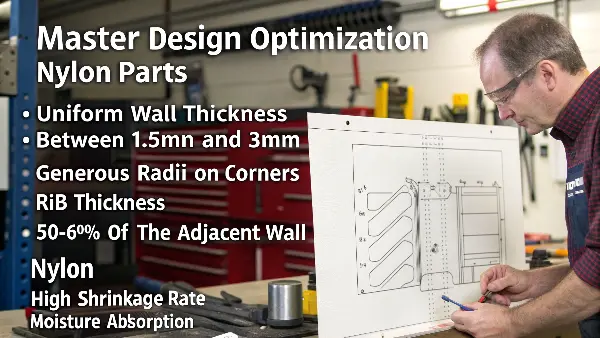
To optimize your nylon part design, focus on maintaining a uniform wall thickness, ideally between 1.5mm and 3mm. Use generous radii, at least 50% of the wall thickness, on all corners to reduce stress. When adding ribs for strength, limit their thickness to 50-60% of the adjacent wall to prevent sink marks. Crucially, you must account for nylon’s high shrinkage rate and its tendency to absorb moisture, as both will affect the final dimensions and performance of your part.
You now have the core principles for designing with nylon. But knowing what to do is different from knowing how and why to do it. The real success comes from understanding the reasons behind these rules. I’ve seen many projects succeed or fail based on these very details.
Let’s dive deeper into each of these areas. I’ll share what I’ve learned over the years to help you turn these guidelines into successful, real-world parts.
What makes nylon so tricky for part design?
Have you ever designed a nylon part that looked perfect in your CAD software, only to see it fail during testing? You’re not alone. Its unique combination of properties, like high shrinkage and moisture absorption, can easily turn a theoretically great design into a production nightmare. Let’s look at why nylon is so challenging, so you can anticipate and design around its specific behaviors.
Nylon is tricky primarily because of its semi-crystalline structure, which causes high and non-uniform shrinkage that leads to warping. It is also hygroscopic, meaning it absorbs moisture from the air, which changes its dimensions, strength, and flexibility after molding. Finally, its low viscosity when molten can easily cause flash if the mold is not perfectly sealed and clamped. Understanding these three core traits is the key to designing successful nylon components.
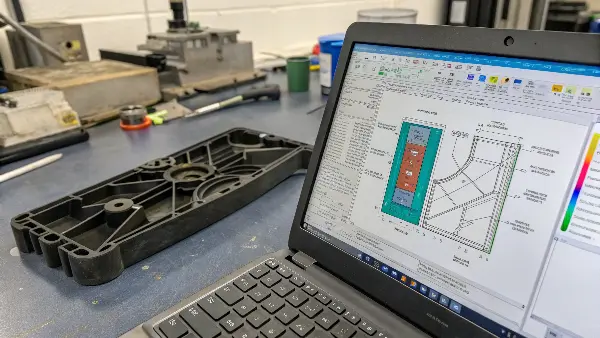
The challenges of working with nylon are not just theoretical; they have real-world consequences for your parts. I remember a client who came to us with a housing part that kept warping. They had designed it like they would for ABS plastic, and the results were disastrous. The problem was they didn’t account for nylon’s unique nature. Once you understand its personality, you can work with it instead of against it.
The Impact of its Semi-Crystalline Structure
Nylon isn’t a uniform solid like glass. At a microscopic level, it’s a mix of ordered, crystalline regions and random, amorphous regions. When the molten nylon cools in the mold, these crystalline structures form and pull the material together much more tightly than the amorphous parts. This pull is what causes shrinkage, and because the cooling rate is never perfectly even across a complex part, the shrinkage isn’t uniform either. This "differential shrinkage" is the primary culprit behind warping. A thicker section will cool slower, form more crystals, and shrink more than a thinner section, causing the part to twist.
The Double-Edged Sword of Moisture Absorption
We call materials that absorb moisture "hygroscopic," and nylon is a prime example. A freshly molded nylon part is at its strongest and most brittle. Over time, it will absorb water molecules from the surrounding air. This absorbed water acts as a plasticizer, making the material more flexible and impact-resistant but also causing it to swell. This change in size can be significant, sometimes up to 2-3% in humid environments. If your part has tight tolerances, this dimensional change can cause major assembly issues down the line. We must always consider the end-use environment when designing nylon parts.
Managing its Low Viscosity Flow
When nylon is melted for injection molding, it flows like water. This low viscosity is great for filling very thin or intricate sections of a mold. However, it also means the material can easily seep into tiny gaps, like the parting line between the two halves of the mold or around ejector pins. This unwanted seepage is called "flash," and it creates thin, sharp slivers of plastic on the part that must be manually removed, adding cost and labor. To prevent flash, we need exceptionally high-quality molds with precise seals and a molding machine that can apply massive, consistent clamping pressure.
How should you handle wall thickness and ribs for nylon parts?
You are designing a structural component and need it to be strong, but you also want to keep it lightweight and cost-effective. Adding thick sections seems like an easy solution, but with nylon, this often creates more problems than it solves, leading to sink marks and internal voids. Let’s look at the correct strategy for achieving strength and stability without these defects.
Properly handling wall thickness and ribs is critical for nylon parts. Maintain a consistent nominal wall thickness throughout the part to ensure uniform cooling and shrinkage. When you need extra stiffness, use ribs instead of thickening the entire section. These ribs should be no more than 50-60% of the thickness of the wall they are attached to. This approach provides the necessary structural support while minimizing the risk of sink marks, voids, and warping.
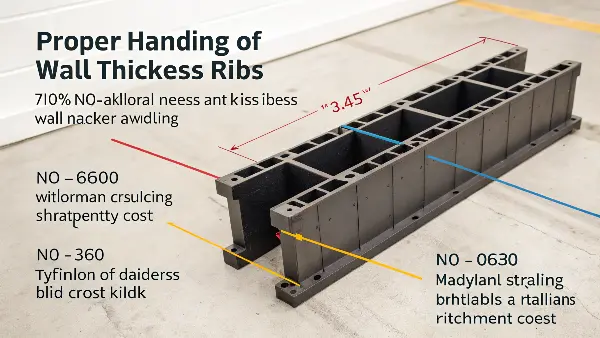
This principle of "uniform walls, thin ribs" is one of the first things I teach new designers. I learned it the hard way early in my career. We were making a handle for a power tool, and the designer made the main grip area very thick for a “solid feel.” The result was a part full of ugly sink marks and internal bubbles. We had to do a major mold redesign, adding a core to hollow out the handle and using a network of thin ribs instead. The new part was stronger, lighter, and looked perfect.
The Golden Rule: Uniform Wall Thickness
The single most important design rule for nylon (and most injection-molded plastics) is to maintain a uniform wall thickness wherever possible. As we discussed, non-uniform cooling leads to differential shrinkage and warping. When one section of a part is twice as thick as another, it will cool much more slowly. It will continue to shrink long after the thinner section has solidified, creating internal stresses that pull and twist the part out of shape. For most nylon grades, a wall thickness between 1.5mm and 3mm is a safe and effective range. If you absolutely must change thickness, make the transition as gradual and smooth as possible.
Using Ribs for Strength, Not Mass
When your design requires extra stiffness or strength, your first instinct might be to make the wall thicker. Resist this urge. The better solution is to use ribs. Ribs are thin, wall-like features that provide support without adding a large mass of material. This is much more efficient from both a structural and a manufacturing standpoint.
Here are the key guidelines for designing effective ribs for nylon parts:
| Rib Design Parameter | Guideline | Reason |
|---|---|---|
| Rib Thickness at Base | 50-60% of the attaching wall thickness | Prevents sink marks and voids on the opposite surface of the wall. |
| Rib Height | No more than 3 times the wall thickness | Tall, thin ribs can be difficult to fill and can break during ejection. |
| Draft Angle | At least 0.5° per side (1° is better) | Allows the rib to release easily from the mold without being damaged. |
| Base Radius | Minimum of 0.25mm, ideally 25% of thickness | Reduces stress concentration at the point where the rib meets the wall. |
| Spacing Between Ribs | At least 2 times the wall thickness | Ensures proper cooling and prevents creating isolated hot spots in the mold. |
By following these rules, you can create strong, lightweight parts that are easy to manufacture and free from common cosmetic and structural defects. It’s about being smart with your material placement.
Why are sharp corners a deal-breaker for nylon designs?
You’ve spent days perfecting your design, and every feature is precisely where it needs to be. But in the model, you have sharp internal corners where walls meet. This might look clean in CAD, but in the real world, it’s a critical failure point waiting to happen. These sharp corners can concentrate stress and cause your nylon parts to crack under load, even when the rest of the design is robust.
Sharp corners are a deal-breaker for nylon parts because they create extreme stress concentrations. When a part is subjected to impact or flexing, all the force is focused on that sharp point, acting like a wedge that initiates a crack. By adding a smooth, rounded corner, known as a fillet or radius, you distribute that stress over a much larger area. This simple change dramatically increases the part’s strength and durability, preventing premature failure.
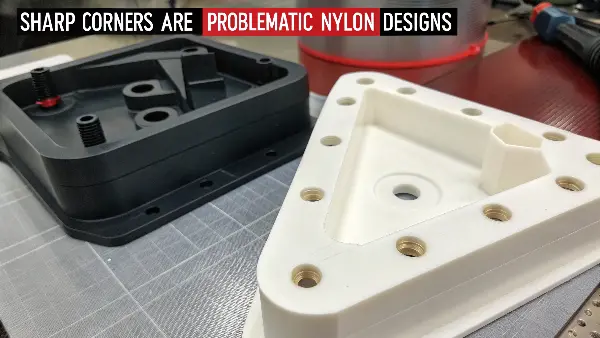
The importance of this rule cannot be overstated. I once worked on a project for a set of nylon clips that held a wire harness in a car engine bay. The first prototypes kept snapping at the point where a small retaining tab met the main body. A quick inspection showed a perfectly sharp 90-degree internal corner. We added a tiny 0.5mm radius to that corner in the mold, and the problem completely disappeared. That tiny curve made all the difference between a failing part and a successful product.
Understanding Stress Concentration
Imagine a river flowing smoothly. If you place a large, sharp rock in its path, the water has to rush violently around it. A smooth, rounded stone, however, allows the water to flow past with minimal disturbance. Mechanical stress in a part behaves in a very similar way. A sharp internal corner forces the lines of stress to "bunch up" as they flow around it. This concentration can multiply the applied stress by a factor of 3, 4, or even more. Nylon, while tough, is "notch sensitive," meaning it is particularly susceptible to cracking when a sharp notch or corner is present to initiate the failure.
The Simple Fix: Generous Radii
The solution is incredibly simple: never design a sharp internal or external corner. Instead, always add a radius.
For Inside Corners (Fillets): A good rule of thumb is to make the inside radius at least 50% of the nominal wall thickness. For example, if your part has a 2mm wall, you should use an inside radius of at least 1mm. More is always better if the design allows it. A larger radius spreads the stress out even further, creating a much stronger part.
For Outside Corners (Rounds): The outside radius should be equal to the inside radius plus the wall thickness. Using our example of a 2mm wall and a 1mm inside radius, the outside radius would be 3mm (1mm + 2mm). This simple formula ensures you maintain that critical uniform wall thickness even around the corner, preventing cooling issues.
This practice doesn’t just improve the part’s strength; it also helps the molten plastic flow more easily and smoothly through the mold cavity. Sharp corners create turbulence in the material flow, which can lead to incomplete filling (short shots) or weak points called knit lines. By adding radii, you are making the part stronger, more durable, and easier to manufacture correctly. It’s a win-win-win.
How can you manage shrinkage and warping in nylon parts?
You’ve followed all the design rules—uniform walls, correct ribs, rounded corners—but when the first parts come out of the molding machine, they are twisted and warped. This is one of the most common and frustrating issues when working with nylon. It happens because nylon has a very high and variable shrinkage rate, making it a challenge to control the final shape of the part.
To manage shrinkage and warping in nylon, you must address it from both the design and processing stages. In design, ensure perfectly uniform wall thickness and use ribs for support instead of thick sections. Design the mold with cooling channels that follow the part’s geometry to promote even cooling. In processing, control mold temperature, injection pressure, and holding time. For glass-filled nylons, be aware that shrinkage will be different in the direction of flow versus perpendicular to it.
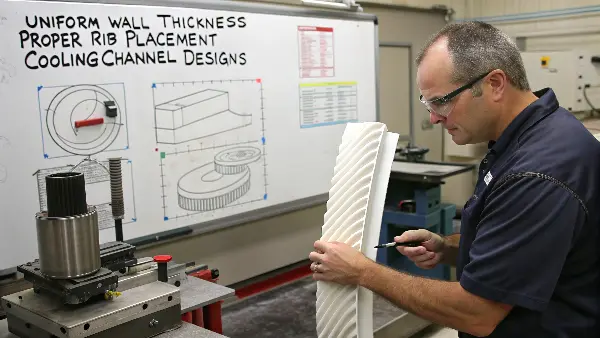
Warpage is a battle fought on two fronts: part design and mold design. I often tell my clients that we can only do so much with the molding machine; the real solution is usually baked into the part and tool design from the very beginning. We once had a large, flat cover plate part that was warping into a potato chip shape. The part design was good, with uniform walls. The problem was in the mold. We had to remachine the cooling channels to be more uniform and add extra cooling near a hotter section of the mold. It was an expensive fix, but it was the only way to get flat parts.
Designing to Minimize Warping
Your first line of defense is always the part design itself. The root cause of warping is differential shrinkage, which is caused by differential cooling. Therefore, the primary design goal is to create a part that cools as evenly as possible.
- Symmetry is Your Friend: Symmetrical parts tend to warp less because the stresses created during cooling are balanced. A U-shaped channel will tend to close in on itself, while a T-shaped section is more stable.
- Avoid Large, Flat Surfaces: Large, unsupported flat areas are highly prone to warping. If you can’t avoid them, add a slight crown (a very subtle curve) to the surface or break it up with a pattern of shallow ribs on the non-visible side. This adds rigidity without impacting the uniform wall thickness.
- Core Out Thick Sections: As mentioned before, never have a large, solid mass of plastic. If you need a thick boss for a screw, for example, core it out from the bottom and use ribs to connect it to the main wall.
The Critical Role of Mold and Process Control
Even a perfect part design can warp if the mold and molding process are not optimized for nylon.
- Cooling Channel Design: This is arguably the most critical aspect of the mold design for controlling warpage. Cooling lines must be placed strategically to extract heat evenly from all areas of the part. They should follow the contours of the part, providing more cooling to thicker areas and less to thinner ones to try and achieve a uniform cooling rate across the entire part.
- Gate Location and Type: The gate is where the molten plastic enters the mold cavity. Its location has a huge influence on how the material flows and cools, and thus on the final shrinkage pattern. Placing the gate at the thickest section of the part is generally a good practice.
- Glass-Filled Nylon Considerations: When you add glass fibers to nylon, it changes everything. The fibers align themselves with the direction of plastic flow. The material will shrink very little along the direction of the fibers, but it will shrink much more in the direction perpendicular to the fibers. This anisotropy is a major cause of warpage in glass-filled parts and must be carefully predicted and compensated for in the mold design.
Conclusion
Mastering nylon part design isn’t about memorizing a complex set of rules. It’s about understanding the unique personality of the material—its thirst for moisture, its tendency to shrink, and its love for smooth corners. By designing with these characteristics in mind, focusing on uniform walls and smart reinforcement, you can avoid costly mistakes and create robust, reliable parts. This approach will save you time, money, and frustration.