
Struggling to get consistent, high-quality nylon parts? It’s frustrating when issues like warping, brittleness, and sink marks ruin your production run, costing you time and money. The good news is that mastering just a few critical processing parameters can solve these problems and transform your results.
The most critical processing parameters for nylon injection molding are melt temperature, mold temperature, injection pressure, holding pressure, and cooling rate. For hygroscopic materials like nylon, proper material drying is an equally crucial pre-processing step. Getting these five elements right is the foundation for producing strong, dimensionally stable nylon parts consistently and efficiently.

I’ve worked with nylon for many years, and it’s a fantastic material. It’s strong, tough, and resistant to wear. But I’ve also seen it cause major headaches for project managers like Alex, who need reliable parts for their assembly lines. The truth is, nylon isn’t forgiving. It demands respect for its unique properties. If you treat it like any other commodity plastic, you’re setting yourself up for failure. But if you understand its specific needs, you can unlock its full potential. Let’s break down what really matters when you’re running nylon, so you can turn those frustrations into predictable success.
What Are the Truly Critical Process Parameters for Injection Molding?
Feeling overwhelmed by the dozens of settings on an injection molding machine? It’s easy to get lost in the details, and focusing on the wrong ones leads to endless tweaking, inconsistent parts, and wasted production time. Let’s simplify things by focusing on what really moves the needle.
The four most critical process parameters for any injection molding job are temperature (both melt and mold), pressure (injection and holding), injection speed, and time (cooling and overall cycle). Mastering these four pillars gives you direct control over the part’s final properties, dimensions, and appearance, solving over 90% of common molding defects.

When I first started in this industry, a mentor told me, "Think of it like baking a cake. You need the right oven temperature, the right mixing speed, and the right time in the oven. Get one of those wrong, and you don’t get a cake; you get a mess." Injection molding is no different. These parameters are all interconnected. A change in one will almost certainly require an adjustment in another. The key is to understand their individual roles and how they work together to shape the final product.
Temperature: The Foundation of Flow
Temperature is arguably the most important parameter. It dictates how the plastic flows into the mold.
- Melt Temperature: This is the temperature of the plastic as it leaves the nozzle. Too low, and the plastic will be too viscous, leading to short shots or high stress in the part. Too high, and you risk material degradation, causing brittleness, discoloration, or gas burns. Every material has a specific processing window you must respect.
- Mold Temperature: This controls the cooling rate of the plastic once it’s in the cavity. A warmer mold allows the polymer chains to relax and pack out properly, reducing internal stress and improving surface finish. A cooler mold shortens the cycle time but can lead to defects like sink marks and warpage if not managed carefully.
Pressure & Speed: Filling the Mold
Pressure and speed work together to fill the mold completely and accurately.
- Injection Pressure & Speed: This is the force and velocity used to push the molten plastic into the mold cavity. High speeds can overcome flow resistance in thin-walled parts but can also cause jetting or burn marks. The goal is to fill the mold about 95-99% full on the first stage before switching to the holding pressure phase.
- Holding Pressure: After the initial fill, holding pressure is applied to pack out the part and compensate for material shrinkage as it cools. This step is critical for dimensional accuracy and preventing defects like sink marks.
Getting these fundamentals right is the a first step for any material. When we specifically talk about a material as sensitive as nylon, these basics become even more critical.
What Makes the Parameters for Nylon Injection Molding So Unique?
You’ve successfully molded parts with ABS or polypropylene, but now you’re running nylon and suddenly facing a new set of challenges. Parts are brittle, dimensions are unstable, and you’re seeing splay marks. Why is nylon so different? It’s because its very nature demands a unique approach.
The parameters for nylon injection molding are unique due to its semi-crystalline structure and hygroscopic nature. Nylon has a sharp, distinct melting point, requiring precise temperature control. More importantly, it readily absorbs moisture from the air, which can cause severe processing defects and part failure if not properly removed before molding.
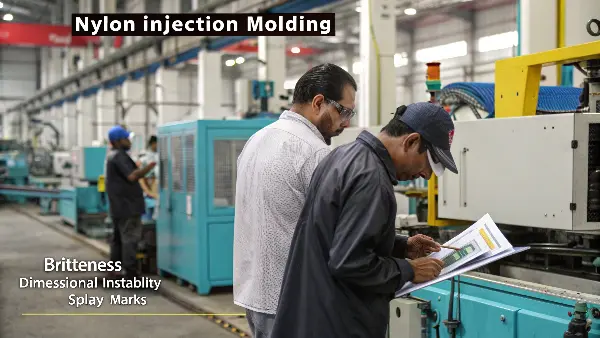
I remember a project for a client who needed high-strength gears for a power tool. They were experienced molders but new to nylon. Their initial samples were incredibly brittle and snapping under minimal load. The problem wasn’t their pressures or temperatures; it was moisture. They weren’t drying the nylon pellets properly. Once we implemented a strict drying protocol, the parts came out strong and performed exactly as designed. This experience taught me that with nylon, you have to master the material before you can master the process.
The Double Challenge: Crystallinity and Moisture
Nylon’s behavior is governed by two main characteristics that set it apart from amorphous plastics like ABS or polycarbonate.
Semi-Crystalline Structure: Unlike amorphous plastics that soften gradually over a wide temperature range, semi-crystalline materials like nylon have a very sharp melting point. They go from solid to a low-viscosity liquid very quickly. This low viscosity means nylon flows very easily, which is great for filling complex, thin-walled parts. However, it also makes it prone to flashing if the mold’s parting line isn’t perfect. This structure is also responsible for its high shrinkage, which must be carefully managed with proper holding pressure and mold design.
Hygroscopic Nature: This is the big one. "Hygroscopic" simply means it loves water. Nylon can absorb significant amounts of moisture from the ambient air. When these wet pellets are heated in the barrel of the molding machine, the water turns to steam. This steam causes a chemical reaction called hydrolysis, which breaks down the polymer chains, severely reducing the material’s strength and impact resistance. It also causes cosmetic defects on the part surface, such as splay or silver streaking. Proper drying isn’t optional with nylon; it is a mandatory first step.
Key Considerations for Nylon
To address these unique traits, you must adjust your entire process. The table below outlines the core differences in approach compared to a standard amorphous plastic like ABS.
| Parameter/Step | Standard Amorphous Plastic (e.g., ABS) | Semi-Crystalline Nylon | Why it’s Different for Nylon |
|---|---|---|---|
| Material Drying | Often optional or requires less time. | Mandatory. Dry to <0.2% moisture content. | Moisture causes hydrolysis, leading to brittle parts and splay marks. |
| Melt Temperature | Wide processing window. | Narrow processing window, sharp melting point. | Requires precise barrel temperature control to avoid degradation. |
| -Viscosity | Higher, more gradual change. | Very low viscosity once melted. | Flows easily but is prone to flash and drooling from the nozzle. |
| Mold Temperature | Cooler molds are common for fast cycles. | Requires a hot mold (e.g., 80°C / 175°F). | A hot mold is essential for controlling crystallinity, reducing stress, and improving dimensional stability. |
| Shrinkage | Lower and more uniform. | Higher and non-uniform (anisotropic). | Must be accounted for in mold design and managed with holding pressure. |
Understanding these fundamental differences is the key to success. You cannot use the same settings or mindset for nylon that you use for other plastics.
What Is the Ideal Processing Temperature for Nylon?
You know temperature is critical for nylon, but "hot" is a relative term. Are we talking about the barrel or the mold? How hot is too hot? Setting the wrong temperatures can be the difference between a perfect part and a batch of rejects due to degradation or warpage.
The ideal processing temperature for nylon depends on the specific grade, but a typical melt temperature is 260-290°C (500-555°F), while the mold temperature must be held at a consistent 80-90°C (175-195°F). Precise control of both melt and mold temperature is essential for managing viscosity, crystallinity, and preventing material degradation.

Setting the right temperatures is a balancing act. For a project involving an intricate electronics housing with long, thin snap-fits, we had to get this balance perfect. Too low on the melt temperature, and we couldn’t fill the snap-fits completely (a short shot). Too high, and the material started to degrade, turning yellow and becoming brittle. The solution was a carefully profiled barrel temperature, starting lower at the feed throat and gradually increasing toward the nozzle, combined with a consistently hot mold to ensure the part cooled slowly and uniformly.
Setting the Melt Temperature Profile
The melt temperature isn’t a single number; it’s a profile across different zones of the machine’s barrel. This gradual heating is gentler on the material and ensures a homogenous melt.
- Rear Zone (Feed Zone): This zone should be cooler, typically around 230-250°C (445-480°F). This allows the pellets to convey forward smoothly without melting prematurely and bridging.
- Center Zones (Transition/Compression Zone): Here, the temperature should ramp up. This is where most of the frictional heat from the screw rotation is generated and the material transitions from solid to molten. Set these zones around 260-280°C (500-535°F).
- Front Zone & Nozzle: These should be the hottest zones to ensure the material is at its final target viscosity before injection. A setting of 270-290°C (520-555°F) is common. The nozzle temperature is especially critical; a nozzle that is too cold can cause freeze-off, while one that is too hot can lead to drooling and stringing.
The Critical Role of Mold Temperature
For nylon, the mold temperature is just as important as the melt temperature. Many people make the mistake of running the mold too cool to shorten the cycle time. This is a critical error with semi-crystalline materials.
Why a Hot Mold is Non-Negotiable
- Controls Crystallinity: Nylon needs time to form its crystalline structure as it cools. A hot mold slows down the cooling rate, allowing for a more complete and uniform crystal structure to develop. This directly impacts the part’s mechanical properties, such as tensile strength, stiffness, and heat resistance. A part cooled too quickly in a cold mold will be weaker and less stable.
- Reduces Internal Stress: Slow, controlled cooling allows the polymer chains to relax, minimizing molded-in stress. High internal stress is a primary cause of warpage and can make parts more susceptible to cracking over time, especially when exposed to chemicals or temperature changes.
- Improves Surface Finish and Dimensions: A hot mold helps achieve a better pack-out during the holding phase, resulting in a glossy surface finish and preventing sink marks. It ensures the part holds its intended dimensions after cooling.
At CavityMold, when we design a mold for nylon, we always incorporate well-designed cooling (or in this case, heating) channels to ensure we can maintain a stable and uniform temperature across the entire cavity surface.
How Can You Optimize Pressure and Cooling for Flawless Nylon Parts?
You’ve dialed in your temperatures and dried your material perfectly, but you’re still fighting defects like sink marks, flash, or warping. The problem often lies in the dynamic duo of pressure and cooling. Getting these right is the final piece of the puzzle for creating dimensionally perfect nylon parts.
To optimize pressure for nylon, use a fast injection speed to fill the mold quickly, then switch to a sufficient holding pressure (50-60% of injection pressure) to compensate for shrinkage. For cooling, use a hot mold (80°C+) and allow adequate cooling time in the mold to ensure the part is rigid enough to eject without warping.

Optimizing these final parameters requires a systematic approach. It’s not about randomly turning dials. We use a method called a "gate seal study" to scientifically determine the perfect holding time. You mold a series of parts, increasing the hold time for each one while keeping all other settings constant. You then weigh each part. The weight will increase with hold time until it plateaus. That plateau is your gate seal point—the moment the gate has frozen solid, and no more material can be packed in. Any hold time beyond this is wasted cycle time.
Fine-Tuning Injection and Holding Pressure
Pressure settings are about filling the mold and then perfecting the part’s final shape.
Injection Phase
- Injection Speed: Because nylon has a low viscosity, a fast injection speed is generally preferred. This fills the cavity quickly before the material has a chance to freeze off in thin sections. However, you must be careful not to create excessive shear heat or jetting. The speed should be controlled and profiled—slowing down as the plastic approaches the end of the fill path to prevent flash.
- Transfer Position: This is the critical point where the process switches from the velocity-controlled injection phase to the pressure-controlled holding phase. This should happen when the mold is about 95-99% full. Transferring too early will result in a short shot or sinks; transferring too late will overpack the part and cause flash.
Holding Phase
- Holding Pressure: This is your primary tool for combating nylon’s high shrinkage rate. The pressure should be high enough to pack additional material into the cavity as the part cools and shrinks. A good starting point is about 50% of the peak injection pressure.
- Holding Time: As determined by the gate seal study, this is the duration the holding pressure is applied. Holding for too short a time will cause sinks and voids. Holding for too long just wastes energy and extends the cycle time unnecessarily.
Optimizing the Cooling Cycle
Cooling isn’t just a waiting period; it’s an active process that solidifies the part’s final properties.
- Cooling Time: This is the most significant portion of the overall cycle time. The part must remain in the mold long enough to become rigid so it can be ejected without deforming. For nylon, with its high shrinkage and need for a hot mold, the cooling time might be longer than for other materials. Don’t rush it. A few extra seconds of cooling can prevent a whole batch of warped parts.
- Ejection: Ensure the ejector pins are well-placed to push on robust areas of the part, like ribs or bosses. Pushing on a thin, still-warm wall can easily cause blemishes or distortion. A slow, gentle ejection speed is often better than a fast, aggressive one.
By systematically optimizing these pressure and cooling parameters, you take full control of the molding process, ensuring every part meets specification.
Conclusion
Mastering nylon injection molding comes down to respecting its unique properties. It requires meticulous material drying, precise temperature control for both the melt and the mold, and a balanced approach to pressure and cooling. Getting these core parameters right is the key to producing strong, stable, and flawless nylon parts.