
Getting that perfect, flawless surface on your plastic parts can feel like a constant battle. You spend weeks perfecting a design, only to see the first articles come back with sink marks or flow lines. These issues not only ruin the product’s look but can lead to costly project delays and tool modifications.
To achieve high surface quality, you must engineer it from the start by carefully balancing four key areas: the part’s geometric design, the choice of plastic material, the injection mold’s construction, and the molding process parameters. Optimizing these factors together is the most effective way to produce aesthetically pleasing parts and prevent common molding defects like sink marks, flow lines, and warping, ensuring your final product matches your design intent.

Achieving a flawless finish is less about luck and more about a systematic approach. As a project manager, I’ve learned that you can’t just hand off a CAD file and hope for the best. You have to be involved in the details that influence the final look and feel of the part. It’s a process of balancing aesthetics with manufacturability. Let’s break down the critical design considerations that I focus on in every project to ensure we get the surface quality right from the very beginning.
What are some general plastics design considerations?
You’ve finalized a product design and feel confident in its function, but you’re worried the final plastic part won’t look as good as your 3D render. Simple oversights in the part’s geometry can lead to ugly surface defects, forcing you into expensive and time-consuming tool modifications.
The most crucial design considerations for plastic parts are maintaining uniform wall thickness, adding adequate draft angles, and using generous corner radii. These three principles directly impact how the plastic flows into the mold and cools. Following them helps prevent common surface defects like sink marks, drag marks, and warpage, leading to a much higher quality appearance and easier manufacturing. It’s the foundation for a successful part.
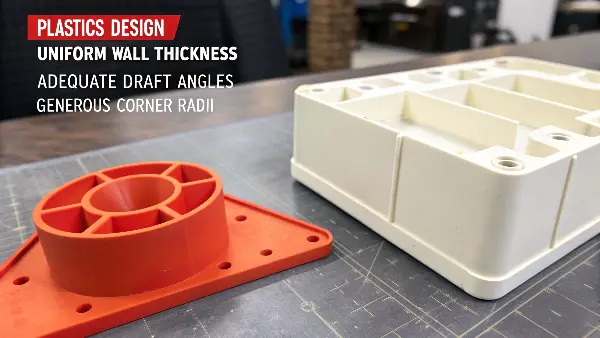
When I first started in this industry, I thought getting the look right was just about the mold’s surface polish. I quickly learned a hard lesson on a project for a handheld device. We had designed a beautiful casing, but we neglected these basic rules. The result was a mess of sink marks and parts getting stuck in the mold. That experience taught me that good surface quality starts with good part design. Let’s go deeper into these core principles.
Maintaining Consistent Wall Thickness
The number one rule in plastic part design is to keep wall thickness as uniform as possible. When molten plastic fills a mold, it cools and shrinks. If one area is much thicker than another, the thick section will cool much slower. This differential cooling causes the thicker area to pull material from the surrounding thinner walls as it shrinks, creating a sunken or dimpled area on the surface known as a sink mark. For a project I managed a few years ago, we had a large flat panel with thick ribs on the back for support. The initial prototypes were covered in sink marks right above every rib. We solved this by redesigning the ribs to be about 50-60% of the main wall thickness, which eliminated the issue entirely.
Incorporating Proper Draft Angles
Draft angles are a small taper applied to the vertical walls of a part. They are essential for a clean release from the mold. Without them, the part’s surface drags against the steel mold as the ejector pins push it out. This creates long, unsightly scratches called drag marks. The amount of draft needed depends on the depth of the part and the texture of the mold surface. A smooth, polished surface might only need 1-2 degrees, but a heavily textured surface could require 5 degrees or more. I always specify a minimum of 1.5 degrees on all non-critical surfaces, even if they’re polished. It’s cheap insurance against ejection problems and surface damage.
Using Radii Instead of Sharp Corners
Sharp internal corners are a major problem in plastic part design. They create high-stress concentrations, making the part weaker and more prone to cracking under load. From a surface quality perspective, they also restrict the flow of molten plastic. The plastic has to make an abrupt change in direction, which can lead to incomplete filling, air traps, and flow marks. By adding a smooth, rounded fillet to inside corners and a radius to outside corners, you improve the structural integrity and help the plastic flow smoothly. A good rule of thumb is to make the inside radius at least 0.5 times the wall thickness.
| Design Feature | Poor Practice (Causes Defects) | Good Practice (Improves Quality) |
|---|---|---|
| Wall Thickness | Abrupt changes from thick to thin. | Uniform thickness, or gradual transitions. |
| Ejection | 0-degree draft (vertical walls). | Minimum 1-2 degrees of draft. |
| Corners | Sharp internal and external corners. | Radiused internal and external corners. |
| Support Ribs | Rib thickness > 70% of wall thickness. | Rib thickness is 50-60% of wall thickness. |
What are three key design considerations for injection mould design?
So, your part design is solid, following all the best practices. But now you need to ensure the tool itself doesn’t introduce surface flaws. A perfectly designed part can still be ruined if the injection mold isn’t built with surface quality in mind. An oversight in the mold can create defects that are impossible to fix without major tool rework.
The three most critical design considerations for an injection mold are the gating system, the cooling circuit, and the venting strategy. The gate’s location and type determine how plastic enters the cavity, affecting flow lines and weld lines. The cooling system controls shrinkage and warpage. Proper venting allows trapped air to escape, preventing burn marks and incomplete fills. These three elements work together to dictate the final surface quality.

I learned the importance of mold design when a supplier for one of my projects decided to change the gate location without telling us. They moved it to a more visually prominent area to make their mold easier to build. The result was a nasty blemish right on the A-surface of our product. We had to reject the entire first production run and force them to remake the tool. Since then, I’ve made it a point to personally review and approve the gate, cooling, and venting plan before any steel is cut. Let’s dive into why these three are so critical.
The Gating System: The Doorway for Plastic
The gate is the opening through which molten plastic is injected into the mold cavity. Its location and size are probably the most important decisions in mold design. Where you place the gate dictates how the part fills. An improperly placed gate can cause streaky flow lines, weak weld lines where two flow fronts meet, and "jetting," where plastic squirts across the cavity and creates a snake-like pattern on the surface. For cosmetic parts, we always try to place gates in non-visible areas, like an edge or on the back. Sometimes, we use special gates like a hot-tip gate that injects directly into the part, leaving only a tiny, clean witness mark. The goal is to fill the part smoothly and uniformly from a thick section to a thin section.
The Cooling System: Controlling Shrinkage
As I mentioned earlier, plastic shrinks as it cools. The cooling system, which consists of channels drilled through the mold with water flowing through them, is responsible for removing heat from the part consistently. If one side of the mold is hotter than the other, the part will warp as it cools unevenly. We put a lot of effort into designing "conformal cooling" channels that follow the shape of the part. This ensures every area of the part, from deep cores to thin walls, cools down at the same rate. This detailed approach is more expensive initially, but it pays for itself by preventing warpage and reducing cycle times, which saves money in the long run.
Mold Venting: Letting Trapped Air Escape
When molten plastic rushes into the empty mold cavity, the air that was inside needs a way to get out. If it can’t escape, it gets compressed by the high-pressure plastic and heats up dramatically, often scorching the plastic and creating black or brown burn marks. This trapped air can also create back-pressure that prevents the plastic from filling the mold completely, resulting in "short shots." To prevent this, we design tiny vents into the mold, usually along the parting line or near an ejector pin. These vents are very shallow channels, typically only 0.01-0.03 mm deep, so they are big enough for air to escape but too small for the plastic to squeeze through.
What are the 4 variables in injection molding?
Your part is well-designed, and the mold is engineered for success. But the job isn’t done. Now it’s time for manufacturing, and even the best tool can produce bad parts if the process isn’t dialed in. You’re worried that mistakes on the factory floor will undo all your careful design work.
The four primary variables in the injection molding process are temperature, pressure, injection speed, and time. These are often called the "big four" of processing. Temperature affects the plastic’s viscosity, pressure ensures the mold is filled completely, speed influences surface appearance, and time controls the cooling and solidification of the part. Each must be precisely controlled and balanced to achieve consistent, high-quality parts.
Getting these four variables right is more of an art than a science, and it relies heavily on the skill of the process technician. On one occasion, we were struggling with splay marks—silvery streaks—on a clear polycarbonate part. The molder blamed the material, but I suspected a process issue. I asked the technician to make sure the plastic was dried properly before molding. It turned out the dryer wasn’t working correctly. Once we fixed that and properly pre-dried the material, the temperature profile in the machine worked perfectly and the splay marks vanished. It’s a reminder that these variables are all interconnected.
Temperature: Melt and Mold
Temperature is arguably the most critical variable. There are two main temperatures to control: the melt temperature and the mold temperature.
- Melt Temperature: This is the temperature of the plastic as it’s injected. If it’s too low, the plastic will be too viscous and may not fill the mold completely. If it’s too high, the material can degrade, causing discoloration or weak parts. Each plastic has an ideal processing window recommended by the supplier.
- Mold Temperature: This affects how the plastic cools and solidifies. A warmer mold can improve surface gloss and reduce weld lines but may increase cycle time and the risk of sink marks. A cooler mold speeds up production but can cause flow marks and higher internal stress.
Pressure: Pack and Hold
Pressure is used to push the plastic into the mold and hold it there while it cools.
- Injection Pressure: This is the force used to fill the cavity. It needs to be high enough to overcome resistance and fill the part quickly and completely.
- Holding Pressure (or Packing Pressure): After the mold is filled, a lower pressure is applied to "pack out" the part. This pushes more material into the cavity to compensate for shrinkage as the part cools, which is key to preventing sink marks. However, too much holding pressure can cause flash—where plastic seeps out of the mold’s parting line.
Injection Speed
This is the speed at which the injection screw pushes molten plastic into the mold. Injection speed has a huge impact on surface finish. A slow speed can sometimes cause "hesitation" or flow marks as the plastic cools too quickly. A very fast speed can cause jetting or burn marks due to high shear heat. We often use a "velocity profile," where the injection speed changes during the fill. For example, we might start slow as the plastic passes the gate and then speed up to fill the rest of the part quickly and evenly.
Time: Injection, Cooling, and Cycle
The final variable is time, broken down into several phases.
- Injection Time: The time it takes to fill the mold. This is determined by the injection speed and part volume.
- Cooling Time: This is the longest part of the cycle. It’s the time the part spends solidifying in the mold after injection. It must be long enough for the part to become rigid enough for ejection without deforming.
- Cycle Time: The total time from one shot to the next. Reducing cycle time is key to cost-effective production, but it can’t come at the expense of part quality. Trying to shorten cooling time too much is a common cause of warpage.
What other factors can contribute to part quality?
You’ve controlled the part design, mold design, and the main processing variables. Yet, you’re still seeing occasional defects pop up in production. It can be frustrating when you think you’ve covered all the bases but quality still isn’t consistent. There are several other, more subtle factors at play.
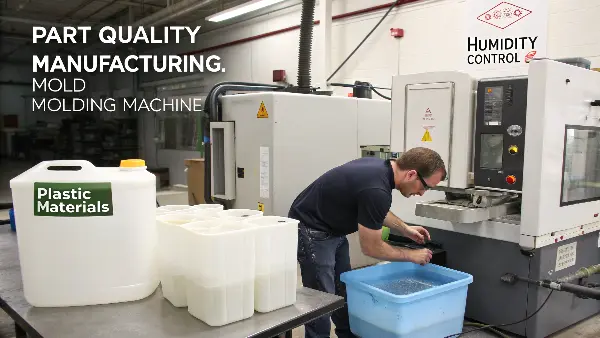
Beyond the main design and process variables, part quality is heavily influenced by material selection and handling, the condition of the molding machine itself, and environmental factors like humidity. The specific grade of plastic, how it’s dried before use, and the consistency of the molding press all play a crucial role in achieving a repeatable, high-quality surface finish. Even the best design can be undermined by a poor material choice or a poorly maintained machine.
These "secondary" factors can often be the source of the most difficult-to-diagnose quality problems. I remember a project where we saw random batches of parts with poor surface gloss. We checked the process settings, and everything was perfect. After days of investigation, we discovered that the material supplier had slightly changed their formulation without telling us. The new batch had a different melt flow characteristic. This taught me that you have to control every input, not just the obvious ones. A truly robust process accounts for these other influences.
Material Selection and Handling
The type and grade of plastic you choose is fundamental. Different materials have vastly different flow characteristics, shrinkage rates, and cosmetic properties. An amorphous material like polycarbonate (PC) will typically produce a glossier surface than a semi-crystalline material like nylon (PA), but it’s also more prone to stress cracking. Within the same material family, there can be hundreds of grades. A high-flow grade will fill thin walls more easily but may be more likely to flash. Beyond selection, proper handling is vital. Many engineering plastics are "hygroscopic," meaning they absorb moisture from the air. If not dried properly before molding, this moisture turns to steam in the barrel, causing splay marks on the part surface. We rely on industrial material dryers and moisture analyzers to ensure our raw materials are perfectly prepared.
The Injection Molding Machine
The machine itself is another key factor. A stable and repeatable process requires a machine that is well-maintained and properly sized for the job.
- Machine Capability: The press must be capable of providing consistent temperature, pressure, and speed, shot after shot. Older or poorly maintained machines can have fluctuations that lead to inconsistent part quality.
- Shot Size: The size of the part (the "shot size") should be a good match for the machine’s barrel capacity. A good rule of thumb is that the shot size should be between 20% and 80% of the barrel capacity. Using a barrel that is too large for a small part means the plastic sits in the hot barrel for too long, risking degradation.
Environmental Factors
Finally, the environment in the molding facility can have an impact. High humidity can affect how plastics absorb moisture, as mentioned before. Even the temperature of the factory can influence how quickly molds cool and how consistently the machine’s hydraulics operate. This is why high-precision molding is often done in climate-controlled environments. It helps eliminate variables and ensures the process remains stable day after day, regardless of the weather outside.
Conclusion
In the end, engineering the perfect surface finish is not about a single magic bullet. It is the result of careful, upfront planning across every stage of development. By focusing on solid part design principles, collaborating on an intelligent mold design, and respecting the key variables of the molding process, you can consistently achieve beautiful, functional plastic parts.