
Choosing the wrong plastic for your project can lead to part failure, budget overruns, and frustrating delays. It’s a high-stakes decision that can feel overwhelming. Our expert-guided process removes the guesswork, ensuring you select the perfect material from the start.
At CAVITYMOLD, we help you choose the optimal material by following a structured process. We analyze your product’s function, mechanical needs, environment, and budget. Our engineers then use this data to recommend a material that balances performance, cost, and manufacturability. This collaborative approach ensures your final product is a success.
Making the right material choice is one of the most critical steps in product development. Get it right, and you have a successful, reliable product. Get it wrong, and the consequences can be costly. Over the years, we’ve refined our process to make sure our clients always get it right. It’s a partnership where we bring our deep knowledge of materials to your unique product vision.
Let’s break down exactly how we guide you through this journey, step by step. We’ll look at the key factors we consider, how we balance cost with performance, and the role prototyping plays in making the final call.
What Key Factors Drive Our Material Recommendations?
With thousands of material options available, trying to pick one can feel like finding a needle in a haystack. Guessing or making an uninformed choice can lead to critical product failures down the line. We simplify this complexity by focusing on the core technical factors that truly matter for your project’s success.
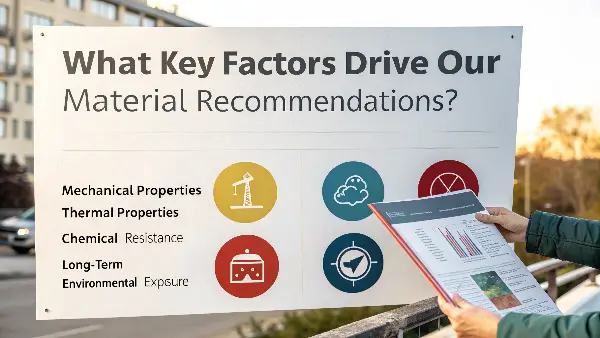
We primarily focus on four key factors: mechanical properties (like strength and flexibility), thermal properties (heat resistance), chemical resistance, and long-term environmental exposure. By evaluating your part’s needs against these criteria, we can narrow down the options to find a material that performs reliably in its intended application every time.
When a client like Alex, a project manager for a consumer electronics company, comes to us, he has a clear vision for the final product. My job is to translate that vision into a tangible, durable part. The first thing we do is sit down and create a "performance profile" for the part. This isn’t a quick chat; it’s a deep dive into the life of the product. We break it down into a few essential categories.
Mechanical and Thermal Demands
First, we ask: what does this part have to do? Will it bear a load? Does it need to bend without breaking or resist impacts? This is where we discuss properties like tensile strength, hardness, and flexibility. For a snap-fit enclosure, flexibility is key. For a gear, wear resistance is non-negotiable. At the same time, we analyze its thermal environment. Will it be near a motor, or left in a hot car? The material’s Heat Deflection Temperature (HDT) tells us if it can keep its shape under heat. Flammability ratings, like UL94, are also critical for many electronic products.
Chemical and Environmental Resistance
Next, we look at external threats. What will the part come into contact with? We need to consider everything from cleaning agents and oils to specific industrial chemicals. A wrong choice here could cause the material to crack, swell, or dissolve. We also consider the environment itself. A part used outdoors needs to be UV resistant to prevent it from becoming brittle and discolored over time. For a medical device, we need to know if it requires sterilization, as that dictates the use of specific medical-grade polymers. By mapping these requirements, we build a clear and objective picture of the ideal material candidate.
| Factor Category | Key Considerations | Example Application |
|---|---|---|
| Mechanical Properties | Tensile strength, impact resistance, flexibility, hardness | A durable housing for a power tool needing high impact strength. |
| Thermal Properties | Operating temperature, heat deflection, flammability rating | An internal connector in an automotive engine bay exposed to high heat. |
| Chemical Resistance | Exposure to oils, acids, solvents, cleaning agents | A reusable container for laboratory chemicals. |
| Environmental Factors | UV exposure, humidity, long-term stress | An outdoor sensor housing that must withstand sun and rain for years. |
How Do We Balance Cost and Performance in Material Selection?
You want the best possible performance for your part, but high-spec materials can easily break the budget. On the other hand, choosing the cheapest option can compromise quality and lead to costly failures and recalls. We help you find that perfect sweet spot where cost, performance, and manufacturability meet.
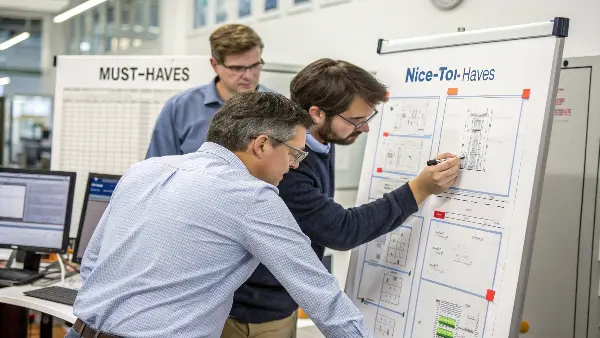
We achieve a balance by categorizing your product’s requirements into "must-haves" and "nice-to-haves." This helps us prioritize performance needs. We then explore material families that meet the critical criteria, presenting you with a tiered list of options that balance cost against performance, so you can make an informed, budget-conscious decision.
I remember working on a project for a series of handheld scanners. The initial request was for a material with extremely high impact resistance, similar to what you’d use for military equipment. The cost of this polymer was significant. After talking it through, we realized the device would be used in a retail environment, not a battlefield. The risk was an occasional drop onto a store floor, not extreme impact. This is where a frank discussion about cost versus real-world needs becomes so important. We don’t just take a spec sheet at face value; we challenge and explore it with you.
Finding the Value Point
Our first step is to analyze the cost-drivers. Sometimes, a feature like "flame retardant" can double a material’s price. But does your part truly need a V-0 rating, or would a less expensive V-2 be sufficient and safe? We present these trade-offs clearly. We might suggest a glass-filled Nylon as a more affordable alternative to a high-performance PEEK, explaining that it meets 95% of the performance needs for 50% of the cost.
Looking Beyond Material Price
It’s crucial to look at the total cost of production, not just the price-per-kilogram of the resin. Some exotic materials are difficult to process. They might require extremely high mold temperatures, longer cycle times, or specialized equipment. This increases the cost of manufacturing each part. Often, a slightly more expensive but easier-to-mold material like ABS can result in a lower final part price than a cheaper but trickier material like Polypropylene, because the cycle times are faster and the scrap rate is lower. We use our manufacturing experience to model these scenarios, giving you a complete picture of the costs involved. Our goal is to find the most economical solution that absolutely does not compromise the product’s core function and safety.
How Does Your Product’s Application and Environment Influence Material Choice?
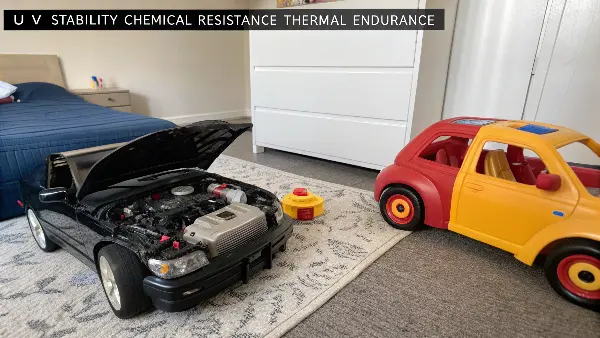
A material that’s perfect for a toy in a child’s bedroom would fail instantly as a component under the hood of a car. The specific application and environment are not just details; they are the primary drivers of material selection. Ignoring them is a recipe for disaster.
The product’s end-use and environment are the most critical factors. We analyze the setting—whether it’s indoors, outdoors, in contact with chemicals, or under constant stress. This context dictates the necessary properties, from UV stability and chemical resistance to thermal endurance, ensuring the material is fit for its real-world purpose.
Thinking about the product’s life from the end-user’s perspective is a huge part of my job. We are not just molding a piece of plastic; we are creating a component that has to function reliably for years in a specific setting. I once worked on a project for an agricultural sensor housing. The initial material choice was a standard ABS, which is a great, versatile plastic. However, during our review, I asked about its life in the field. The device would be outdoors 24/7, exposed to direct sunlight, rain, and fluctuating temperatures for over a decade.
Matching Material to the Real World
Standard ABS would become brittle and fail within a couple of years under that kind of UV and environmental stress. We had to change course. We recommended ASA (Acrylonitrile Styrene Acrylate) instead. ASA is often called "outdoor ABS" because it has a similar mechanical profile but offers far superior UV stability and long-term weather resistance. It was a slightly more expensive raw material, but it was the only way to guarantee the product’s 10-year design life. This simple change prevented a massive field failure and recall down the road.
Considering Indirect Influences
We also think about less obvious environmental factors. For example, consider a part for a medical device. The material must not only be strong enough, but it may also need to be biocompatible if it touches skin. More importantly, it must withstand sterilization methods like gamma radiation or autoclave steam cycles without degrading. A food container has different needs; it must be made from a food-grade polymer that complies with FDA regulations and doesn’t leach chemicals. Each application brings a unique set of rules. We use a checklist approach to ensure we cover all these bases, from regulatory compliance to an end-user’s unspoken expectations of quality and durability. This detailed analysis ensures the final material choice is not just technically correct, but contextually perfect.
What Is the Role of Prototyping in Validating Material Selection?
You can analyze spec sheets all day, but nothing proves a material’s suitability like holding a physical part in your hands. Prototyping turns theory into reality, but it’s easy to waste time and money on the wrong method. A strategic approach is needed to get meaningful results.
Prototyping is the ultimate validation step. We use methods like CNC machining or 3D printing with a similar-grade material to create a functional prototype. This allows you to test the part’s form, fit, and even some of its functions in a real-world context before committing to the high cost of a production mold.
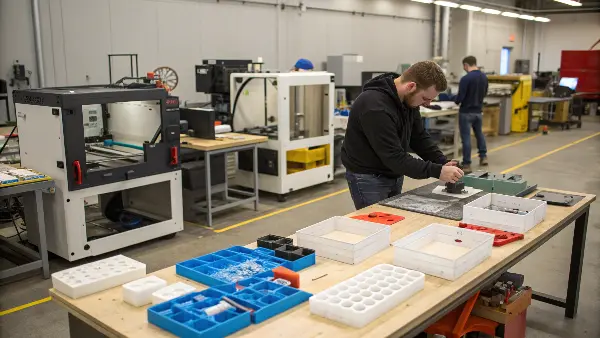
After we’ve narrowed down the material options with a client, the next question is always, "How can we be sure?" That’s where prototyping comes in, and it’s one of the most valuable services we offer. It’s about more than just seeing what a part looks like; it’s about de-risking the entire project. I always tell my clients that a small investment in a good prototype can save them tens of thousands of dollars by catching a design or material flaw before the steel is cut for the final mold.
Choosing the Right Prototyping Method
There isn’t a one-size-fits-all solution for prototyping. The method we choose depends on the validation goals.
- For Form and Fit: If the main goal is to check ergonomics, assembly, and appearance, SLA or SLS 3D printing is often a fast and cost-effective choice. It creates a highly accurate model you can hold, feel, and test-fit with other components.
- For Functional Testing: When you need to test mechanical properties like strength or snap-fits, CNC machining the part from a block of the actual target material (or a close equivalent) is the gold standard. A CNC-machined piece of PEEK will behave just like a molded piece of PEEK. This is perfect for testing a critical part’s real-world performance.
From Prototype to Production
Recently, we worked with a client on a complex medical instrument handle. Our material analysis pointed toward a specific grade of polycarbonate. Before an expensive multi-cavity mold was made, we CNC-machined a few handles from a solid block of the exact same PC. The client’s team was able to assemble it, feel the weight and balance, and even perform drop tests. During this process, they realized they needed a slightly different surface texture for better grip. It was an easy fix on a prototype. Had they discovered this after the mold was complete, changing the texture would have been extremely difficult and expensive. Prototyping bridged that crucial gap between the digital design and the final, mass-produced product, ensuring total confidence before we moved to the next stage.
Conclusion
Ultimately, selecting the right material is a collaborative journey, not a simple transaction. By focusing on key factors, balancing cost and performance, and using prototyping to validate our choices, we turn a complex decision into a clear path forward, ensuring your product is built to succeed.