
Are you tired of black specks ruining your perfectly molded plastic parts? This common defect seems to appear randomly, causing costly rejects and production delays. You’ve tried troubleshooting, but the specks keep coming back, especially when you switch between different types of plastics.
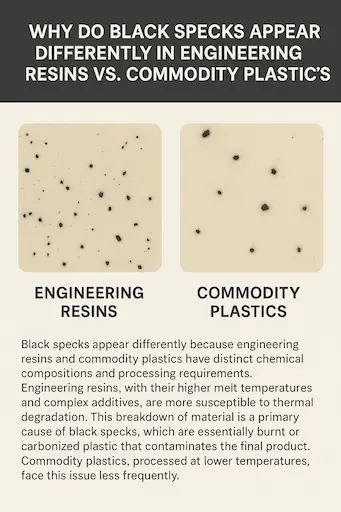
Black specks appear differently because engineering resins and commodity plastics have distinct chemical compositions and processing requirements. Engineering resins, with their higher melt temperatures and complex additives, are more susceptible to thermal degradation. This breakdown of material is a primary cause of black specks, which are essentially burnt or carbonized plastic that contaminates the final product. Commodity plastics, processed at lower temperatures, face this issue less frequently.
It’s a frustrating problem that I’ve seen countless times over my career. A beautiful design and a perfect mold can be completely undermined by these tiny, persistent impurities. Understanding why they happen is the first step to eliminating them for good. The answer lies deep in the material science of the plastics themselves. Let’s dig into why your material choice could be the root cause of your black speck challenges.
What Exactly Differentiates Engineering Plastics from Commodity Plastics?
Having trouble deciding between a standard plastic and a high-performance one for your project? The price difference is huge, and it’s hard to justify the extra cost without knowing if you truly need the advanced properties. Choosing wrong can lead to premature product failure or unnecessary expenses.
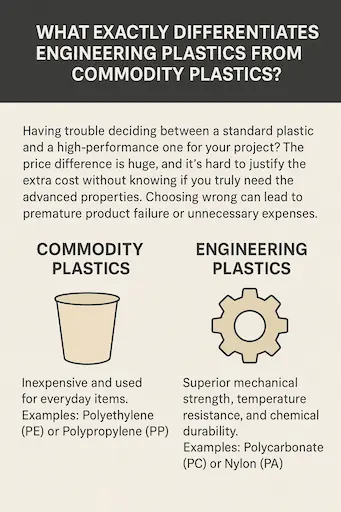
The main difference lies in performance and price. Commodity plastics, like Polyethylene (PE) or Polypropylene (PP), are inexpensive and used for everyday items. Engineering plastics, such as Polycarbonate (PC) or Nylon (PA), offer superior mechanical strength, temperature resistance, and chemical durability. They are designed for demanding applications where reliability is critical, justifying their higher cost. They are not interchangeable in most applications.
Diving Deeper into Material Capabilities
When we talk about plastic, it’s not a one-size-fits-all situation. The distinction between commodity and engineering plastics is fundamental to product design and manufacturing. At CavityMold, helping clients select the right material is a core part of our process.
Commodity plastics are the workhorses of the industry. They are produced in massive volumes, making them very affordable. Think about packaging, disposable containers, and simple household goods. Their properties are adequate for these roles, but they fall short in more stressful environments.
Engineering plastics are developed for performance. They are designed to replace traditional materials like metal in applications from automotive components to medical devices. Their molecular structures are more complex, giving them enhanced properties. This is where you find materials that can withstand high heat, resist harsh chemicals, or bear heavy loads without deforming.
Let’s break down the key differences in a more structured way:
| Feature | Commodity Plastics (e.g., PP, PE, PVC) | Engineering Plastics (e.g., PC, PA, PEEK) |
|---|---|---|
| Mechanical Strength | Lower (Flexible, less rigid) | Higher (Strong, stiff, high impact) |
| Temperature Resistance | Low (Typically below 100°C) | High (Can exceed 150°C, some over 300°C) |
| Chemical Resistance | Good against common substances | Excellent against oils, solvents, acids |
| Cost | Low | High (3x to 20x+ more than commodity) |
| Processing | Simpler, lower temperatures | More complex, higher temperatures |
Choosing the right category is the first step. If your part needs to survive repeated stress or extreme temperatures, a commodity plastic will almost certainly fail. But if it’s a simple cover with no mechanical function, using an expensive engineering resin is just wasting money.
What Causes Those Dreaded Black Specks in Plastic Parts?
You’ve just opened a box of freshly molded parts, only to find them dotted with ugly black specks. Now you have to deal with high rejection rates and figure out what’s wrong. Is it the machine, the material, or the operator? The uncertainty is costing you time and money.
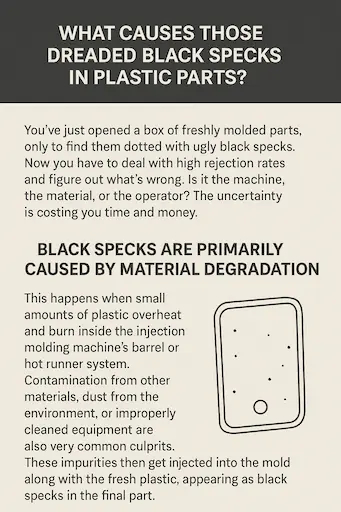
Black specks are primarily caused by material degradation. This happens when small amounts of plastic overheat and burn inside the injection molding machine’s barrel or hot runner system. Contamination from other materials, dust from the environment, or improperly cleaned equipment are also very common culprits. These impurities then get injected into the mold along with the fresh plastic, appearing as black specks in the final part.
Tracing the Source of Contamination
Black specks are the bane of many molding operations. In my experience, they are rarely caused by a single issue, but rather a combination of factors. Finding the root cause requires a systematic investigation, like being a detective at the scene of a crime.
The number one suspect is always thermal degradation. Plastic has a specific processing temperature window. If the barrel temperature is set too high, or if the plastic sits in the hot barrel for too long (known as residence time), it literally cooks. It breaks down, carbonizes, and turns into little black flecks. These flecks stick to the screw and barrel walls, then randomly break free and get pushed into the next shot.
The second major cause is contamination.
- External Contamination: This is dust, dirt, or even cardboard fibers from packaging that gets mixed in with the plastic pellets in the hopper. A clean workshop environment is not just for show; it’s critical for quality.
- Internal Contamination: This happens when you switch from one material to another without properly cleaning, or "purging," the machine. For instance, leftover bits of black ABS from a previous job can contaminate a new run of clear Polycarbonate.
- Cross-Contamination: Sometimes, a processing aid or color masterbatch might not be fully compatible with the base resin, leading to clumps that burn and create specks.
Finally, machine wear can be a hidden cause. If the screw or barrel is worn or scratched, it creates dead spots where plastic can get trapped, degrade over time, and then release into the melt stream. Regular machine maintenance is crucial for preventing this.
Why Are Engineering Resins More Prone to Black Specks?
You switched to a high-performance engineering resin for its strength, but now you’re facing a new problem: a sudden increase in black specks. It feels like you solved one issue just to create another. Why do these expensive, advanced materials seem so much more sensitive?
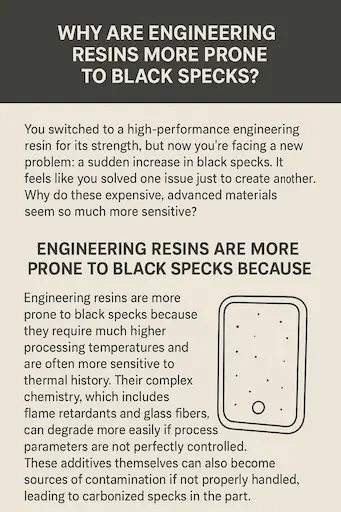
Engineering resins are more prone to black specks because they require much higher processing temperatures and are often more sensitive to thermal history. Their complex chemistry, which includes flame retardants and glass fibers, can degrade more easily if process parameters are not perfectly controlled. These additives themselves can also become sources of contamination if not properly handled, leading to carbonized specks in the part.
The High-Temperature Challenge
The very properties that make engineering plastics so valuable are also what make them tricky to process. Their robustness comes from long, strong polymer chains and complex formulations. Unfortunately, this also makes them less forgiving in the molding machine.
First, let’s talk about processing temperature. A commodity plastic like Polypropylene might melt at around 220°C. An engineering plastic like PEEK, on the other hand, needs temperatures approaching 400°C. This is a massive difference. At these elevated temperatures, the window between perfectly melted plastic and burnt plastic becomes incredibly narrow. Any small fluctuation in temperature control or a slight delay in cycle time can be enough to start degrading the material.
Second, the additives are a major factor. Engineering plastics are often filled with things to enhance their properties:
- Glass Fibers: For strength and rigidity.
- Flame Retardants: For safety and compliance.
- UV Stabilizers: For outdoor applications.
These additives have their own thermal limits. Sometimes, the additive can burn before the base resin even melts, creating an instant source of black specks. Glass fibers can also be abrasive, causing wear on the machine’s screw and barrel over time. This wear creates nooks and crannies where plastic can hang up, degrade, and flake off into the part. It’s a vicious cycle that we always watch out for when running filled materials.
What Are the Best Practices to Prevent Black Specks in Engineering Resins?
You’re struggling to control black specks when molding with sensitive engineering plastics. Your team is constantly tweaking settings, but the results are inconsistent. You need a reliable strategy to ensure clean, high-quality parts every single time, minimizing waste and maximizing efficiency.
To prevent black specks, focus on three key areas: material handling, machine maintenance, and process control. Ensure your resins are properly dried and free from dust. Use a high-quality purging compound between material changes. Implement a strict preventative maintenance schedule for the screw and barrel. Finally, optimize your process to avoid excessive temperatures and residence times.

A Systematic Approach to Clean Molding
At CavityMold, we treat black speck prevention as a core part of our quality control process, not an afterthought. It’s about discipline and attention to detail. We’ve built our reputation on delivering perfect parts, and that starts long before the plastic enters the mold. Here’s a breakdown of our strategy.
1. Immaculate Material Handling
This is ground zero for contamination.
- Drying: Engineering resins are often hygroscopic, meaning they absorb moisture from the air. Molding wet material can cause degradation and splay. Always dry resins to the manufacturer’s exact specifications using a properly functioning dryer.
- Cleanliness: Keep material containers sealed. Use a vacuum loader to transfer pellets instead of scooping them from an open container. The area around the hopper must be spotless.
2. Rigorous Machine and Mold Cleaning
You can’t make a clean part with a dirty machine.
- Purging: Don’t just push old material out with new material. Use a commercial purging compound specifically designed for high-temperature resins. It’s formulated to chemically scrub the screw and barrel.
- Screw Pulls: For critical applications or after running a problematic material, we physically pull the screw out of the barrel for a thorough manual cleaning. It’s labor-intensive but fool-proof.
- Mold Maintenance: The hot runner system in the mold can also trap and burn material. It needs to be cleaned regularly, especially at the gates where pressure and shear are highest.
3. Precision Process Control
Fine-tuning the process is the final piece of the puzzle.
- Temperature Profile: Don’t just set one high temperature. Use a graduated profile, starting cooler at the feed throat and increasing towards the nozzle. This ensures the plastic melts gradually without getting scorched.
- Residence Time: Match your shot size to the barrel capacity as closely as possible. Using a big machine for a small part means the plastic will sit in the hot barrel for too long. If unavoidable, reduce barrel temperatures during any downtime.
By mastering these three areas, you can transform your black speck problem from a constant headache into a solved issue.
Are There Disadvantages to Using Engineering Plastics Besides Black Speck Risk?
You’ve decided an engineering plastic is right for your part’s performance needs. But beyond the higher price and the risk of black specks, what other challenges should you be aware of? Overlooking these potential downsides could lead to unexpected problems in production or with the final product.
Yes, besides cost and processing sensitivity, engineering plastics have other disadvantages. They are often hygroscopic, requiring meticulous drying before molding to prevent defects. Their high processing temperatures mean higher energy consumption. Furthermore, their stiffness can sometimes translate into brittleness, and many are opaque or difficult to color, limiting aesthetic options. They can also be more difficult to recycle.
A Balanced View on High-Performance Materials
While engineering plastics are incredible materials, they are not without their trade-offs. I always advise my clients to look at the complete picture. The goal is to select a material that meets the performance criteria without introducing unnecessary manufacturing complications or costs.
One of the biggest operational challenges is their hygroscopic nature. Materials like Nylon, PC, and PET will absorb moisture right out of the air. If you mold them without proper drying, the water turns to steam in the hot barrel, chemically attacking the polymer chains. This severely degrades the material’s properties and causes cosmetic defects. It requires investment in good drying equipment and disciplined procedures.
Another consideration is their impact on the mold design itself. Because these materials are processed at high temperatures and pressures, and are often filled with abrasive fibers, the mold must be built to withstand that abuse. This means using higher-grade, harder tool steels like H-13 or S-7, which adds to the initial mold cost. The gate design is also more critical to manage the flow of these stiffer materials.
Finally, think about the end of the product’s life. While many commodity plastics have established recycling streams, recycling filled or blended engineering plastics is much more complex. It’s a factor that is becoming increasingly important for companies focused on sustainability. Understanding these disadvantages doesn’t mean you shouldn’t use them; it means you can plan for them, ensuring your project is a success from start to finish.
Conclusion
Ultimately, controlling black specks, especially in sensitive engineering resins, comes down to a deep understanding of your materials and a disciplined approach to your processes. By focusing on cleanliness, precise temperature control, and proper maintenance, you can overcome these material-specific challenges and achieve flawless production runs.