
Your new product looks fantastic, but daily use leaves it covered in ugly scratches and scuffs. This damages the user’s perception of quality and can lead to costly returns and warranty claims. You need a material that can withstand wear and tear while maintaining its appearance.
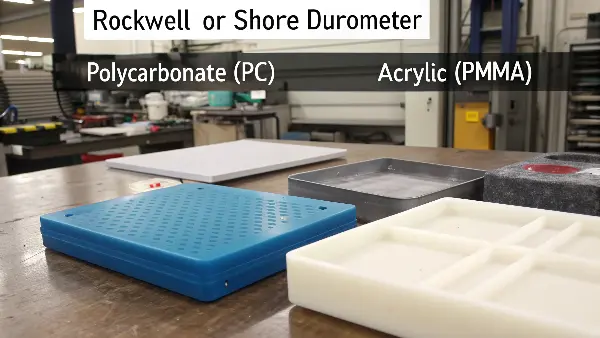
The best way to choose a scratch-resistant plastic is by evaluating its surface hardness, measured by Rockwell or Shore durometer scales. Materials like Polycarbonate (PC) and Acrylic (PMMA) are top choices due to their inherent hardness. Adding special coatings or textured surface finishes during the molding process can also significantly enhance scratch resistance, providing a durable and aesthetically pleasing final product.
Choosing the right material is a critical step. It feels like a balancing act between performance, cost, and aesthetics. Get it wrong, and the product’s lifespan and brand reputation could suffer. Get it right, and you create a product that customers love for its durability and lasting good looks. But there is more to it than just picking the hardest plastic you can find. You have to consider the entire manufacturing process, from raw material to the finished part. Let’s explore the details you need to make the best decision for your project.
What Key Properties Define a Scratch-Resistant Plastic?
Your product’s surface is the first thing customers interact with, but it’s constantly under attack from keys, fingernails, and abrasive surfaces. How can you be sure the plastic you choose will hold up? You need to understand the fundamental properties that prevent these scratches from happening.
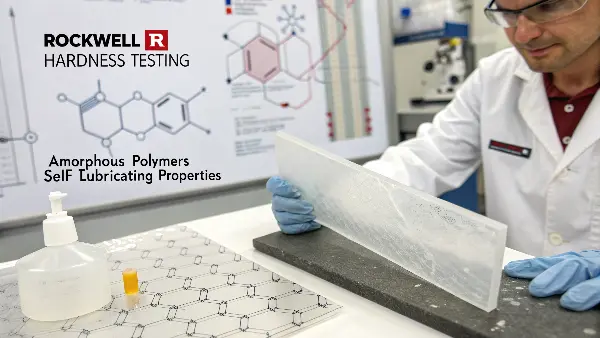
A plastic’s scratch resistance is primarily defined by its surface hardness, intrinsic lubricity, and material composition. Hardness, measured by scales like Rockwell R, prevents sharp objects from penetrating the surface. Self-lubricating properties reduce friction, while a dense molecular structure, like in amorphous polymers, provides a smoother, more resilient surface that effectively resists abrasion and wear from daily use.
Diving Deeper into Material Characteristics
To really master material selection, you need to look beyond a single datasheet value. It’s about understanding how different characteristics work together to create a tough and durable surface. It’s not just about hardness; other factors are just as important. I remember a project involving a handheld scanner where we initially focused only on Rockwell hardness. The parts passed lab tests but failed in the field because we overlooked how the material reacted to fine dust, which caused micro-abrasions. We had to go back and reassess. That experience taught me to look at the full picture.
Key Performance Indicators for Scratch Resistance
- Surface Hardness: This is the most direct measure of scratch resistance. It indicates how well a material can resist localized plastic deformation, like a scratch or indentation from a sharp object. We use standardized tests to measure it. The two most common are:
- Rockwell Hardness (R Scale): This is great for harder plastics. It measures the depth of an indentation left by a specific load. A higher Rockwell R number, like R120 for Polycarbonate, means better resistance.
- Shore Hardness (D Scale): This is used for softer to semi-rigid plastics. A higher Shore D value indicates a harder material.
- Coefficient of Friction: A lower coefficient of friction means a more "slippery" surface. Materials with natural lubricity, like PTFE or Acetal (POM), allow objects to slide over them with less force, which reduces the chance of a scratch forming.
- Material Structure: The internal structure of the polymer plays a huge role.
- Amorphous plastics like PMMA and PC have a random molecular structure, which often results in excellent clarity and a smooth, hard surface.
- Semi-crystalline plastics like POM and PEEK have both ordered and random regions. Their crystalline structure often gives them superior chemical resistance and lubricity, contributing to wear resistance.
Here is a quick breakdown:
| Property | How It Helps | Measurement/Indicator |
|---|---|---|
| Surface Hardness | Directly opposes penetration from sharp objects. | Rockwell Hardness (R Scale), Shore Hardness (D Scale) |
| Lubricity | Reduces friction, allowing objects to slide off without digging in. | Low Coefficient of Friction |
| Toughness | Absorbs impact energy without cracking, which can prevent deeper gouges. | Izod Impact Strength |
| Tensile Strength | Resists being pulled apart, contributing to overall durability and integrity. | Megapascals (MPa) or Pounds per Square Inch (PSI) |
Understanding these properties together gives you a much better framework for selecting a material that will look great not just on day one, but for years to come.
Which Common Plastics Offer the Best Scratch Resistance?
You know the properties to look for, but now you need to pick a specific material for your project. With hundreds of options, which plastics actually deliver the best performance against scratches and scuffs? Choosing the wrong one could mean a brittle part or a budget overrun.
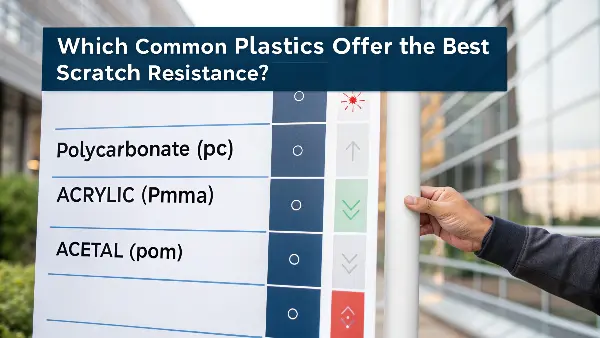
For top-tier scratch resistance, Polycarbonate (PC) and Acrylic (PMMA) are the industry-standard choices. PC offers superior toughness and impact strength, while PMMA provides exceptional optical clarity and surface hardness, often rivaling glass. For applications needing chemical resistance and low friction, Acetal (POM) is another excellent option. These materials form the go-to list for durable, aesthetic parts.
Diving Deeper into Material Options
Choosing the right plastic is a conversation I have with my clients nearly every day. It’s often the most critical decision in the entire product development process. A project manager, let’s call him Alex, once came to us with a design for a new remote control. He was fixated on using standard ABS because it was cheap and he’d used it before. I showed him two prototypes, one in ABS and one in a PC/ABS blend. I took my car keys and lightly dragged them across both. The difference was immediate. The ABS was clearly scratched, while the PC/ABS part looked almost untouched. That simple demonstration changed his perspective and saved his product from negative reviews about "looking cheap" after a few weeks of use. Let’s break down the top contenders so you can have that same confidence.
Head-to-Head Comparison of Top Materials
Each material has its own unique profile of strengths and weaknesses. The best choice depends entirely on your specific application’s demands for toughness, clarity, cost, and processability.
Polycarbonate (PC): Think of PC when you need toughness. It’s the material used for safety glasses, police riot shields, and durable electronic housings. It has excellent impact resistance and good hardness.
- Pros: Extremely durable, high impact strength, good temperature resistance.
- Cons: Can be more expensive, susceptible to stress cracking from certain chemicals.
Acrylic (PMMA): Often called Plexiglas, acrylic is known for its incredible clarity and glass-like surface hardness. It’s perfect for lenses, light pipes, and high-gloss decorative panels.
- Pros: Excellent optical clarity, high surface hardness, UV resistant.
- Cons: More brittle than PC, can crack under high impact.
ABS (Acrylonitrile Butadiene Styrene): ABS is a workhorse in plastic injection molding. It offers a good balance of properties and is cost-effective. While not as scratch-resistant as PC or PMMA on its own, it can be blended (like PC/ABS) or textured to improve performance.
- Pros: Good toughness, easy to process, low cost, readily available.
- Cons: Moderate scratch resistance, poor UV resistance without additives.
Acetal / POM (Polyoxymethylene): This is an engineering thermoplastic known for its high stiffness, low friction, and excellent wear resistance. It’s great for gears, bearings, and conveyor parts where parts rub against each other.
- Pros: Very low friction, excellent dimensional stability, high chemical resistance.
- Cons: Difficult to bond, can be sensitive to UV light.
Here’s a table to simplify the comparison:
| Material | Scratch Resistance | Impact Strength | Cost | Key Advantage |
|---|---|---|---|---|
| Polycarbonate (PC) | High | Excellent | Medium-High | Unmatched toughness and durability |
| Acrylic (PMMA) | Excellent | Fair | Medium | Glass-like clarity and surface hardness |
| PC/ABS Alloy | Good-High | Very Good | Medium | Best of both worlds: toughness and processing |
| Acetal (POM) | Very Good | Good | Medium | Natural lubricity and superb wear resistance |
| Standard ABS | Fair | Good | Low | Cost-effective and easy to mold |
By comparing these materials against your project’s specific needs, you can narrow down the choices and select a plastic that provides the right level of durability without compromising on other essential features.
How Do Surface Hardness and Coatings Improve Scratch Resistance?
You’ve selected a base material, but what if you need to push its performance even further? Sometimes, the raw plastic alone isn’t enough for high-wear environments. You’re worried about long-term durability and keeping that "new product" look. How can you enhance the surface to meet these demands?
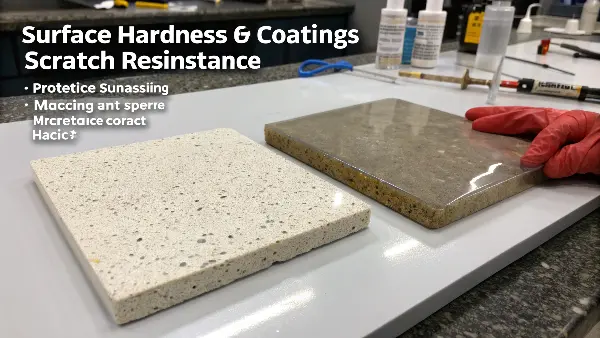
Applying a hard coat or a specialized surface treatment after molding is a highly effective way to boost scratch resistance. These transparent coatings add a durable, sacrificial layer that can increase surface hardness significantly. Additionally, implementing a textured finish in the mold itself helps to mask minor scuffs and abrasions, maintaining the product’s aesthetic appeal over time.
Diving Deeper into Surface Enhancements
Enhancing a surface is part art, part science. It’s about creating a better user experience. I recall we worked on a project for a point-of-sale terminal. The screen bezel was made from PC, which is already quite tough. But after six months in a busy café, the test units were covered in fine scratches from constant wiping and handling. The client was concerned. Instead of changing the entire design, we recommended a simple solution: adding a UV-cured hard coat. We treated a few parts and sent them back. The difference was night and day. The coated parts resisted the abrasion from cleaning cloths and daily use far better. It was a small additional step that made a huge impact on the product’s perceived quality and lifespan.
Strategies for a More Durable Surface
There are two main paths you can take to improve the durability of your part’s surface: adding a layer on top or changing the surface itself.
1. Additive Coatings (Post-Molding)
This involves applying a thin layer of another material after the part has been molded. It’s a very common and effective method.- UV-Cured Hard Coats: These are liquid coatings applied to the plastic surface and then instantly cured with ultraviolet light. They form a very hard, thin, transparent layer. This is the go-to choice for clear parts like lenses or display windows. They can take a plastic’s scratch resistance to a level comparable to glass.
- Parylene Coatings: This is a more specialized vacuum-deposition process that applies an ultra-thin, pinhole-free coating that conforms perfectly to the part’s shape. It provides excellent protection against abrasion and chemicals.
2. Mold-Based Surface Finishes
Instead of adding a coating, you can design the surface finish directly into the mold tool. This is a very cost-effective strategy because it happens during the molding cycle.- Texturing: By etching a specific pattern (like a light sandblast or a geometric design) into the mold cavity, the resulting plastic part will have a textured surface. This is brilliant for hiding scratches. A small scuff on a high-gloss surface is very noticeable, but on a textured surface, it blends in and becomes nearly invisible. Common textures are defined by standards from VDI or Mold-Tech.
- Gloss Level Control: The glossier the surface, the more it will show scratches. By polishing the mold to a lower gloss level (e.g., a semi-gloss or matte finish), you can inherently make scratches less apparent.
Here’s how these methods stack up:
| Enhancement Method | Primary Benefit | Best Application | Considerations |
|---|---|---|---|
| UV Hard Coating | Dramatically increases surface hardness (3-5x or more). | Clear lenses, display screens, high-gloss parts. | Adds a secondary process step and cost. |
| Textured Mold Finish | Hides fingerprints, scuffs, and minor wear effectively. | Housings, handles, non-cosmetic surfaces. | A one-time tooling cost; affects part ejection. |
| Lower Gloss Polish | Reduces the visibility of micro-scratches. | Consumer electronics, automotive interiors. | Part of the standard mold-making process. |
By combining a good base material with the right surface enhancement, you can create a part that is truly built to last.
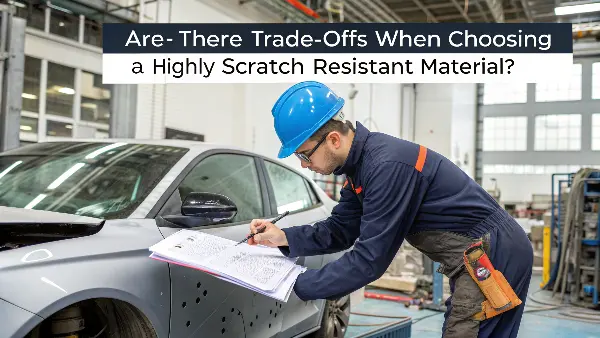
Are There Trade-offs When Choosing a Highly Scratch-Resistant Material?
You’ve identified some great-performing, scratch-resistant plastics. But focusing only on one property can be a trap. Will choosing the hardest material blow your budget? Will it be too brittle or impossible to manufacture? You need to consider the full picture to avoid unforeseen problems down the line.
Yes, there are significant trade-offs. Highly scratch-resistant materials like PMMA can be more brittle and prone to cracking under impact compared to tougher but softer plastics like ABS. They are also often more expensive and may require special processing conditions, such as higher mold temperatures or slower cycle times. Balancing scratch resistance with cost, impact strength, and manufacturability is essential for a successful project.
Diving Deeper into the Balancing Act
Every engineering decision is about balance. I’ve seen teams get so focused on achieving one perfect metric that they sacrifice others that are just as critical. A few years ago, a startup developing a premium smart home hub wanted the glossiest, most scratch-proof housing possible. They insisted on using a special grade of coated PMMA. The prototypes looked incredible—like black glass. But during drop testing, the housings shattered. The material was too brittle. We had to pivot to a high-gloss PC/ABS blend. It had slightly less scratch resistance but passed the drop tests with flying colors. The end product was still a success because we found the right balance between aesthetics, durability, and real-world use. The "perfect" material is rarely the best one.
Key Factors to Balance
When you select a material, you’re not just choosing a single property. You’re choosing a bundle of characteristics, and improving one often means compromising on another.
Scratch Resistance vs. Impact Strength: This is the classic trade-off. Hard materials (high scratch resistance) tend to be more brittle, meaning they can’t absorb as much energy before they fracture. Softer, more flexible materials (lower scratch resistance) can deform and absorb a lot of impact without breaking.
- Example: PMMA is harder than PC, but PC can withstand a much heavier blow.
Scratch Resistance vs. Cost: High-performance materials almost always come with a higher price tag. Engineering plastics like PC, POM, or PEEK cost significantly more per kilogram than commodity plastics like PP or ABS. You have to ask: does the improved performance justify the added cost for your specific product?
Scratch Resistance vs. Processability: Some hard materials are more challenging to mold. They may require:
- Higher Melt Temperatures: This means more energy consumption and more stress on the molding machine.
- Higher Injection Pressures: This can require a larger, more powerful machine.
- Special Mold Considerations: The mold may need to be made from higher-grade steel or have special cooling channels to manage the processing conditions. This can increase tooling costs and cycle times.
Here’s a simplified table to visualize these trade-offs:
| If you prioritize… | You might have to compromise on… | Example Material Move |
|---|---|---|
| Maximum Scratch Resistance | Impact Strength and Cost | Moving from ABS to PMMA. |
| Maximum Impact Strength | Surface Hardness and sometimes UV resistance | Moving from PMMA to PC. |
| Lowest Material Cost | Scratch Resistance and overall durability | Choosing standard PP or ABS over an engineering blend. |
| Ease of Manufacturing | The performance ceiling of exotic materials | Sticking with ABS instead of a tricky-to-mold PEEK. |
The key is to define your product’s absolute must-haves versus its nice-to-haves. This allows you to find the sweet spot where the material is good enough in all the important areas, creating a well-rounded and successful product.
What Role Does Mold Design Play in the Surface Finish of a Part?
You think you’ve picked the perfect material. But what if the final parts come out of the mold looking dull, or with flow lines and imperfections? The raw plastic is only half the story. The mold itself is the tool that shapes the final outcome. How does its design directly impact surface quality and scratch resistance?
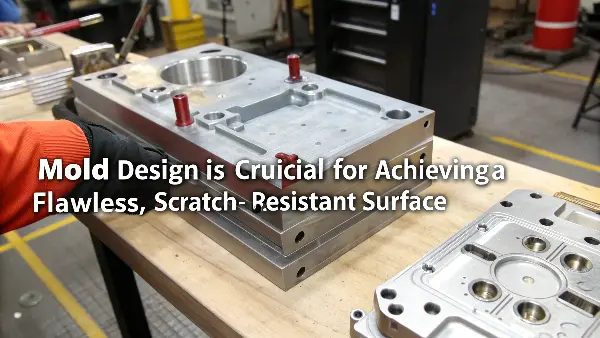
Mold design is crucial for achieving a flawless, scratch-resistant surface. The quality of the mold’s steel, the precision of its surface polish, and the strategic placement of gates all dictate the final part’s finish. A poorly designed mold can introduce surface defects like flow marks or sink marks, which compromise both aesthetics and the effectiveness of the material’s inherent scratch resistance.
Diving Deeper into the Mold’s Influence
As a mold maker, this is where my team and I bring the most value. We can take a good material choice and make it great. I remember a client who was developing a high-end audio speaker with a large, high-gloss front panel. They had chosen a fantastic PC/ABS material, but their previous supplier produced parts riddled with faint flow lines near the gate. The finish just didn’t scream "premium." When they came to us, we didn’t change the material. Instead, we redesigned the gating. We switched from a simple pin gate to a fan gate. This spread the plastic flow out evenly, creating a uniform fill front. The result? A perfectly smooth, defect-free surface. It showed that the best material in the world can fail if the mold isn’t designed with its specific properties in mind.
Key Mold Design Factors for Superior Surfaces
The quality of an injection molded part is born from the quality of its mold. For surfaces where appearance and durability are critical, we focus on several key areas of the tool design.
1. Mold Steel and Polishing:
- Steel Quality: You cannot achieve a high-gloss, mirror-like finish on the plastic part without starting with a high-quality, hardenable mold steel (like S136 or NAK80). Softer steels simply can’t hold a high polish and will degrade over time.
- Polishing Technique: The surface of the mold cavity must be meticulously polished. For a true "Class A" finish, this is a multi-stage process done by hand by skilled technicians using progressively finer diamond pastes. An SPI A-2 or A-1 polish is required for parts that need to be crystal clear or have a perfect mirror gloss.
2. Gating and Parting Line Strategy:
- Gate Location and Type: The gate is where the molten plastic enters the cavity. Its location and type are critical to prevent cosmetic defects. A poorly placed gate can cause "jetting" or visible flow lines. For cosmetic parts, we often use gates that can be hidden on a non-visible surface or use types like fan gates or submarine gates that minimize vesting.
- Parting Line: This is the line where the two halves of the mold meet. We carefully place it along a sharp edge or a non-visible area of the part to make it as inconspicuous as possible. A poorly placed parting line on a smooth face can ruin the aesthetic.
3. Venting and Ejection:
- Venting: Air trapped in the mold cavity can cause burn marks or incomplete filling. Proper vents, which are tiny channels that let air escape but not plastic, are essential for a defect-free surface.
- Ejector Pins: These pins push the part out of the mold. If they are placed on a cosmetic surface, they will leave a mark. We always strive to place ejector pins on non-visible surfaces or use alternative ejection methods like stripper plates for highly sensitive parts.
Here is how these mold features connect to the final part quality:
| Mold Design Element | Its Impact on the Plastic Part | Why It Matters for Scratch Resistance |
|---|---|---|
| High-Quality Polish | Creates a perfectly smooth, high-gloss surface on the part. | A flawless surface is the foundation for good scratch resistance. |
| Strategic Gating | Prevents flow lines, weld lines, and other cosmetic defects. | Defects create weak points on the surface that can scratch easily. |
| Hidden Parting Lines | Keeps the main cosmetic surfaces seamless and uninterrupted. | A visible parting line breaks the illusion of a premium surface. |
| Proper Venting | Ensures the part is fully formed without burn marks or voids. | A complete, dense surface is a strong surface. |
Ultimately, investing in a well-designed and precisely crafted mold is not an expense—it’s an investment in the quality of every single part you produce.
Conclusion
Choosing the right material for scratch-resistant parts involves more than just picking the hardest plastic. You must balance hardness with toughness, cost, and processability. By understanding the key properties, evaluating top materials like PC and PMMA, and considering enhancements like coatings, you can make an informed decision.