
Struggling to get your plastic part manufactured correctly? You might have a great design, but if it ignores the material’s properties, you’re heading for costly failures like warping and cracking. It’s frustrating to see a brilliant concept fail because of a small, overlooked detail in material selection.
The core reason different plastics need different design approaches is that each material has unique physical and chemical properties. These properties, such as shrinkage rate, flexibility, flow characteristics, and processing temperature, directly influence how a part should be designed. To ensure dimensional accuracy, structural integrity, and proper function, your design must accommodate the specific behavior of the chosen plastic material during and after the molding process.

I’ve been in this industry for over a decade, and I can tell you a common story. A project manager like Alex from Australia sends us a file that looks perfect on his CAD screen. But he designed it in a vacuum, without thinking about whether it would be molded in ABS or Nylon. That’s a critical error. The success of your project isn’t just in the design; it’s in designing for the material. Let’s break down why this is so important and how you can get it right.
Why Does Plastic Shrinkage Rate Dictate Your Entire Mold Design Strategy?
You received the first batch of molded parts, and they are all out of tolerance. Your assembly line grinds to a halt, your project timeline is in jeopardy, and you now have to explain the costly delay. The root cause is often a failure to account for the material’s shrinkage.
Plastic shrinkage dictates mold design because the mold cavity must be precision-machined larger than the final part’s nominal dimensions. Every plastic shrinks differently as it cools. If you don’t apply the correct, specific shrinkage factor for that material, your parts will be dimensionally wrong. This single property impacts part tolerances, feature integrity, and even the final choice of mold steel.
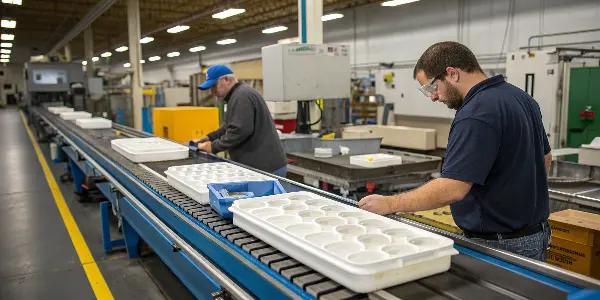
When we talk about shrinkage, we’re not just talking about one simple number. It’s a complex behavior that separates experienced mold makers from amateurs. This is where we, as your manufacturing partner, really dig into the details to prevent problems before they start. Ignoring this step is like building a house without accounting for the ground settling—the foundation is guaranteed to fail.
The Two Faces of Shrinkage: Uniform and Differential
First, we have to understand that plastic doesn’t shrink evenly. It shrinks differently in the direction of the plastic flow compared to the direction across the flow. This is called differential shrinkage. Imagine squeezing a tube of toothpaste; it gets longer and thinner. Plastic behaves similarly as it’s injected. This difference, even if small, is what causes internal stresses. These stresses are the primary cause of parts warping or twisting as they cool. A part that looks like a flat plate in the CAD model can come out of the mold looking like a potato chip if we don’t manage this.
How We Design to Control Shrinkage
Our entire mold design process revolves around controlling this variable. We use Moldflow analysis software to simulate how the plastic will fill the cavity. This lets us predict where high-stress areas and potential warping will occur. Based on that, we adjust the gate location and design the cooling channels. Proper cooling is everything; we design intricate cooling channels that follow the part’s geometry to ensure the part cools as evenly as possible. An unevenly cooled part will always warp.
Here’s a quick look at how much shrinkage can vary between common materials:
| Material | Typical Shrinkage Rate (%) | Key Design Consideration |
|---|---|---|
| ABS | 0.4 – 0.7 | Low, very stable and predictable. |
| Polypropylene | 1.0 – 2.5 | High and variable, needs robust cooling. |
| Nylon (PA66) | 0.8 – 2.0 | High, very sensitive to moisture. |
| Polycarbonate | 0.5 – 0.7 | Low, but prone to stress cracking. |
| Acetal (POM) | 1.8 – 2.5 | High and very consistent, predictable. |
As you can see, the difference between ABS and PP is huge. We can’t just use the same mold for both. The cavity for a PP part needs to be significantly larger. This is why a final material choice is one of the first things we ask for.
Designing for Flexibility: How Do Materials like TPE Change Your Approach Compared to Rigid ABS?
You’ve designed a part with a critical snap-fit, but when it’s molded, the clip is too stiff and breaks on the first use. Or, you designed a flexible seal that ends up being too rigid to function. This is a classic case of a design mismatch with material properties, wasting time and money.
Designing for a flexible material like TPE versus a rigid one like ABS requires a completely different mindset. For TPE, you can design features like deep undercuts and living hinges that would be impossible with ABS. We also have to use very different ejection methods, like stripper plates instead of simple ejector pins, to avoid damaging the soft part during removal from the mold.
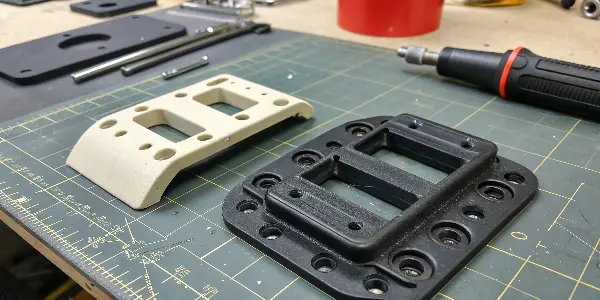
I remember a project for a client who wanted to make a protective electronics case. The initial design was made for ABS, with complex slides in the mold to handle some small undercuts. Later, they switched to a flexible TPE material. This change was a game-changer. We were able to simplify the mold dramatically by eliminating the slides, as the flexible TPE part could just be pulled out of the cavity, flexing around the undercuts. This saved them a lot of money on tooling.
Living Hinges and Undercuts
With flexible materials, you can do things that seem to break all the rules of injection molding. The most common is the living hinge, a thin section of plastic that acts as a hinge. It’s perfect for container lids. This is easy to do with a flexible material like Polypropylene (PP) or TPE. If you tried to make a living hinge with a brittle, rigid material like general-purpose Polystyrene, it would snap after just a few uses.
Undercuts are another big one. An undercut is a feature that prevents the part from being ejected straight out of the mold. With a rigid material like ABS or Polycarbonate, you need a complex and expensive mold mechanism, like a lifter or a slide, to create that feature. But with a flexible material, we can often design a "bump-off," where the part just flexes and pops over the undercut during ejection. This makes the mold much simpler and more reliable.
Gate Design and Ejection
How we get plastic into the part (gating) and how we get the part out (ejection) also change completely.
- Gating: Flexible materials like TPE often have a higher viscosity, meaning they flow like thick honey. We may need to use larger gates and runners to ensure the cavity fills properly without excessive pressure. A pinpoint gate that works perfectly for ABS might not work at all for TPE.
- Ejection: Pushing a rigid ABS part out with small ejector pins is fine. If you try that with a soft TPE part, the pins will likely just punch right through it, leaving ugly marks or even ruining the part. For these materials, we often use a stripper plate, which is a plate that pushes on the entire edge of the part for a smooth, even ejection.
It all comes down to respecting the material’s nature—forcing a flexible material to act rigid, or vice-versa, is a recipe for failure.
Amorphous vs. Crystalline: What’s the Real Impact on Your Part’s Design and Processing?
You choose a plastic based on its datasheet properties, but in reality, the part fails under stress or warps unexpectedly. The problem isn’t the material itself, but its hidden molecular structure. This frustration often stems from not understanding the fundamental difference between amorphous and crystalline plastics.
The real impact is that amorphous and crystalline plastics behave very differently during and after molding. Amorphous plastics (like ABS, PC) have a random molecular structure, offering good dimensional stability and impact strength. Crystalline plastics (like Nylon, PP) have an ordered structure, providing excellent chemical resistance and a sharp melting point, but they also have much higher and less uniform shrinkage.

Thinking about plastics as either amorphous or crystalline helps us make better decisions right from the start. It guides our design choices for wall thickness, our strategy for mold cooling, and our parameters for injection molding. It’s one of those "behind the scenes" details that has a huge effect on the quality of the final part. Treat them the same, and you’re asking for trouble.
Why Structure Dictates Performance
Let’s break down the key differences and how they affect your design.
Amorphous Plastics (e.g., ABS, PC, Polystyrene):
- Structure: The polymer chains are tangled up randomly, like a bowl of spaghetti.
- Behavior: They soften gradually over a wide range of temperatures. They don’t have a true melting point. This makes them easier to process.
- Shrinkage: They shrink less and more uniformly. This makes it easier to hold tight tolerances and create flat parts without warping.
- Strengths: Good impact resistance and dimensional stability. They are also often transparent.
- Weaknesses: Generally have poor chemical resistance and are prone to stress cracking.
Semi-Crystalline Plastics (e.g., Nylon, PP, Acetal):
- Structure: The polymer chains fold up into organized, tightly packed regions called crystallites. These are surrounded by amorphous regions.
- Behavior: They have a very sharp and distinct melting point. They stay solid until they hit that temperature, then quickly turn into a low-viscosity liquid.
- Shrinkage: This is the big one. They shrink a lot more than amorphous plastics, and the shrinkage is less uniform. This makes them much more challenging to work with.
- Strengths: Excellent chemical resistance, good wear resistance, and good performance at elevated temperatures.
- Weaknesses: Prone to warping, lower impact strength (unless modified), and are typically opaque.
Practical Design Implications
If your part needs to be very dimensionally stable and hold a tight tolerance, an amorphous material like ABS or PC is a safer bet. If your part will be exposed to chemicals or needs to withstand repeated friction, a crystalline material like Nylon or Acetal is a better choice. But if you choose a crystalline material, you must design for it. This means keeping wall thicknesses as uniform as possible, adding generous radii, and knowing that we will need a very well-designed cooling system in the mold to manage the high shrinkage and prevent warp.
Working with High-Temp Plastics like PEEK: What Design Rules Can’t You Afford to Break?
You are developing a high-performance part for the aerospace or medical industry that must withstand extreme heat. You’ve chosen an advanced material like PEEK, but the costs are high, and there is zero room for error. A failed part isn’t just a setback; it could be a catastrophic failure.
When working with high-temperature plastics like PEEK or PEI (Ultem), you cannot break the rules of thermal management and stress concentration. These materials require extremely high mold temperatures (up to 200°C), so the mold design must include advanced heating systems. Also, any sharp internal corners must be rounded with generous radii, as these materials are notch-sensitive and can easily crack under stress if not designed correctly.
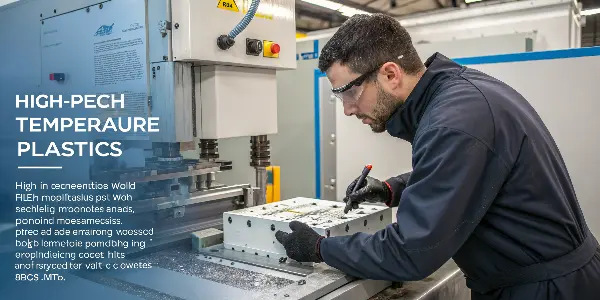
We handle projects with high-performance plastics regularly, and they require a different level of precision and planning. You can’t just treat PEEK like it’s a stronger version of ABS. Its processing window is narrow, and the material itself is very expensive. A mistake in mold design is not just a rework; it’s a significant financial loss. This is where expertise truly matters.
The Cardinal Rules for High-Temp Plastics
If you’re designing a part with PEEK, PEI, or other similar materials, there are a few rules that are non-negotiable. Breaking them will lead to part failure.
Uniform Wall Thickness is Paramount: While this is good practice for all plastics, it’s absolutely critical for high-temp materials. Their flow characteristics are very different, and variations in thickness can create massive internal stresses as the part cools from a very high temperature. These stresses will cause weak spots or warping. We aim for a thickness variation of no more than 25%.
Generous Radii on ALL Internal Corners: High-temp plastics, especially when reinforced with glass or carbon fiber, are incredibly strong but can be notch-sensitive. A sharp internal corner concentrates stress in one tiny point. This is the most common failure point. A good rule of thumb is to make the internal radius at least 50% of the wall thickness. More is always better.
Mold Temperature is Not Optional: These plastics will not achieve their full strength and properties unless the mold is heated to the correct temperature. For PEEK, this can be 150°C to 200°C. This requires a mold with integrated cartridge heaters or a hot oil circulation system. It’s a complex and expensive part of the mold build, but it’s the only way to get a good part.
The table below highlights the processing differences:
| Parameter | Standard Plastic (ABS) | High-Temp Plastic (PEEK) | Why it Matters |
|---|---|---|---|
| Melt Temperature | ~230°C | ~380°C | Requires specialized machine and safety |
| Mold Temperature | 60-80°C | 150-200°C | Critical for crystallinity and part strength |
| Injection Pressure | Medium | High to Very High | Needed to push the viscous material |
| Material Cost | Low | Very High | Mistakes are extremely expensive |
Designing with these materials is a partnership. We need to work closely with you from the very beginning to ensure the part design is optimized for manufacturing.
Conclusion
As we’ve seen, you can’t separate part design from material selection. Each plastic has its own personality—its own set of rules for shrinkage, flexibility, and processing. Ignoring them leads to failed parts and wasted money. By designing for your specific material, you ensure a successful outcome.