
Are your nylon parts failing due to warpage, sink marks, or short shots? Nylon’s unique properties can make it a challenging material to mold correctly, leading to costly production delays and scrap. Ignoring these details for different nylon grades means you are just guessing, hoping for a good result.
To optimize mold design for various nylons, you must tailor gating, venting, and cooling strategies to the material’s specific grade. Key factors include nylon’s low viscosity, high shrinkage, and moisture sensitivity. Proper gate design prevents jetting, adequate venting stops burn marks, and strategic cooling manages warpage. This ensures robust, dimensionally stable parts and an efficient molding process for materials like Nylon 6, 66, or glass-filled variants.
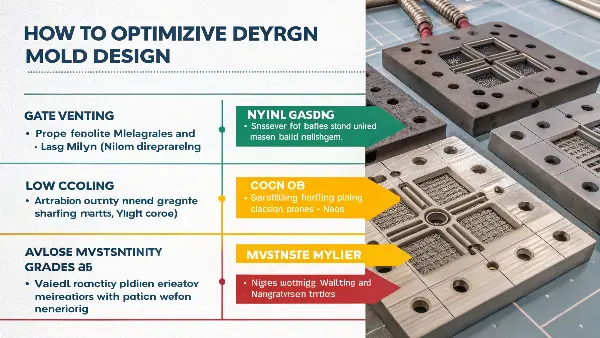
Nylon is a fantastic material, known for its strength and toughness. But as I am sure you know if you are reading this, it can also be a real headache to work with. Over my years at CavityMold, I have seen countless projects struggle because the mold was not designed with nylon’s specific personality in mind. It is not just a "one-size-fits-all" situation. The small details in your mold can make the difference between success and failure. Let’s break down the most critical areas you need to get right.
Why Do Different Nylon Grades Need Special Mold Designs?
You have selected a nylon grade for its properties, but your standard mold design is producing inconsistent results. Parts that worked with Nylon 6 are now warping badly with glass-filled Nylon 66. Treating all nylons the same is a common but expensive mistake. Each grade has a unique flow rate, shrinkage, and abrasive nature that your mold simply is not accounting for.
Different nylon grades need special mold designs due to variations in their molecular structure, viscosity, and additives like glass fibers. For example, glass-filled nylon is more abrasive and has lower, more anisotropic shrinkage than unfilled nylon. Similarly, Nylon 6 is more moisture-sensitive than Nylon 66. These differences directly impact flow behavior, cooling requirements, and part warpage, demanding unique considerations for gate location, steel hardness, and cooling channel layout.
I remember a project with a client, let’s call him Alex, a sharp project manager from Australia. He was struggling with a component for a new handheld device. They switched from an unfilled Nylon 6 to a 30% glass-filled Nylon 66 for better stiffness and heat resistance, but their existing mold was producing warped, brittle parts. The problem was not the material; it was the mold design that did not account for the change.
Let’s break down why these grades behave so differently.
Unfilled vs. Glass-Filled Nylon
The biggest difference comes from additives. Glass fibers dramatically change the game. They act like tiny reinforcing rods within the plastic matrix. This makes the material stronger and stiffer, but it also affects how the plastic flows and shrinks. The fibers align themselves in the direction of the melt flow. Because of this, the part shrinks less in the direction of flow and more in the direction transverse to the flow. This is called anisotropic shrinkage, and it is a major cause of warpage if not managed. A mold designed for the uniform shrinkage of an unfilled nylon will fail here.
Nylon 6 vs. Nylon 66
Even between standard nylons, there are key differences. Nylon 66 generally has a higher melting point and is a bit stiffer and more crystalline than Nylon 6. This means it often needs higher processing temperatures. Nylon 6, on the other hand, is a bit tougher and absorbs moisture more readily, which can affect its dimensional stability over time.
Here is a simple table to illustrate:
| Feature | Unfilled Nylon 6 | 30% Glass-Filled Nylon 66 |
|---|---|---|
| Shrinkage | High & Isotropic (uniform) | Low & Anisotropic (directional) |
| Abrasiveness | Low | High (requires hardened steel) |
| Viscosity | Low | Higher (can be harder to fill) |
| Warpage Tendency | Moderate | High (due to anisotropic shrinkage) |
| Mold Steel | Standard (P20) | Hardened (H13, S7) recommended |
Understanding these nuances is crucial. It’s why we at CavityMold always start with the material data sheet. We need to know exactly what we are working with before we even think about cutting steel. For Alex’s project, we had to re-evaluate the gate location and cooling layout to counteract the warpage from the glass fibers.
What’s the Best Gating Strategy for Low-Viscosity Nylon?
You are experiencing jetting, gate blush, or weak weld lines in your nylon parts. The low viscosity of the molten nylon causes it to spray into the cavity uncontrollably instead of filling smoothly. This leads to cosmetically ugly parts and, even worse, structural weaknesses that can cause failure in the field. Your injection parameters can only do so much to fix a bad gate design.
The best gating strategy for low-viscosity nylon involves designs that slow down and control the initial melt flow to prevent jetting. Submarine (tunnel) gates, fan gates, or tab gates are highly effective. They direct the flow against a cavity wall or a pin, which breaks the initial high-velocity stream and allows the mold to fill in a controlled, progressive manner. The gate should be located in the thickest section of the part to ensure proper packing.
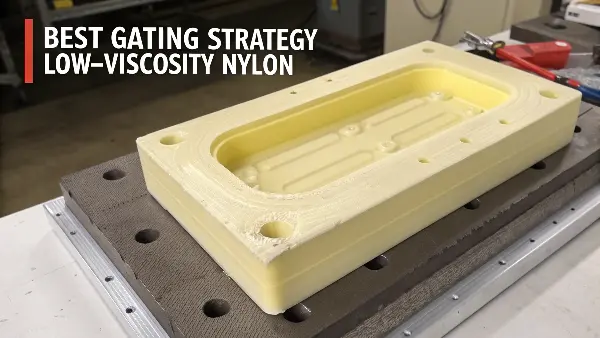
Nylon flows like water compared to some other plastics. If you just shoot it straight into an open cavity through a small pin gate, it is going to jet. Jetting looks like a worm-like string of material on the surface of the part, starting from the gate. It is not just a cosmetic defect; it is a point of weakness because that initial string does not properly fuse with the rest of the material that fills in behind it.
So, how do we stop this? We have to give the nylon something to hit right as it enters the cavity. This slows it down and helps it establish a steady, advancing flow front.
Effective Gate Types for Nylon
We avoid simple direct sprue or pin gates unless absolutely necessary and properly designed. Instead, we lean on gate types that promote smooth filling.
- Submarine (Tunnel) Gate: This is a popular choice. The gate enters the part below the parting line and is angled, so it shears off automatically when the mold opens. By aiming the tunnel at a core pin or a wall, we can effectively break up the jetting.
- Tab Gate: A tab gate adds a small, thin tab to the side of the part where the melt enters. The plastic first fills this tab, and then flows from the tab into the main cavity. This slows the velocity and creates a wide, even flow front, which is great for flat parts to prevent warpage.
- Fan Gate: Similar to a tab gate, a fan gate spreads the flow out over a wide area. It’s ideal for large, flat parts where a uniform fill is critical to minimize cosmetic defects and internal stress.
Here is how we decide on the gate location:
| Consideration | Best Practice for Nylon | Why it Matters |
|---|---|---|
| Gate Location | Thickest section of the part. | Ensures the gate freezes last, allowing for effective packing pressure to compensate for nylon’s high shrinkage and prevent sink marks. |
| Flow Direction | Aim at a wall or pin. | Prevents jetting by immediately disrupting the high-velocity flow entering the cavity. |
| Gate Size | Large enough to pack, small enough to freeze. | Needs to be carefully calculated. Too small, and you get short shots or high stress. Too large, and the cycle time increases. |
For glass-filled nylons, this gets even more critical. The gate design directly influences fiber orientation, which in turn controls warpage and shrinkage. A poorly placed gate can create a nightmare of dimensional instability. It’s a puzzle we solve every day, often using mold flow analysis to simulate and perfect the gate design before any steel is cut.
How Can You Ensure Proper Venting for Moisture-Sensitive Nylons?
Your nylon parts are coming out with burn marks, black specks, or incomplete filling, especially at the end of the flow path. You have tried adjusting injection speed, but the problem persists. Trapped air and gas are likely the culprits. Nylon is hygroscopic, and when heated, this moisture turns to steam, adding to the gas that needs to escape the mold.
To ensure proper venting for moisture-sensitive nylons, provide deep, wide vents at the end of every flow path and along the parting line. Typical vent depth for nylon is 0.01-0.025 mm (0.0004-0.001 inches). Because nylon is very low-viscosity, vents must be precise to avoid flash. Also, add vents to any blind ribs or bosses using vented ejector pins. Proper venting allows trapped air and steam to escape, preventing burn marks.
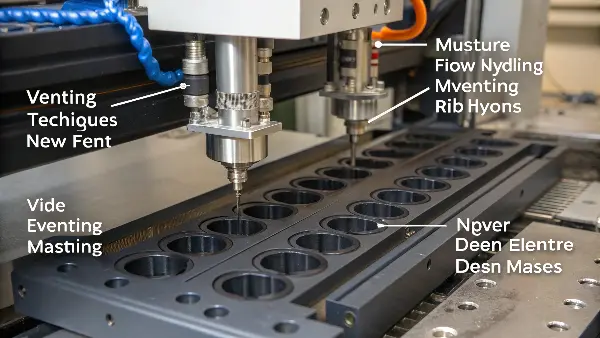
Venting is one of those things that is often overlooked until it is a problem. With nylon, it is almost always a problem if you do not plan for it. Here is why: as the molten plastic shoots into the mold cavity, it is pushing the air that is already in there out of the way. If that air has nowhere to go, it gets compressed by the incoming plastic. This compression heats the air to extreme temperatures—hot enough to burn the plastic. This is called the "diesel effect," and it is what causes those ugly black burn marks at the edges of your part.
Nylon makes this worse for two reasons. First, its low viscosity means it fills VERY fast, giving the air less time to escape. Second, it absorbs moisture from the air. Even if you use a dryer, some residual moisture can remain. When you melt the nylon pellets, that water turns into high-pressure steam, which also needs to be vented.
Venting Strategies and Best Practices
So, our approach at CavityMold is to be aggressive with venting from the very start of the design.
- Parting Line Vents: The primary place for vents is along the parting line of the mold. We cut very shallow channels—typically only 0.015 mm deep—that run from the edge of the cavity to the outside of the mold. The channel is shallow enough that the thick nylon plastic cannot flow into it, but air and gas can escape easily.
- Vented Ejector Pins: What about areas that are far from the parting line, like deep ribs or bosses? It is impossible for the air to get out from there. For these spots, we use vented ejector pins. These pins have tiny flats or channels ground into their sides, creating a perfect escape route for trapped gas.
- Porous Mold Inserts: For really challenging parts with complex geometry, we might even use special porous steel inserts. These inserts are made of sintered metal and are breathable, allowing air to pass right through them while stopping the plastic.
Here is a quick reference for vent dimensions:
| Nylon Type | Recommended Vent Depth | Vent Land Length |
|---|---|---|
| Unfilled Nylon (6, 66) | 0.02 – 0.025 mm (0.0008" – 0.001") | 1.0 – 1.5 mm |
| Glass-Filled Nylon | 0.025 – 0.035 mm (0.001" – 0.0014") | 1.0 – 1.5 mm |
Getting venting right is not just about preventing burns. It also allows you to run a faster, more stable process. With good vents, you do not have to fight against back-pressure, so the mold fills more easily and consistently. It is a small detail that has a huge impact on cycle time and part quality.
What Are the Keys to Effective Cooling to Control Nylon Warpage?
Your nylon parts look great coming out of the mold, but they twist and warp as they cool. You are struggling with dimensional instability, making it impossible to hold tight tolerances. This is a direct result of nylon’s high and non-uniform shrinkage, which is caused by inconsistent cooling. One side of the part is cooling faster than the other, creating massive internal stress.
The key to effective cooling for nylon is uniformity. Design cooling channels to be as close to the molding surface as possible and follow the part’s geometry. Ensure balanced cooling between the core and cavity halves of the mold. For glass-filled nylons, which warp due to differential shrinkage, use conformal cooling or strategically placed baffles and bubblers to pull heat away from thick sections.
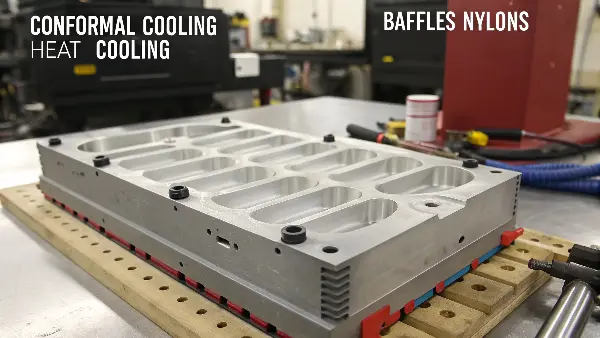
I cannot stress this enough: cooling is everything when it comes to nylon warpage. Nylon has a high shrinkage rate, sometimes over 1.5%. If that shrinkage is not perfectly uniform, the part will warp—it’s simple physics. The goal of the cooling system is not just to make the part solid; it is to make it solid evenly.
Think about a simple flat part. If the cavity side of the mold is running at 80°C and the core side is at 90°C, the cavity side will solidify first and shrink. Then, as the core side finally cools and shrinks, it will pull the already-solid cavity side with it, causing the whole part to bow. We need to keep the temperature difference between mold halves, and across any single mold surface, to an absolute minimum, ideally within 5°C.
Advanced Cooling Techniques
How do we achieve this uniform cooling, especially on complex parts?
- Conformal Cooling: This is the gold standard. Instead of straight-drilled lines, we create cooling channels that follow the exact contours of the part. This allows us to place cooling right where it is needed most, like in sharp corners or thick sections. It is more complex to manufacture, but the results in cycle time reduction and warpage control are incredible.
- Baffles and Bubblers: These are clever ways to get coolant into long, thin core pins. A baffle is a blade that splits a cooling channel in two, forcing water to flow up one side and down the other. A bubbler is a small tube inside a larger channel that shoots water to the bottom, where it "bubbles" up and carries heat away.
- High-Conductivity Inserts: For hot spots that are hard to reach with water lines, we can use inserts made from materials with high thermal conductivity, like beryllium-copper. These inserts act like heat sinks, pulling heat out of the hot spot and transferring it to a nearby cooling channel.
We use a checklist approach for designing nylon cooling systems:
| Checkpoint | Action | Rationale |
|---|---|---|
| Channel Placement | Maximize surface area coverage. Keep channels close to part surface. | Ensures even heat extraction across the part. |
| Flow Rate | Ensure turbulent flow, not laminar. | Turbulent flow is much more efficient at transferring heat than smooth, laminar flow. |
| Core/Cavity Balance | Use separate temperature controllers for each mold half. | Allows for precise temperature matching to prevent differential cooling and warpage. |
| Material-Specific Temp | Set mold temperature to the material supplier’s recommendation (typically 60-120°C for nylon). | Promotes the right level of crystallinity for optimal mechanical properties. |
Getting this right is a combination of experience and technology. We rely heavily on thermal simulation software to predict hot spots and validate our cooling designs before we make the mold. It saves so much time and money compared to the old trial-and-error method.
Conclusion
Success with nylon molding is not about luck; it is about control. By carefully considering the specific nylon grade and optimizing your gating, venting, and cooling strategies, you can master this powerful material. It transforms the process from a challenge into a reliable manufacturing advantage for high-performance parts.