
Are you stepping up from standard nylon to a glass-filled grade for a demanding project? You know it offers superior strength, but you’re likely concerned about how these additives will impact your process and tooling. One wrong move can lead to failure, but mastering it is straightforward.
Adding glass fibers to nylon fundamentally changes injection molding parameters. You’ll need higher melt and mold temperatures (by 10-30°C), increased injection pressure, and faster injection speeds to ensure the viscous material fills the cavity properly. Most importantly, the abrasive nature of glass fibers requires hardened tool steel molds (like H-13) and wear-resistant machine components to prevent premature failure and ensure part consistency. Lowering back pressure is also key to minimizing fiber breakage.
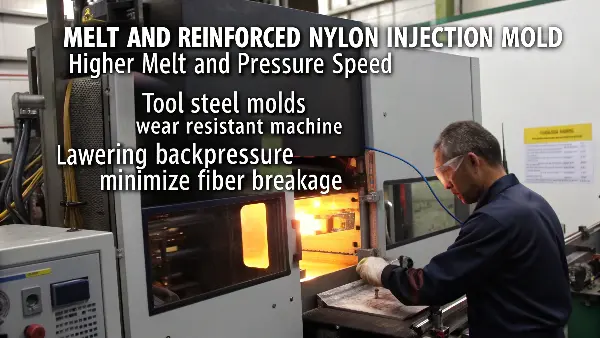
The information above gives you the quick-start guide, the essential changes you need to make right away. It’s the difference between a successful first run and a frustrating series of adjustments. But to truly become an expert and troubleshoot any issue that comes your way, you need to understand the "why" behind each of these changes. Let’s dive deeper into how these powerful additives transform not just the material, but the entire manufacturing process.
Why Are Fillers and Additives Even Used in Injection Molding?
Ever specified a standard polymer only to find it cracks, warps, or fails under stress in the final application? This common problem leads to costly redesigns and project delays. The solution isn’t always a new, exotic polymer; often, it’s enhancing a familiar one with additives.
Fillers and additives are used in injection molding to enhance or modify the base polymer’s properties, creating a composite material tailored for a specific application. These enhancements include increasing mechanical strength, improving thermal resistance, reducing cost, ensuring dimensional stability, and altering electrical or aesthetic characteristics. Essentially, they turn a general-purpose plastic into a high-performance, specialized material without starting from scratch.
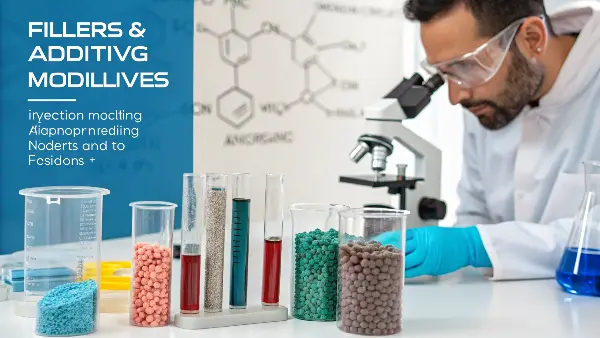
When we source a material for a client’s project, we’re not just picking a polymer; we’re designing a material system. A base resin like nylon is a great starting point, but it’s rarely perfect for every situation. This is where fillers and reinforcements come in. I remember a project for an automotive client where a housing part needed to sit close to the engine block. Standard nylon just couldn’t handle the heat and would deform over time. Instead of switching to an expensive, high-temperature polymer like PEEK, we recommended Nylon 66 with a 30% glass fiber fill. This simple change gave the part the thermal stability it needed at a fraction of the cost. This is the core purpose of additives: targeted problem-solving. They allow us to fine-tune material performance to meet the exact demands of the end-use environment.
Common Fillers and Their Impact
Each additive brings a unique set of properties to the table. It’s crucial to select the one that directly addresses your product’s primary requirements.
| Filler/Reinforcement | Primary Benefit | Common Application |
|---|---|---|
| Glass Fibers | High strength, stiffness, thermal stability | Automotive parts, power tool housings |
| Carbon Fibers | Extreme stiffness, strength, electrical conductivity | Aerospace components, high-performance sports gear |
| Talc / Mica | Increased stiffness, dimensional stability | Appliance parts, electrical housings |
| Calcium Carbonate | Cost reduction, increased stiffness | PVC pipes, disposable containers |
| Flame Retardants | Prevents or slows combustion | Housings for consumer electronics |
Choosing the right filler is a balance of performance, processability, and price. While carbon fiber offers incredible stiffness, it’s also expensive and highly abrasive. For many applications, glass fiber provides the best all-around boost in mechanical and thermal properties for the cost.
What Are the Baseline Parameters for Standard Nylon Injection Molding?
Before you can adjust for fillers, do you have a solid grasp of the settings for standard, unfilled nylon? Using the wrong baseline can lead you to misdiagnose problems, blaming the glass fibers when the root cause is actually an incorrect fundamental parameter like improper drying.
For standard nylon (like PA6 or PA66), key injection molding parameters start with thorough drying to below 0.2% moisture content. Typical settings include a melt temperature of 230-280°C (446-536°F), a mold temperature of 60-90°C (140-194°F), medium-to-high injection pressure, and a fast injection speed to prevent premature freezing in the mold. These values provide the foundation before modifications for reinforcements are considered.
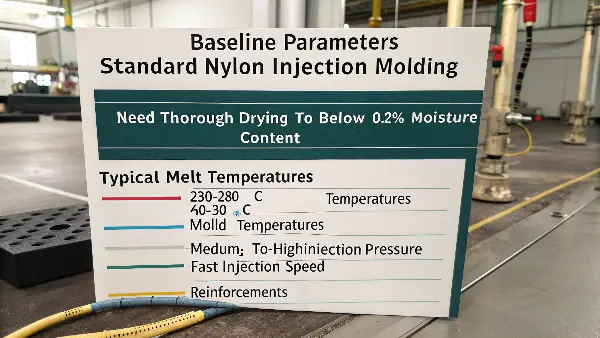
Every experienced molder knows that nylon is hygroscopic, meaning it loves to absorb moisture from the air. This is the single biggest factor to control before the pellets even enter the machine. I’ve seen more part defects caused by wet nylon than almost any other issue. When damp nylon is heated in the barrel, the water turns to steam, causing splay marks, brittleness, and a loss of mechanical integrity. We insist on drying all our nylon, unfilled or not, for at least 4 hours at 80°C (176°F) in a desiccant dryer. It’s a non-negotiable first step. Once you have properly dried material, you can establish your baseline process.
Establishing Your Starting Point
Think of these parameters as a well-tested recipe. You might need to adjust them slightly based on your specific machine, mold design, and the exact grade of nylon, but this is where we at CavityMold typically start.
| Parameter | Typical Range (Unfilled Nylon 66) | Why It’s Important |
|---|---|---|
| Drying | 4-6 hours @ 80°C (<0.2% moisture) | Prevents hydrolysis, which degrades the material and causes cosmetic and structural defects. |
| Melt Temperature | 260-290°C (500-554°F) | Ensures the material flows easily without being so hot that it degrades. |
| Mold Temperature | 80-90°C (176-194°F) | Controls the level of crystallinity, affecting shrinkage, warpage, and final part dimensions/strength. |
| Injection Pressure | 75-125 MPa | Needs to be sufficient to pack out the part completely, overcoming flow resistance. |
| Injection Speed | Fast | Nylon solidifies quickly, so a fast speed ensures the mold is filled before any section freezes off. |
These settings give you a solid process for standard nylon parts. The material flows well, cycle times are reasonable, and the parts come out with good mechanical properties and a smooth surface finish. This is the benchmark we’ll be changing when we introduce glass fibers.
So, How Does Glass-Filled Nylon Change the Injection Molding Process?
You’ve got your baseline for standard nylon, but now you’re introducing the glass-filled variant. Can you just use the same settings and hope for the best? That approach almost guarantees problems, from worn-out tooling to parts that don’t even fill the mold cavity.
Yes, glass-filled nylon is absolutely designed for injection molding, but it requires significant process adjustments. The glass fibers increase the material’s viscosity and abrasiveness. This necessitates higher melt temperatures, higher injection pressures, and faster speeds. Crucially, it demands molds made from hardened, wear-resistant tool steels and specially treated machine components (barrel, screw, nozzle) to withstand the intense wear and tear from the fibers.
The first time I worked on a high-volume project with 40% glass-filled nylon, I learned a hard lesson about tooling. We were using a standard P20 steel mold, which is a great workhorse for many materials. Within a few thousand cycles, we noticed significant erosion around the gate area. The abrasive glass fibers were literally sandblasting the steel away with every shot. This changed the part’s dimensions and caused flashing. We had to halt production and remake the mold with D2 tool steel. Now, we plan for this from the start. Any project involving reinforced plastics automatically gets specified with a high-hardness, wear-resistant tool steel like H-13 or S-7.
Key Parameter Adjustments for Glass-Filled Nylon
The presence of glass fibers acts like a roadblock to flow, making the molten plastic thicker and more sluggish. It also fundamentally changes how the material behaves inside the mold.
| Parameter | Change for Glass-Filled Nylon | Reason for the Change |
|---|---|---|
| Tooling Material | Upgrade to Hardened Steel (H-13, S-7) | Glass fibers are extremely abrasive and will quickly wear down softer steels like P20, especially at the gate. |
| Melt Temperature | Increase by 10-20°C (20-40°F) | The fibers increase viscosity (thicken the melt). Higher temperatures are needed to reduce this viscosity and promote smooth flow. |
| Mold Temperature | Increase by 10-20°C (20-40°F) | A hotter mold surface helps the viscous material flow better, improves weld line strength, and results in a more resin-rich, glossy surface finish. |
| Injection Speed | Increase to Maximum Safe Level | A fast injection helps to orient the fibers in the direction of flow, maximizing strength, and fills the part before the thick material can freeze. |
| Back Pressure | Decrease to a Minimum (0.35-0.7 MPa) | This is critical. High back pressure grinds the glass fibers against the barrel and screw, breaking them and reducing their strengthening effect. |
One more crucial point is gate design. With reinforced materials, you need larger gates. Pinpoint gates that work for unfilled nylon will create excessive shear, breaking the fibers and creating a weak spot right at the entry point of the part. We often recommend tab gates or fan gates to allow for a gentle transition of material into the cavity, preserving fiber length and maximizing the part’s strength.
How Can You Optimize the Injection Molding Parameters for Reinforced Plastics?
You’ve made the basic adjustments for glass-filled nylon and your parts are coming out okay. But are they truly optimized? If you’re seeing minor warpage, inconsistent strength, or a dull surface finish, your process still has room for improvement to achieve truly high-performance components.
Optimizing for reinforced plastics involves a systematic approach that goes beyond basic adjustments. It means fine-tuning the balance between opposing parameters, such as injection speed and back pressure, to maximize fiber integrity. Key areas for optimization include strategic gate design to control fiber orientation, precise mold temperature control to manage anisotropic shrinkage and warpage, and potentially using a Design of Experiments (DOE) approach to find the ideal processing window.
Optimization is where art meets science. It’s about understanding the subtle trade-offs. For instance, you need high injection speed for fiber alignment, but if it’s too high, you risk jetting and excess shear. You need a high mold temperature for a good surface finish, but if it’s too high, your cycle times increase, hurting productivity. I worked on a long, flat electronics housing where we struggled with warpage. The part would bow like a banana after cooling. We realized the fibers were aligning perfectly along the length, causing massive shrinkage in that direction but very little across the width. The solution wasn’t in the machine settings but in the mold design. By adding specific cooling channels to cool the length of the part slower than the width, we were able to counteract the anisotropic shrinkage and produce perfectly flat parts.
Advanced Optimization Techniques
To move from "good parts" to "perfect parts," focus on these three critical areas. They have the biggest impact on the final quality of reinforced components.
Gate Design and Location are Critical
With reinforced plastics, the gate doesn’t just let material in; it dictates the strength of the final part. The size, type, and location of the gate control how the glass fibers orient as they enter the cavity. Fibers align in the direction of flow. If you have a center-gated disc, the fibers will orient radially, creating different strength properties from the center to the edge. For a long part gated at one end, the fibers will align along the length, making it very strong in that direction but weaker across the width. We carefully use mold flow simulation software during the design phase to predict this fiber orientation and place gates in locations that deliver strength exactly where the part needs it most.
Balancing Back Pressure and Screw Recovery
This is a delicate dance. You need some back pressure to ensure a consistent melt density and mix, but every bit of pressure adds shear and risks breaking the glass fibers. Broken fibers provide far less reinforcement than long fibers. The goal is to use the absolute minimum back pressure necessary to get a stable screw recovery—often just 50-100 psi. We also recommend slowing down the screw rotation speed (RPM) for the same reason. A slower, gentler recovery preserves fiber length, which is essential for maximizing the mechanical properties you’re paying for with a reinforced material.
Managing Cooling and Warpage
Reinforced plastics are notorious for warpage because of anisotropic shrinkage—they shrink differently in the direction of fiber alignment versus perpendicular to it. This differential shrinkage creates internal stresses that bend and distort the part as it cools. The key to control is uniform cooling, but sometimes you need strategic non-uniform cooling. As in my previous story, you can use hotter or colder water in different sections of the mold to manipulate the cooling rate and counteract the inherent tendency to warp. This level of control requires a well-designed mold with multiple cooling zones.
Conclusion
Switching to glass-filled nylon is a powerful move for creating stronger, more durable parts, but it’s not a simple drop-in replacement. It changes everything from melt viscosity to tooling requirements. Success depends on adapting your process with higher temperatures, pressures, and speeds while protecting your equipment with hardened steel.
By understanding why these changes are necessary—to manage flow, reduce abrasion, and control fiber orientation—you can move beyond basic adjustments and truly optimize your process. At CavityMold, we believe mastering these advanced materials is key to unlocking new levels of product performance.