
Are you struggling to select the best manufacturing process for your mold’s core and cavity? Choosing the wrong method can lead to production delays, poor part quality, and budget overruns. This puts your entire project at risk. I’ll guide you through the key technologies to make an informed decision.
The best manufacturing technology for your mold’s core and cavity depends on complexity, material, budget, and lead time. Conventional methods like CNC machining and EDM are reliable for most applications. Advanced techniques like 3D printing (DMLS) offer solutions for complex geometries and conformal cooling channels. Knowing the pros and cons of each method is crucial for optimizing your mold’s performance and cost-effectiveness.
The heart of any injection mold is its core and cavity. These components define the final product’s shape, finish, and functionality. Over my years in this industry, I’ve seen how the evolution of manufacturing technologies has completely transformed what’s possible in mold making. It’s a journey from traditional craftsmanship to high-tech precision. Let’s explore these methods, from the tried-and-true to the cutting-edge, so you can understand which approach best fits your next project.
What Are the Foundational Conventional Methods for Making Mold Cores and Cavities?
Do you find traditional machining methods like CNC milling old-fashioned? Ignoring these foundational techniques could mean overlooking the most reliable and cost-effective solutions for your molds. This can lead to unnecessary complexity and higher costs. I’ll show you why these methods are still the backbone of the industry.
CNC milling and grinding are the cornerstones of conventional mold manufacturing. CNC milling precisely carves out the core and cavity from a solid block of steel using rotating cutters. Grinding is then used for achieving tight tolerances and exceptional surface finishes. These methods are valued for their accuracy, reliability, and ability to handle hardened tool steels, making them ideal for a wide range of mold applications.
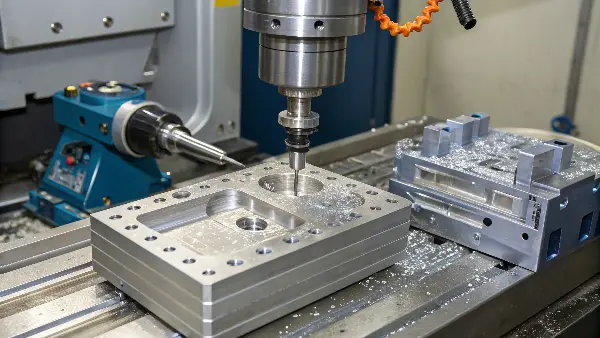
When we talk about making a mold, we almost always start with Computer Numerical Control (CNC) machining. It’s the workhorse of our industry for a reason. It’s all about subtraction—we take a solid block of tool steel, like P20 or H13, and systematically remove material to reveal the shape we need. It’s precise, repeatable, and incredibly versatile. I remember a project for a medical device housing where the tolerances were incredibly tight. We relied on a combination of 5-axis milling for the main geometry and precision grinding for the shut-off surfaces. The result was a flawless mold that produced millions of parts without a hitch. It’s a testament to the power of these conventional methods when executed correctly.
The Role of 3-Axis vs. 5-Axis CNC Machining
The main difference here is how the cutting tool and the workpiece can move.
- 3-Axis Machining: The tool moves along the X, Y, and Z axes. It’s fantastic for simpler parts, pockets, and drilling holes. It’s straightforward and cost-effective.
- 5-Axis Machining: This adds two rotational axes. The machine can tilt the tool or the workpiece, allowing it to approach the part from any direction. This is essential for complex, contoured surfaces like those found in automotive or aerospace components. It reduces the need for multiple setups, which improves accuracy and saves time.
Why Precision Grinding Still Matters
After milling, especially on hardened steel, the surface isn’t perfect yet. It might have tiny tool marks or not meet the exact dimensional tolerance. That’s where grinding comes in. We use grinding machines to achieve extremely high precision and a superior surface finish. It’s crucial for flat parting lines and shut-off surfaces where the two halves of the mold meet. A perfect seal here prevents flashing, which is that thin, unwanted layer of plastic that can seep out. For any high-precision mold, grinding is not optional; it’s a required finishing step that ensures quality.
How Does Electrical Discharge Machining (EDM) Create Intricate Mold Features?
Do your mold designs include sharp internal corners, deep ribs, or complex textures that are impossible to mill? Sticking only to conventional cutting tools can force you to compromise on your product’s design. This leads to functional or aesthetic sacrifices. I’ll explain how EDM solves these challenges.
Electrical Discharge Machining (EDM) uses electrical sparks to erode material, allowing for the creation of features that are impossible with traditional cutting tools. It’s perfect for sharp internal corners, deep, narrow ribs, and intricate textures. Wire EDM cuts through-features with a thin wire, while Sinker EDM uses a custom-shaped electrode to "burn" the desired shape into the steel, offering unparalleled design freedom for complex molds.
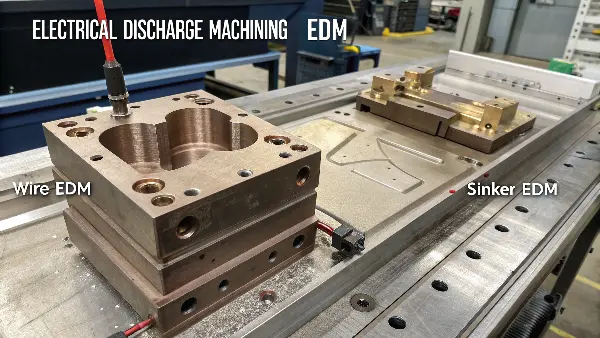
Think of EDM as a controlled, high-precision lightning storm. Instead of a cutting tool physically touching the steel, we use a powerful electrical spark to vaporize tiny bits of the material. This process is amazing because it doesn’t care how hard the steel is. Once a mold component is heat-treated to its final hardness, you can’t easily machine it with a traditional cutter, but you can use EDM. We once had a client who needed a very specific textured finish on a consumer product handle. No amount of milling could achieve that grainy, matte feel. We created a custom graphite electrode with the inverse of the texture and used sinker EDM to impart it onto the cavity surface. The client was thrilled; it was a perfect example of EDM doing what no other process can.
Sinker EDM: Forging Complex Cavities
With Sinker EDM, we first machine an electrode, usually out of graphite or copper, into the inverse shape of the feature we want to create. This electrode is then lowered into the workpiece, which is submerged in a dielectric fluid. We send an electrical current through the electrode, creating sparks that jump the gap and erode the steel into the desired shape. This is how we create blind cavities, ribs, and complex surface textures that a milling tool simply cannot reach.
Wire EDM: The Precision Cutter
Wire EDM works on a similar principle, but instead of a shaped electrode, it uses a thin, continuously fed strand of brass wire. Think of it like a high-tech bandsaw, but one that cuts with electricity instead of teeth. It can cut incredibly precise shapes and profiles all the way through a piece of hardened steel. We use it to create punches, inserts, and precise holes for ejector pins. The accuracy is astounding, often down to a few microns.
Here’s a simple breakdown of the two:
| Feature | Sinker EDM (Die Sinking) | Wire EDM |
|---|---|---|
| Tool | Custom-shaped electrode (graphite/copper) | Thin, charged wire |
| Application | Blind cavities, complex shapes, textures | Through-cuts, punches, inserts |
| Advantage | Creates features from a solid block | Extremely high precision, fine details |
| Limitation | Slower process, electrode needs making | Can only cut all the way through a part |
Is Additive Manufacturing Really Changing the Game for Mold Making?
Are you facing issues with long cooling times and part warpage in your injection molding process? Traditional mold cooling channels can be inefficient, leading to lower productivity and inconsistent part quality. You might be missing out on a revolutionary solution. Let me show you how additive manufacturing is a game-changer.
Yes, additive manufacturing, specifically Direct Metal Laser Sintering (DMLS), is revolutionizing mold making. It allows us to build mold inserts layer by layer from metal powder. This makes it possible to create complex internal structures like conformal cooling channels. These channels follow the part’s contour, providing uniform and rapid cooling. This drastically reduces cycle times and improves part quality by minimizing warpage and sink marks.
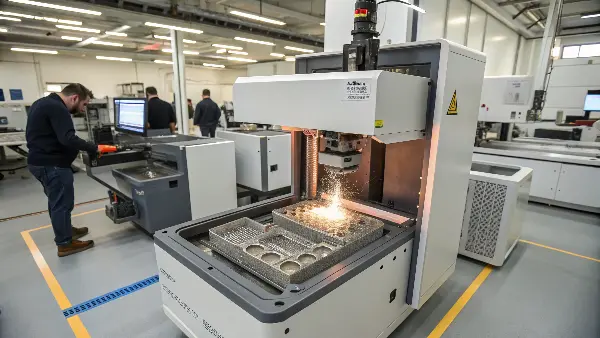
Additive manufacturing, or 3D printing, is no longer just for plastic prototypes. With DMLS, we can print fully dense, functional mold components from metal powder. A high-powered laser melts the metal powder, layer by microscopic layer, to build the part from the ground up. This opens up possibilities that are simply impossible with any other method. The biggest impact by far has been on mold cooling. I worked on a project for an automotive lens where warpage was a major issue due to thick sections. By using DMLS to create an insert with conformal cooling, we cut the cycle time by 40% and virtually eliminated warpage. The initial investment in the DMLS insert paid for itself in just a few months through increased productivity and lower scrap rates.
Conformal Cooling: The Secret to Faster Cycles
In a traditional mold, cooling channels are just straight lines drilled through the steel. This often leads to uneven cooling. Some parts of the mold are far from a cooling line, creating hot spots that increase cycle time and can cause defects like warpage or sink marks.
Conformal cooling channels, built with DMLS, can follow the exact shape of the part, like veins under the skin.
- Traditional Cooling: Straight, drilled channels. Often creates uneven cooling, leading to hot spots, longer cycle times, and part defects.
- Conformal Cooling: Follows the part’s geometry. Ensures uniform temperature across the mold surface, resulting in rapid, even cooling.
This uniform cooling can reduce injection cycle times by 30-50%. For a high-volume part, that is a massive increase in productivity and profitability.
Beyond Cooling: Hybrid Mold Solutions
While DMLS is powerful, it’s not the answer for every mold. The surface finish often requires secondary polishing, and the cost is higher than traditional machining. The true innovation lies in a hybrid approach. We can CNC machine the main mold base and larger, simpler components. Then, for a critical area with a complex shape or a cooling challenge, we can print a DMLS insert. This insert is then fitted into the conventionally machined mold. This strategy gives you the best of both worlds: the cost-effectiveness of traditional methods and the high-performance capabilities of additive manufacturing right where you need them most.
How Do You Choose the Right Manufacturing Technology for Your Mold Project?
Feeling overwhelmed by the options for manufacturing your mold? Choosing the wrong technology can be a costly mistake, impacting everything from your timeline to your final product quality. Guesswork is not a strategy. I’ll give you a clear framework for making the right choice every time.
To choose the right technology, evaluate your project against four key factors: Part Complexity, Material, Production Volume, and Budget. Simple shapes in standard steel are suited for CNC milling. Intricate features require EDM. High-volume parts needing fast cycles benefit from DMLS with conformal cooling. A careful analysis of these trade-offs ensures you select the most efficient and cost-effective method for your specific needs.
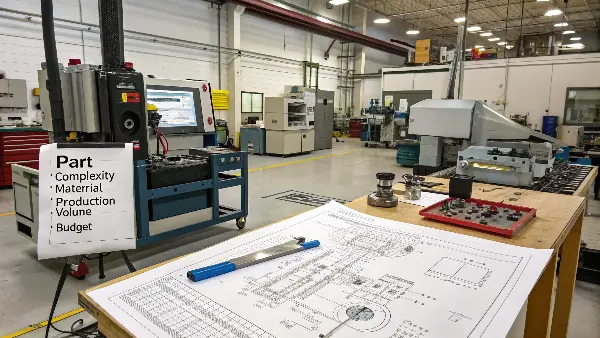
As a project manager, I know you live by making smart trade-offs. Choosing a mold manufacturing method is no different. There is no single "best" technology; there is only the best technology for your specific part. The key is to analyze your project systematically. An experienced mold maker like us at CavityMold does this assessment on every project, often using a hybrid approach to optimize quality, cost, and speed. We don’t just pick one method; we orchestrate a combination of them to deliver the best possible outcome.
Factor 1: Part Geometry and Complexity
Is your part relatively simple, with open contours and few deep features? 3-axis and 5-axis CNC milling will be your most direct and cost-effective route. Does it have sharp internal corners, deep, thin ribs, or fine surface textures? Then you absolutely need to incorporate EDM into the process.
Factor 2: Mold Material and Hardness
Will the mold be made from pre-hardened steel like P20 or softer aluminum for prototyping? CNC milling works well. But if you need to use a high-wear, hardened tool steel like H13 or S136 for a long production run, you will need to machine it before heat treatment and then finish it with grinding and EDM after it’s been hardened.
Factor 3: Production Volume and Cycle Time Requirements
Are you making millions of parts where every second of cycle time counts? The higher initial cost of a DMLS insert with conformal cooling could have a massive ROI by reducing cycle times and scrap rates. For lower-volume runs, traditional cooling created by CNC drilling is usually sufficient and more budget-friendly.
Factor 4: Budget and Lead Time
Every project has its constraints. CNC machining is generally the fastest and most affordable method. EDM adds time and cost for creating electrodes and the slower erosion process. DMLS has the highest upfront cost but can accelerate project timelines by quickly producing complex inserts. We can use this table as a starting point for discussion:
| Technology | Best for… | Key Consideration | Cost / Lead Time |
|---|---|---|---|
| CNC Milling | Simple to moderately complex geometries, large components. | Material machinability, standard features. | Low to Moderate / Fast |
| Sinker EDM | Sharp internal corners, blind cavities, fine textures. | Electrode manufacturing time, slower process. | Moderate / Moderate |
| Wire EDM | High-precision through-cuts, inserts, ejector pin holes. | Feature must be a through-cut. | Moderate / Moderate-Slow |
| Additive (DMLS) | Conformal cooling, complex internal features, rapid prototypes. | High initial cost, needs post-processing. | High / Fast for inserts |
Conclusion
Understanding the range of technologies from conventional CNC and EDM to advanced DMLS is key. The right choice, often a hybrid approach, depends on balancing your part’s complexity, performance goals, and budget. A partnership with an experienced mold maker helps you navigate these decisions for an optimal result.